Ch. 15 Anatomy Lecture
 Call Kai
 Learn
Learn Practice Test
 Spaced Repetition
 Match
Match Flashcards
 Knowt Play
1/37

There's no tags or description
Looks like no tags are added yet.
Name | Mastery | Learn | Test | Matching | Spaced | Call with Kai |
|---|
No analytics yet
Send a link to your students to track their progress
38 Terms
Meninges
Underneath the cranium (skull): dura mater → arachnoid → pia mater
Dura mater
Thickest and toughest layer of the meninges
Two layers (contains superior sagittal sinus)
Dura = durable!
Arachnoid mater
Arachnoid = spider web!
Subarachnoid space
Where cerebrospinal fluid (CSF) is found
Gray matter
Mostly cell bodies and dendrites
White matter
Mostly axons
Lighter color because of myelin (fat)
Cortex
Gray matter on the surface of the cerebrum and cerebellum
Densely packed with neurons (6 layers); most complex
Nuclei
Collections of gray matter in the interior of the CNS
Function: complex muscle movements, expression of emotions/behavior (esp. fear), and integration of information from multiple sensations
Tracts
Bundles of white matter that share a common origin and destination (ex. nucleus to nucleus)
Funiculi
Groups of tracts in specific locations within the spinal cord
Pathway
Interconnected sets of nuclei and tracts that connect the nervous system to tissues/organs
Ganglia
Collections of gray matter in the PNS
Nerves
Bundles of white matter in the PNS
Corpus Callosum
Piece of white matter that connects the cerebral hemispheres
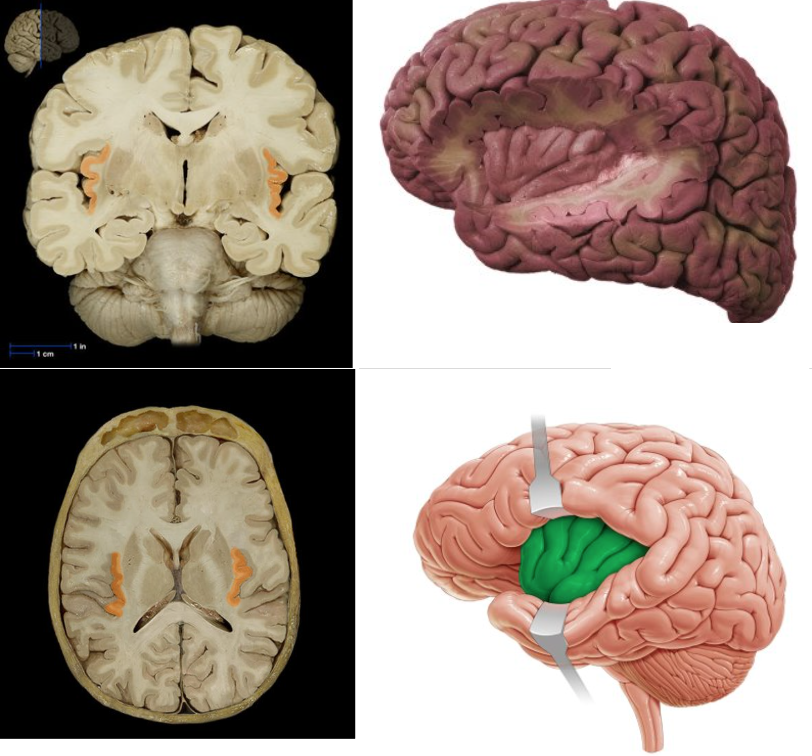
Insular lobe (aka insula)
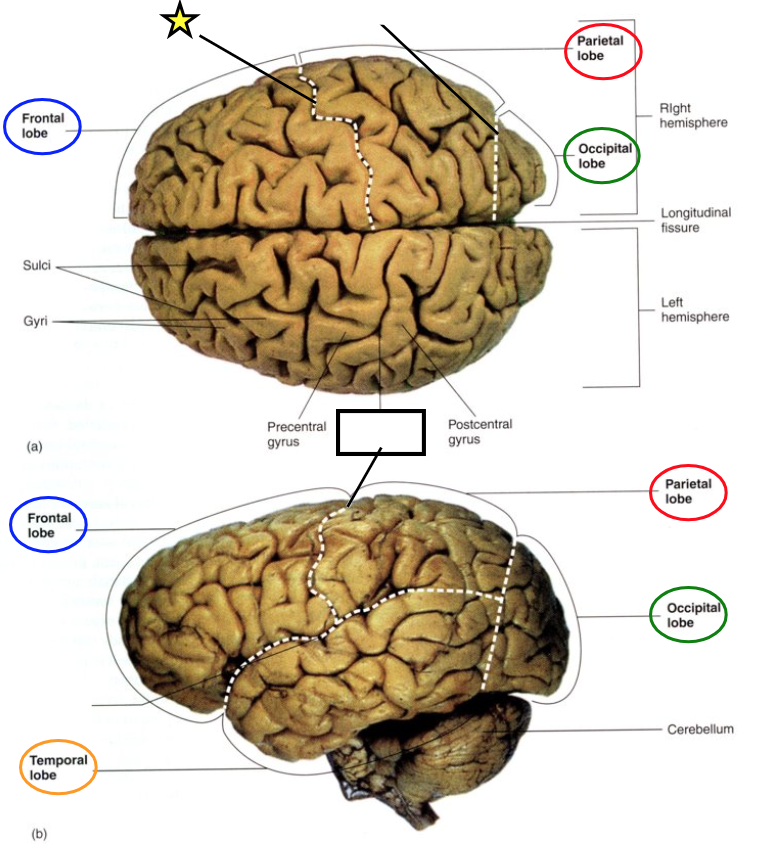
Central sulcus of the right hemisphere
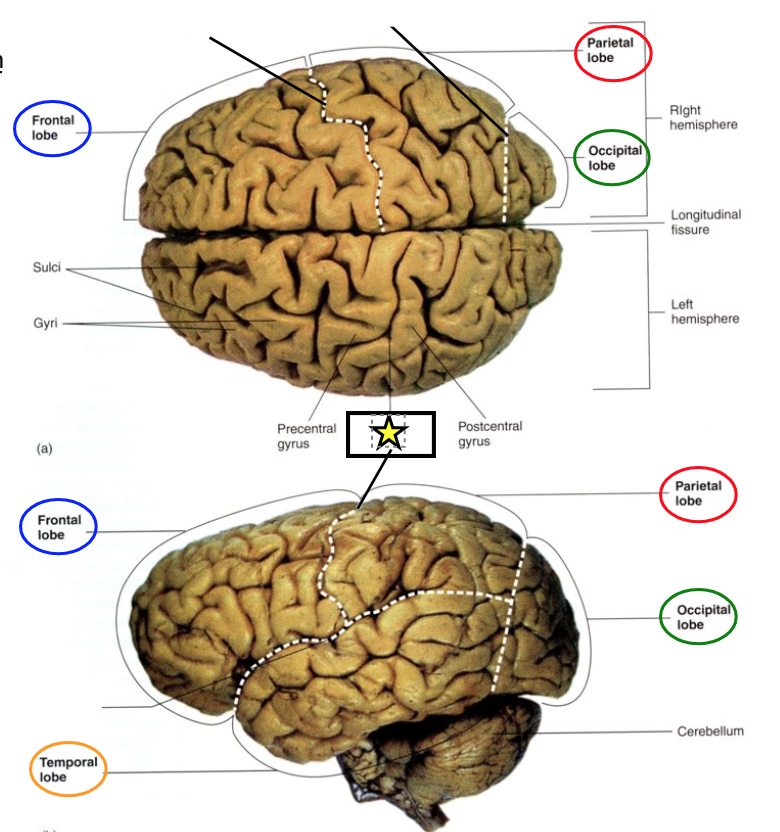
Central sulcus of the left hemisphere
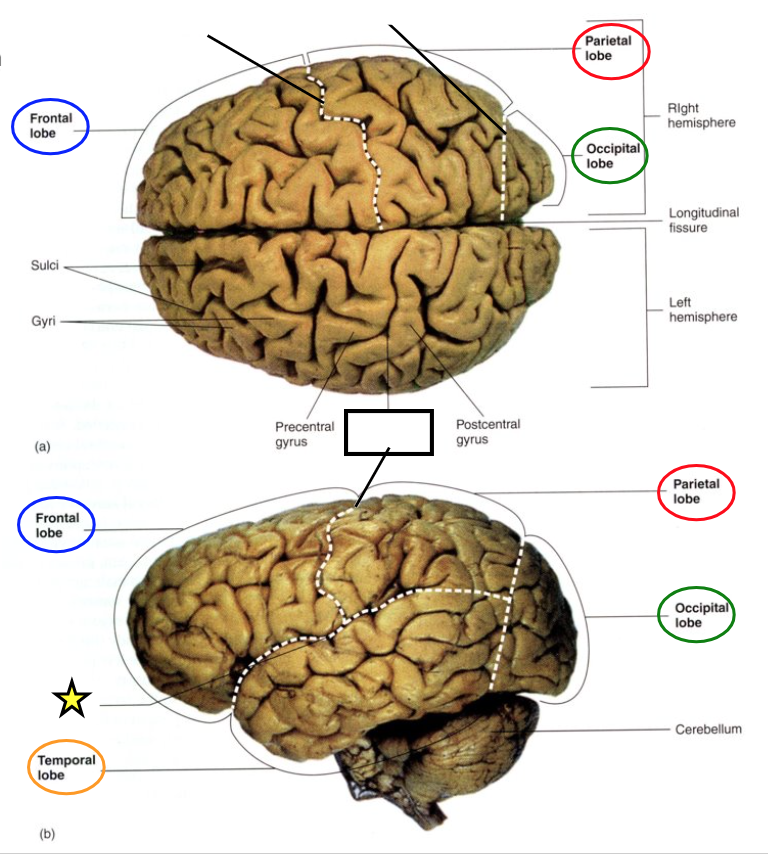
Lateral fissure
Below it is the insula
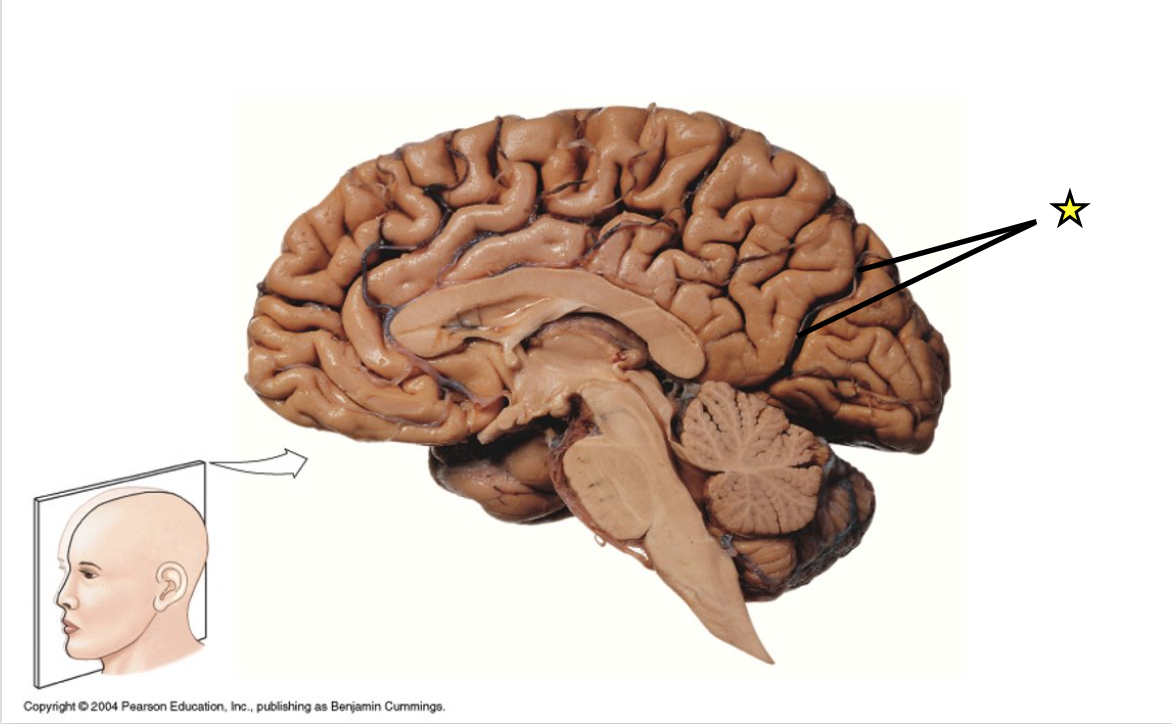
Parieto-occipital sulcus
Cortex of the frontal lobe
Function: primary motor cortex; higher intellectual functions; short-term memory
Cortex of the parietal lobe
Function: primary somatosensory cortex; perception of motion
Cortex of temporal lobe
Function: primary auditory and olfactory cortex; visual recognition of objects (esp. faces)
Cortex of occipital lobe
Function: primary visual cortex
Cortex of insula lobe
Function: primary gustatory cortex; interoception (awareness of visceral sensations)
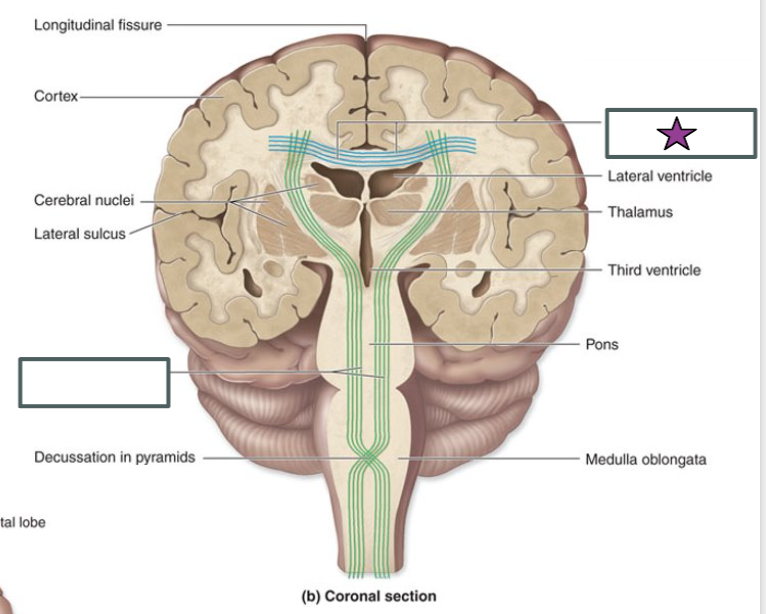
Commissural tracts
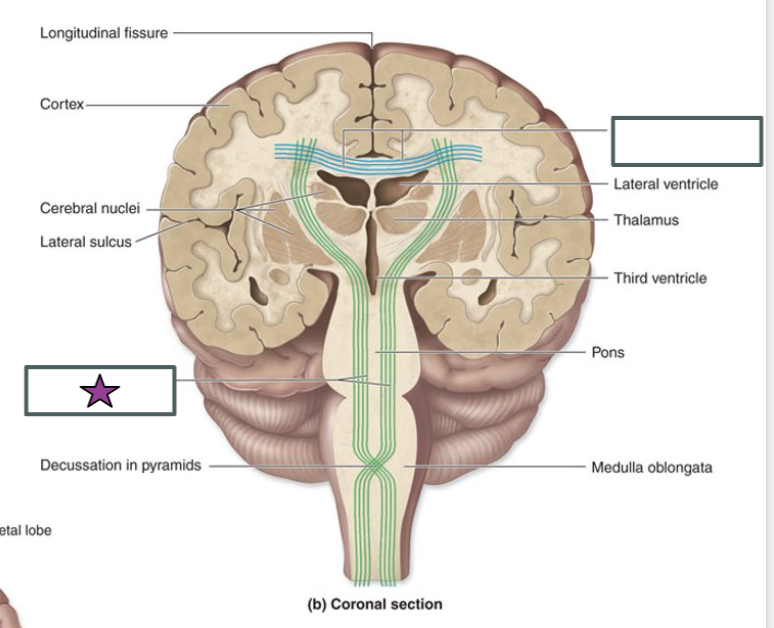
Projection tracts
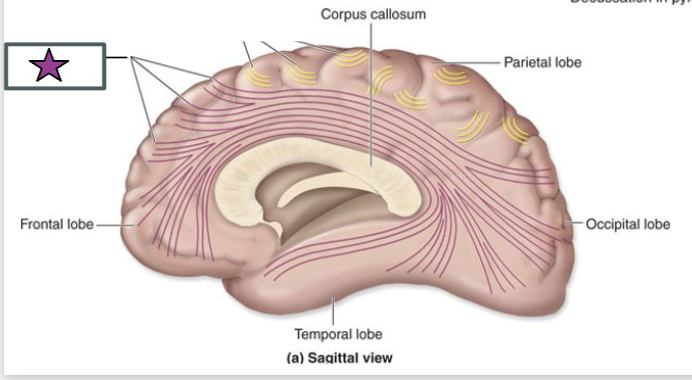
Association tracts
How do we visualize tracts?
Using specialized MRI; diffusion tensor imaging
Thalamus
Made of multiple nuclei
Each nucleus relays info to the appropriate area of the cerebrum
Hypothalamus
Made of multiple nuclei
Function: controls pituitary gland; control of autonomic motor commands; control of drives; regulation of body temperature; regulation of circadian rhythms
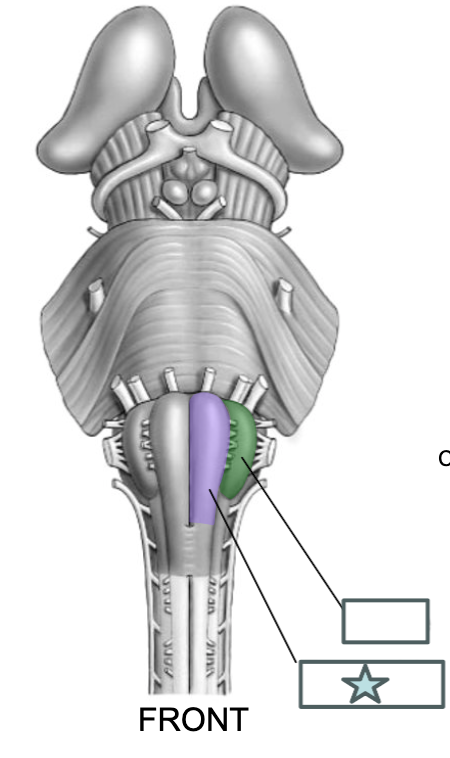
Pyramid
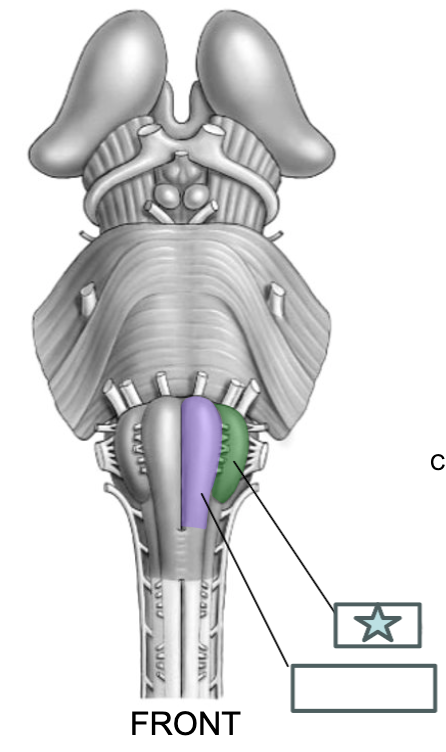
Olive
Brainstem
LOTS of nuclei
Midbrain
Function: involuntary eye movement; reflexes to visual/auditory info
Pons
Function: works with medulla to regulate breathing; relays info from cortex to cerebellum; REM sleep
Medulla oblongata
Function: regulates breathing, heart rate, digestion, sleep, blood vessel diameter; muscle tone/movement; reflexes; relays sounds and equilibrium info to thalamus
Cerebellum
Function: coordination of muscular movement; motor learning
Cerebrospinal fluid (CSF)
Derivative of blood that fills the ventricles, the subarachnoid space, and around the spinal cord
Produced by choroid plexus