Power Sharing
 Call Kai
 Learn
Learn Practice Test
 Spaced Repetition
 Match
Match Flashcards
 Knowt Play
1/13

There's no tags or description
Looks like no tags are added yet.
Name | Mastery | Learn | Test | Matching | Spaced | Call with Kai |
|---|
No analytics yet
Send a link to your students to track their progress
14 Terms
Explain the state of cultural diversity in Belgium
Belgium is a small country in Europe, smaller in area than the state of Haryana. It has a population of a little over one crore, about half the population of Haryana.
It has borders with Netherlands, France and Germany.
The ethnic composition of this small country is very complex. Of the country’s total population, 59 per cent lives in the Flemish region and speaks Dutch language. Another 40 per cent people live in the Wallonia region and speak French. Remaining 1 per cent of the Belgians speak German. In the capital city Brussels, 80 per cent people speak French while 20 per cent are Dutch-speaking.
The minority French-speaking community was relatively rich and powerful. This was resented by the Dutch-speaking community who got the benefit of economic development and education much later.
This led to tensions between the Dutch-speaking and French-speaking communities during the 1950s and 1960s.
The tension between the two communities was more acute in Brussels. Brussels presented a special problem: the Dutch-speaking people constituted a majority in the country, but a minority in the capital.
Explain the state of cultural diversity in Sri Lanka
Sri Lanka is an island nation, just a few kilometres off the southern coast of Tamil Nadu. It has about 2 crore people, about the same as in Haryana.
Like other nations in the South Asia region, Sri Lanka has a diverse population. The major social groups are the Sinhala-speakers (74 per cent) and the Tamil-speakers (18 per cent).
Among Tamils there are two subgroups.Tamil natives of the country are called ‘Sri Lankan Tamils’ (13 per cent). The rest, whose forefathers came from India as plantation workers during colonial period, are called ‘Indian Tamils’ (5 per cent).Sri Lankan Tamils are concentrated in the north and east of the country.
Most of the Sinhala-speaking people are Buddhist, while most of the Tamils are Hindus or Muslims. There are about 7 per cent Christians, who are both Tamil and Sinhala.
What do you mean by the term ethnic?
A social division of society based on shared culture.
People belonging to the same ethnic group believe in their common descent because of similarities of physical type or of culture or both. They need not always have the same religion or nationality
What do you mean by majoritarianism?
A belief that the majority community should be able to rule a country in whichever way it wants, by disregarding the wishes and needs of the minority.
Explain majoritarianism in Sri lanka
Sri Lanka emerged as an independent country in 1948. The leaders of the Sinhala community sought to secure dominance over government by virtue of their majority.
As a result, the democratically elected government adopted a series of MAJORITARIAN measures to establish Sinhala supremacy.
In 1956, an Act was passed to recognise Sinhala as the only official language, thus disregarding Tamil.
The governments followed preferential policies that favoured Sinhala applicants for university positions and government jobs. A new constitution stipulated that the state shall protect and foster Buddhism.
All these government measures, coming one after the other, gradually increased the feeling of alienation among the Sri Lankan Tamils. They felt that none of the major political parties led by the Buddhist Sinhala leaders were sensitive to their language and culture.
They felt that the constitution and government policies denied them equal political rights, discriminated against them in getting jobs and other opportunities and ignored their interests.
As a result, the relations between the Sinhala and Tamil communities strained over time. The Sri Lankan Tamils launched parties and struggles for the recognition of Tamil as an official language, for regional autonomy and equality of opportunity in securing education and jobs. But their demand for more autonomy to provinces populated by the Tamils was repeatedly denied.
By 1980s several political organisations were formed demanding an independent Tamil Eelam (state) in northern and eastern parts of Sri Lanka. The distrust between the two communities turned into widespread conflict. It soon turned into a CIVIL WAR.
As a result thousands of people of both the communities have been killed. Many families were forced to leave the country as refugees and many more lost their livelihoods.
Sri Lanka has an excellent record of economic development, education and health. But the civil war has caused a terrible setback to the social, cultural and economic life of the country
What do you mean by the term Civil War?
A violent conflict between opposing groups within a country that becomes so intense that it appears like a war.
Explain accomodation in Belgium
The Belgian leaders took a different path. They recognised the existence of regional differences and cultural diversities. Between 1970 and 1993, they amended their constitution four times so as to work out an arrangement that would enable everyone to live together within the same country. The arrangement they worked out is different from any other country and is very innovative. Here are some of the elements of the Belgian model:
Constitution prescribes that the number of Dutch and French-speaking ministers shall be equal in the central government. Some special laws require the support of majority of members from each linguistic group. Thus, no single community can make decisions unilaterally.
Many powers of the central government have been given to state governments of the two regions of the country. The state governments are not subordinate to the Central Government.
Brussels has a separate government in which both the communities have equal representation. The Frenchspeaking people accepted equal representation in Brussels because the Dutch-speaking community has accepted equal representation in the Central Government.
Apart from the Central and the State Government, there is a third kind of government. This ‘community government’ is elected by people belonging to one language community – Dutch, French and German-speaking – no matter where they live. This government has the power regarding cultural, educational and language-related issues.
The Belgian Model indeed is very complicated, even for people living in Belgium. But these arrangements have worked well so far. They helped to avoid civic strife between the two major communities and a possible division of the country on linguistic lines. When many countries of Europe came together to form the European Union, Brussels was chosen as its headquarters.
What do we learn from these two stories of Belgium and Sri Lanka?
Both are democracies. Yet, they dealt with the question of power sharing differently.
In Belgium, the leaders have realised that the unity of the country is possible only by respecting the feelings and interests of different communities and regions.
Such a realisation resulted in mutually acceptable arrangements for sharing power.
Sri Lanka shows us a contrasting example. It shows us that if a majority community wants to force its dominance over others and refuses to share power, it can undermine the unity of the country.
Why is power sharing desirable?
Two different sets of reasons can be given in favour of power sharing.
PRUDENTIAL REASON
Firstly, power sharing is good because it helps to reduce the possibility of conflict between social groups.
Since social conflict often leads to violence and political instability, power sharing is a good way to ensure the stability of political order.
Imposing the will of majority community over others may look like an attractive option in the short run, but in the long run it undermines the unity of the nation.
Tyranny of the majority is not just oppressive for the minority; it often affects majority adversely as well.
MORAL REASON
There is a second, deeper reason why power sharing is good for democracies. Power sharing is the very spirit of democracy.
A democratic rule involves sharing power with those affected by its exercise, and who have to live with its effects.
People have a right to be consulted on how they are to be governed.
A legitimate government is one where citizens, through participation, acquire a stake in the system.
Let us call the first set of reasons prudential and the second moral. While prudential reasons stress that power sharing will bring out better outcomes, moral reasons emphasise the very act of power sharing as valuable.
What is the meaning of Prudential?
Based on prudence, or on careful calculation of gains and losses. Prudential decisions are usually contrasted with decisions based purely on moral considerations
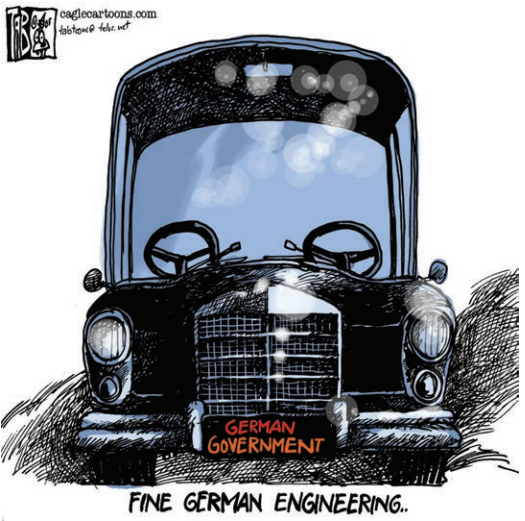
What is being referred to in the given cartoon?
The cartoon refers to the problems of running the Germany’s grand coalition government that includes the two major parties of the country, namely the Christian Democratic Union and the Social Democratic Party.
The two parties are historically rivals to each other. They had to form a coalition government because neither of them got clear majority of seats on their own in the 2005 elections.
They take divergent positions on several policy matters, but still jointly run the government.
State the different forms of government
In modern democracies, power sharing can take many forms, as mentioned below:
Power is shared among different organs of government, such as the legislature, executive and judiciary. This is called horizontal distribution of power because it allows different organs of government placed at the same level to exercise different powers. Such separation ensures that none of the organs can exercise unlimited power. Each organ checks the others. This arrangement is called a system of checks and balances.
Power can be shared among governments at different levels – a general government for the entire country and governments at the provincial or regional level, which is called the federal government.
Power may also be shared among different social groups, such as religious and linguistic groups. ‘Community government’ in Belgium is a good example of this arrangement. This method is used to give minority communities a fair share of power.
Power sharing arrangements can also be seen in the way political parties, pressure groups and movements control or influence those in power. When two or more parties form an alliance to contest elections, and if they get elected, they form a coalition government and thus share power.
What is ‘Power Sharing’?
Power sharing means the distribution of power among the organs of the government, such as the legislature, executive and judiciary.
What are the languages spoken in Belgium?
Belgium is composed of four language areas: the Dutch language area, the French language area, the German language area (9 municipalities in the east of Belgium) and the bilingual Brussels-Capital area.