Lecture 5 - Color Vision Testing
 Call Kai
 Learn
Learn Practice Test
 Spaced Repetition
 Match
Match Flashcards
 Knowt Play
1/42

There's no tags or description
Looks like no tags are added yet.
Name | Mastery | Learn | Test | Matching | Spaced | Call with Kai |
|---|
No analytics yet
Send a link to your students to track their progress
43 Terms
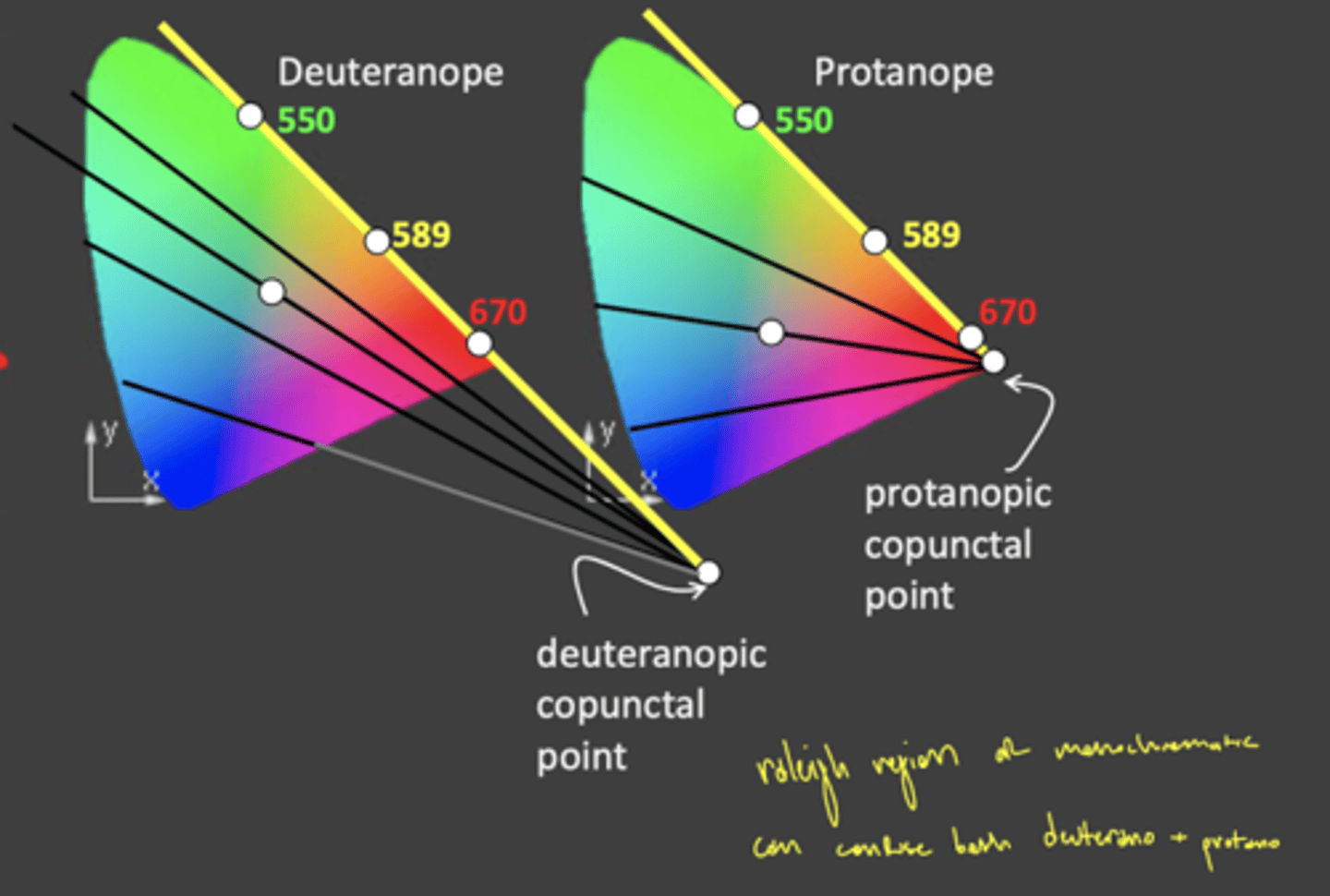
What is a co-punctal point?
point where all color confusion originates for dichromats
What are the neutral points for protanopes and deuteranopes?
protanopes - 492 nm
deuteranopes - 498 nm
How many confusion lines can you draw from the co-punctal point?
infinite number of straight lines from the co-punctal point
How are confusions lines different for stronger and milder color vision defects?
stronger - thicker lines
milder - gaps in lines
Why is the rayleigh region perfect for testing dichromats?
confusion lines intercept on both deuteranopes and protanopes co-punctal points
What is the pro and con of the anomaloscope?
pro - definitive diagnosis of color vision deficiency
con - not often available
What does the temperature (in kelvin) tell you about a light source?
color of its illumination
higher - more white (or blue)
lower - more yellow
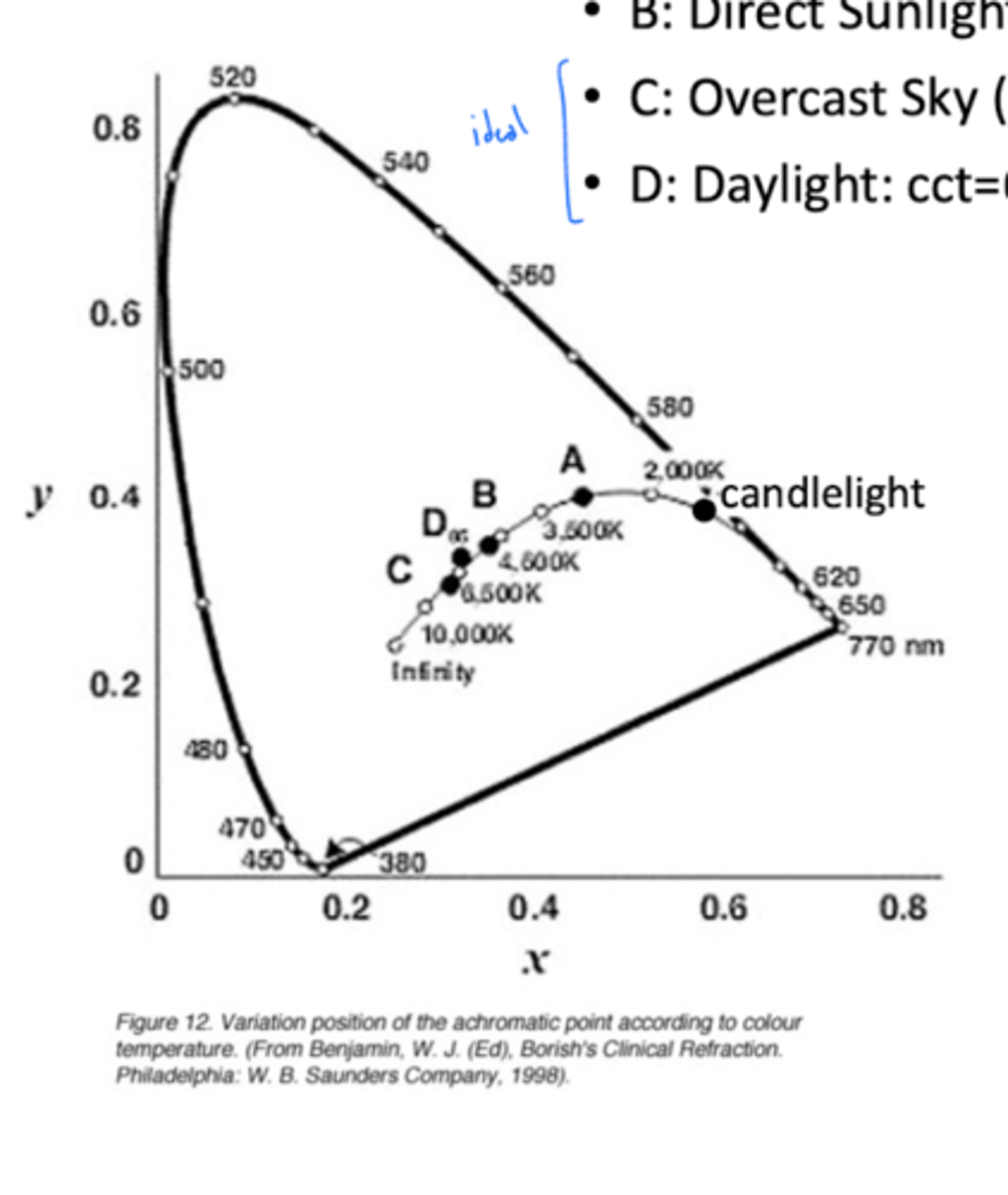
What is the ideal standard light source when performing reflective color vision tests?
>6500 K (daylight or specialized bulb)
What are some types of reflective materials that are color tests?
1. pseudoisochromatic plate tests (ishihara, HRR)
2. arrangement tests (D-15, 100 Hue)
What is the difference between ishihara and HRR?
HRR - R/G + B/Y, shapes
ishihara - R/G only, numbers
What is an issue with pseudoisochromatic plate tests?
sometimes can only find severe color defects
Which pseudoisochromatic plate tests is number and which is shapes?
numbers - ishihara
shapes - HRR
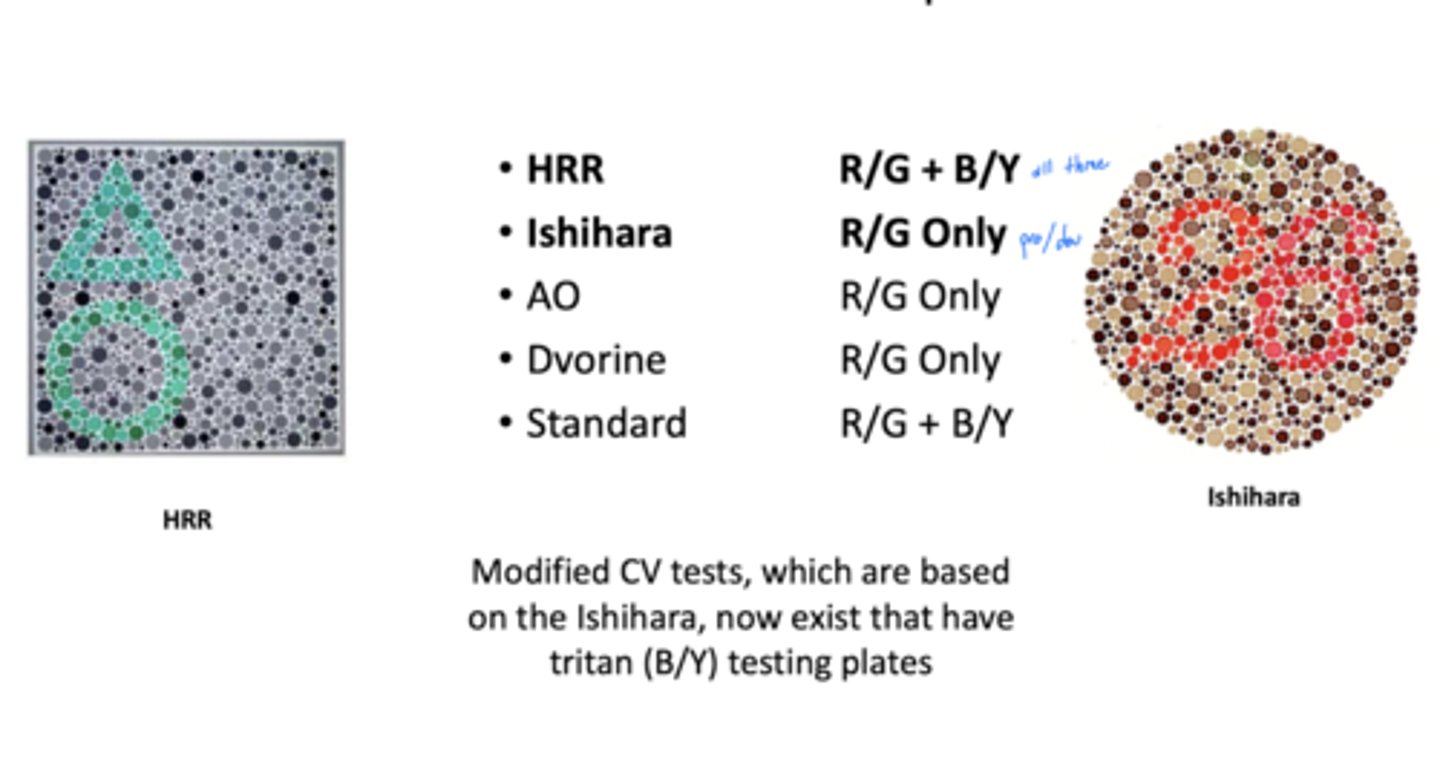
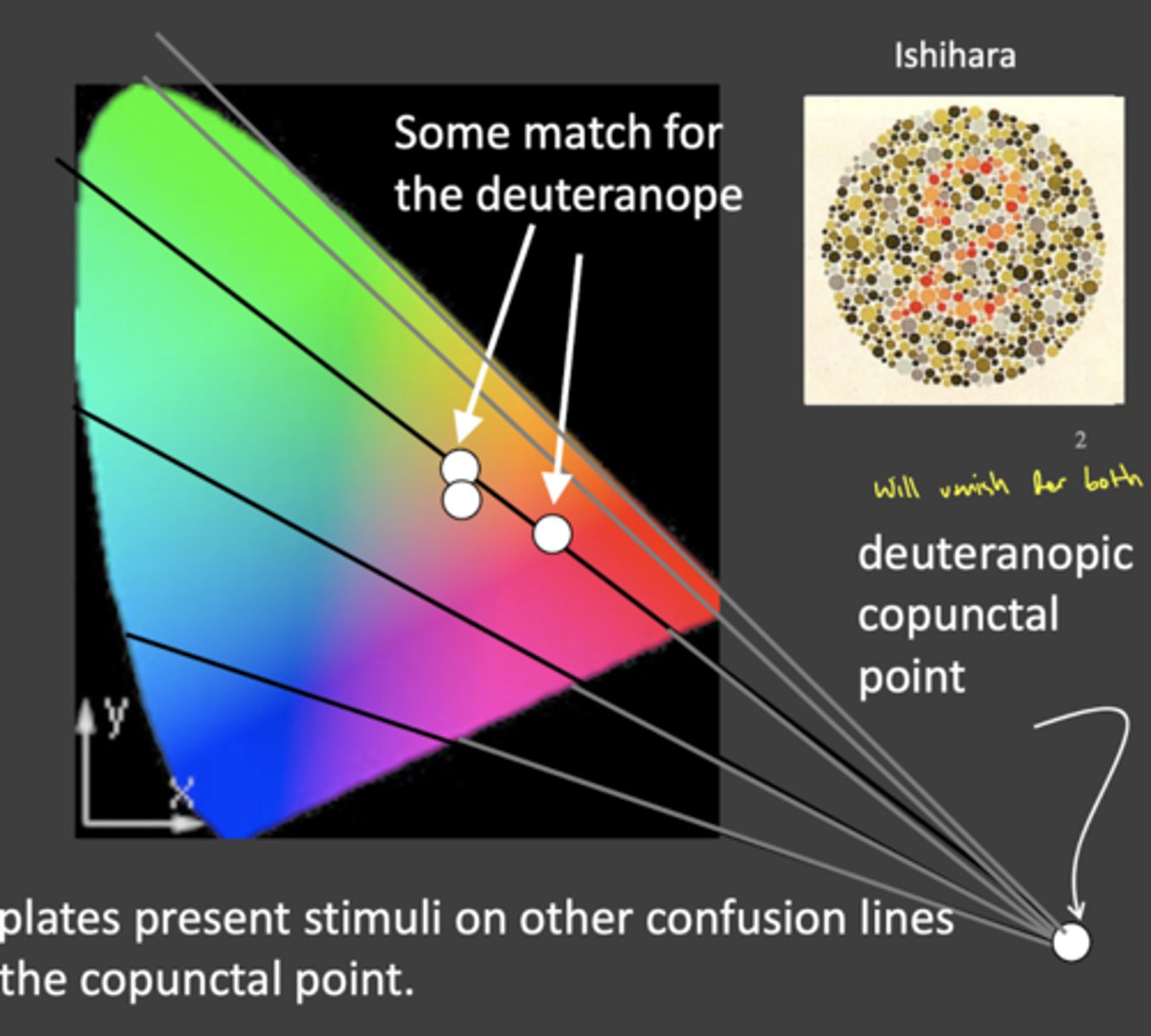
How is the background of pseudoisochromatic plates designed?
use vibrant colors along confusion lines for the numbers/shapes, use the near neutral point as distracting dots
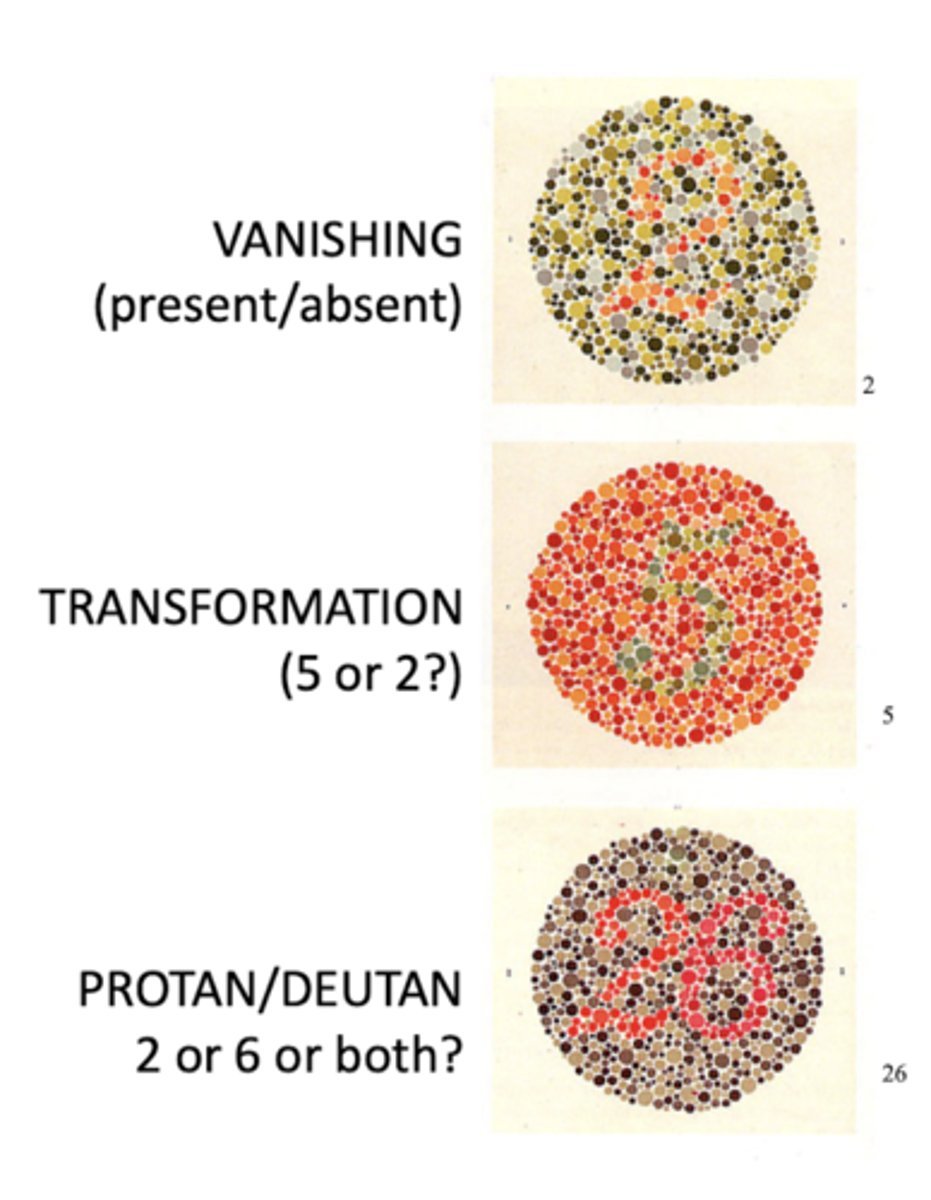
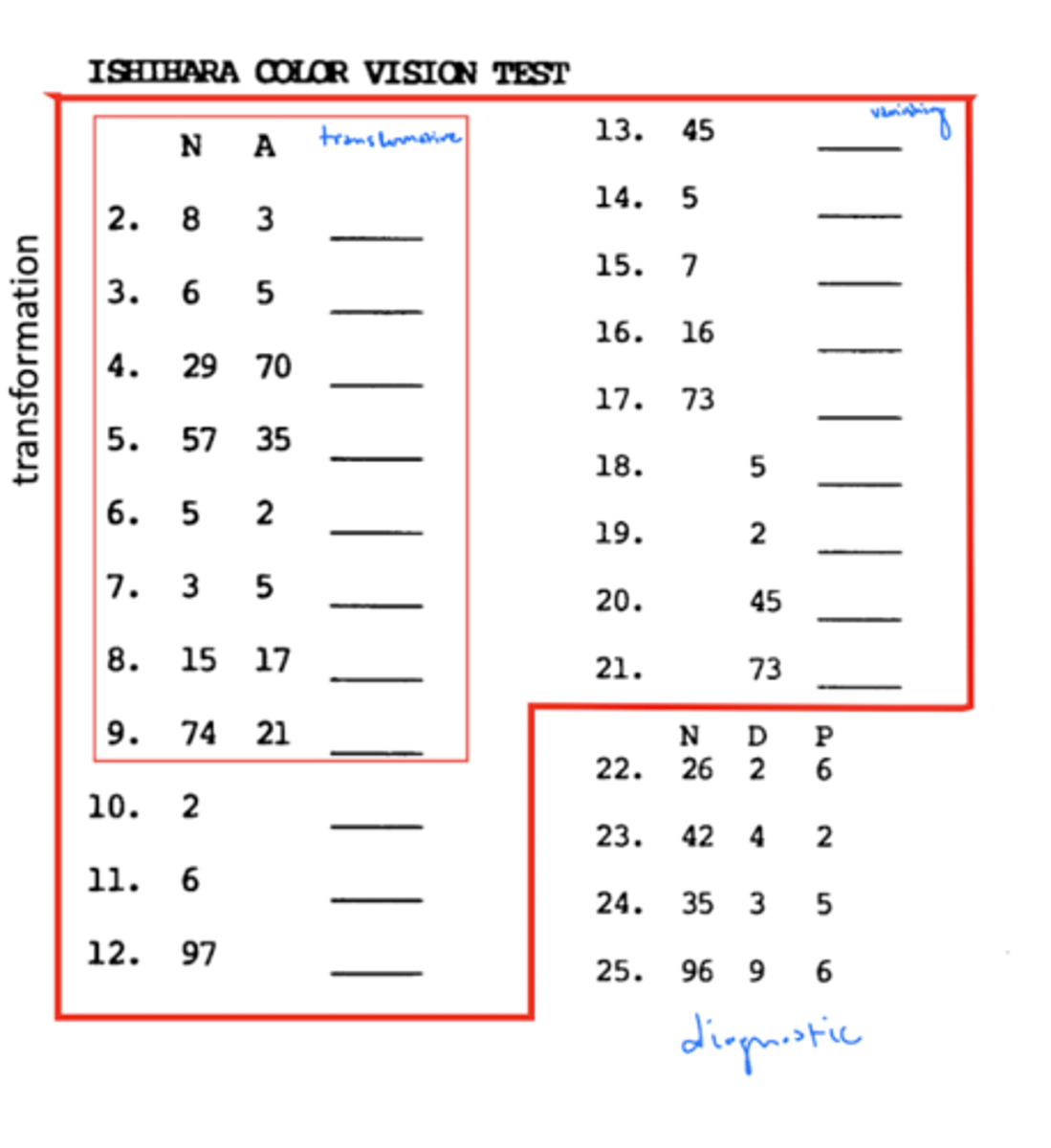
What are the types of pseudoisochromatic plates?
1. vanishing (present or absent)
2. transformation (5 or 2)
3. protan/deutan (aka diagnostic)
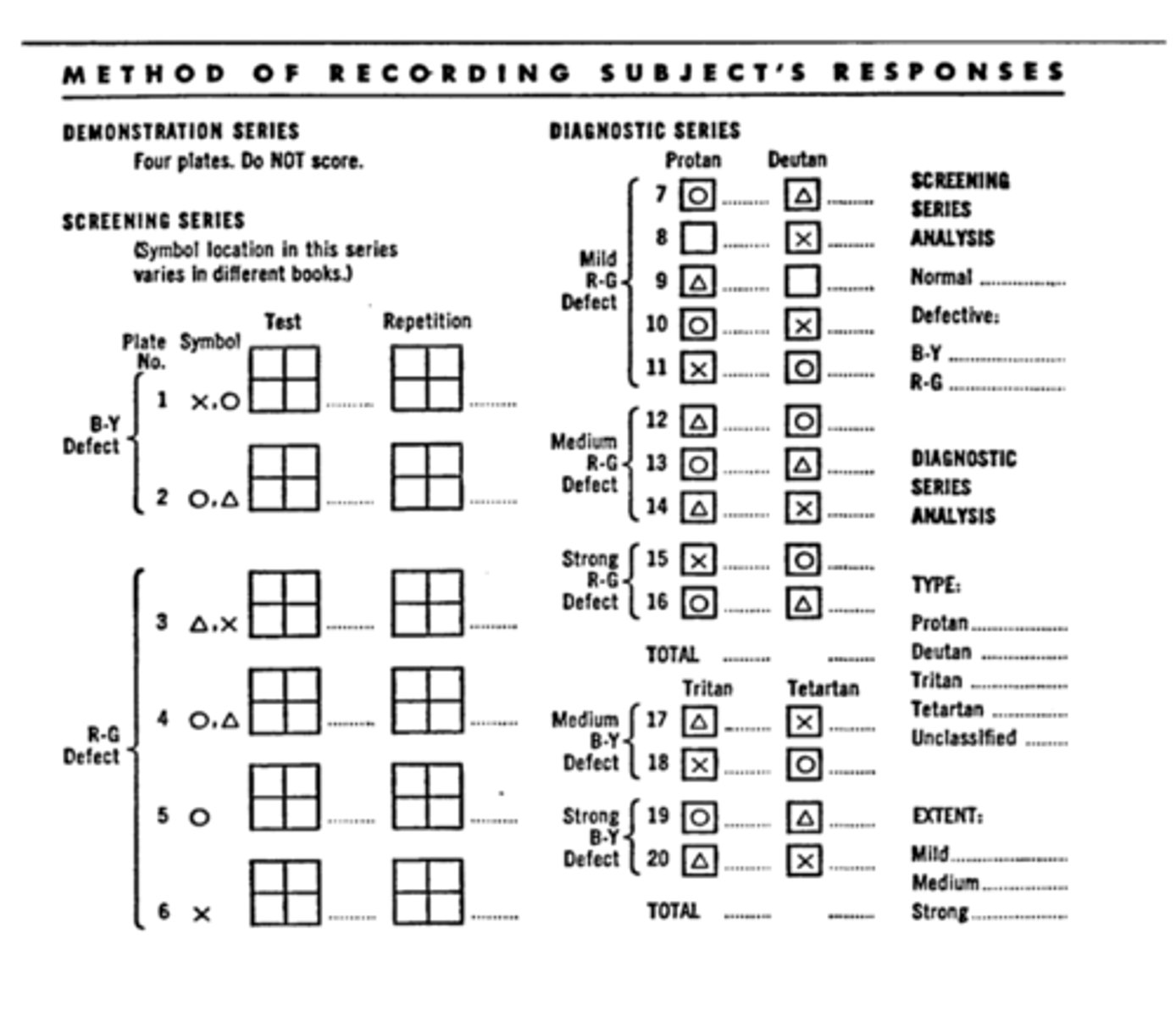
How do you grade an HRR?
1. mark correct identifications (checkmarks)
2. total the successes
3. "type" is the column with the most successes
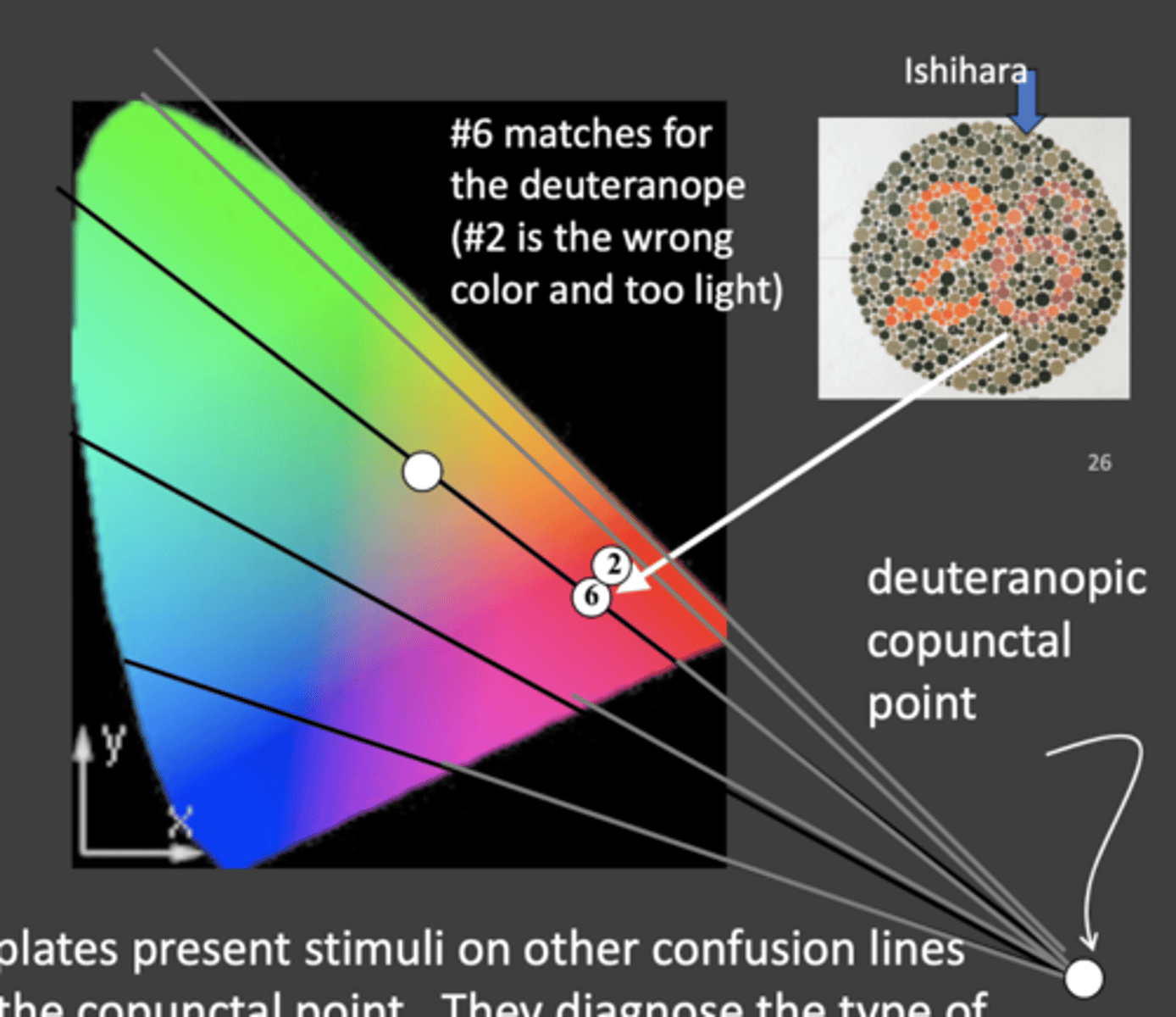
How are protan/deutan (diagnostic) plates made?
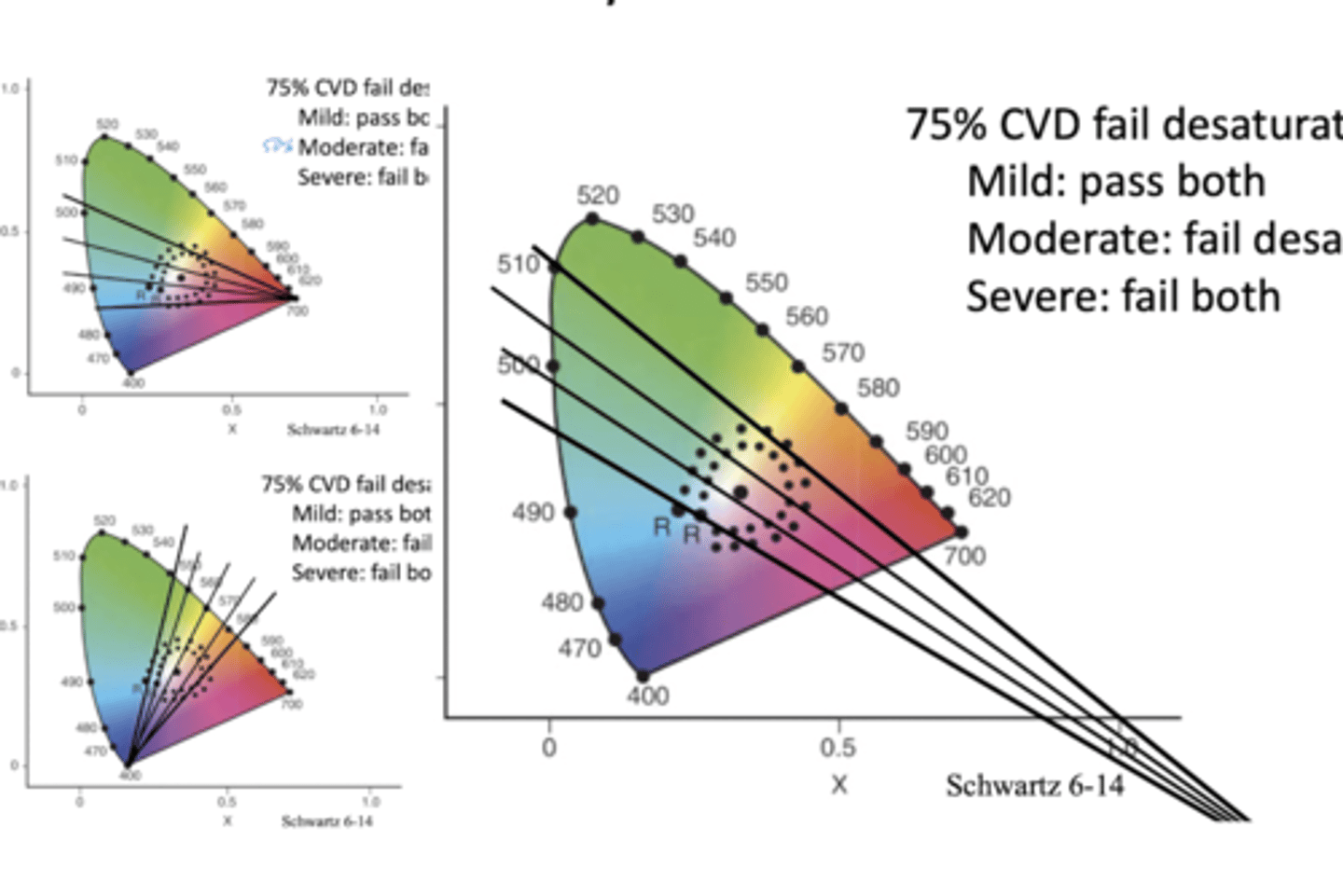
uses two confusion lines from protanopes and deutanopes each and picks a neutral color that intercepts on their respective confusion lines
image - 2 will connect with the white dot with both colors and intercept at the co-punctal points
How do you grade ishihara?
plates 2-21 - 4 or fewer errors pass, 7 or more errors fail
plates 22-25 - diagnostic plates, mild may see both, moderate may see one, severe may see neither
What are the issues with pseudoisochromatic plates?
1. many are R/G only
2. some mild anomalous pass
3. cannot reliably grade severity of defect
4. cannot with 100% discriminate protanopes and deutanopes
What are the types of arrangement color vision tests?
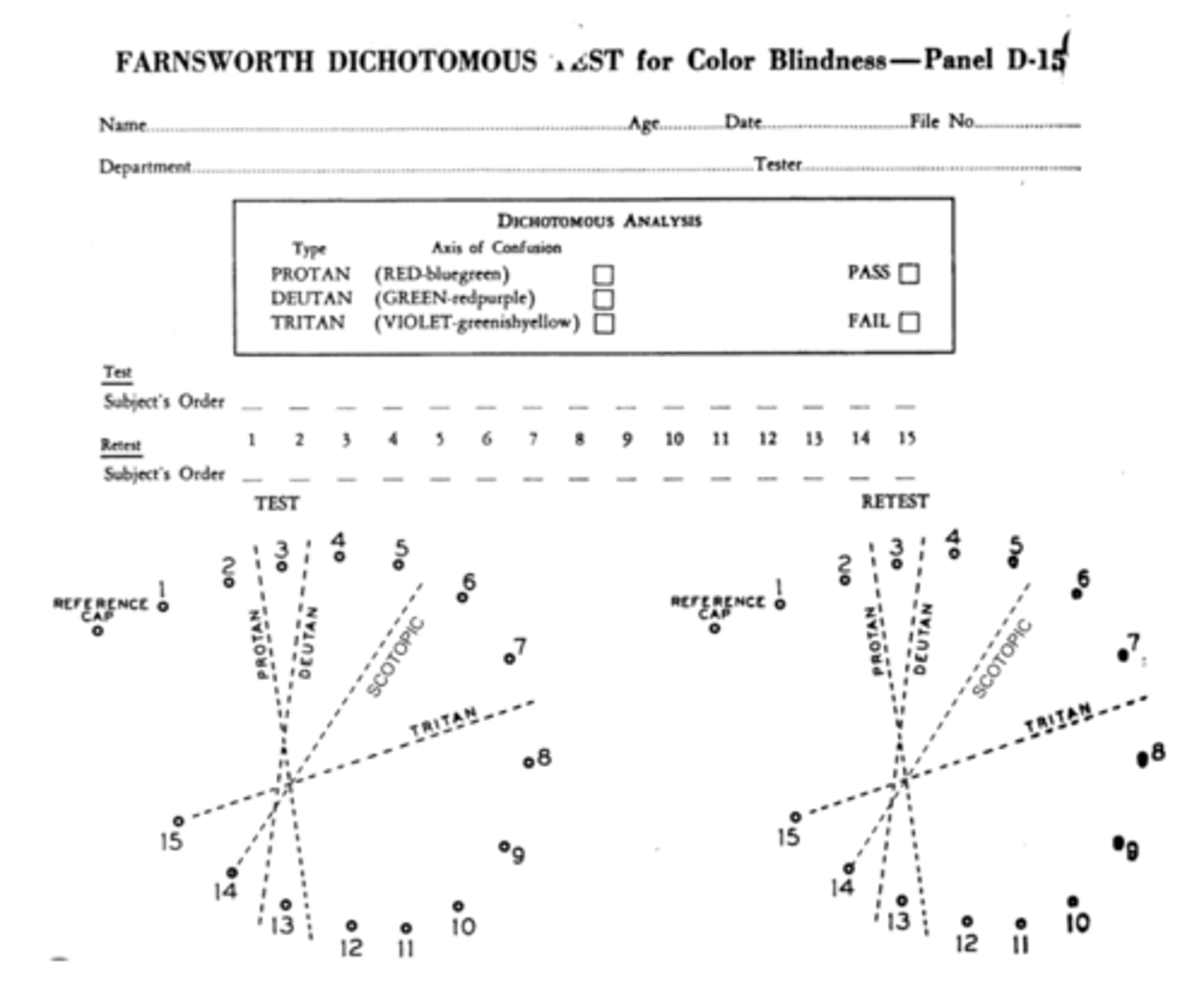
1. farnsworth panel D-15
2. desaturated D-15
3. 100 hue
How is the farnsworth panel laid out on the CIE graph?
spread across confusion lines for each defect
How is the farnsworth panel graded?
2 major errors (>3 apart) constitutes failure
axis of error indicates type of defect (not super reliable)
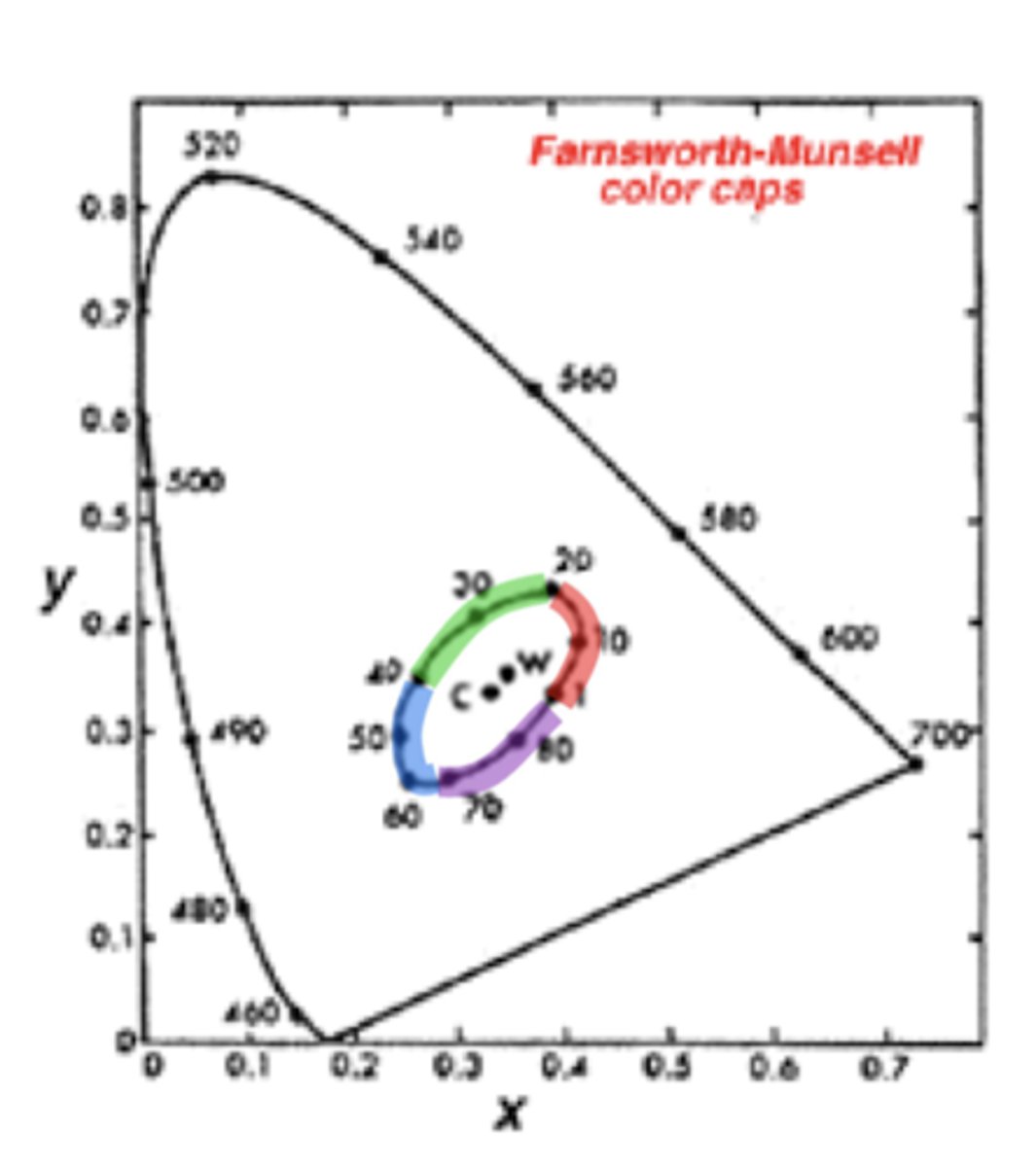
How many caps is the FM 100-Hue test?
only 85 via 4 trays
What is the FM 100-Hue test primarily used for?
industry standards - measure for fine color discrimination
Where are errors made typically for the FM 100-Hue test?
places where the confusion lines are tangent to the color circle
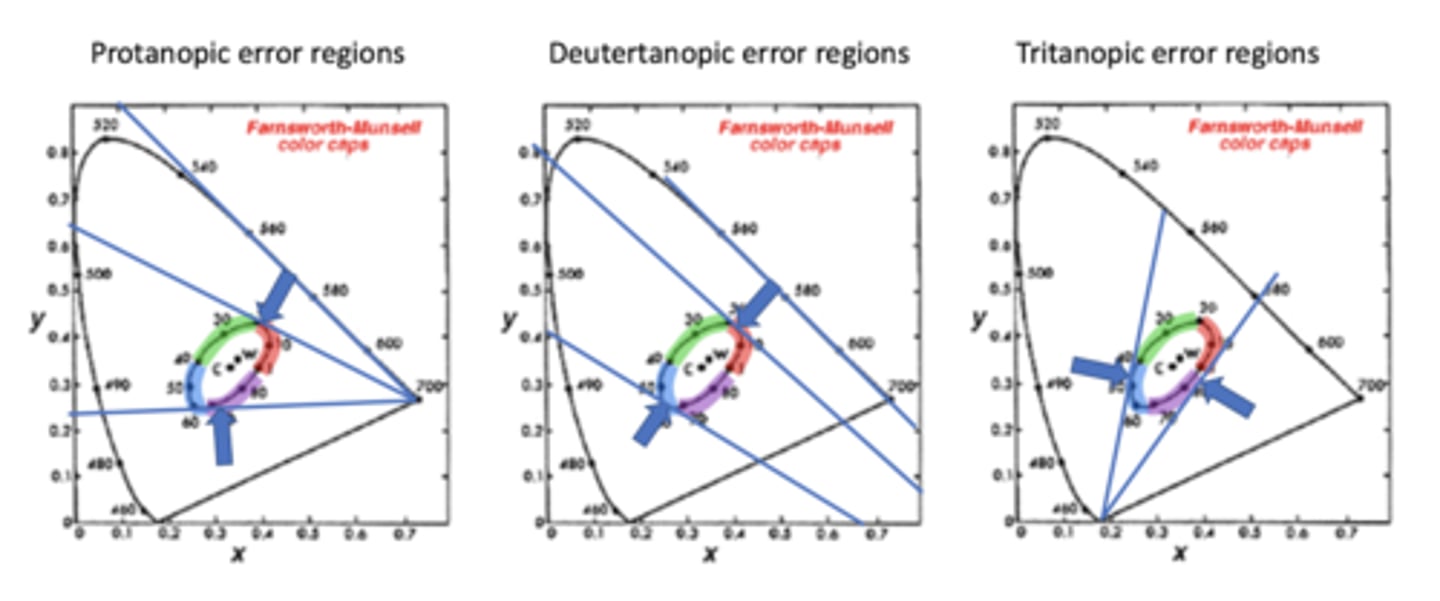
How do you score the FM-100?
1. cap score = difference of cap # added together
2. cap score is subtracted by 2
3. add up error score
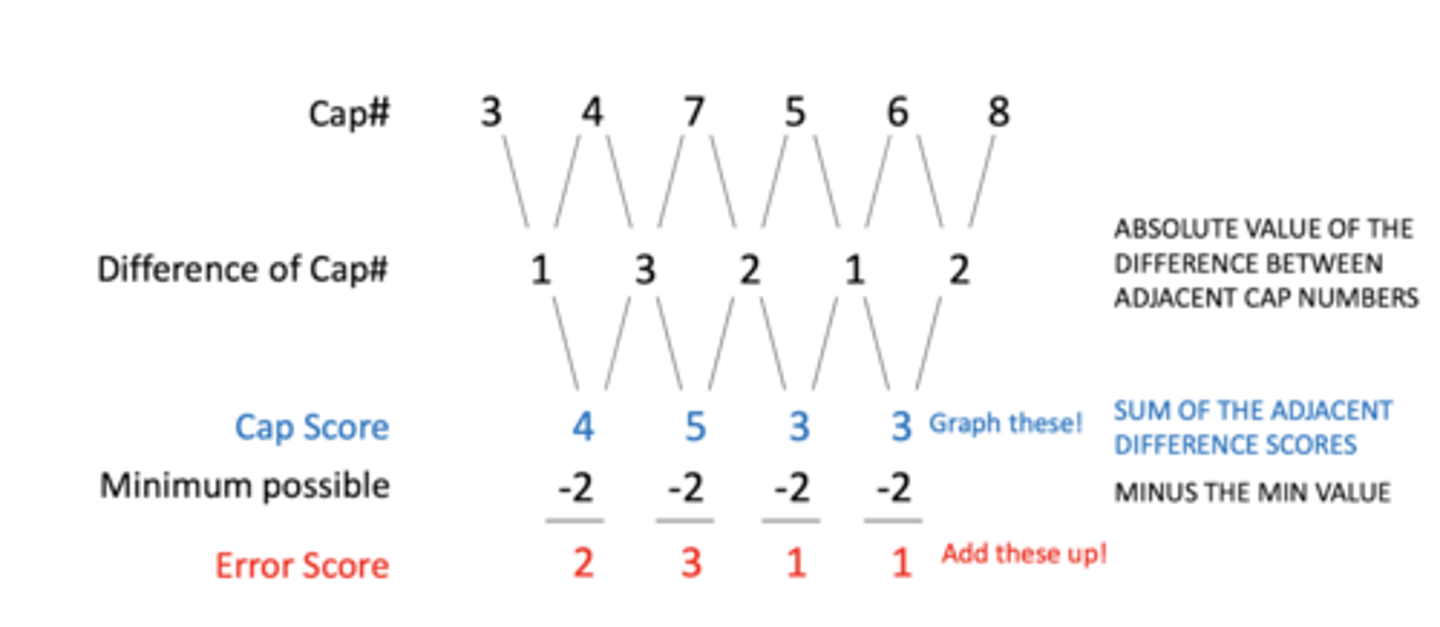
Why does the FM-100 worsen with age?
cataracts
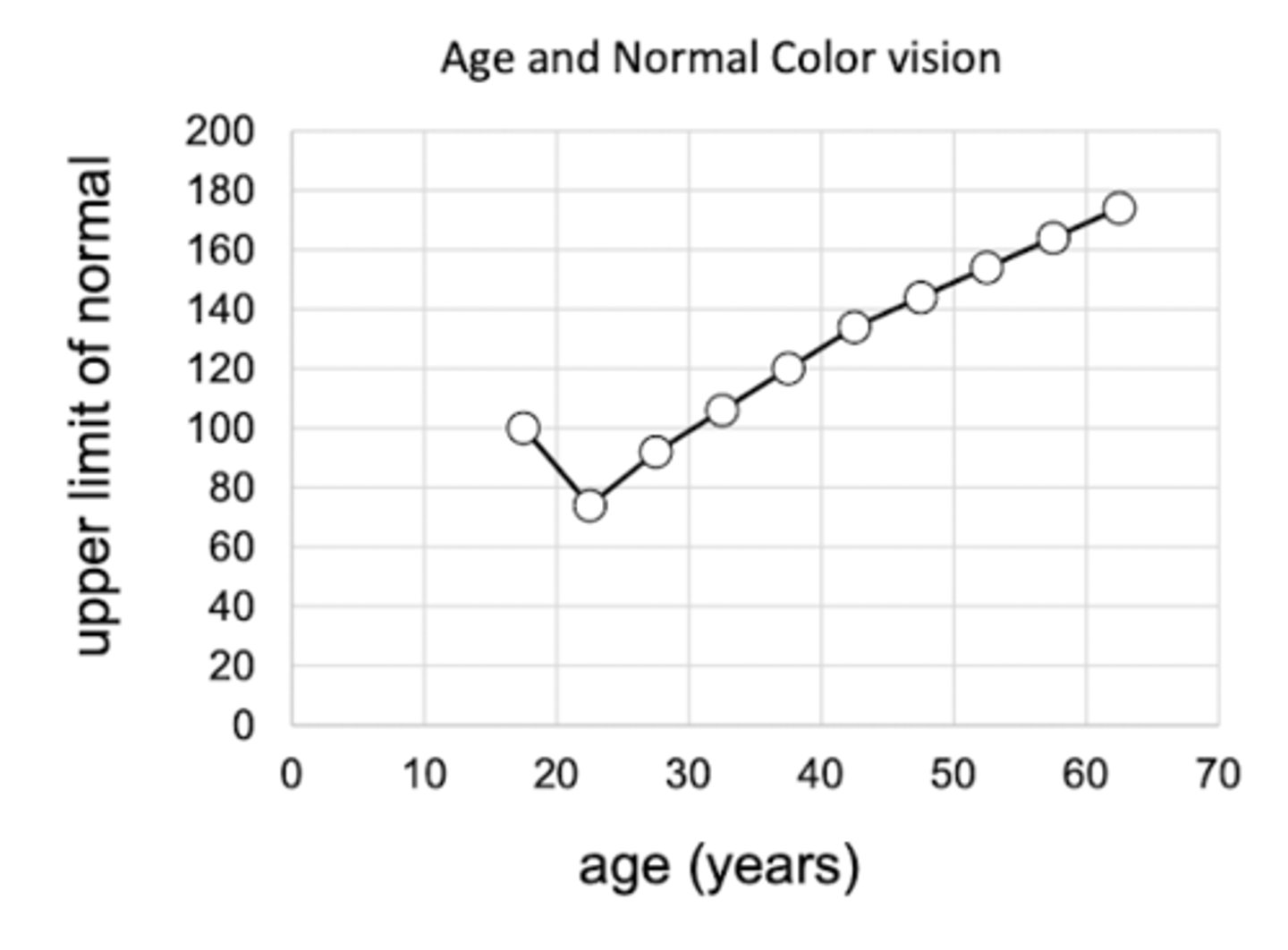
What color defect is the FM-100 good at diagnosing?
tritanopia
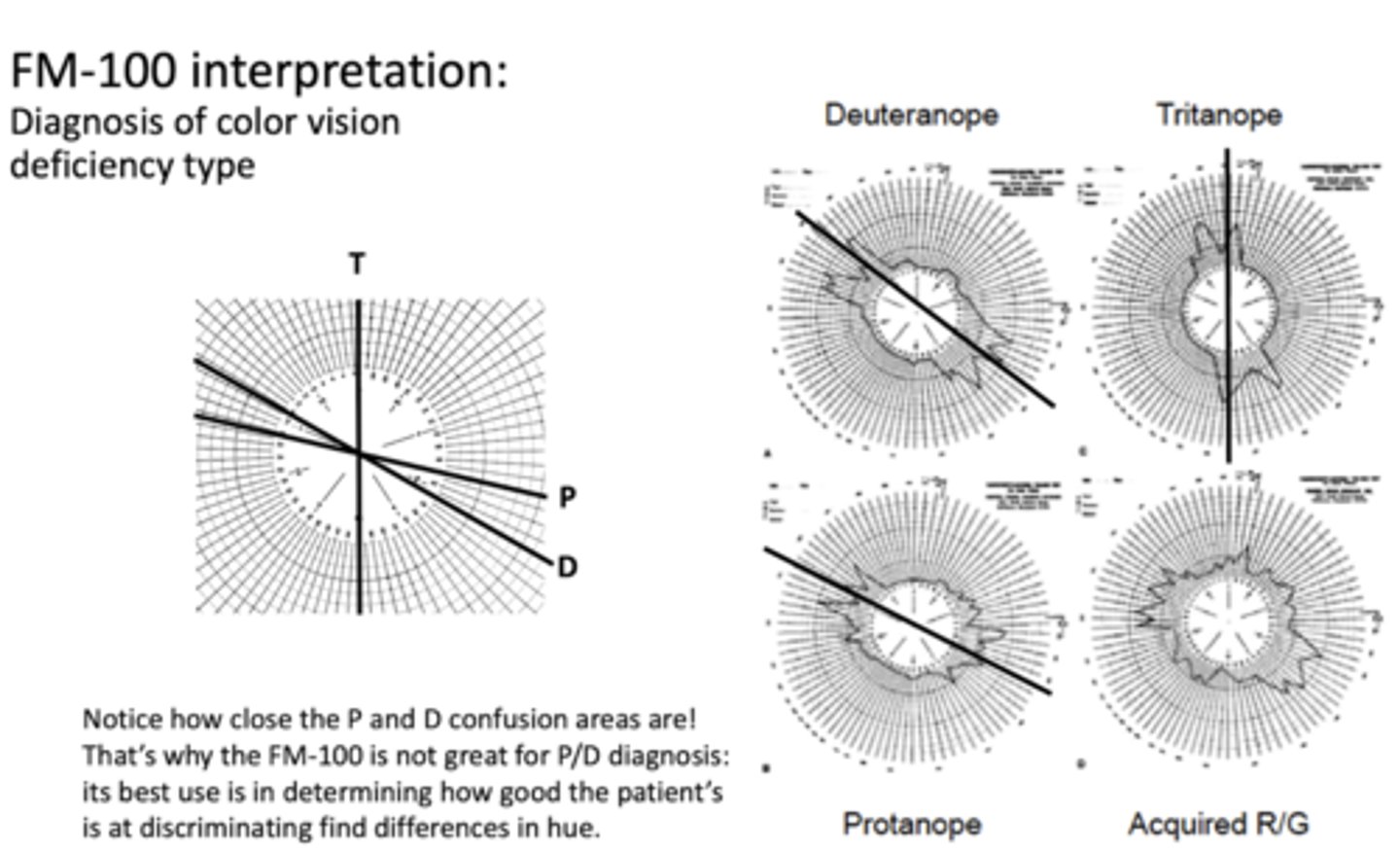
What is the only test that can conclusively distinguish protanopes from deutanopes?
nagel anomaloscope
Which photopigment defect patients will have poor visual acuity?
1. rod monochromat
2. only rods and S-cones (no L or M cones)
Where does the doctor start the anomaloscope?
at the yellow star - everyone has a match there
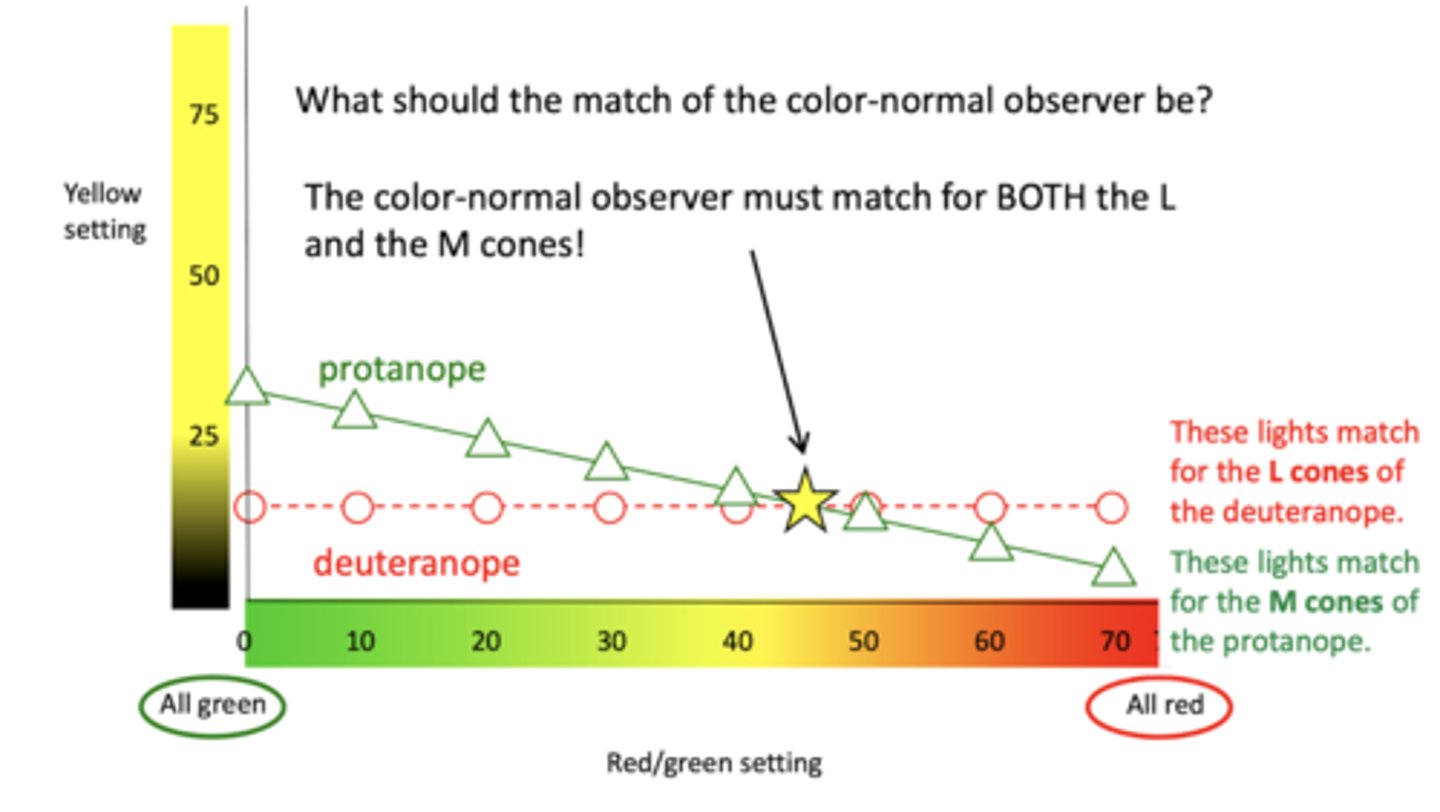
How does a deuteranope behave in an anomaloscope?
yellow (589 nm) light matches any mixture of the two red (670 nm) and green lights (550 nm)
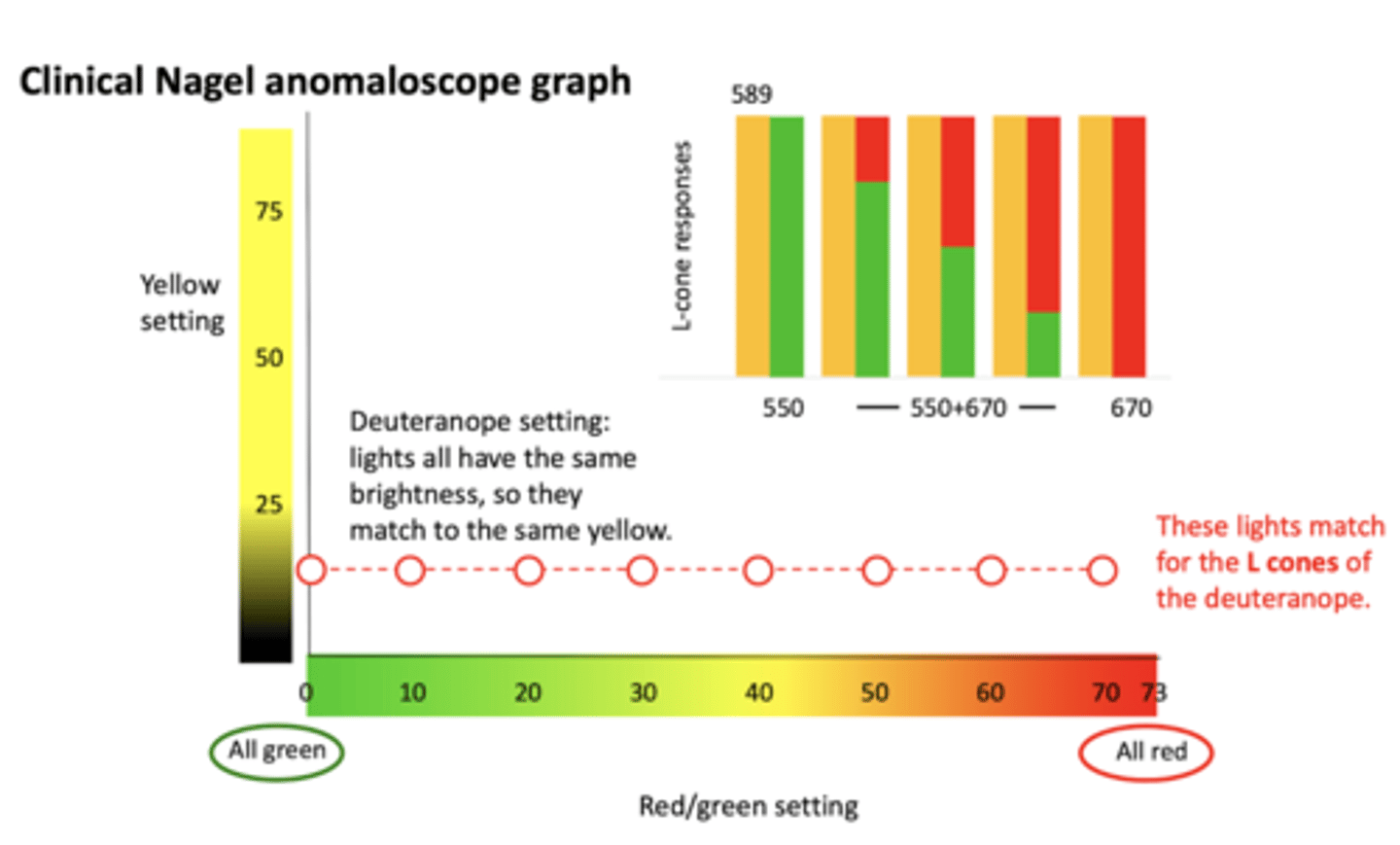
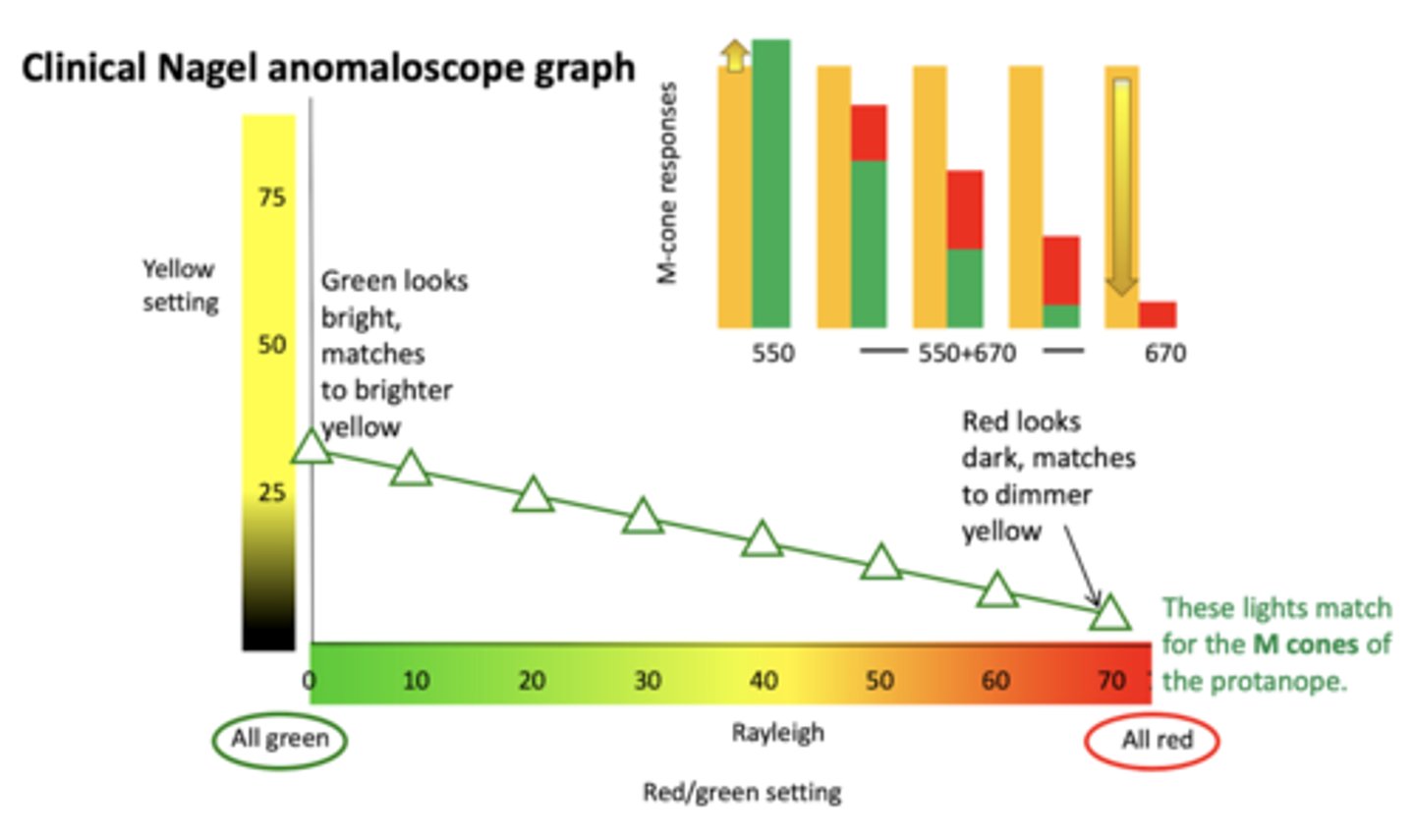
How does a protanope behave in an anomaloscope?
red looks darker and green looks brighter
1. yellow (589 nm) matches red (670 nm) at low yellow levels (brightness)
2. yellow (589 nm) matches green (550 nm) at high yellow (brightness)
Which photopigment defect has impaired foveal function?
rod monochromat - no central vision
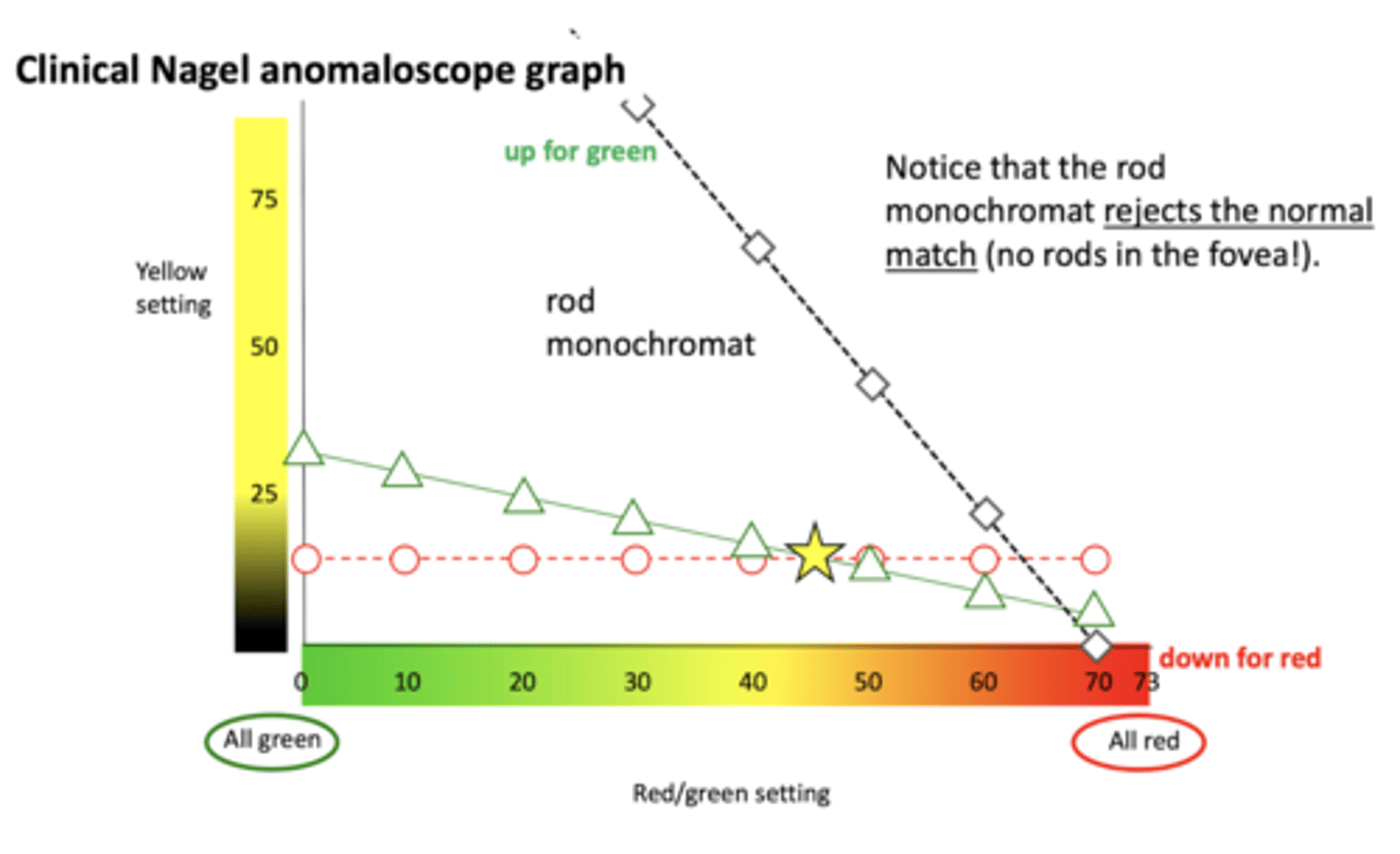
How will a rod monochromat behave in an anomaloscope?
long-wavelength light (red) - very dim
1. green will match bright yellow
2. red will match very dim yellow
What is another way to confirm a rod monochromat diagnosis?
OCT
How will a trianope behave in an anomaloscope?
normal - no defects within Rayleigh's region
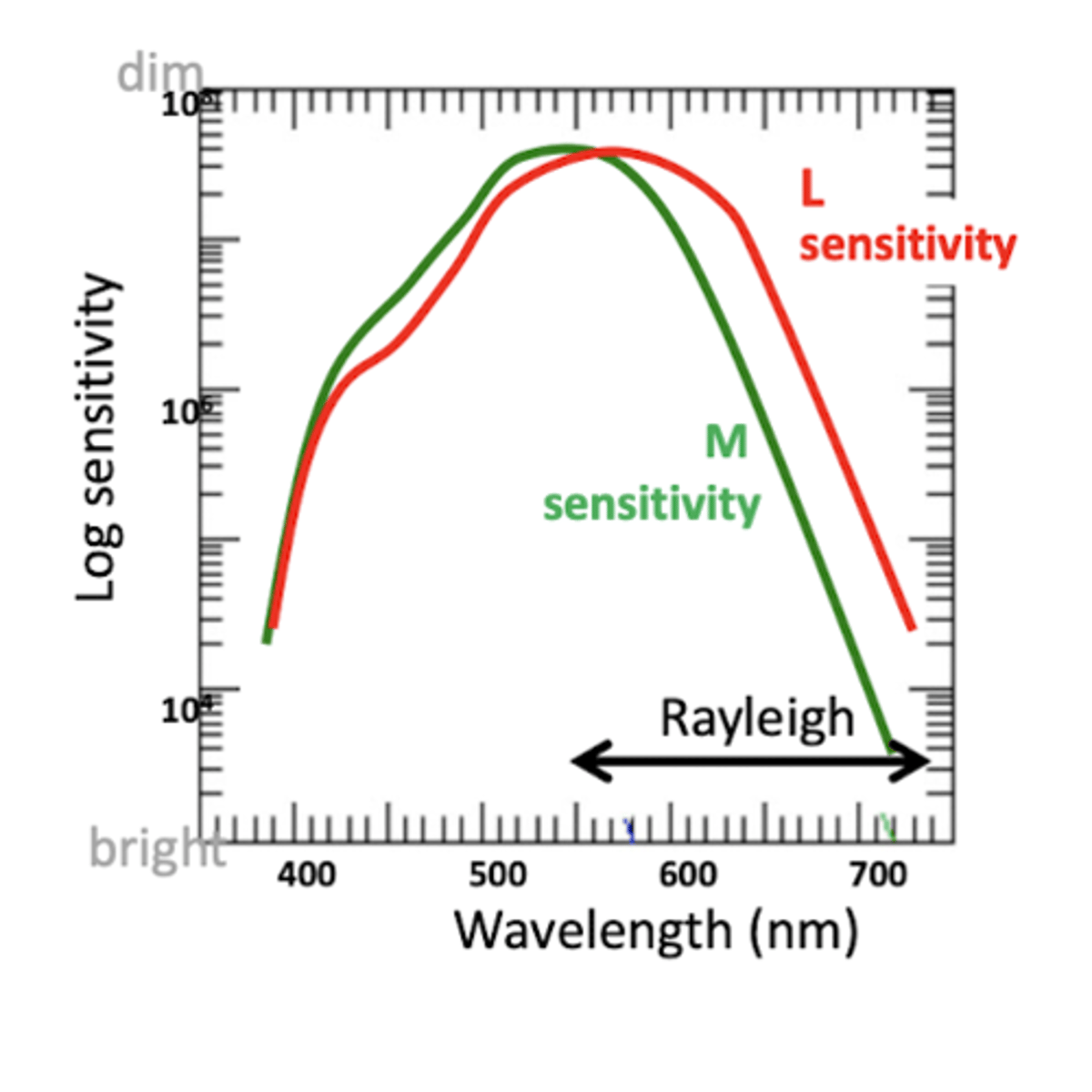
What is achromatopsia?
another term for rod monochromacy
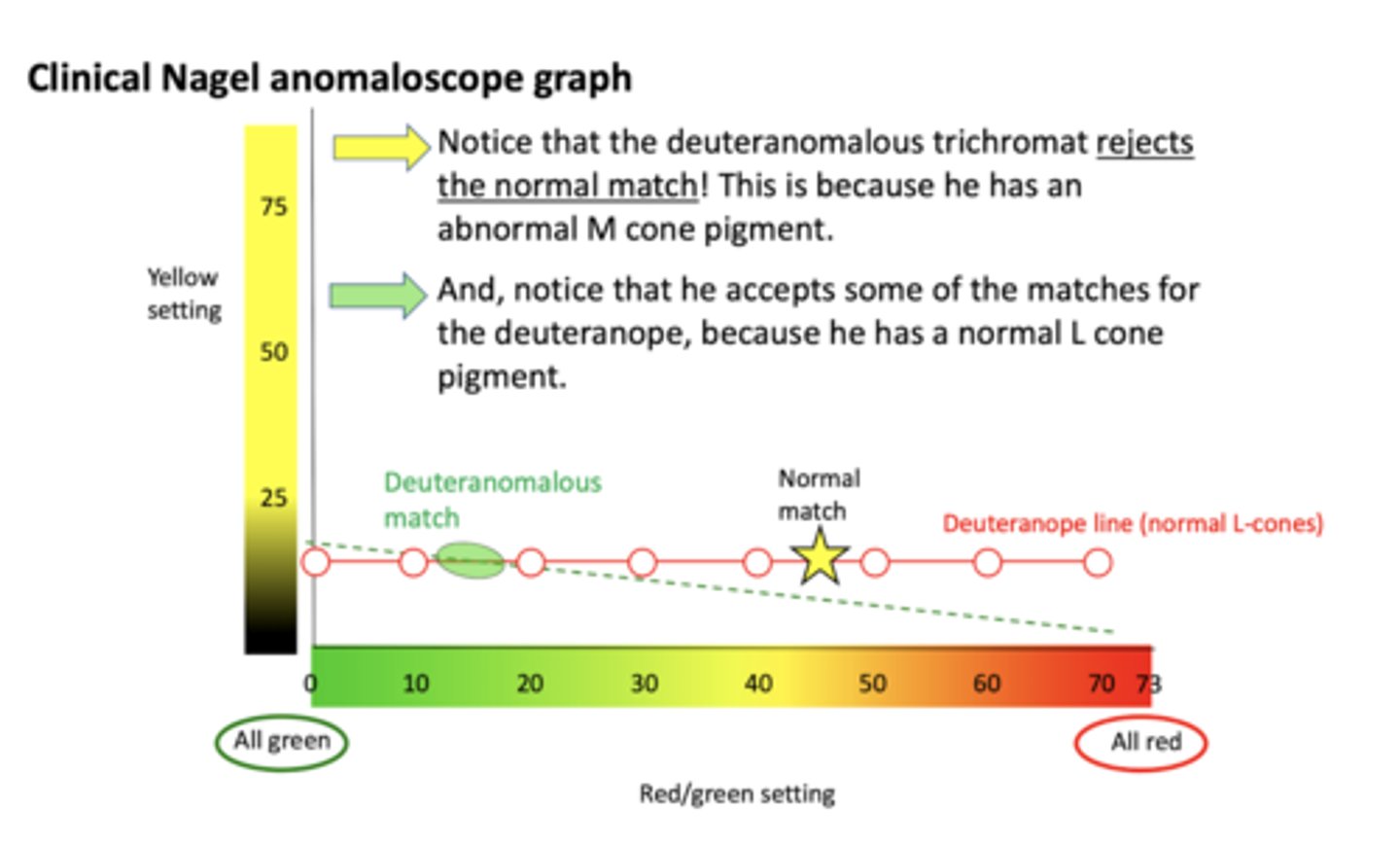
How will deuteranomalous patient behave in an anomaloscope?
1. reject normal match (beginning of test)
2. matches too much green for the normal yellow
why? - "green-weak", don't have normal M-cones
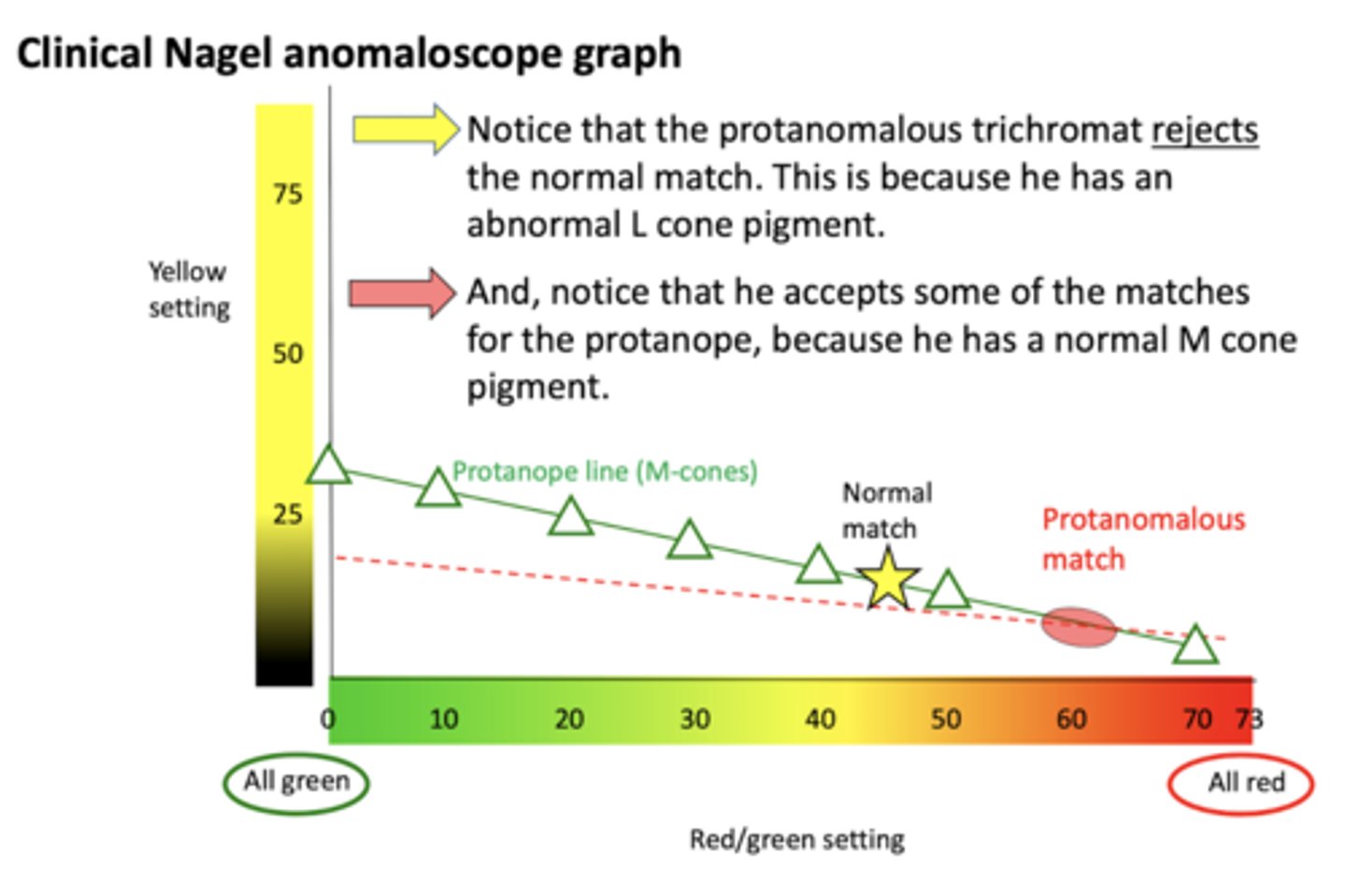
How will protanomalous patient behave in an anomaloscope?
1. reject normal match (beginning of the test)
2. matches too much red for the normal yellow
why? - "red-weak", don't have normal L-cones
What should you be thinking if the patient initially rejects the matched color (anomalous scope)?
1. some type of anomalous trichromat
2. rod monochromat
What should you be thinking if the patient initially accepts the matched color?
1. normal trichromat
2. dichromat (including tritanopes)
What color deficiency can the anomaloscope not detect?
tritanopes
why? - only tests in Rayleigh's region and functional M and L cones
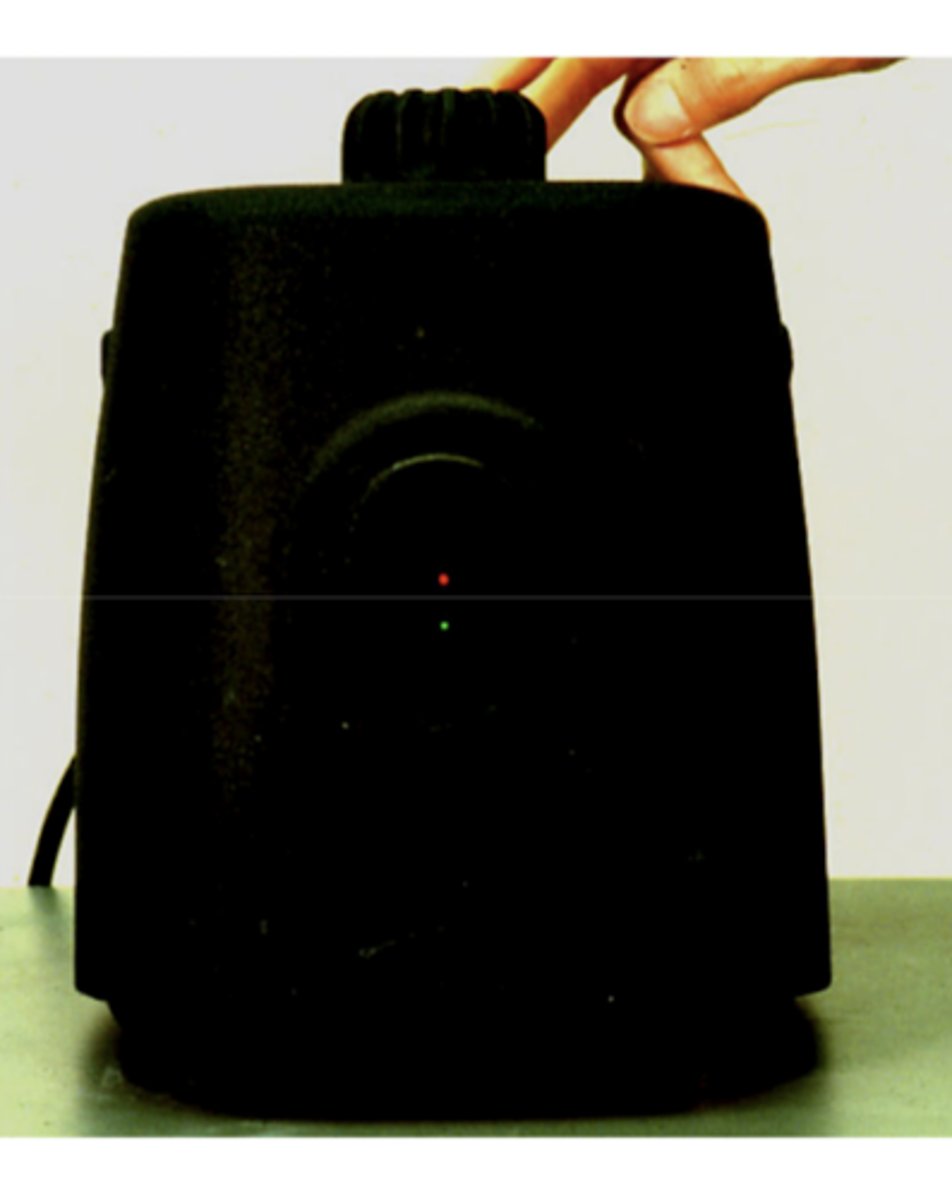
What is the Farnsworth lantern?
red, green, or white lights shown in pairs that mimic signal lights at 800 feet