sciencee
 Call Kai
 Learn
Learn Practice Test
 Spaced Repetition
 Match
Match Flashcards
 Knowt Play
1/34

There's no tags or description
Looks like no tags are added yet.
Name | Mastery | Learn | Test | Matching | Spaced | Call with Kai |
|---|
No analytics yet
Send a link to your students to track their progress
35 Terms
what is the eye diagram
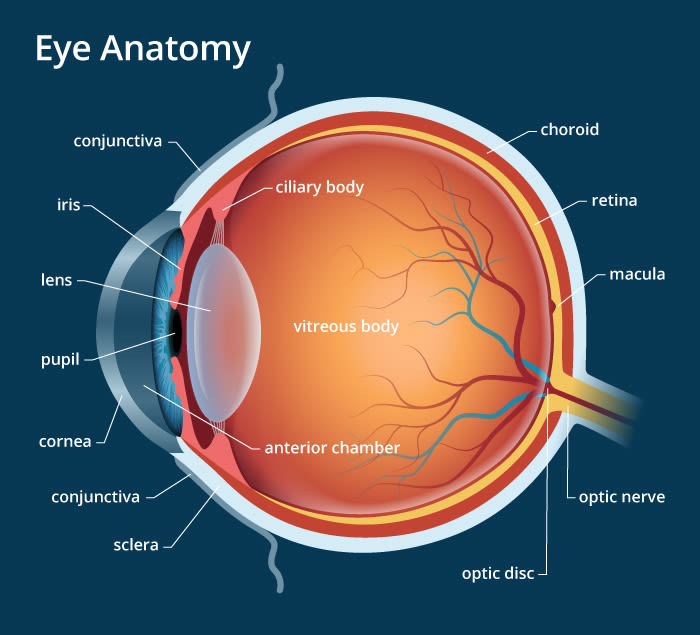
define sclera
tough, opaque outer coating layer of the eye
function- the 6 tiny muscles are connected which controls the eye’s movements
define choroid
a highly tough, pigmented vascular layer between the sclera and retina
function- contains blood vessels that provide oxygen and nutrients, mostly photoreceptors
define retina
the light sensitive part of the eye, covered in light receptors called rod and cones
function- specialised cells catch light photons and convert into electrical impulses.
define optic disc (blind spot)
where the optic nerves leave the retina theres no rods and cones
function- serves as gateway where over 1 million retinal cell axons converge and exit the eye.
define optic nerves
carries impulses from the light receptors to the brain
function- transmits sensory data to trigger autonomic reflexes
define cornea
clear, dome-shaped outer surface covering the front of the eye
function- provides two-third of the eye's focusing power and refracts light to the ear
define iris
a coloured, ring-shaped muscular membrane
function- changes the size of pupil to control how much light enters the eye
define aqueous humour
jelly-like substance thats found between the cornea and lens
function- supplies oxygen, glucose and acids to avascular structures like cornea and lens
define suspensory ligaments
controls the shape of lens with the ciliary muscles
define ciliary muscles
controls the shape of lens with the suspensory ligaments
define pupil
black, circular opening located in the centre of the iris
function- changes size to manage light entering the eye, protecting the inner structures in bright environments
define lens
flexible, biconvex structure located directly behind the iris and pupil
function- provides one-third of the eye's total focusing power of the cornea
define vitreous humour
jelly-like substance thats found between the retina and lens
function- exerts outward pressure to keep the eyeball spherical and prevents it from collapsing
explain the path of light through the eye
Cornea → Aqueous Humour → Pupil/Iris → Lens → Vitreous Humour → Retina, which transmits signals to Optic Nerve and the brain
why is the eye called a sense organ
contains specialised sensory receptors that detect physical stimuli from the environment
what gives people different eye colours
amount and type of melanin pigment in front layers of iris
what happens to lens when viewing a nearby object
the lens of the eye undergoes a process called accommodation becomes thicker, more curved and the ciliary muscles contract
what happens to lens when viewing a distant object
the lens of the eye undergoes a process called accommodation becomes thinner, more flatter and the ciliary muscles relax
why does the lens change thickness
to shift focus between objects that are close by and objects that are far by
define photoreceptors
specialised neurons in the retina at the back of the eye that convert light energy to electrical signals
difference between rod cells and cone cells
rod cells- enables vision in low-light conditions but cant detect colours, low resolution, back and white
cone cells- requires bright light to function and responsible for high resolution with colour vision
what do rod cells detect
colour wavelength, fine details and rapid changes on light
what do cone cells detect
low-intensity light, shapes and motions in dark environments
where are rods and cones mainly found in the retina
Rods: spread throughout the peripheral retina outside the central zone
Cones: highly concentrated in the fovea centralis in the central retina
define fovea
a tiny, specialised depression in the centre of the retina that provides our sharpest, most detailed vision
define myopia and how its treated
condition in which close objects appear clearly, but far away objects are blurry.
how its treated- eyeglasses, contact lenses with negative lens, laser surgery to change the cornea or lens
define hyperopia and how its treated
condition in which far away objects appear clearly but nearby objects are blurry.
how its treated- eyeglasses, contact lenses with positive lens, laser surgery to change the cornea or lens
define astigmatism and how its treated
common imperfection in the curvature of the eye’s curvature
how its treated- special astigmatism eyeglasses, contact lenses, laser surgery to change the cornea or lens
define cataracts and how its treated
clouding in normal clear lens of the eye, resulting in blurry vision
how its treated- replacing the cloudy lens with a clear, artificial lens.
why do cataracts cause blurry vision
the clumped proteins inside the eye’s natural lens scatter and block light rays
define glaucoma and how its treated
clouding in normal clear lens of the eye, resulting in blurry vision
how its treated- eye drops, medications to reduce eye and blood pressure, laser surgery to remove tissue
define colourblindness and how its treated
A reduced ability to distinguish between certain colors.
how its treated- no treatments
define macular degeneration and how its treated
Deterioration of the center of the retina causing central vision loss.
how its treated- special combination of vitamins and minerals and surgery
difference between concave and convex lens
(myopia) concave- diverges light rays so that they are further apart
(hyperopia) convex- converges light rays so that they are further apart