SMM5 - Social media marketing effects (keywords, mp + scenario questions)

0.0(0)
Studied by 0 people
call kaiCall Kai
learnLearn
examPractice Test
spaced repetitionSpaced Repetition
heart puzzleMatch
flashcardsFlashcards
GameKnowt Play
Card Sorting

1/34

encourage image

There's no tags or description

Looks like no tags are added yet.

Last updated 1:57 PM on 5/29/26
Name
Mastery
Learn
Test
Matching
Spaced
Call with Kai

No analytics yet

Send a link to your students to track their progress

35 Terms

1
New cards
What is Augmented Reality (AR)?
A technology that overlays virtual objects onto the real-world environment, blending digital content with the physical world
2
New cards
What is Artificial Intelligence (AI) in a marketing context?
Technology focused on creating intelligent systems that can perform tasks autonomously or assist humans in decision-making
3
New cards
What distinguishes AR from AI?
AR changes what you perceive (visual overlay on reality); AI changes what a system can do (autonomous decision-making). They can be combined, e.g., AI-enhanced AR apps
4
New cards
What is social listening?
Proactive data collection and analysis of social media content to gain insights that support strategic marketing decisions
5
New cards
What is social monitoring?
Reactive tracking of specific words or phrases (e.g., brand name) on social media that triggers a company response when necessary
6
New cards

What distinguishes social listening from social monitoring?

Social listening is proactive and strategic (broad data collection for insight); social monitoring is reactive and operational (tracking specific triggers)
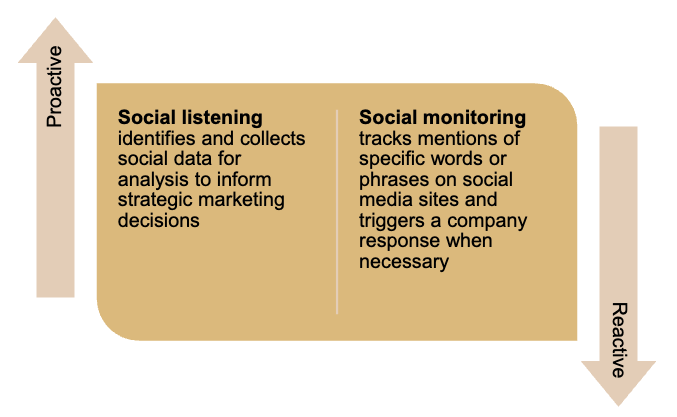
<p>Social listening is proactive and strategic (broad data collection for insight); social monitoring is reactive and operational (tracking specific triggers)</p>
7
New cards
What are the three types of campaign measurement metrics?
1. Activity metrics (input) 2. Interaction metrics (reaction) 3. Return metrics (outcome)
8
New cards
What are examples of activity metrics?
Views/impressions, clickthroughs, time spent with content, virality, organic buzz
9
New cards
What are examples of interaction metrics?
Followers/fans, comments, likes, shares, recommendations, reviews
10
New cards
What are examples of return metrics?
Social Media ROI and Blog Value Index (BVI)
11
New cards
What does a Blog Value Index (BVI) of less than 1 mean?
The blog costs more money than it generates (loss)
12
New cards
What does a Blog Value Index (BVI) greater than 1 mean?
The blog generates more value than it costs (profit)
13
New cards
What is brand perception and why is it different from other metrics?
It covers what consumers think of your brand (awareness, attitude, loyalty, etc.) and cannot be derived from platform data — it must be actively measured via surveys
14
New cards
What are the four steps of the Data Approach for SMM campaigns?
1. Define (SMART objectives) 2. Assess (costs vs. revenue) 3. Track (link results to campaign) 4. Adjust (optimize)
15
New cards
What does SMART stand for in campaign goal-setting?
Specific, Measurable, Appropriate, Realistic, Time-oriented
16
New cards
What is brand loyalty?
A consumer's strong relationship with and identification with a brand, expressed in both attitude loyalty (feelings) and behavioral loyalty (repeat purchase)
17
New cards
What does brand loyalty lead to for a company?
Increased sales revenue, larger market share, and greater profitability
18
New cards
What is brand engagement according to Park et al. (2020)?
A brand's motivational state to connect and build social relationships with all consumers, e.g., through responding to comments, sharing UGC, or posting interactive content
19
New cards
What is a firestorm in SMM?
The sudden occurrence of many, predominantly negative social media expressions against a brand
20
New cards
Under what conditions does a firestorm have the biggest impact?
When it arises from a lively trigger (e.g., video), stems from brand errors, generates a lot of content, and lingers for a long time
21
New cards
What are the three steps for dealing with a firestorm?
1. Monitor the situation 2. Express sympathy and understanding 3. React quickly
22
New cards
Why is earned media both the most powerful and most risky type of media?
It has the largest reach of all three media types, but the brand has the least control over the message — positive WOM spreads far, but so does negative WOM and firestorms
23
New cards
What is computer vision analysis?
Using AI algorithms to interpret and understand visual content (images, videos) from social media platforms
24
New cards
What are the three challenges of computer vision analysis?
1. Data privacy (consent, regulations) 2. Accuracy/bias (refining models) 3. Scalability (processing large volumes)
25
New cards
What did Liu et al. (2023) find about Gen Z travel behavior?
Gen Z is more susceptible than older generations to entertainment, trendiness, customization, and WOM when choosing destinations and deciding to pay a premium
26
New cards
What gender differences did Liu et al. (2023) find within Gen Z?
Gen Z females are more influenced by customization and WOM; Gen Z males are more influenced by entertainment and trendiness
27
New cards
What is the counterintuitive finding of Liu et al. (2023) about interaction?
Interaction has a significant *negative* effect on Gen Z's willingness to pay a premium, making it the least effective SMMA factor overall
28
New cards
What did Yang et al. (2021) find about smiling in Instagram ads?
Models with smiling facial expressions are perceived as more genuine, which increases trustworthiness, brand authenticity, brand attitude, and behavioral intent
29
New cards
What did Yang et al. (2021) find about snapshot vs. studio aesthetics?
Snapshot aesthetic leads to higher perceived model genuineness than studio aesthetic — but studio amplifies the effect of smiling (smiling in studio = most genuine) while punishing non-smiling more harshly
30
New cards

What is brand authenticity according to Yang et al. (2021)?

A multidimensional construct reflecting consumers' subjective evaluations of a brand's continuity, originality, reliability, naturalness, credibility, symbolism, integrity, and genuineness
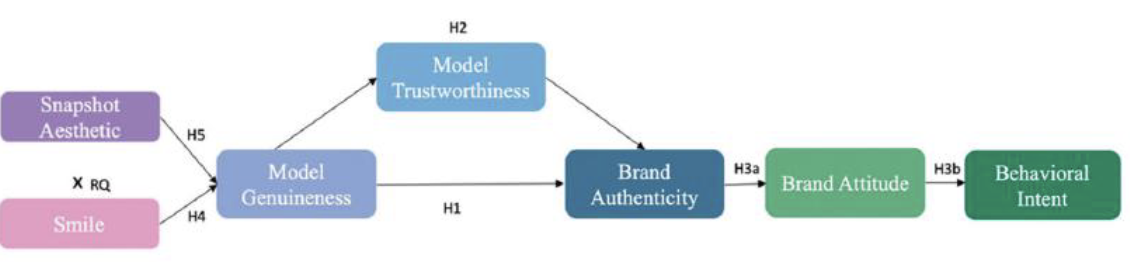
<p>A multidimensional construct reflecting consumers' subjective evaluations of a brand's continuity, originality, reliability, naturalness, credibility, symbolism, integrity, and genuineness</p>
31
New cards
Explain why 'what leads to likes does not necessarily lead to sales'
Activity and interaction metrics (likes, shares) measure engagement, not purchase behavior. Effect metrics must be matched to campaign objectives — a like is not the same psychological step as a buying decision
32
New cards

What is the pinball model of marketing and why does it matter for SMM?

It describes modern marketing as non-linear and customer-controlled, with multiple touchpoints across traditional media, marketing activities, social media, and customer reactions. Because the brand cannot control the flow, social monitoring and social listening are essential to track and understand what is happening across all touchpoints
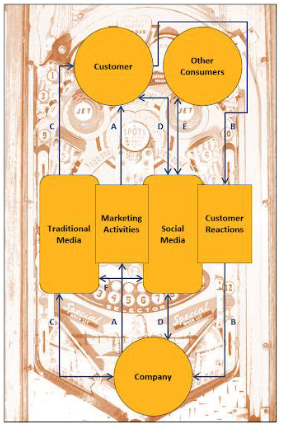
<p>It describes modern marketing as non-linear and customer-controlled, with multiple touchpoints across traditional media, marketing activities, social media, and customer reactions. Because the brand cannot control the flow, social monitoring and social listening are essential to track and understand what is happening across all touchpoints</p>
33
New cards
What are the 5 characteristics of the pinball model?
1. Non-linear customer journeys 2. Multiple touchpoints 3. Customer-controlled flow 4. Feedback 5. Content-rich and contextual
34
New cards
What are the four 'bumpers' in the pinball model?
Traditional media, marketing activities, social media, and customer reactions
35
New cards
Why does the pinball model make social monitoring and social listening essential?
Because the customer journey is non-linear and customer-controlled, brands cannot predict or steer the flow — they need monitoring (reactive) and listening (proactive) to understand what is happening across all touchpoints



