EMT Chapter 10 - Respiration and Artificial Ventilation
 Call Kai
 Learn
 Practice Test
 Spaced Repetition
 Match
 Flashcards
 Knowt Play
1/57

Earn XP
Description and Tags
58 Terms
ventilation
the process of moving gases (oxygen and carbon dioxide) into and out of the pulmonary circulation; also, artificial provision of breaths.
Inhalation
An active process where intercostal muscles and the diaphragm contract, creating negative pressure that pulls air into the lungs.
exhalation
A passive process where muscles relax, creating positive pressure that pushes air out; typically takes longer than inhalation.
tidal volume
The amount of air moved in one breath; a normal volume is typically 5−7 mL per kg of body weight.
minute volume
The amount of air moved into and out of the lungs per minute, calculated as MV=TV×RR
Ventilation
(inhalation and exhalation) is ultimately designed to move air to and from the alveoli for gas exchange
Adult average tidal volume
500 mL, 350 mL reaches the alveoli
dead space, dead air space
Parts of the airway, such as the trachea and bronchioles, where no gas exchange occurs.
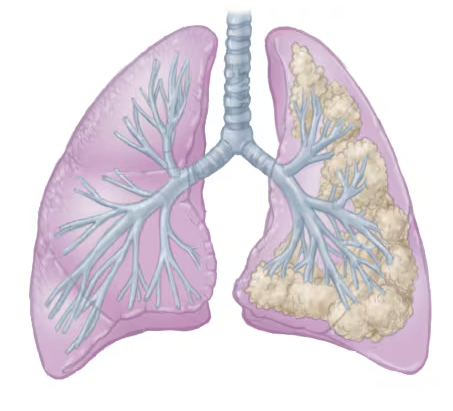
alveolar ventilation
the amount of air that reaches the alveoli.
diffusion
The process where molecules move from an area of higher concentration to an area of lower concentration.
pulmonary respiration
The exchange of oxygen and carbon dioxide between the alveoli and the circulating blood in pulmonary capillaries.
cellular respiration
The exchange of oxygen and carbon dioxide between the body's cells and the circulating blood.
respiration
The combination of pulmonary and cellular respiration involving the diffusion of gases and the act of breathing.
hypoxia
an insufficiency of oxygen in the body’s tissues.
hypercapnia
Elevated levels of carbon dioxide (CO2) in the blood, often triggering a compensatory increase in respiratory rate.
respiratory distress
increased work of breathing; a sensation of shortness of breath.
respiratory failure
the inadequacy of breathing to the point where oxygen intake or the ventilation removal of carbon dioxide is not sufficient to support life. Hypoxia becomes profound, carbon dioxide builds to dangerous levels, and the muscles used for increased respiration begin to tire.
respiratory arrest
when breathing completely stops.
Adequate Breathing Signs
Normal mental status, symmetric chest expansion, clear breath sounds, normal skin color, and oxygen saturation >95%
Inadequate Breathing (Respiratory Failure) Signs
Altered mental status, shallow or labored breathing, cyanosis, diminished breath sounds, bradycardia, and oxygen saturation <95%.
Patient is Not Breathing (Respiratory Arrest) Signs
No chest or abdominal rise and fall; No evidence of air being moved from the mouth or nose; No breath sounds
Adequate Breathing EMT Intervention
Identify and treat respiratory challenge; Consider supplemental oxygen (nonrebreather mask or nasal cannula).
Inadequate Breathing (Respiratory Failure) EMT Intervention
Assisted ventilations (air forced into the lungs under pressure) with a pocket face mask or bag–valve mask
Patient is Not Breathing (Respiratory Arrest) EMT Intervention
Artificial ventilations with a pocket face mask or bag–valve mask at 10–12/minute for an adult or 12–20/minute for an infant or child
Normal Respiratory Rate for Adults
12–20 per minute
Normal Respiratory Rates for Children
18–30 per minute
Normal Respiratory Rate for Infants
30-60 per minute
cyanosis
a blue or gray color resulting from lack of oxygen in the body.
Artificial ventilation
the use of positive pressure to force air or oxygen into the lungs when a patient has stopped breathing or has inadequate breathing. Also called positive pressure ventilation.
negative side effects of positive pressure ventilation
Decreased cardiac output, gastric distention, and hyperventilation-induced vasoconstriction.
Face Mask Ventilation: Core Principles
Maintaining a patent airway and ensuring a secure, airtight mask seal.
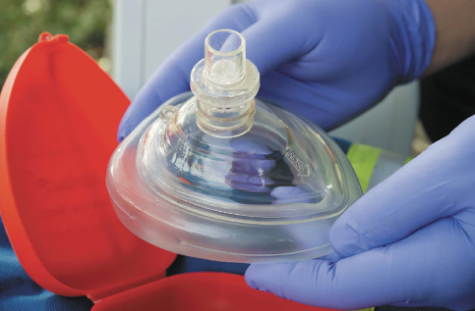
pocket face mask
a device, usually with a one-way valve, to aid in artificial ventilation. A rescuer breathes through the valve when the mask is placed over the patient’s face.
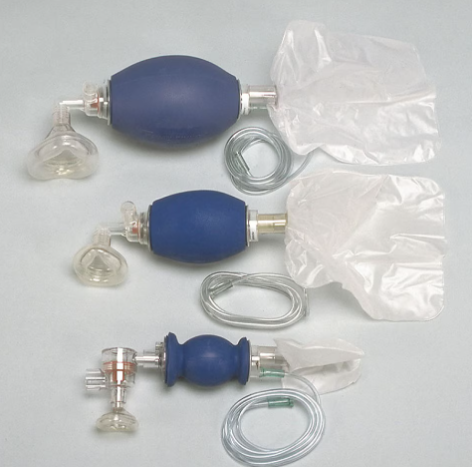
bag–valve mask (BVM)
a handheld device with a face mask and self-refilling bag that can be squeezed to provide artificial ventilations to a patient. It can deliver air from the atmosphere or oxygen from a supplemental oxygen supply system.
stoma
a surgically created permanent opening into the body, as with a tracheostomy, colostomy, or ileostomy. BVM can be used to artificially ventilate a patient with this opening.
Ventilation Rate
The number of breaths per minute (can be provided artificiality)
Ventilation Volume
the amount of air moved into and out of the lungs during one cycle of inhalation and exhalation
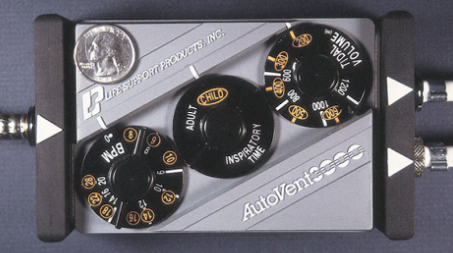
automatic transport ventilator (ATV)
a device that provides positive pressure ventilations. It includes settings designed to adjust ventilation rate and volume, is portable, and is easily carried on an ambulance.
oxygen cylinder
Pressurized vessels (typically
2,000−2,200 psi) containing oxygen; common sizes include D (350 L), E (625 L), and M (3,000 L).
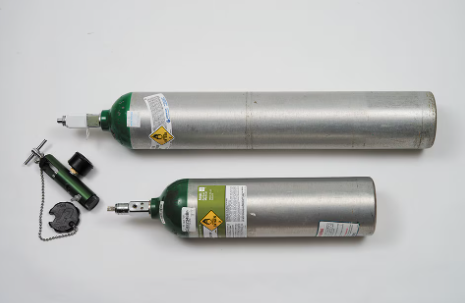
Oxygen Cylinders: Duration of Flow
Gauge pressure in psi (pounds per square inch) minus the safe residual pressure (always 200 psi) times the constant (D=0.16, E=0.28, M=1.56, G=2.41, H=3.14, K=3.14) divided by the flow rate in liters per minute = duration of flow in minutes.
pressure regulator
a device connected to an oxygen cylinder that reduces pressure to a safe working level of 30−70 psi.
flowmeter
connected to the pressure regulator, a valve that indicates the flow of oxygen in liters per minute.
Low-Pressure Flowmeters
Low-pressure flowmeters, specifically the pressure-compensated flowmeter and the constant flow selector valve, are in general use in the field.
Pressure-compensated flowmeter
A gravity-dependent upright meter that uses a ball float to indicate actual oxygen flow.
Constant flow selector valve
type of flowmeter that has no gauge and allows for the adjustment of flow in liters per minute in stepped increments. It can be accurately used with the nasal cannula or nonrebreather mask and with any size oxygen cylinder.
humidifier
a device connected to the flowmeter to add moisture to the dry oxygen coming from an oxygen cylinder.
nonrebreather (NRB) mask
a face mask–and–reservoir bag device that delivers high concentrations of oxygen. The patient’s exhaled air escapes through a valve and is not rebreathed. Delivers 80−90% oxygen at 12−15 L/min
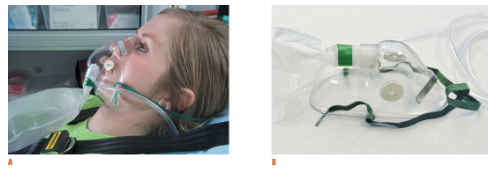
nasal cannula
a device that delivers low concentrations of oxygen through two prongs that rest in the patient’s nostrils. Delivers 40−60% oxygen at 9−10 L/min; allows some exhaled air to mix with the oxygen supply.
partial rebreather mask
a face mask and reservoir oxygen bag with no one-way valve to the reservoir bag. Delivers 40−60% oxygen at 9−10 L/min; allows some exhaled air to mix with the oxygen supply.
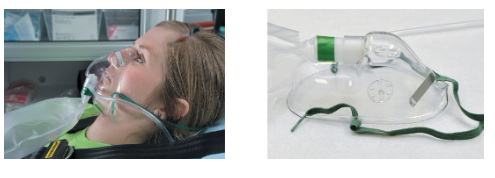
Venturi mask
a face mask–and–reservoir bag device that delivers specific concentrations of oxygen by mixing oxygen with inhaled air.
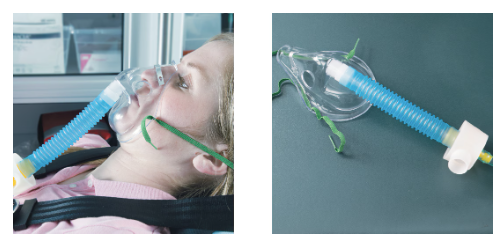
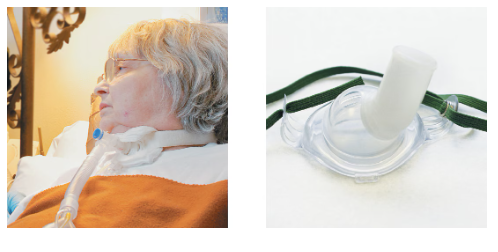
tracheostomy mask
A device placed over a stoma or tracheostomy tube to deliver supplemental oxygen at 8−10 L/min
Duration of Flow (minutes) Formula
FlowRate((GaugePressure−200psi)⋅(CylinderConstant))
D Cylinder Constant
0.16
E Cylinder Constant
0.28
M Cylinder Constant
1.56
G Cylinder Constant
2.41
H Cylinder Constant
3.14
K Cylinder Constant
3.14
Adult ventilation rate
once every 6 seconds