Iterative Design Process
 Call Kai
 Learn
Learn Practice Test
 Spaced Repetition
 Match
Match Flashcards
 Knowt Play
1/31

Earn XP
Description and Tags
Lecture 5
Name | Mastery | Learn | Test | Matching | Spaced | Call with Kai |
|---|
No analytics yet
Send a link to your students to track their progress
32 Terms
Sid Meler’s Definition
“A game is a series of interesting decisions.”
An interesting decision is generally one where:
The player has multiple valid options from which to choose.
Each option has both positive and negative potential consequences.
The outcome of each option is predictable but not guaranteed.
This brings up the second goal as a game designer: “to create interesting decisions.”
If the player is presented with a number of choices, but one choice is obviously superior to the others, the experience of deciding which to choose doesn’t actually exist. If the game is designed well, players will often to have multiple choices from which to choose, and those decisions will be tricky ones.
Iterative Design
is a design methodology based on a cyclic process of prototyping, testing, analyzing, and refining a product or process.
Iterative Design
This process is intended to ultimately improve the quality and functionality of a design.
In ___, interaction with the designed system is used as a form of research for informing and evolving a project, as successive versions, or iterations of a design are implemented.
The Four Phases:
Analysis
Design
Testing
Implementation
Analysis
In ___, every design seeks to solve a problem or take advantage of an opportunity, and before starting a design, designers must have a clear idea of what that problem or opportunity is.
“For whom am I designing the game?” knowledge of your target audience.
“What are my resources?” Talent and time.
“What prior art exists?”
“What is the fastest path to a playable game that demonstrates what I want to test?” Think about the core mechanic of the game.
Prior art
is the term used to describe existing games and other media that are related to a game in some way.
Design
The ____ stage starts with brainstorming and ends with a concrete plan for implementation.
Jesse Schell
(author of the book The Art of Game Design) states that listening is the most important skill that a game designer can have.
Schell lists five kinds of listening a game designer needs to develop.
Listen to your audience
Listen to your team
Listen to your client
Listen to your game
Listen to yourself – gut
Listen to your health
Listen to your audience
“Whom do you want to play your game?”, “Whom do you want to buy your game?”
Listen to your team
A job of a designer is to listen to all of other team members thoughts and ideas and work with them to discover ideas that will create the best game for the audience.
Listen to your client
A lot of time, as a professional game designer, a game designer will be working for a client, and a designer should listen to their input.
Listen to your game
Even if a certain aspect of a game is brilliant design, it might not fit well with the rest.
Listen to yourself – gut
“When your gut tells you something about a design, give it a try.”
Listen to your health
Pulling all-nighters, being stressed, and not exercising have a real and tremendously negative effect to do creative work.
Design
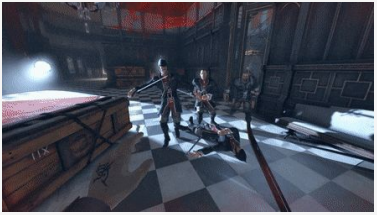
Dishonored (2012) is a action-adventure game developed by Arkane Studios and published by Bethesda Softworks
Implementation
In this phase, Game designer must playtest or execute the current design in the most effective way possible.
Implementation
If a game design revolves around shooting, a game designer must make a digital prototype.
Implementation
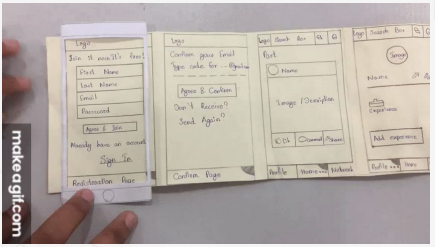
If a game designer is testing a Graphical User Interface (GUI) menu system, printing out images of the various states of the menu and asking testers to navigate through them is enough (paper prototype).
Implementation
Testing
after a game designer have the minimum of a prototype working, ___ is the next phase.
Testing
It is to identify and locate what’s not working or performing to expectations. Stakeholders, users, and product testers weigh in with their experiences.
Brainstorming and Ideation
is a group problem-solving method that involves the spontaneous contribution of creative ideas and solutions.
game jam
is an accelerated opportunistic game creation event where a game is created in a relatively short timeframe exploring given design constraint(s) and end results are shared publicly.
Activity: Brainstorming and Ideation
Step 1
Step 1: Expansion Phase
Game Jam Theme: Fiction
Everyone start with some kind of brainstorming. Draw a fiction character/object in the middle of a whiteboard, draw a circle around it, and start free-associating.
Don’t worry about what you’re writing at this point – don’t censor anything – just write whatever comes to mind as you go.
Activity: Brainstorming and Ideation
Step 2
Step 2: Collection Phase
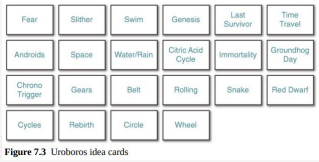
Collect all the nodes of the brainstorming expansion phase and write them each down on one note card. These are called Idea Cards
Activity: Brainstorming and Ideation
Step 3
Step 3: Collision Phase
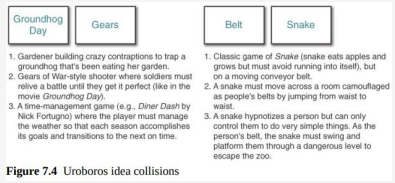
Shuffle together all the idea cards and deal two to each person in the group. Each person takes their two cards up to the whiteboard and reveals them to everyone. Then the group collectively comes up with three different game ideas inspired by the collision of the two cards.
If the two cards either are too closely paired or just don’t work together at all, it’s okay to skip them.
Activity: Brainstorming and Ideation
Step 4
Step 4: Rating Phase
Now that ideas are set, it’s time to start culling them. Each person should write on the whiteboard the two ideas from Step 3 that she/he thinks have the most merit.
After everyone does this, then everyone should simultaneously put a mark next to the three ideas written on the board that they like the most. Everyone should end up with some ideas with lots of marks and some with very few.
Activity: Brainstorming and Ideation
Step 5
Step 5: Discussion
Continue the selection/culling process by modifying and combining several of the ideas with the highest rating.
With dozens of different crazy ideas to choose from, you should be able to find a couple that sound really good and to combine them into a great starting point for your design.