Topic 15 Urinary System Physiology
 Call Kai
 Learn
Learn Practice Test
 Spaced Repetition
 Match
Match Flashcards
 Knowt Play
1/23

There's no tags or description
Looks like no tags are added yet.
Name | Mastery | Learn | Test | Matching | Spaced | Call with Kai |
|---|
No analytics yet
Send a link to your students to track their progress
24 Terms
Structures that transport urine
Renal Pelvis
Ureter
Urinary Bladder
Urethra
Kidney’s Functions
Maintain plasma volume → … Maintains Blood Pressure
Regulate the [Ion] + [H2O]
Acid-base balance
Eliminate waste like drugs, hormones
Endocrine → - Renin (bp) - Erythropoietin (RBC prod.)
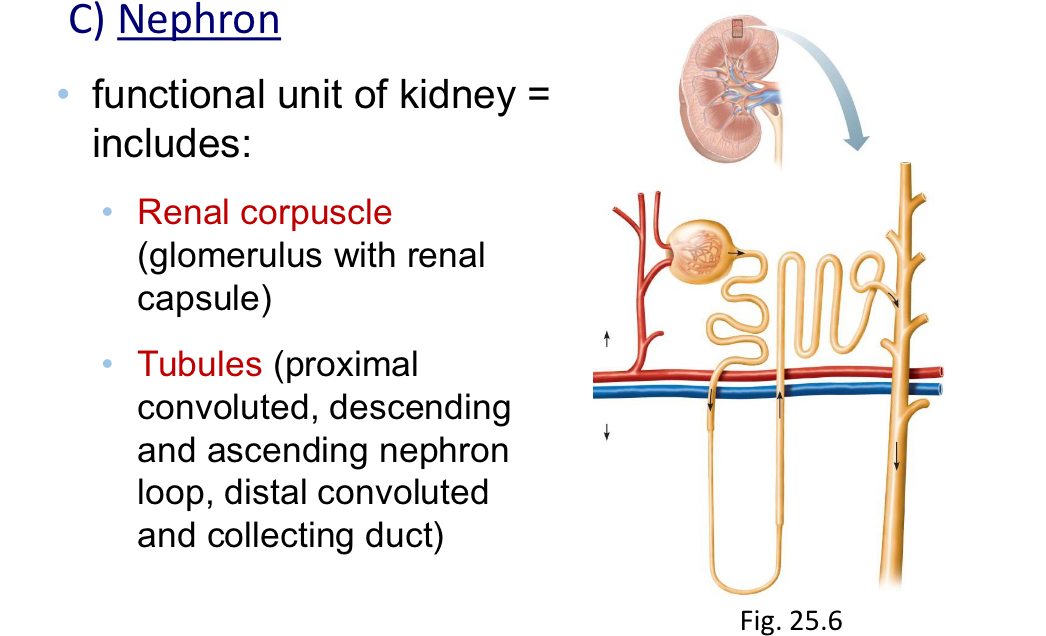
The Nephron
Is a functional unit of the kidney that includes the:
Renal Corpuscle (glomerus with renal capsule) and Tubules (proximal convoluted, descending and ascending nephron loop, distal convoluted and collecting duct)
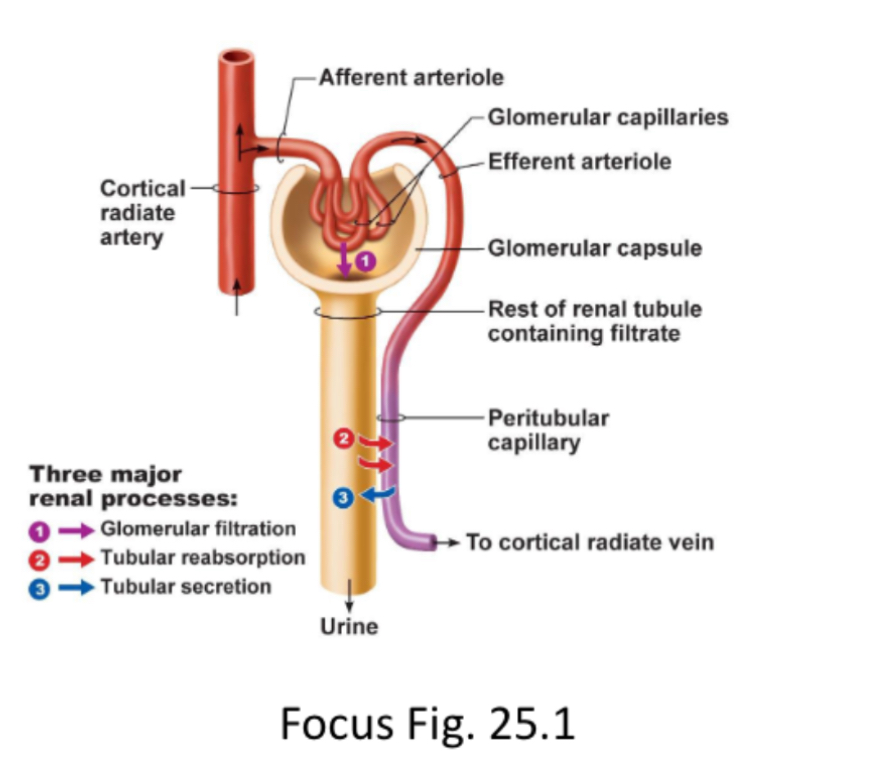
Processes in the nephron that lead to urine formation
Glomerular Filtration
Tubular Reabsorption
Tubular Secretion
What happens during Glomerular Filtration
There is a pressure difference across the filtration membrane, which leads to water and small solutes going from: Blood in Glomerus → Bowman’s Capsule.
What happens during Tubular Reabsorption
Substances like water, glucose, and ions, transport from filtrate in the nephron into the bloodstream.
What happens during Tubular Secretion
From here, waste products are transported from peritubular capillaries into the lumen of nephron tubules to be excreted as urine.
Process of Glomerular Filtration→Bowmans Capsule
20% of the plasma is filtered from the glomerus to the bowman’s capsule VIA bulk flow across the filtration membrane.
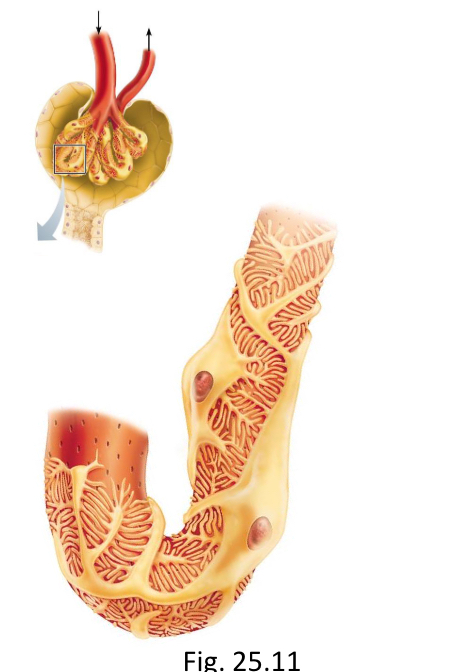
The filtration membrane which is between the glomerus and bowman’s capsule is composed of?
Fenestrated endothelium (glomerus)
Fused basement membranes
Podocytes (layer of bowman’s capsule) with filtration slits in between.
Filtrate makeup?
Is identical to plasma minus large proteins
H2O, glucose, amino acids, vitamins, ions, urea, some small proteins.
Ph ~7.45
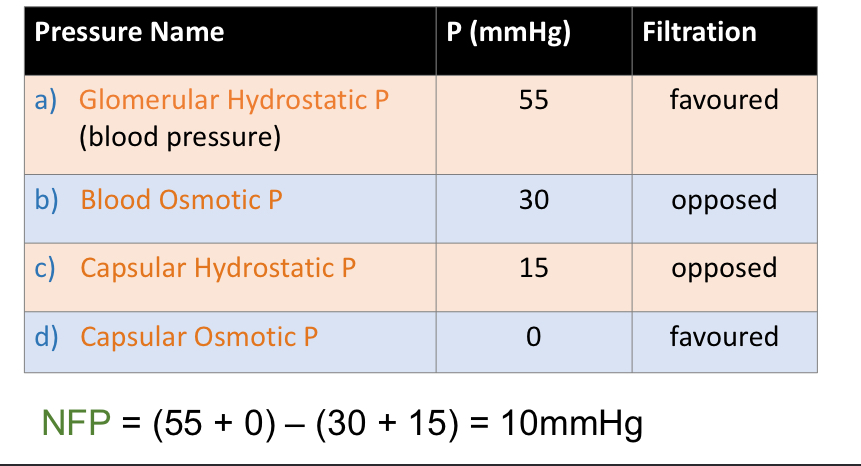
Net Filtration Pressure Components
Glomerular Hydrostatic P (Favoured)
(Blood Pressure)
Blood Osmotic P
Capsular Hydostatic P
Capsular Osmotic P (Favoured)
Glomerular Filtration Rate
~180 L/day filtrate = ~125 mL/min (entire plasma volume filtered ~65 times per day)
How much of filtered volume remains at end of collecting duct?
< 1% (Reabsorption)
Regulation of GFR
Keeping GFR from changing when systematic pressure changes if not - MAP and GFR increase. If GF rate is too high, it filters too quickly and nutrients and water is lost through urine. If GF rate is low, waste will accumulate in the blood w waste.
Regulation of GFR processes.
Intrinsic regulation
Extrinsic regulation
Intrinsic Regulation of GFR
Commonly known as autoregulation - for bp in range of resting to moderate exercise. Two processes:
Juxtaglomerular complex (apparatus
Myogenic
Myogenic
Mean Arterial Pressure increases → Aff. Arteriole stretches → Arteriole smooth muscle contracts → prevents the increase of BP in glomerular capillaries. (Vice versa)
Juxtaglomerular Complex
The macula densa monitors [NaCl] levels in filtrate
High MAP → high GFR → more NaCl → signals afferent arteriole to constrict
Low MAP → low NaCl → arteriole dilates
![<ol><li><p>The <u>macula densa</u> monitors [NaCl] levels in filtrate</p></li></ol><ol start="2"><li><p><span>High MAP → high GFR → more NaCl → signals afferent arteriole to constrict</span></p></li><li><p><span>Low MAP → low NaCl → arteriole dilates</span></p></li></ol><p></p>](https://assets.knowt.com/user-attachments/a32c2f4f-c8c8-4749-b40c-691bad4bd998.jpg)
Extrinsic Regulation
When the body outside the kidney takes over the filtration control, usually a “survival mode” when there’s extreme stress. Ex. Heavy exercise.
SNS → Arteriolar vasoconstriction
Afferent → decrease flow into glomerulus
Efferent → blood backs up in glomerulus
Moderate SNS activation → both balance → GFR doesn’t change much.
NFP can change?
Blood Osmotic P (proteins)
ex. Dehydration inc BOP = dec GFR
Ex. Burns dec BOP = inc GFR
Capsular hydrostatic pressure
ex. Urinary tract obstruction - kidney stones inc CHP = dec GFR
Tubular Reabsorption
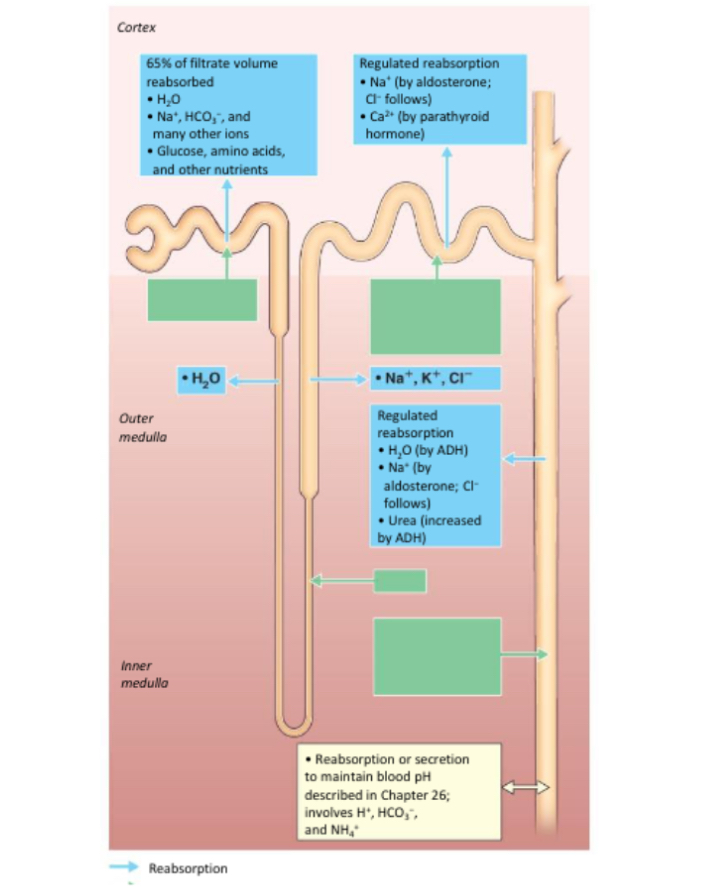
99% of filtrate is reabsorbed from the tubules into the peritubular as vasa recta capillaries
Can be passive or active.
Active → requires energy
Na+, Other ions, Glucose, a
Passive → no energy
Cl-, H2O, Urea