MCAT Chemistry

0.0(0)
Studied by 0 people
call kaiCall Kai
learnLearn
examPractice Test
spaced repetitionSpaced Repetition
heart puzzleMatch
flashcardsFlashcards
GameKnowt Play
Card Sorting

1/299

encourage image

There's no tags or description

Looks like no tags are added yet.

Last updated 9:55 AM on 6/22/26
Name
Mastery
Learn
Test
Matching
Spaced
Call with Kai

No analytics yet

Send a link to your students to track their progress

300 Terms

1
New cards
Atomic number (Z) vs mass number (A)
Z = number of protons (defines the element). A = protons + neutrons. Neutrons = A − Z.
2
New cards
Isotopes
Same element (same Z, same protons) but different number of neutrons, so different mass number A. Same chemical behaviour, different mass.
3
New cards

Atomic mass vs atomic weight

Atomic mass ≈ mass of one specific isotope (amu).

Atomic weight = weighted average of all naturally occurring isotopes (the value on the periodic table).

4
New cards
Bohr model — key idea
Electrons orbit the nucleus in fixed, quantised energy levels. Light is emitted/absorbed only when an electron jumps between levels; energy of photon = ΔE between shells.
5
New cards
Emission vs absorption spectrum
Absorption = electron jumps UP a level (absorbs a photon of specific energy). Emission = electron falls DOWN (emits a photon). Lines correspond to discrete ΔE values.
6
New cards
Quantum numbers — n
Principal quantum number (n = 1,2,3...). Sets the shell / energy level and size. Max electrons in a shell = 2n².
7
New cards
Quantum numbers — l
Azimuthal/angular momentum (l = 0 to n−1). Sets subshell/shape: l=0 s, l=1 p, l=2 d, l=3 f.
8
New cards
Quantum numbers — ml
Magnetic quantum number (ml = −l...0...+l). Specifies the orbital orientation. Number of orbitals in a subshell = 2l+1.
9
New cards
Quantum numbers — ms
Spin (ms = +½ or −½). Each orbital holds at most 2 electrons with opposite spins.
10
New cards
Pauli exclusion principle
No two electrons in an atom can have the same set of all four quantum numbers; an orbital holds max 2 electrons with opposite spin.
11
New cards

Hund's rule

Electrons fill degenerate (equal-energy) orbitals singly with parallel spins before pairing up — minimises repulsion.
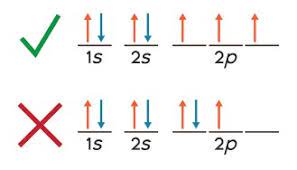
<p>Electrons fill degenerate (equal-energy) orbitals singly with parallel spins before pairing up — minimises repulsion.</p>
12
New cards

Aufbau principle

Electrons fill lowest-energy orbitals first. Order: 1s 2s 2p 3s 3p 4s 3d 4p… (note 4s fills before 3d).
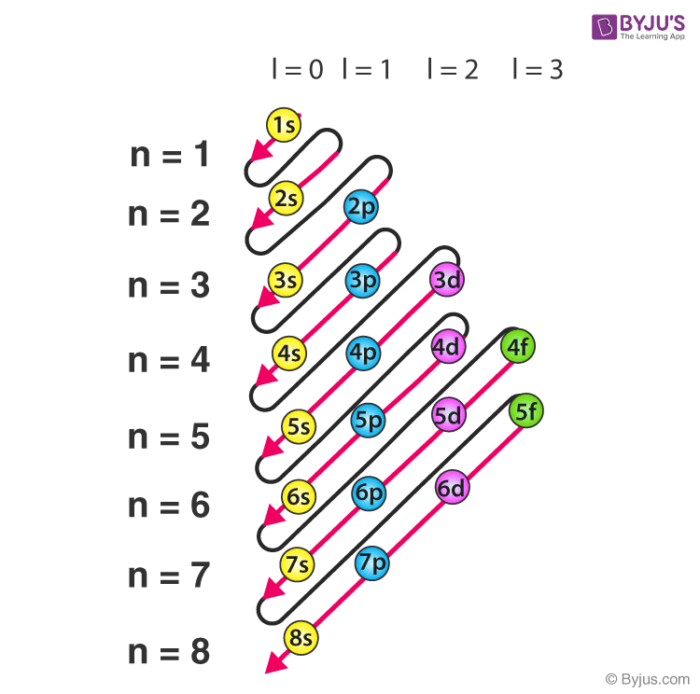
<p>Electrons fill lowest-energy orbitals first. Order: 1s 2s 2p 3s 3p 4s 3d 4p… (note 4s fills before 3d).</p>
13
New cards
Paramagnetic vs diamagnetic
Paramagnetic = has unpaired electrons, attracted to a magnetic field. Diamagnetic = all electrons paired, slightly repelled.
14
New cards
Heisenberg uncertainty principle
You cannot simultaneously know an electron's exact position and momentum; the more precisely one is known, the less precisely the other.
15
New cards
Ground vs excited state
Ground state = electrons in lowest available energy configuration. Excited state = one or more electrons promoted to higher orbitals after absorbing energy.
16
New cards
Common stable-configuration exceptions (Cr, Cu)
Cr is [Ar]4s¹3d⁵ and Cu is [Ar]4s¹3d¹⁰ — a half-filled or fully-filled d subshell is extra stable, so one 4s electron shifts.
17
New cards
Valence electrons
Outermost-shell electrons involved in bonding. For main-group elements they equal the group number's ones digit (e.g. group 16 → 6 valence e⁻).
18
New cards
Effective nuclear charge (Zeff)
Net positive charge an electron actually feels = Z − shielding by inner electrons. Increases across a period → pulls electrons in tighter.
19
New cards
Atomic radius trend
Decreases left→right across a period (rising Zeff). Increases top→bottom down a group (more shells).
20
New cards
Ionization energy trend
Energy to remove an electron. Increases left→right and bottom→top (opposite of atomic radius).
21
New cards
Electron affinity trend
Energy released when an atom gains an electron; generally more negative toward the upper right. Many exceptions: noble gases are unfavourable, and Cl is actually more favourable (more negative) than F due to F's small size and electron–electron repulsion.
22
New cards
Electronegativity trend
Tendency to attract bonding electrons. Increases toward upper right; F is the most electronegative.
23
New cards
Cation vs anion size
Cations are SMALLER than the parent atom (lost a shell / higher Zeff per e⁻). Anions are LARGER (added e⁻, more repulsion).
24
New cards
Metallic character trend
Increases down and to the left. Metals lose electrons easily (low ionisation energy).
25
New cards
Groups to know
1 = alkali metals, 2 = alkaline earth, 17 = halogens, 18 = noble gases, plus transition metals (d-block). Halogens are highly reactive nonmetals; noble gases are inert.
26
New cards
Metalloids
Elements with intermediate properties along the staircase (e.g. B, Si, Ge, As, Sb, Te) — often semiconductors.
27
New cards
Successive ionization energies
Each successive electron is harder to remove. A huge jump occurs after the valence shell is emptied (removing a core electron).
28
New cards
Alpha decay (α)
Emits a ⁴₂He nucleus. Mass number −4, atomic number −2. Weakly penetrating (stopped by paper/skin).
29
New cards
Beta-minus decay (β⁻)
A neutron → proton + emitted electron. Atomic number +1, mass number unchanged.
30
New cards
Beta-plus / positron decay (β⁺)
A proton → neutron + emitted positron. Atomic number −1, mass number unchanged.
31
New cards
Electron capture
Nucleus captures an inner electron; a proton → neutron. Atomic number −1, mass number unchanged.
32
New cards
Gamma decay (γ)
Emission of a high-energy photon; no change in mass or atomic number. Most penetrating radiation.
33
New cards
Half-life (t½)
Time for half of a radioactive sample to decay. After n half-lives, fraction remaining = (1/2)ⁿ. First-order process.
34
New cards
Mass defect & binding energy
The nucleus weighs slightly less than its parts; the missing mass converted to binding energy via E = mc². Higher binding energy per nucleon = more stable.
35
New cards

Fission vs fusion

Fission = splitting a heavy nucleus into lighter ones.

Fusion = combining light nuclei into a heavier one.

Both release energy by increasing binding energy per nucleon.

36
New cards
Ionic vs covalent vs metallic
Ionic = electron transfer (metal + nonmetal). Covalent = electron sharing (nonmetals). Metallic = delocalised 'sea' of electrons.
37
New cards

Polar vs nonpolar covalent

Nonpolar: ΔEN ≈ 0–0.4 (shared evenly).

Polar: ΔEN ≈ 0.5–1.7 (partial charges). >~1.7 → largely ionic.

These ΔEN cutoffs are rough guidelines, not strict rules.

38
New cards
Octet rule & exceptions
Atoms tend toward 8 valence electrons. Exceptions: H/He (2), incomplete octets (B, Be), expanded octets (P, S, Cl and beyond, period 3+).
39
New cards
Formal charge
FC = (valence e⁻) − (nonbonding e⁻) − ½(bonding e⁻). Best Lewis structure minimises formal charges and puts negative FC on the most electronegative atom.
40
New cards
Resonance
When a molecule's bonding can be drawn multiple valid ways; the true structure is a delocalised hybrid (weighted average). Delocalisation = stability.
41
New cards
Sigma (σ) vs pi (π) bonds
σ = head-on overlap, free rotation, present in every bond. π = side-on p-orbital overlap, no rotation. Single = 1σ; double = 1σ+1π; triple = 1σ+2π.
42
New cards
Bond order vs length vs strength
Higher bond order (triple>double>single) → shorter and stronger bond. Resonance gives fractional bond orders.
43
New cards
VSEPR — premise
Electron domains (bonds + lone pairs) repel and arrange to maximise separation, setting molecular geometry.
44
New cards
VSEPR geometries
2 domains linear (180°); 3 trigonal planar (120°); 4 tetrahedral (109.5°); 5 trigonal bipyramidal; 6 octahedral (90°).
45
New cards
Lone pairs & bond angle
Lone pairs repel more than bonding pairs, compressing bond angles (e.g. H2O ~104.5°, NH3 ~107° vs ideal 109.5°).
46
New cards
Hybridisation from domains
2 domains = sp (linear); 3 = sp² (trig planar); 4 = sp³ (tetrahedral). Count electron domains on the central atom.
47
New cards
Molecular polarity
Polar if bond dipoles do NOT cancel (asymmetric, e.g. H2O, NH3). Nonpolar if symmetric dipoles cancel (e.g. CO2, CCl4).
48
New cards
Lewis acid vs base
Lewis acid = electron-pair acceptor (electrophile). Lewis base = electron-pair donor (nucleophile).
49
New cards
Coordinate (dative) bond
A covalent bond where both shared electrons come from the same atom (e.g. in NH4⁺ or metal complexes).
50
New cards
Ranking of intermolecular forces
Strongest→weakest: ion–dipole > hydrogen bonding > dipole–dipole > London dispersion (van der Waals).
51
New cards
London dispersion forces
Temporary induced dipoles present in ALL molecules; the only force in nonpolar molecules. Stronger with greater molar mass / surface area (more polarisable).
52
New cards

Hydrogen bonding requirement

An H bonded to F, O or N interacting with a lone pair on another F/O/N.

Explains water's high boiling point, surface tension, ice density.

FON - Full Of Nonsense

53
New cards
IMF effect on physical properties
Stronger IMFs → higher boiling/melting point, higher viscosity & surface tension, lower vapour pressure.
54
New cards
Why ice floats
Hydrogen bonding locks water into an open hexagonal lattice, making solid water LESS dense than liquid.
55
New cards
The mole & Avogadro's number
1 mole = 6.022×10²³ particles. Moles = mass / molar mass. The bridge between grams and number of particles.
56
New cards
Empirical vs molecular formula
Empirical = simplest whole-number ratio of atoms (e.g. CH2O). Molecular = actual numbers (e.g. C6H12O6). Molecular = (empirical) × n.
57
New cards
Limiting reagent
The reactant that runs out first and caps product yield. Convert all reactants to moles of product; the smallest amount is limiting.
58
New cards
Percent yield
% yield = (actual yield / theoretical yield) × 100. Theoretical yield is based on the limiting reagent.
59
New cards
Types of reactions
Combination, decomposition, single replacement, double replacement (metathesis), combustion, and acid–base neutralisation.
60
New cards
Net ionic equation
Shows only species that change; spectator ions (unchanged on both sides) are cancelled out.
61
New cards

Solubility rules (key ones)

Always soluble: group 1, NH4⁺, NO3⁻, most acetates.

Generally insoluble: most carbonates, phosphates, sulfides, hydroxides (except group 1/2).

62
New cards
Balancing — conservation of mass
Atoms of each element must be equal on both sides; adjust coefficients only, never subscripts.
63
New cards
Dilution equation
M1V1 = M2V2. Moles of solute stay constant when you add solvent; use it for any dilution.
64
New cards
Mass percent
% by mass = (mass of solute / mass of solution) × 100. Mass of solution = solute + solvent.
65
New cards
Parts per million (ppm)
ppm = mg of solute per L of dilute aqueous solution (since 1 L water ≈ 1 kg = 10⁶ mg, 1 mg/L ≈ 1 ppm).
66
New cards
Percent composition
% of an element = (mass of that element in 1 mol / molar mass of compound) × 100.
67
New cards
Molecular formula from empirical
Molecular formula = empirical formula × n, where n = (molecular molar mass / empirical formula mass), rounded to the nearest integer.
68
New cards

Titration mole ratios

At equivalence, moles acid H⁺ = moles base OH⁻. MaVa = MbVb ONLY holds for a 1:1 reaction; otherwise scale by the balanced-equation ratio.

69
New cards
Serial dilution
Each step multiplies the dilution factor; total dilution = product of all step factors (e.g. three 1:10 steps = 1:1000).
70
New cards
Ideal Gas Law
PV = nRT. Relates pressure, volume, moles, and temperature (T in Kelvin). R = 0.0821 L·atm/mol·K.
71
New cards
Kinetic molecular theory assumptions
Gas particles: have negligible volume, no intermolecular forces, undergo elastic collisions, and have average KE proportional to absolute temperature.
72
New cards
Boyle's law
At constant T, n: P ∝ 1/V (P1V1 = P2V2). Squeeze the volume → pressure rises.
73
New cards
Charles's law
At constant P, n: V ∝ T (V1/T1 = V2/T2). Heat a gas → it expands.
74
New cards
Avogadro's law
At constant T, P: V ∝ n. Equal volumes of gases hold equal numbers of molecules. 1 mol gas = 22.4 L at STP.
75
New cards
Dalton's law of partial pressures
Total pressure = sum of partial pressures. Partial pressure = mole fraction × total pressure.
76
New cards

Graham's law of effusion

Rate ∝ 1/√(molar mass).

Lighter gases effuse/diffuse faster.

(rate1/rate2 = √(M2/M1))
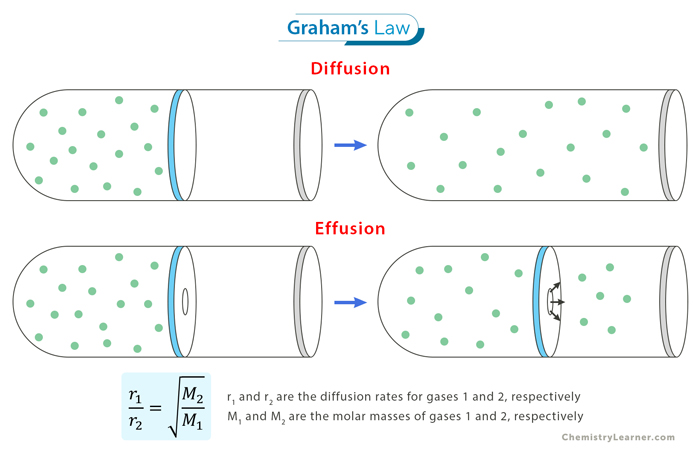
<p>Rate ∝ 1/√(molar mass). </p><p>Lighter gases effuse/diffuse faster. </p><p>(rate1/rate2 = √(M2/M1))</p>
77
New cards
Real gas deviations
Real gases deviate from ideal at HIGH pressure and LOW temperature (molecular volume and IMFs matter). Van der Waals equation corrects for both.
78
New cards
Henry's law
Gas solubility in a liquid is proportional to its partial pressure above the liquid (more pressure → more dissolved gas).
79
New cards
Molarity
M = moles of solute / litres of solution. The most common MCAT concentration unit.
80
New cards
Molality
m = moles of solute / kg of solvent. Used for colligative properties (temperature-independent).
81
New cards
Solubility product (Ksp)
Equilibrium constant for a slightly soluble salt dissolving. Larger Ksp = more soluble. Pure solids/liquids excluded from the expression.
82
New cards
Common-ion effect
Adding an ion already present in a dissolved salt shifts equilibrium back (Le Châtelier), DECREASING solubility.
83
New cards
Solubility vs pH
Salts of weak acids/bases become more soluble in solutions that consume their ions (e.g. carbonates and hydroxides dissolve more in acid).
84
New cards
Colligative properties — definition
Depend on the NUMBER of dissolved particles, not their identity: vapour-pressure lowering, boiling-point elevation, freezing-point depression, osmotic pressure.
85
New cards
Van 't Hoff factor (i)
Number of particles a solute dissociates into (NaCl → i≈2, glucose → i=1). Multiplies colligative effects.
86
New cards
Boiling-point elevation / freezing-point depression
ΔTb = i·Kb·m (raises BP); ΔTf = i·Kf·m (lowers FP). Adding solute makes solutions boil higher and freeze lower.
87
New cards
Osmotic pressure
Π = iMRT. Pressure needed to stop solvent flowing across a semipermeable membrane toward higher solute concentration.
88
New cards
Electrolytes
Strong electrolytes fully dissociate (strong acids/bases, soluble salts) and conduct well; weak electrolytes partially dissociate.
89
New cards
'Like dissolves like'
Polar/ionic solutes dissolve in polar solvents; nonpolar solutes dissolve in nonpolar solvents.
90
New cards
Brønsted–Lowry definition
Acid = proton (H⁺) donor; base = proton acceptor.
91
New cards
Arrhenius vs Brønsted vs Lewis
Arrhenius: produces H⁺ / OH⁻ in water. Brønsted–Lowry: donates/accepts H⁺. Lewis: accepts/donates an electron pair (broadest).
92
New cards
Conjugate acid–base pair
Differ by one H⁺ (e.g. NH4⁺/NH3, CH3COOH/CH3COO⁻). A strong acid has a weak conjugate base, and vice versa.
93
New cards
Strong acids (memorise)
HCl, HBr, HI, HNO3, H2SO4, HClO4 (and HClO3). They dissociate completely. Mnemonic: 'So I Brought No Clean Clothes'. Note: H2SO4 is fully strong only for its first proton; the second (HSO4⁻) is weak.
94
New cards
Strong bases
Group 1 hydroxides (NaOH, KOH) and the heavier group 2 hydroxides (Ca(OH)2, Sr(OH)2, Ba(OH)2) dissociate completely. Mg(OH)2 is a strong base in principle but only sparingly soluble, so it produces little [OH⁻].
95
New cards
Kw and pH of water
Kw = [H⁺][OH⁻] = 1×10⁻¹⁴ at 25°C. Pure water: [H⁺]=[OH⁻]=10⁻⁷, pH=7 (neutral).
96
New cards
pH and pOH
pH = −log[H⁺]; pOH = −log[OH⁻]; pH + pOH = 14 (at 25°C). Each pH unit = 10× change in [H⁺].
97
New cards
Ka, Kb, pKa, pKb
Ka = acid dissociation constant (larger = stronger acid). pKa = −log Ka (smaller = stronger acid). pKa + pKb = 14 for a conjugate pair.
98
New cards

Hydrolysis of salts

Salt of strong acid + weak base → acidic solution.

Salt of weak acid + strong base → basic.

Salt of strong acid + strong base → neutral.

99
New cards
Amphoteric species
Can act as either acid or base (e.g. water, HCO3⁻, HSO4⁻, amino acids).
100
New cards
Polyprotic acids
Donate more than one H⁺ (e.g. H2SO4, H3PO4) in successive steps, each with its own Ka (Ka1 > Ka2 > Ka3).



