bio 2 - protists and fungi ch 29 (post)

0.0(0)
Studied by 0 people
call kaiCall Kai
learnLearn
examPractice Test
spaced repetitionSpaced Repetition
heart puzzleMatch
flashcardsFlashcards
GameKnowt Play
Card Sorting

1/82

encourage image

There's no tags or description

Looks like no tags are added yet.

Last updated 11:44 AM on 4/16/26
Name
Mastery
Learn
Test
Matching
Spaced
Call with Kai

No analytics yet

Send a link to your students to track their progress

83 Terms

1
New cards

the four kingdoms within domain eukarya are:

Protista, Fungi, Plantae, and Animalia

2
New cards

protists aka protozoans

are generally microscopic and unicellular; found in all the supergroups

  • can be colonial or multicellular

  • six supergroups each a separate evolutionary lineage of eukaryotes

  • easier to identify them as eukaryotic that is not a plant, animal, or fungus

  • Prokaryotes are most likely related to the first eukaryotic cell to have evolved

  • some are disease causing but many have significant ecological importance such as aquatic photoautotrophic protists that make oxygen

  • endosymbiotic theory

3
New cards

endosymbiotic theory

suggests that mitochondria may have resulted when a nucleated cell engulfed aerobic bacteria

  • Chloroplasts may have originated when a nucleated cell with mitochondria engulfed cyanobacteria

4
New cards

protists bridge the gap between ____ and _____

eukaryotic cells and multicellular organisms

5
New cards

general characteristics of protists

  • Structurally diverse

  • Most single-celled

    • exceptions are kelp, volvox, and spirogyra

  • high level of complexity

    • some have unique organelles

  • Sometimes grouped according to how they acquire nutrients

  • Protists reproduce sexually and asexually

    • Mostly asexually - only sexually when in unfavorable conditions

  • can form spores or cysts in unfavorable environmental conditions

6
New cards

eukaryotic supergroups

  • Archaeplastida

  • Chromalveolata

  • Rhizaria

  • Excavata

  • Amoebozoa

  • Opisthokonta

7
New cards

archaeplastida - eukaryotic supergroups

  • photosynthetic organisms with chloroplasts (plastids) derived from endosymbiotic cyanobacteria

  • A number of colonial forms occur among chlorophytes

8
New cards

examples of archaeplastida

volvox, spirogyra, red algae, and green algae

9
New cards

colony

loose association of independent cells

10
New cards

spirogyra - supergroup archaeplastida

  • charophyte

  • Filamentous green alga in which each cell has a ribbonlike chloroplast

  • reproduces sexually via conjugation

<ul><li><p>charophyte</p></li><li><p>Filamentous green alga in which each cell has a ribbonlike chloroplast</p></li><li><p>reproduces sexually via conjugation</p></li></ul><p></p>
11
New cards

how do spirogyra reproduce (supergroup archaeplastida)

  • conjugation —— cell contents of one haploid filament move into cells of another aligned filament

    • Forms diploid zygospores that can survive winter and undergo meiosis in the spring to form new haploid filaments

12
New cards

red algae - supergroup archaeplastida

  • Most multicellular charophytes

  • Contain red and blue pigments, as well as chlorophyll

  • Coralline algae have calcium carbonate in their cell walls; contribute to formation of coral reefs

13
New cards

volvox colonies - supergroup archaeplastida

type of chlorophyte green algae

  • a hollow sphere with thousands of cells arranged in a single layer surrounding a watery interior

  • Cells move the colony by coordinating movement of their flagella

  • Some cells are specialized for reproduction and divide to produce a daughter colony within the parental colony

<p>type of chlorophyte green algae </p><ul><li><p>a hollow sphere with thousands of cells arranged in a single layer surrounding a watery interior</p></li><li><p>Cells move the colony by coordinating movement of their flagella</p></li><li><p>Some<em> </em>cells are specialized for reproduction and divide to produce a daughter colony within the parental colony</p></li></ul><p></p>
14
New cards

green algae - supergroup archaeplastida

  • protists with both chlorophylls a and b

  • found in many habitats

  • Most are single-celled; some filamentous or colonial; some are multicellular

  • related to land plants

  • divided in chlorophytes and charophytes

    • within chlamydomonas: motile, single-celled green alga that inhabits freshwater pools → Single, large, cup-shaped chloroplast with pyrenoid

15
New cards

chlamydomonas

chlorophyte green algae that is motile, single-celled and inhabits freshwater pools → Single, large, cup-shaped chloroplast with pyrenoid (dense body)

<p>chlorophyte green algae that is motile, single-celled and inhabits freshwater pools → Single, large, cup-shaped chloroplast with pyrenoid (dense body) </p><p></p>
16
New cards

chromalveolata - eukaryotic supergroups

types of organisms: Dinoflagellates, apicomplexans, ciliates, diatoms, golden brown algae, brown algae, water molds

  • proposed that alveolates and stramenopiles were common ancestors

  • Represent a very large, diverse group of protistans.

  • Photosynthetic

  • Different lineage from the green and red algae

17
New cards

Brown algae - supergroup chromalveolata

  • Multicellular seaweeds

  • Contain accessory pigments ranging in color from beige to black

  • Produce algin-gelatinous product used in foods

  • Sargasso Sea has large floating mats of brown algae

  • Kelp are most familiar: have blades and stalks

<ul><li><p><span>Multicellular seaweeds</span></p></li><li><p><span>Contain accessory pigments ranging in color from beige to black</span></p></li><li><p><span>Produce algin-gelatinous product used in foods</span></p></li><li><p><span>Sargasso Sea has large floating mats of brown algae</span></p></li><li><p><span>Kelp are most familiar: have blades and stalks</span></p></li></ul><p></p>
18
New cards

diatoms - supergroup chromalveolata

  • Single-celled with variety of elaborate, two-part shells made of silica

  • Photosynthetic accessory pigment gives them an orange-yellow color

  • Significant part of plankton

  • Reproduce asexually and sexually

    • •Diploid parent cells reproduce asexually to produce two daughter cells until too small; then gametes form by meiosis in sexual reproduction

  • Diatomaceous Earth is formed from the fossilized remains of diatoms that accumulate on the ocean floor

    • •Mined for use as filtering agents or abrasives

<ul><li><p><span>Single-celled with variety of elaborate, two-part shells made of silica</span></p></li><li><p style="text-align: left;"><span>Photosynthetic accessory pigment gives them an orange-yellow color</span></p></li><li><p style="text-align: left;"><span>Significant part of plankton</span></p></li><li><p style="text-align: left;"><span>Reproduce asexually and sexually</span></p><ul><li><p style="text-align: left;"><span>•Diploid parent cells reproduce asexually to produce two daughter cells until too small; then gametes form by meiosis in sexual reproduction</span></p></li></ul></li><li><p style="text-align: left;"><span>Diatomaceous Earth is formed from the fossilized remains of diatoms that accumulate on the ocean floor</span></p><ul><li><p style="text-align: left;"><span>•Mined for use as filtering agents or abrasives</span></p></li></ul></li></ul><p></p>
19
New cards

What word refers to unicellular eukaryotes that are typically heterotrophic consumers?

protozoans

20
New cards

Which organisms studied in this lab exercise are eukaryotic, multicellular, and heterotrophs?

hydras or flatworms

21
New cards

When black bread mold sexually reproduces, what kind of spore does it make?

zygospore

22
New cards

Where are the spore-producing structures located on a mushroom?

on the underside of the cap

23
New cards

What kind of algae has silica in its cell walls?

diatoms

24
New cards

oomycetes (water molds) - super chromalveolata

  • Most are saprotrophs - feed on dead organic water

  • usually live in water and decompose remains and form furry growths when they parasitize fish

    • some are parasites

  • Have a filamentous body with cell walls of cellulose

  • Use asexual and sexual reproduction

    • During sexual reproduction, they produce eggs and sperm

<ul><li><p>Most are saprotrophs - feed on dead organic water</p></li><li><p>usually live in water and decompose remains and form furry growths when they parasitize fish </p><ul><li><p>some are parasites</p></li></ul></li><li><p>Have a filamentous body with cell walls of cellulose</p></li><li><p>Use asexual and sexual reproduction</p><ul><li><p>During sexual reproduction, they produce eggs and sperm</p></li></ul></li></ul><p></p>
25
New cards

dinoflagellates - supergroup chromalveolata

  • causes algal blooms that are toxic

  • Important members of phytoplankton in marine and freshwater ecosystems

  • Generally photosynthetic

  • Have protective cellulose plates encrusted with silica and two flagella in two different grooves

  • Whirl to move with their dinoflagellate

  • Some are luminous

  • Colorless heterotrophs can live as symbionts inside other organisms

<ul><li><p>causes algal blooms that are toxic</p></li><li><p>Important members of phytoplankton in marine and freshwater ecosystems</p></li></ul><ul><li><p style="text-align: left;">Generally photosynthetic</p></li><li><p style="text-align: left;">Have protective cellulose plates encrusted with silica and two flagella in two different grooves</p></li><li><p style="text-align: left;">Whirl to move with their dinoflagellate</p></li><li><p style="text-align: left;">Some are luminous</p></li><li><p style="text-align: left;">Colorless heterotrophs can live as symbionts inside other organisms</p></li></ul><p></p>
26
New cards

ciliates - supergroup chromalveolata

largest group of protozoans

  • All have cilia, which are hairlike structures that rhythmically beat

  • Most are freely motile, but some can be anchored

  • rotate as they move

  • use cilia to also help them eat

  • Paramecium is the most widely known ciliate

  • Visible contractile vacuoles which help maintain water balance w environment

  • Macronucleus—produces mRNA and directs metabolism

  • Conjugation—a form of sexual reproduction

  • Micronucleus plays a role

<p>largest group of protozoans</p><ul><li><p>All have cilia, which are hairlike structures that rhythmically beat</p></li><li><p>Most are freely motile, but some can be anchored</p></li><li><p>rotate as they move </p></li><li><p>use cilia to also help them eat </p></li><li><p><em>Paramecium </em>is the most widely known ciliate</p></li><li><p>Visible <strong>contractile vacuoles</strong> which help maintain water balance w environment</p></li><li><p><em>Macronucleus</em>—produces mRNA and directs metabolism</p></li><li><p><em>Conjugation</em>—a form of sexual reproduction</p></li><li><p><em>Micronucleus</em> plays a role</p></li></ul><p></p>
27
New cards

apicomplexa - supergroup chromalveolata

Commonly called sporozoans because they produce spores

  • all phases of life cycle are nonmotile other than male gametes and zygotes

  • Either intercellular or extracellular parasites

  • Single cell; one end has a complex composed of fibrils, microtubules, and organelles

    • Enzymes for attacking host cells are secreted through a pore at the end

28
New cards

rhizaria - eukaryotic supergroups

organisms with fine and threaadlike pseudopods (temporary, arm-like cytoplasmic extensions used by eukaryotic cells or locomotion and feeding)

  • types of organisms: Cercozoans, foraminiferans, radiolarians

29
New cards

foraminiferans and radiolarians - supergroup rhizaria

they have fine, threadlike pseudopods and a skeleton called a test made of calcium carbonate

  • Fossilized shells can be used to date sedimentary rock

  • Their presence is used as an indicator of oil deposits on land or sea
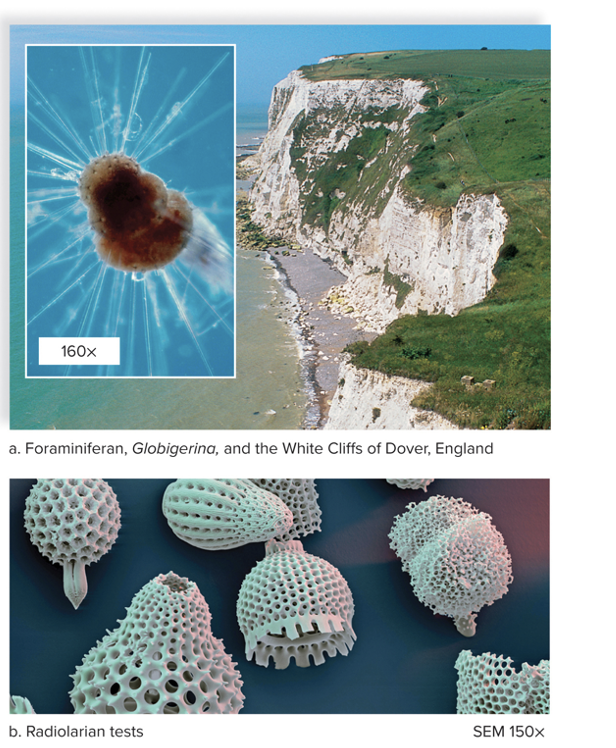
<p>they have fine, threadlike pseudopods and a skeleton called a <em>test</em> made of calcium carbonate</p><ul><li><p><span>Fossilized shells can be used to date sedimentary rock</span></p></li><li><p><span>Their presence is used as an indicator of oil deposits on land or sea</span></p></li></ul><p></p>
30
New cards

excavata - eukaryotic supergroups

sometimes referred to as flagellates

types of organisms: Euglenozoans, diplomonads, parabasalids, flagellates

31
New cards

euglenozoans - supergroup excavata

Euglenids—Freshwater unicellular organisms with two flagella, one much longer than the other

  • most have chloroplasts

  • surrounded by three membranes (endosymbiosis or green algal cell)

  • have a photoreceptor ( eyespot apparatus)

  • plasma membrane surrounded by a flexible pellicle

32
New cards

euglena

part of euglenozoans and then supergroup excavata

<p>part of euglenozoans and then supergroup excavata </p>
33
New cards

pellicle in euglenids

a specialized, protein-based cell covering located directly underneath the plasma membrane that provides both structural support and the ability to change shape

34
New cards

amoebozoa - eukaryotic supergroups

protozoans that move by pseudopods which form when the microfilaments contract and extend as the cytoplasm streams toward a particular direction. usually live in aquatic environments

  • types of organisms: Amoeba, slime molds

35
New cards

opisthokonta - eukaryotic supergroups

animals, fungi, and several closely related protists

types of organisms: Animals, fungi, choanoflagellates

36
New cards

parabasilids and diplomonads - supergroup excavata

  • Single-celled endosymbionts of animals

  • Survive in anaerobic environments

  • Lack mitochondria and use fermentation to produce ATp

37
New cards

Parabasilids - supergroup excavata

single celled and flagellated excavants that are endosymbionts with a unique fibrous connection between the Golgi apparatus and flagella

  • Trichomoniasis is caused by Trichomonas vaginalis, which causes vaginitis in women

<p>single celled and flagellated excavants that are endosymbionts with a unique fibrous connection between the Golgi apparatus and flagella </p><ul><li><p><em>Trichomoniasis</em> is caused by <em>Trichomonas vaginalis, </em>which causes vaginitis in women</p></li></ul><p></p>
38
New cards

Diplomonads - supergroup excavata

  • single celled

  • two flagella

  • two nuclei

  • endosymbionts

  • Giardia attaches to the human intestinal wall, causing severe diarrhea

<ul><li><p>single celled</p></li><li><p>two flagella</p></li><li><p>two nuclei</p></li><li><p>endosymbionts</p></li><li><p><em>Giardia</em> attaches to the human intestinal wall, causing severe diarrhea</p></li></ul><p></p>
39
New cards

amoeba - supergroup amoebozoa

  • Pseudopods form when cytoplasm streams forward in a particular direction

  • When they feed, their pseudopods surround and engulf their prey - eats algae, bacteria, or other protists and digestion within food vacuole

<ul><li><p><span>Pseudopods form when cytoplasm streams forward in a particular direction</span></p></li><li><p><span>When they feed, their pseudopods surround and engulf their prey - eats algae, bacteria, or other protists and digestion within food vacuole</span></p></li></ul><p></p>
40
New cards

slime molds - supergroup amoebozoa

  • there are vegetative cells that are mobile and amoeboid which feeds on bacteria - ingestion via phagocytosis

  • plasmodial slime mold

  • cellular slime mold

41
New cards

plasmoidal slime molds - supergroup amoebozoa

  • exist as plasmodium - a diploid and multinucleated cytoplasmic mass enveloped by a slime sheath that creeps along phagocytizing decaying plans material in forests and fields

    • many develop sporangia during unfavorable conditions such as drought and will help them survive until moisture is sufficient for germination

      • Spores release a haploid flagellated cell or haploid amoeboid cell, which can fuse to form a zygote

<ul><li><p>exist as plasmodium - a diploid and multinucleated cytoplasmic mass enveloped by a slime sheath that creeps along phagocytizing decaying plans material in forests and fields </p><ul><li><p>many develop sporangia during unfavorable conditions such as drought and will help them survive until moisture is sufficient for germination </p><ul><li><p>Spores release a haploid flagellated cell or haploid amoeboid cell, which can fuse to form a zygote</p></li></ul></li></ul></li></ul><p></p>
42
New cards

cellular slime molds - supergroup amoebozoa

can exist as individual amoeboid cells and are common in soil as they feed on bacteria and yeast

  • During food scarcity, cells aggregate into sluglike pseudoplasmodium which give rise to a fuiting body that produces spores and hen when favorable conditions return and spores germinate releasing haploid amoeboid cells - asexual

    • sexual cycle is known to occur under very moist conditions

  • some of the earliest eukaryotes

  • complex behavior

43
New cards

phagocytosis

form of endocytosis where immune cells (phagocytes) engulf and destroy large particles

  • often termed "cell eating"

44
New cards

sporangia

an enclosure in which spores are formed. It can be composed of a single cell or can be multicellular

45
New cards

choanoflagellates - supergroup opisthokonts

  • Animal-like protists closely related to sponges

  • Single-celled and colonial forms

  • Filter feeders; resemble choanocytes that line the inside of sponges

  • Each one has a single, posterior flagellum surrounded by a collar of microvilli

  • Beating of flagellum creates a water current through the collar, where food is taken in by phagocytosis
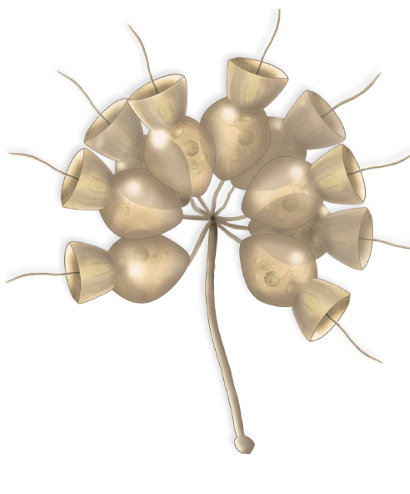
<ul><li><p><span>Animal-like protists closely related to sponges</span></p></li><li><p><span>Single-celled and colonial forms</span></p></li><li><p><span>Filter feeders; resemble choanocytes that line the inside of sponges</span></p></li><li><p><span>Each one has a single, posterior flagellum surrounded by a collar of microvilli</span></p></li><li><p><span>Beating of flagellum creates a water current through the collar, where food is taken in by phagocytosis</span></p></li></ul><p></p>
46
New cards

malaria - disease caused by protistans

a protozoan disease caused by by one of several sporozoan parasites in the genus Plasmodium

  • complex life cycles

  • sexual reproduction involves involves sporozoites moving to the salivary glands of the mosquito and being transmitted to humans by a bite

  • in humans , they reproduce asexually in the liver and red blood cells, forming merozoites

47
New cards

toxoplasmosis - protistan disease

Toxoplasma gondi and is often transmitted from cat feces

  • no obvious symptoms but can harm fetus

Cryptosporidium parvum is a related disease found in surface water or in feces of animals and birds

  • unaffected by chlorine treatment and causes gastroenteritis and sometime fatal watery diarrhea

48
New cards

african sleeping sickness - protistan disease

caused by Trypanosoma brucei, which is transmitted by the tsetse fly

  • attacks the blood and causing inflamation that decreases oxygen flow to the brain

49
New cards

Chagas disease - protistan disease

caused by T. cruzi, is transmitted by the kissing bug

50
New cards

amoeboid related disease

  1. Parasitic amoeboids in the genus Entamoeba cause amoebic dysentery

  • invades intestinal lining and reproduces there - liver or brain involvement can be fatal

  1. Acanthamoeba can cause corneal inflammation

  2. Naegleria fowleri can invade the human nervous system, nearly always causing death

  • caused by swimming in warm bodies of fresh water

51
New cards

fungi!

domain Eukarya, supergroup Opisthokonta, kingdom Fungi

  • structurally diverse group of heterotrophs

  • release enzymes into their external environment and digest food outside of the body

  • some are parsitic

  • some are saprotrophs that decompose dead plants, animals, and microbes

  • important to recycling inorganic nutrients

  • degrade cellulose and lignin

  • six groups: microsporidia, chytrids, zygospore, sac, and club

  • nonmotile - move toward a food by growing toward it

  • glycogen is used as an energy reserve

  • no chloroplasts

52
New cards

evolution of fungi

  • ancestry to protists

  • closer related to animals than to plants

  • do not fossilize well

  • likely originated when organisms began to colonize land

  • lots of questions about its evolution

53
New cards

hyphae

body of a fungus composed of many of these filaments

  • gives mycelium a large surface area to facilitate absorption of nutrients

54
New cards

what is a mass of hyphae called for fungi?

mycelium

55
New cards

what are septa?

cross walls that separate hyphae into chains of cells in fungi

  • these sorts of hyphae are septate

  • xxx have pores to allow cytoplasm to pass from cell to cell

  • non septate fungi have no cross walls and hyphae are multinucleated
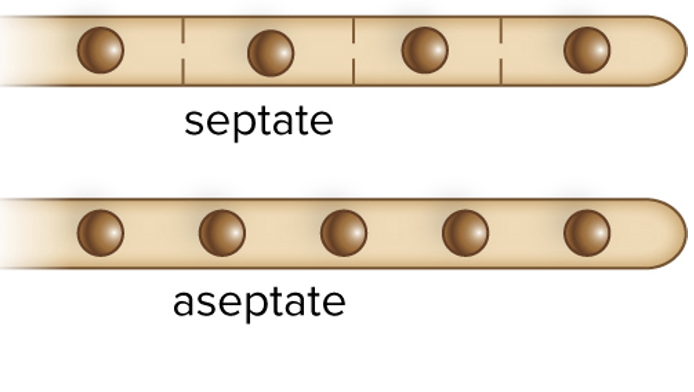
<p>cross walls that separate hyphae into chains of cells in fungi</p><ul><li><p>these sorts of hyphae are septate </p></li><li><p>xxx have <span>pores to allow cytoplasm to pass from cell to cell</span></p></li><li><p><span>non septate fungi have no cross walls and hyphae are multinucleated </span></p></li></ul><p></p>
56
New cards

what are the cell walls of fungal cells comprised of?

chitin

57
New cards

fungi windblown spores - reproduction

used as a method of adaptation to dry land

  • spores are haploid reproductive cells that develop into a new organism without the need to fuse with another cell

    • spores germinate into new mycelia

  • sexual reproduction occurs by the conjugation of hyphae from different mating types

    • Haploid nuclei may not immediately fuse

    • Eventually, the nuclei fuse to form a zygote

    • Zygote undergoes meiosis to produce haploid spores
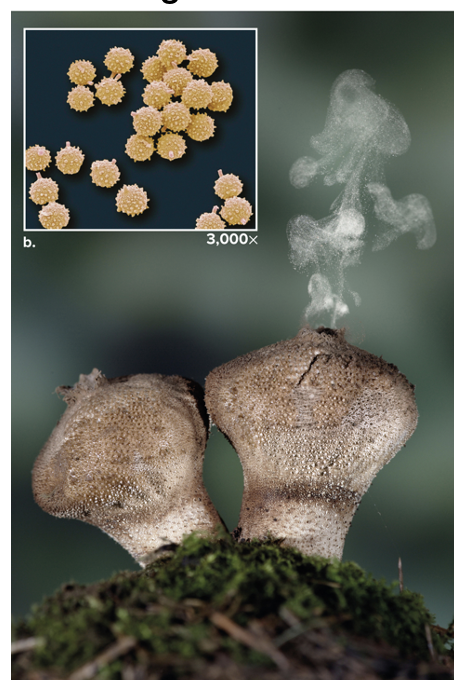
<p>used as a method of adaptation to dry land </p><ul><li><p>spores are <span>haploid reproductive cells that develop into a new organism without the need to fuse with another cell</span></p><ul><li><p>spores germinate into new mycelia </p></li></ul></li><li><p>sexual reproduction occurs by the <span>conjugation of hyphae from different mating types</span></p><ul><li><p><span>Haploid nuclei may not immediately fuse</span></p></li><li><p><span>Eventually, the nuclei fuse to form a zygote</span></p></li><li><p><span>Zygote undergoes meiosis to produce haploid spores</span></p></li></ul></li></ul><p></p>
58
New cards

fungal diversity

classified by mode of sexual reproduction

  • Microsporidians

  • Chytrids (Chytridiomycota)

  • Zygospore fungi (Zygomycota)

  • Sac fungi (Ascomycota)

  • Club fungi (Basidiomycota)

  • AM fungi (Glomeromycota)

59
New cards

chytrid fungi

phylum Chytridiomycota

  • aquatic

  • They produce flagellated reproductive cells

  • Most reproduce asexually using zoospores which grow into new xxx

  • Many play a role in decay, but some are parasitic

<p><span>phylum Chytridiomycota</span></p><ul><li><p>aquatic</p></li><li><p><span>They produce flagellated reproductive cells</span></p></li><li><p><span>Most reproduce asexually using <em>zoospores </em>which grow into new xxx</span></p></li><li><p><span>Many play a role in decay, but some are parasitic<em> </em></span></p></li></ul><p></p>
60
New cards

Zygospore fungi

phylum Zygomycota

  • Mainly saprotrophs

  • some are parsites of soil protists or worms

  • Rhizopus stolonifer—black bread mold

    • Have specialized hyphae

    • reproduce sexually

      • The ends of (+) and (−) hyphae join, haploid nuclei fuse, and a thick-walled zygospore forms which is dormant before meiosis and germination then turns into aerial hyphae with sporangia at tips produce many spores

        • spores then are dispersed by air currents and give rise to new mycelia

<p>phylum Zygomycota</p><ul><li><p>Mainly saprotrophs</p></li><li><p>some are parsites of soil protists or worms</p></li><li><p><strong><em>Rhizopus stolonifer</em></strong>—black bread mold</p><ul><li><p>Have specialized hyphae</p></li><li><p>reproduce sexually</p><ul><li><p>The ends of (+) and (−) hyphae join, haploid nuclei fuse, and a thick-walled <strong>zygospore</strong> forms which is dormant before meiosis and germination then turns into aerial hyphae with sporangia at tips produce many spores</p><ul><li><p>spores then are dispersed by air currents and give rise to new mycelia</p></li></ul></li></ul></li></ul></li></ul><p></p>
61
New cards

saprotrophs

organisms that obtain nutrients by breaking down dead and decaying organic matter through extracellular digestion

62
New cards

sporangium

a capsule that produces spores

63
New cards

sac fungi

phylum Ascomycota

  • are named after their cuplike sexual reproductive structure, called an ascocarp

  • many reproduce by producing chains of asexual spores called conidia

  • Cup fungi, morels, and truffles have conspicuous ascocarps

  • Truffles, underground symbionts of hazelnut and oak trees

  • most fungal pathogens are these type

  • Ergot, a parasitic sac fungus that infects rye

  • Penicillium—original source of antibiotic penicillin - PURPLE

  • Aspergillus used to produce citric acid - GREEN

<p>phylum Ascomycota</p><ul><li><p>are named after their cuplike sexual reproductive structure, called an <strong>ascocarp</strong></p></li><li><p>many reproduce by producing chains of asexual spores called <strong>conidia</strong></p></li><li><p>Cup fungi, morels, and truffles have conspicuous ascocarps</p></li><li><p>Truffles, underground symbionts of hazelnut and oak trees</p></li><li><p>most fungal pathogens are these type</p></li><li><p><em>Ergot,</em> a parasitic sac fungus that infects rye</p></li><li><p><em>Penicillium</em>—original source of antibiotic penicillin - PURPLE</p></li><li><p><em>Aspergillus</em> used to produce citric acid - GREEN</p></li></ul><p></p>
64
New cards

yeast

unicellular fungi, many are sac fungi

  • most reproduce by budding

65
New cards

budding

reproduction that is unequal binary fission

  • A small cell gets pinched off and grows to full size

  • Asexual reproduction occurs as food sources run out, producing spores

66
New cards

club fungi

phylum Basidiomycota

  • Their characteristic sexual reproductive structure is called a basidium where + and - nuclei join which produces spores by meiosis

    • Contained within a basidiocarp which develops after + and - hyphae gone

    • forms at fusion of + and - hyphae

includes: puffballs, stinkhorns, smuts, and rusts

67
New cards

Symbiotic Relationships of Fungi with Lichens

Associations between fungi and cyanobacteria or green algae

  • Efficient at acquiring nutrients and moisture

  • Are primary colonizers because they produce organic matter and soil that supports plants

  • take three characterstics forms: crustose (compact) fruticose (shrublike) and foliose (leaflike)

  • Lichens can reproduce asexually by releasing fragments with hyphae and an algal cell

68
New cards

Lichen body

has three layers—fungi form top and bottom layers and protect middle layer of photosynthetic cells

  • Fungal portion offers protection and delivers minerals and water

  • Cells of photosynthetic partner give the fungus nutrients

69
New cards

Symbiotic Relationships of Fungi - Mycorrhizae

  • Mutualistic relationships between soil fungi and plant roots

    • •Allow plants to grow more successfully in poor soils

  • Fungal partner can live on the outside surface of roots, enter the cortex, or penetrate the root cells

    • Plants give nutrients to fungus and fungus brings water and mineral to plant

70
New cards

Symbiotic Relationships of Fungi -AM fungi

phylum Glomeromycota

  • Arbuscules are branching invaginations the fungus makes when it invades plant roots

  • They are a type of mycorrhiza fungi that forms mutually beneficial relationships with the roots of plants

71
New cards

fungal diseases of humans

  • cause disease in those humans with a weakened immune system

  • Mycoses - serious disease usually superficial

    • dermatophytes - fingus causing tinnea - athletes foot

    • fingworm - causes infected area to be inflammed

    • Candida albicans causes a wide variety of fungal infections

      • thrush is an infection that occurs in the mouth of newborns and people living with AIDS

72
New cards

systemic mycoses

fungal infections that affect internal organs (mainly the lungs) - in immunocompromised individuals, fungi can spread through the bloodstream

  • Several fungal diseases are considered AIDS-defining

  • death is possible as multiple organ may be infected

  • normal immune systems have no trouble responding but in serious cases they start with  respiratory symptoms, which include coughing, chest pain, hoarseness, or blood in sputum

73
New cards

examples of systemic mycoses

  • Histoplasma capsulatum - A common soil fungus often linked to bird droppings

  • Can cause a lung disease known as histoplasmosis - Resembles tuberculosis

  • Cryptococcus neoformans - Found in soils infected with pigeon or chicken droppings

  • Coccidioides immitis - Found in desert areas; causes valley fever

  • Black mold, Stachybotrys chartarum - Sick building syndrome

74
New cards

antifungal drugs

work for topical medication but not for systemic infections

75
New cards

anabaena

long, unbranched, blue-green to olive-green filaments (trichomes) composed of beaded or barrel-shaped cells, often described as a string of beads. Larger and thicker walled

<p><mark data-color="rgba(0, 0, 0, 0)" style="background-color: rgba(0, 0, 0, 0); color: inherit;">long, unbranched, blue-green to olive-green filaments (trichomes) composed of beaded or barrel-shaped cells, often described as a string of beads</mark><span>. Larger and thicker walled</span></p>
76
New cards

algae filamentous

kingdom protista

division:

Long, thread-like strands comprised of individual cells connected end-to-end. can be unbranched (like Spirogyra) or branched (like Cladophora). They are generally one cell thick and show significant internal detail depending on the genus

<p>kingdom protista </p><p>division: </p><p></p><p>Long, thread-like strands comprised of individual cells connected end-to-end<span>. can be unbranched (like </span><em>Spirogyra</em><span>) or branched (like </span><em>Cladophora</em><span>). They are generally one cell thick and show significant internal detail depending on the genus</span></p>
77
New cards

Spirogyra

in a genus of filamentous, freshwater green algae (belonging to the kingdom Protista or Charophyta)

  • ribbon-like spiral chloroplasts

  • unbranched, thread-like chains of cylindrical cells surrounded by a slimy mucilage sheat

<p>in a genus of filamentous, freshwater green algae (belonging to the kingdom Protista or Charophyta) </p><ul><li><p>ribbon-like spiral chloroplasts</p></li><li><p><mark data-color="rgba(0, 0, 0, 0)" style="background-color: rgba(0, 0, 0, 0); color: inherit;">unbranched, thread-like chains of cylindrical cells surrounded by a slimy mucilage sheat</mark></p></li></ul><p></p>
78
New cards

ulothrix

a genus of filamentous, unbranched green algae (phylum Chlorophyta)

  • characterized by a simple, uniseriate structure - cells are arranged end-to-end in a single row

  • freshwater or marine algae form long, hair-like filaments that appear bright green

<p>a genus of filamentous, unbranched green algae (phylum Chlorophyta) </p><ul><li><p>characterized by a simple, uniseriate structure - <mark data-color="rgba(0, 0, 0, 0)" style="background-color: rgba(0, 0, 0, 0); color: inherit;">cells are arranged end-to-end in a single row</mark></p></li><li><p>freshwater or marine algae form long, hair-like filaments that appear bright green </p></li></ul><p></p>
79
New cards

oedogonium

  • filamentous

  • unbranched green alga characterized by cylindrical cells

  • a specialized holdfast for attachment

  • unique ring-like apical caps resulting from cell division

  • net-like chloroplast

  • thick cell walls (cellulose/chitin)

  • reproduces via zoospores or oogamy

<ul><li><p><mark data-color="rgba(0, 0, 0, 0)" style="background-color: rgba(0, 0, 0, 0); color: inherit;">filamentous</mark></p></li><li><p><mark data-color="rgba(0, 0, 0, 0)" style="background-color: rgba(0, 0, 0, 0); color: inherit;">unbranched green alga characterized by cylindrical cells</mark></p></li><li><p><mark data-color="rgba(0, 0, 0, 0)" style="background-color: rgba(0, 0, 0, 0); color: inherit;">a specialized holdfast for attachment</mark></p></li><li><p><mark data-color="rgba(0, 0, 0, 0)" style="background-color: rgba(0, 0, 0, 0); color: inherit;">unique ring-like apical caps resulting from cell division</mark></p></li><li><p><span>net-like chloroplast</span></p></li><li><p><span>thick cell walls (cellulose/chitin)</span></p></li><li><p><span>reproduces via zoospores or oogamy</span></p></li></ul><p></p>
80
New cards

amoeba v paramecium

Amoeba and Paramecium are both single-celled, eukaryotic microorganisms found in aquatic habitats, but they differ significantly in structure and locomotion

  • Amoebas have an irregular, ever-changing shape and move using temporary projections called pseudopodia (false feet)

  • Paramecium has a fixed, slipper-shaped form, uses hair-like cilia for fast movement, and has a more complex structure, including two nuclei

81
New cards

oscillatoria

is a genus of filamentous cyanobacteria (blue-green algae)

  • Filamentous Structure (Trichomes): long, unbranched filaments which are generally composed of a single row of cells

  • Stack of poker chips

  • Lack of Sheath

  • Filaments are actively motile

<p>is a genus of filamentous cyanobacteria (blue-green algae)</p><ul><li><p><span>Filamentous Structure (Trichomes): long, unbranched filaments which are generally composed of a single row of cells </span></p></li><li><p><span>Stack of poker chips</span></p></li><li><p><span>Lack of Sheath</span></p></li><li><p><span>Filaments are actively motile</span></p></li></ul><p></p>
82
New cards

gleocapsa

a genus of coccoid, colonial cyanobacteria

  • Concentric Sheaths (Gelatinous Envelopes)

  • Colonial Appearance

  • Cell Shape and Division: Cells are spherical, but appear hemispherical or irregular after division

  • Pigmented Sheaths: The envelopes are frequently colored

<p>a genus of coccoid, colonial cyanobacteria</p><ul><li><p>Concentric Sheaths (Gelatinous Envelopes)</p></li><li><p>Colonial Appearance</p></li><li><p>Cell Shape and Division: Cells are spherical, but appear hemispherical or irregular after division</p></li><li><p>Pigmented Sheaths: The envelopes are frequently colored</p></li></ul><p></p>
83
New cards

rhizopus nigrican conjucation

  • Two opposite mating types (+ and −) involved

  • Thick-walled, dark zygospore visible

  • Zygospore often rough/spiny in appearance

  • Suspended between two suspensor cells

  • Fusion region appears swollen compared to normal hyphae

<ul><li><p>Two opposite mating types (+ and −) involved</p></li><li><p>Thick-walled, dark<strong> </strong>zygospore visible</p></li><li><p>Zygospore often rough/spiny in appearance</p></li><li><p>Suspended between two suspensor cells</p></li><li><p>Fusion region appears swollen compared to normal hyphae</p></li></ul><p></p>



