Response to changes in the environment Combined set
 Call Kai
 Learn
Learn Practice Test
 Spaced Repetition
 Match
Match Flashcards
 Knowt Play
1/166

There's no tags or description
Looks like no tags are added yet.
Name | Mastery | Learn | Test | Matching | Spaced | Call with Kai |
|---|
No analytics yet
Send a link to your students to track their progress
167 Terms
what is osmoregulation ?
maintaining the water potential by removing excess water/ retaining water
what is excertion ?
removing nitrogenous waste in form of urea in the blood
what are the 2 roles of the urinary system ?
osmoregulation
excretion
how do kidneys recieve blood ?
renal artery
what is the cotex & the function ?
outer layer of nephrons
where blood is filtered
what is the medulla and what does it contain ?
inner layer which contains tubes carrying filtered waste to centre of kidney
contains loop of henle & collecting duct parts of the nephron
what is the renal pelvis ?
where all the collecting ducts come together & connect under ureter
what are the main parts of the nephron ?
Bowman’s Capsule
Proximal Convoluted Tubule
Loop of Henle
Distal Convoluted Tubule
Collecting Duct
3 kidney processes ?
ultrafiltration
selective reaborption
osmoregulation
Describe how ultrafilration occurs in the glomerulus ?
high hydrostatic pressure
small substances such as amino acids, glucose & urea are pass out
through small gaps in capillary endothelium
4 steps water is reabsorbed into kidneys ?
ultrafiltration
selective reabsorption
loop of henle
distal convoluted tubule & collecting duct
Steps of selective reabsorption (how and what is reabsorbed) ?
glucose reabsorbed by co-transport from epithelial cells of proximal convulated tubule to blood capillaries
steps of loop of henle using Na+ ?
Na+ actively transported out of ascending limb using ATP
creates low water potential
asending limp impermeable to water meaning water can only move out of decending limb by osmosis
water enters blood capillaries by osomosis
at hair pin of loop, water potential lowest as Na+ diffuses out
what happens to water in distal convoluted tubule & the collecting duct ?
water naturally moves out of distal convoluted tubule & collecting duct via osomosis
collecting duct run paralel to loop of henle
what can impact the permeability of the collecting ducts ?
antidiuretic hormones
what is the change in water potential detected by ?
osmoreceptors in hypothalamus
what happens if water potential falls ?
osmoreceptors in hypothalamus detect low water potentialposterior putuitary gland receive impulse and release ADH
ADH secreted into blood & travels to kidneys
distal convoluted tubule and collecting duct becomes more permeable to water
urine volume creases & concentration increases
more water reabsorbed into blood
blood water potential increases
why are aquaporins important ?
intergral membrane proteins that serve as channel proteins in transport of water
How does ADH work ?
cells lining walls of collecting duct has receptors for ADH on plasma membrane
have vesicles with aquaporins
when ADH binds to recpetors, it causes activation of phosphorylase
activated phosphorylase causes vesticles containing aquaprins to move & fuse with membrane on filtrate side, making membrane of cells lining collecting duct to become more permeable to water
how are the cells in proximal convoluted tubule adapted ?
folded membrane = larger surface area
many membrane proteins
many ribosomes
many mitochondria
what does loop of henle do ?
create low water potential in medulla of kidney
what is homeostasis ?
maintanence of constant internal environment for optimal conditions in cells
why is homeostatis important ?
maintaining stable blood glucose concentration
water potential of blood
what does negative feedback do ?
restores systems to their original level
what is positive feedback ?
occurs when deviation from optimum causes changes that result in an even greater deviation than normal
steps of homeostasis during rise in blood temperature ?
thermoreceptors in skin & hypothalamus
heat loss centre in hypothalamus
vasodilation
normal blood temp
blood at right temp so turns off corrective measure
What is the distance between 2 “Z lines” called ?
sacromere
what causes the dark appearance of A band ?
has both thick myosin & thin actin myofilaments
why is I band light ?
only has thin actin myofilaments
image of muscle with bands ?
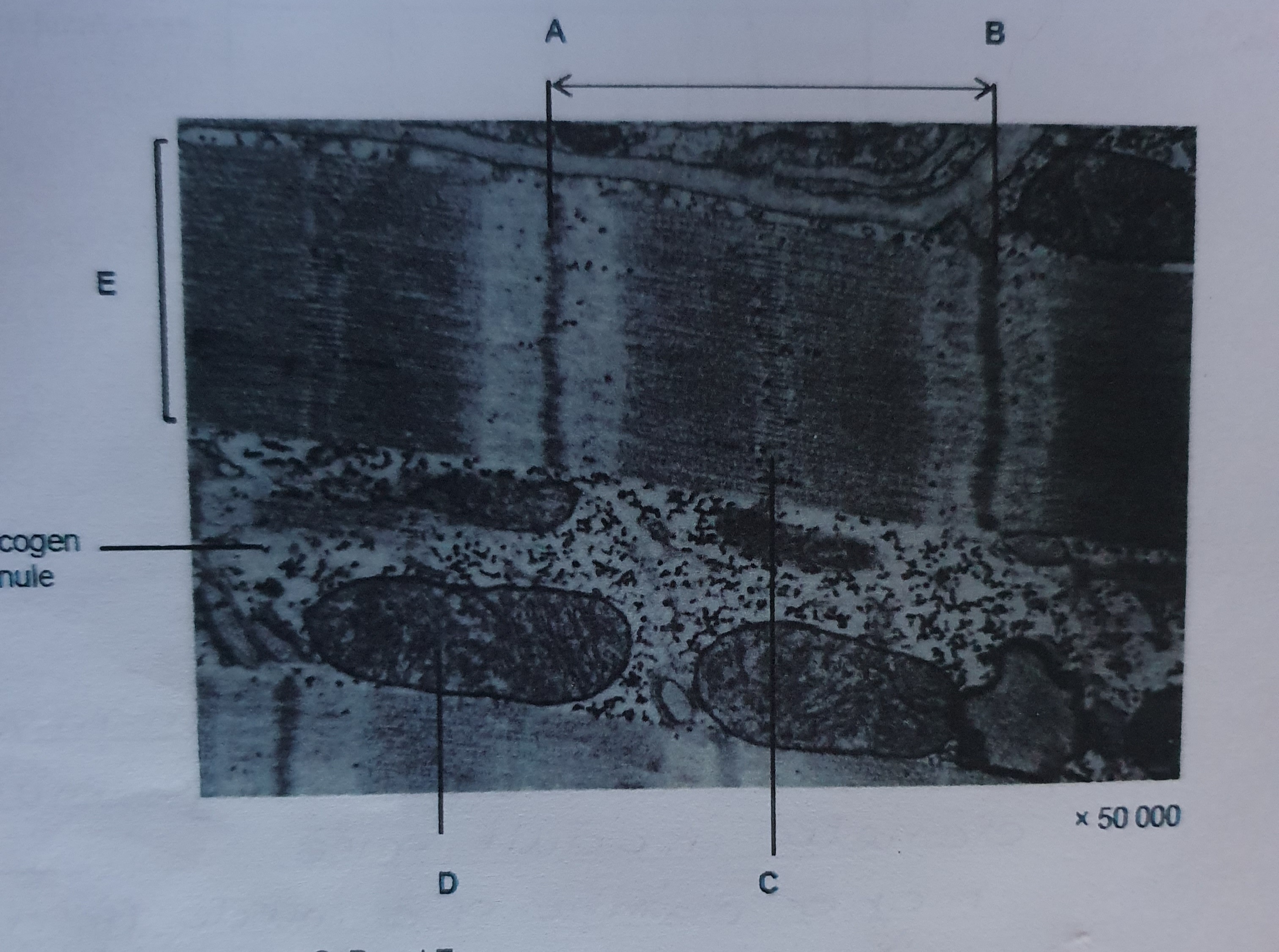
what changes occur to sacromere when muscle contracts ?
I-band becomes narrower
Z-lines move closer together
H-zone becomes narrower
what is actin ?
a globular protein whose molecules are arranged into long chains that are twisted round each other to form a helical strand
what is tropomyosin ?
forms long thin threads that are wound around actin filaments
what is sarcoplasm ?
shared cytoplasm in each muscle fibre
contains mitochondria & endoplasmic rectilium
what is the Z line ?
junction between actin myofilaments in adjacent sacromeres
How does myosin shorten the sacromere ?
myosin heads move their tails, moving the centre of the sacromere, pulling the actin towards eachother
Steps of muscle contraction ?
calcium ions released from sarcoplasmic rectilium
calcium ion in sarcoplasm binds troponin & exposes mysoin- binding site on actin filament
myosin head binds to actin & ADP released
myosin head changes conformation, filament slide past one another
ATP binds to myosin causing it to release actin
hydrolysis of ATP provide energy for mysoin to return to normal position
myosin head attaches further along actin filament 7 cycle repeated
how does muscle relax ?
if calcium ions are returned to sarcoplasmic rectilium
why is ATP important in muscle fibres ?
movement of myosin heads
reabsorption of calcium ions into endoplasmic rectilium by active transport
what does phosphocreatine do that helps in ATP production ?
Pi donated to ADP to make ATP
anaerobic conditions
acts as reserve supply of phosphates
What type of exercise and how are slow twitch muscle fibres adapted ?
slow contractions over longer periods of exercise e.g. marathon
large stores of myoglobin
rich supply of blood vessels
numerous mitochondria
What type of exercise and how are fast twitch muscle fibres adapted ?
rapid release of energy during intense exercise e.g. sprinting
thick & numerous myosin filaments
high concentration of glycogen
store of phosphocreatine
2 types of muscle fibres?
slow twitch
fast twitch
what does tropomysoin do ?
moves out of the way when calcium ions bind, allowing mysoin to bind to actin
2 main aspects of nervous system ?
central nervous system (CNS)
peripheral nervous system (PNS)
what is in the CNS ?
brain
spinal cord
what is in the PNS ?
sensory nervous system
motor nervous system
what is in the motor neurone ?
voluntary nervous system
autonomic nervous system
what do sensory neurones do ?
carry nerve impulses from receptors to CNS
what do motor neurones do ?
carry nerve impulses away from the CNS to effectors
what is the voluntary nervous system ?
carries nerve impulses to body muscles under conscious control
what is the autonomic nervous system ?
carry nerve impulses to glands, smooth muscles & cardiac muscles & isnt under conscious control
main stages of simple reflex arc ?
stimulus
receptor
sensory neurone
coordinator
motor neurone
effector
response
What is stimulus ?
a detectable change in the internal/external environment of organism that leads to a response
what are stimulus detected by ?
receptors
what is a response produced by ?
effector
simple pathway of a stimulus ?
stimulus → receptor → coordinator → effector → response
what is taxis ?
a simple response whose direction is determined by direction of the stimulus
what is kinesis ?
a form of response in which the organism doesn’t move towards or away from the stimulus, instead it changes speed and rate of direction change
what is tropism ?
the growth of part of the plant in response to a directional stimulus
example of positive phototropism ?
plant shoot grows towards light
example of negative phototropism ?
plant root growing away from light
example of postive gravitropism ?
plant roots growing towards gravity
example of negative gravitropism ?
plant shoots growing away from gravity
How does light impact the shape of the plant (steps) Phototropic response
cells in tip produce IAA which is transported down shoot
initially transported evenly
light causes movement of IAA from light side to shaded side of shoot
greater concentration IAA builds up on shaded side of shoot than light side
IAA cause elongation of shoot cells on shaded side
cause shoot tip to bend towards light
how does gravity impact shape of flowering plants (steps of response of hoizontally growing root to gravity) ? Gravitropism response
cells in tip produce IAA which is transported along root
IAA initially transported to all sides of root
gravity influence movement of IAA
greater concentration of IAA builds on lower side of root than upper side
IAA inhibits elongation of roots cell so cells on lower side elongate less than on the upper side
causes root to bend downwards towards gravity
what does greater IAA concentration in shoots cause ?
increases cell elongation
what does greater IAA concentration in roots cause ?
decreased cell elongation
Why is the difference in IAA impact important to plants for phototropism ?
shoot grows towards light
root grows away from light
Symptoms of type I diabetes ?
weight loss
increased urination
sugar in urine
fatigue
Symptoms of type II diabetes ?
increased thirst
vision problems
extreme humger
What is type I diabetes caused by ?
immune system attacks & destroys beta-cells
what causes type II diabetes ?
decreased insulin production or glycoprotein receptors on target cell unresponsive to insulin
how is type I diabetes managed ?
insulin injections
less carbohydrates
how is type II diabetes managed ?
increased exercise
diet control
why is tiredness caused by type I diabetes ?
insulin not produced
blood sugar levels fluctuate
insufficient glucose
cells in muscles & brain have decreased activity
why do people with diabetes experience extreme thirst ?
high blood glucose level
glucose excreted in urine
low water protential in urine
draws water from blood by osmosis
what 3 processes does the liver carry out to regulate blood glucose ?
glycogenesis (storing glucose as glycogen)
glycogenolysis (glycogen to glucose)
gluconeogenesis (glucose from other source e.g amino acids, ect)
what is glycogenesis ?
makes glycogen from glucose removed from the blood
what is glycongenolysis ?
breaking down stored glycogen into glucose which can be released into the blood
what is gluconeogensis ?
synthesis of glucose from other molecules (e.g. amino acids)
What happens when blood glucose is too high ?
rise in blood glucose
detected by beta cells in Islet of Langerhans (in pancreas)
insulin released
insulin attaches to receptors on surface of target cells
- causing change in tertiary structure of transport proteins responsible for glucose →increased uptake of glucose (especially to muscle & liver) →acivates enzymes to convert glucose to glycogen (glycogenesis)
- enzymes activated that convert glucose to fatty acids →fats desposited in adipose tissue
- increased rate of respiration
what happens if blood glucose drops to low ?
blood glucose level decreases
detected by alpha-cells in Islet on Langerhans (in pancreas)
glucagon released
attaches to receptors on cell surface
-activates enzymes which convert glycogen into glucose (glycogenolysis)
-enzymes activated that convert amino acids & glycerol to glucose (glucogenesis)
name the second way glycogen can be broken down into glucose to raise blood glucose levels ?
secondary messenger
second way glycogen can be broken down into glucose to raise blood glucose levels (steps) ?
adrenaline fuses to receptors on cell surface membrane of liver cells (shape changes on inside of membrane)
activating enzyme adenyl cyclase
ATP to cAMP
cAMP changes shape of & activates protein kinase enzyme
catalysing conversion of glycogen into glucose
what is the advantage of the 2nd messanger model ?
has amplification effect
difference between alpha & beta cells in Islet of Langerhans ?
Apha cells
larger
produce glucagon
Beta cells
Smaller
produce insulin
what factors influence blood glucose ?
food intake
exercise
describe how stimulation of a pacinian corpuscle produces a generator potential ?
stretch mediated Na+ channels in membrane
increased pressure changes sensory neurone membrane
Na+ channels open & Na+ diffuse in causing depolarisation
how to obtain the dry mass of lettuce leaves ?
heat & weigh until mass is constant
Describe how inversion mutation can cause production of non-functional protein ?
changes in DNA base sequence
change in amino acids
change in hydrogen bonding
alters tertiary structure
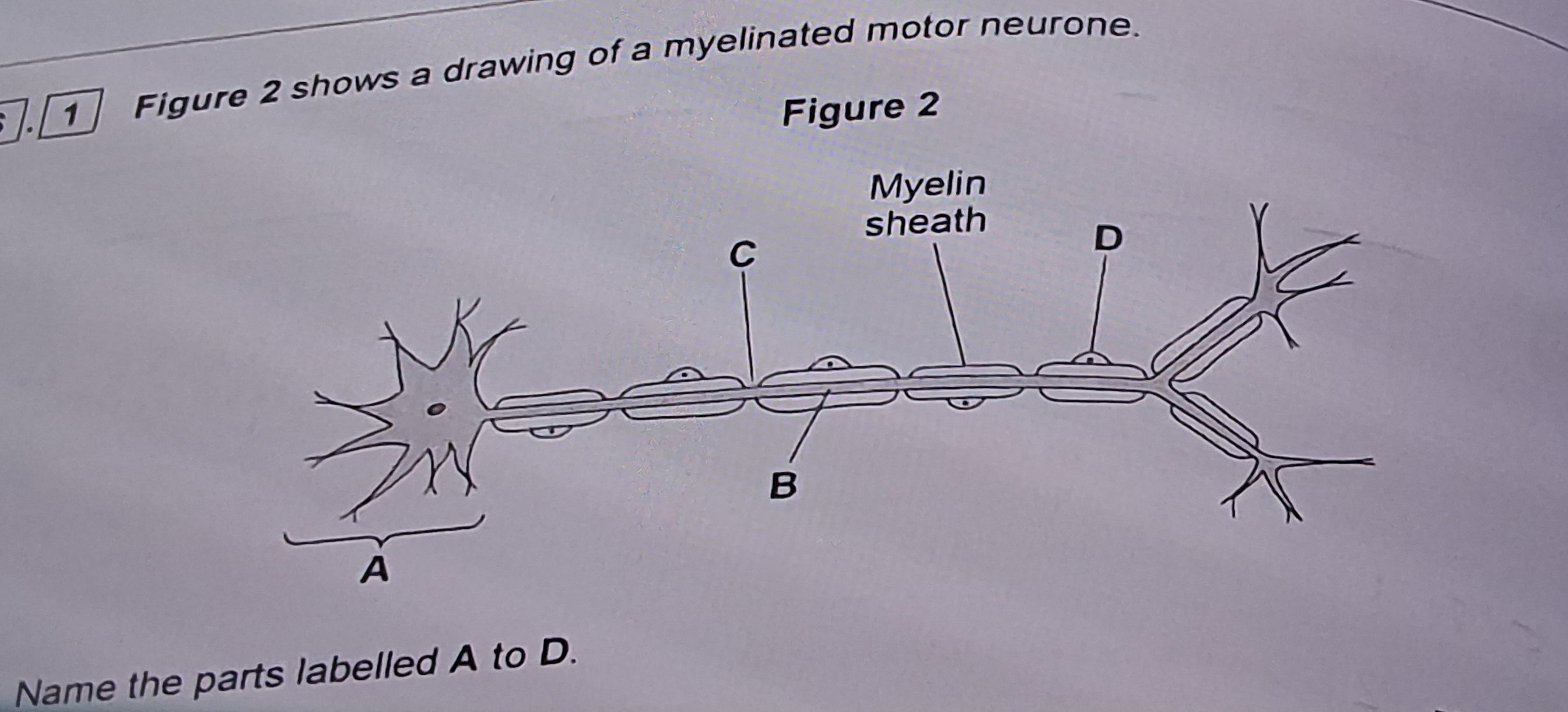
Name the parts labelled A to D ?
A = cell body
B = axon
C = node of ranvier
D = schwann cell
Why can destruction of myelinated sheaths cause increased reflex response times ?
no saltatory conduction
impulses slowed
effects relay neurones
Atropine is drug that attaches to post-synaptic receptors. Can increase heart rate, How ?
less acetylchloine (neurotransmitter) binds to receptors
fewer action potentials
to SAN
what is a synapse ?
junction between 2 neurones
describe the sequence of events involved in transmission across cholingeric synapase ?
depolarisation of synaptic membrane
calcium channels open & calcium ions enter synaptic knob
synaptic vesticles fuse with presynaptic membrane & neurotransmitter produced
acetylchlone diffuses across synaptic cleft
acetylechlonine binds to receptors on membrance
sodium channels open & sodium ions diffuse in
enzymes hydrolyses neurotransmitter
how do drugs affect synapses ?
by blocking reabsorption of neurotransmitter or causing more to be released
by having similar structure & ‘tricks’ post synaptic membrane , neurotransmitter receptor allows the drug to bind to it
what is spatial summation ?
several pre-synaptic neurones join together into a single post-synaptic neurone
what is temporal summation ?
when a single presynaptic neurone releases neurotransmitter many times in a short period, therefore excededing threshold value for triggering an action potential
why does temporal summation help us filter out low level stimulus ?
effective at filtering out-low level stimuli as they dont cause the release of sufficient neurotransmitter