CATEGORIES WITHIN OUR LEGAL SYSTEM
 Call Kai
 Learn
Learn Practice Test
 Spaced Repetition
 Match
Match Flashcards
 Knowt Play
1/30

There's no tags or description
Looks like no tags are added yet.
Name | Mastery | Learn | Test | Matching | Spaced | Call with Kai |
|---|
No analytics yet
Send a link to your students to track their progress
31 Terms
Public law vs. private law
Public law: the law that regulates disputes between individuals and the public as a whole (i.e., the state). The term “public” may be: (i) general (applying to all persons within the jurisdiction); (ii) local (applying to a geographical area); (iii) special (relating to an organization or authority charged with a public interest).
Private law: the law that deals with disputes between two or more individuals.
THE BRITISH COLUMBIA COURT SYSTEM
In British Columbia, court cases are often categorized as criminal cases or civil cases.
Administrative Tribunals
Not part of the court system; less formal adjudicative bodies established to hear disputes in specific areas; certain decisions are reviewable by the courts
Civil Resolution Tribunal (CRT)
A newly created online tribunal tasked with resolving almost all strata corporation disputes, including non-payment of strata fees or non-enforcement of strata bylaws; certain small claims disputes; and certain motor vehicle accident injury disputes; small claims disputes for $5,000 or less relating to debt or damages, recovery of personal property, personal injury, or specific performance of agreements involving personal property or services must be submitted to the CRT. Small claims disputes above $5,000 can be made to the CRT, but the amount above $5,000 must be abandoned and cannot be claimed anywhere else.
3 potential phases involved in settling a dispute through the CRT
negotiation: involves the parties communicating online in an effort to settle the dispute;
facilitation: CRT staff will assist the parties in attempting to reach a settlement;
adjudication: an adjudicator will make a decision that is enforceable by the courts
3 key advantages compared to the traditional court system
online process, the efficiency of the process (~60 days), and the costs associated with seeking dispute resolution (~$200)
Courts of Original Jurisdiction (trial courts)
2 civil courts of original jurisdiction in British Columbia: the Small Claims Court and the Supreme Court.
Small Claims Courts
Deal with most claims of $35,000 or less;
A person must be able to establish:
that the cause of action (i.e., the circumstances that give rise to the claim) arose within the territorial jurisdiction of the court; or
that the person being sued lives or carries on business there.
Supreme Court of British Columbia
Top trial court in the province; no monetary limitation; nor is there any territorial limitation within the province
Appellate Courts
After a trial judge has made their decision, either party may appeal that decision to a higher court (Appellate Court);
The person bringing the appeal = the appellant;
Will not rehear the evidence that was presented at the trial level; instead, it will review the legal principles applied by the trial judge.
Appeal from Small Claims Court
To the BC Supreme Court; The party filing the appeal will first appear before a judge to argue that there are legal or factual errors in the trial judge’s order. If the judge hearing the appeal allows the appeal, a new trial may be ordered
Appeal from BC Supreme Court
To the British Columbia Court of Appeal, the provincial appellate court; Although only one judge sits in the trial courts, a panel of judges hears the appeal in the Court of Appeal, and the majority view decides the matter.
Appeal from the BC Court of Appeal
To the Supreme Court of Canada in Ottawa; can decide not to hear the appeal; a panel of a minimum of five judges, but more commonly, seven or nine judges; the evidence is not reheard and the majority view decides the matter.
Procedure for Bringing a Claim
The Parties to a Lawsuit
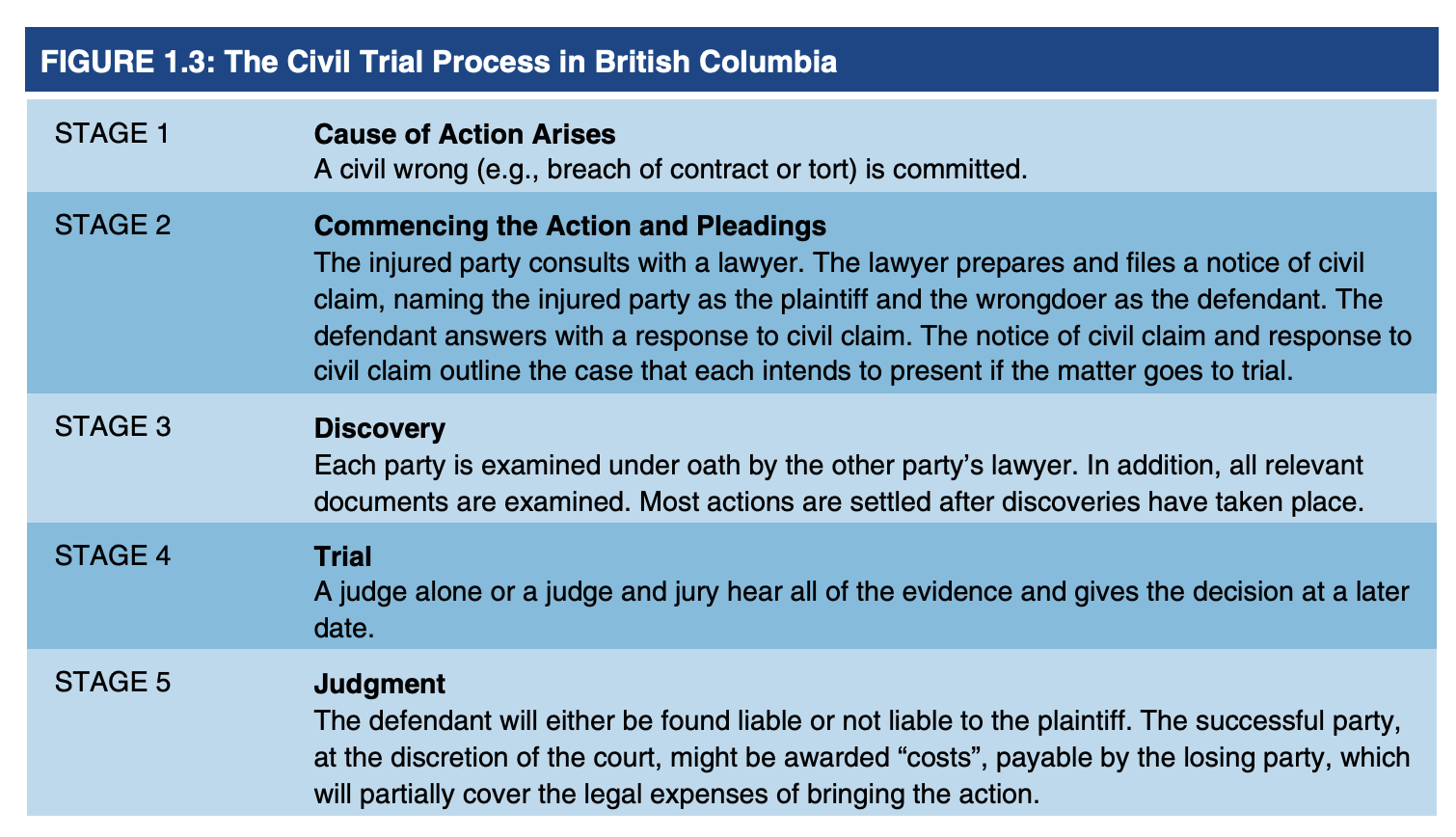
Our common law system is based on an adversarial process: each party to a dispute presents their case or point of view as persuasively as possible, and then an impartial trier of fact, either judge or jury, makes findings of fact, applies the law to those facts, and comes to a decision that is binding on both parties (plaintiff and defendant in Supreme Court; claimant and defendant in Small Claims Count)
The Pre-Trial Process
Written Pleadings: plaintiff begins an action by filing a notice of civil claim and serves it on the defendant → defendant answers by filing a response to civil claim; This process brings the parties to agreement on the points about which they disagree.
Discovery
In addition to the written pleadings there are many legal devices for bringing out the relevant evidence in the case before it ever gets to trial.
Examination for discovery: “mini-trial” that takes place between the parties to the dispute and their lawyers, without a judge present. Each party can examine the opposite party under oath, and the evidence is recorded by a court reporter. Common practice to use them in the cross-examination of the party who gave the evidence under oath.
Discovery of documents: process under which each party is required to provide all relevant documents to the other party before the actual trial.
The Trial
By the time all the evidence has been heard, the plaintiff must have convinced the court that it is more likely than not that the plaintiff’s version of the facts is true and is supported by the evidence
Burden of proof: this obligation of the plaintiff to prove its case
The Judgment
The judgment will set out the duties or liabilities, if any, that are owed by each party to the other, and may include an order of a particular remedy or course of action.
Court Costs
The rules of court prescribe a tariff that sets the amounts to be paid for each stage of the lawsuit.
The longer the litigation proceeds, the greater the court costs for which the unsuccessful party will eventually be responsible.
While costs are normally paid by the loser to the winner, costs are within the court’s discretion to award and, in appropriate circumstances, costs could be awarded to the loser, or each party could be ordered to bear its own costs.
Mediation
A neutral third-party mediator helps facilitate an agreement between the parties to the dispute in a private and informal setting; A voluntary agreement or a Notice to Mediate form;
Arbitration
The arbitrator, after reviewing the evidence and arguments from the parties, will make a binding decision, similar to a judge. Arbitration may be preferred to litigation before the courts due to its flexibility, privacy, speed, and the freedom it allows for parties to choose a decision-maker based on their expertise.
Enforcing a Judgment
A losing defendant who has not yet paid the judgment is also known as a judgment debtor.
Examination of the Judgment Debtor
As a first step, the plaintiff needs to get an idea of the judgment debtor’s income and types of assets owned by the judgment debtor
The plaintiff may apply to examine the judgment debtor under oath about the judgment debtor’s assets, income, liabilities and expenses.
The plaintiff may also be able to obtain an order at this stage that directs the judgment debtor to make installment payments to the plaintiff to repay the judgment.
Execution
If the judgment debtor has assets that are known to the judgment creditor (for example, a car), these can be seized and sold. At the plaintiff’s request, a writ of execution is issued by the court to the sheriff directing seizure and sale of enough of the debtor’s assets to pay the judgment plus the costs of seizure. Where there are no assets for the sheriff to seize, the sheriff returns the writ to the court marked nulla bona or “no goods”.
Remedies Against Land
If the judgment debtor owns an estate or interest in land, the judgment can be registered in the appropriate land title office as a charge against the judgment debtor’s estate or interest. The registration must be renewed every second year to be valid. A judgment creditor can also apply to the court for a judicial sale of the estate or interest in land
Garnishing Order
A garnishing order is served on the third party and orders them to pay the money into the court instead of to the debtor.
Limitation Periods
Once a legal right to bring an action arises, the person having that right must exercise it within a period of time prescribed by legislation.
Limitation Act
The Limitation Act is a default statute, meaning it will not apply to claims brought under different statutes that contain their own limitation periods; a “basic limitation period” of 2 years applies to most civil claims. The Act also reduces the ultimate limitation period (ULP), which usually begins on the day on which the act or omission occurred, from 30 years to 15 years. However, if a potential defendant acknowledges liability, then both limitation periods are reset to begin on the date of acknowledgement.
Real Estate Errors and Omissions Indemnity Plan
Licensees are required to give written notice as soon as is practicable to the Real Estate Errors and Omissions Insurance Corporation of any error or circumstance, however unmeritorious, that could reasonably be expected to form the basis of a claim against the licensee.
In Equity
A person bringing an action in equity must bring that action within both the legal limitation period and also within a reasonable amount of time.