(2) Holy Roman Empire / Germany: Military History and Notable Events (from 962 to 1806)
 Call Kai
 Learn
Learn Practice Test
 Spaced Repetition
 Match
Match Flashcards
 Knowt Play
1/147

There's no tags or description
Looks like no tags are added yet.
Name | Mastery | Learn | Test | Matching | Spaced | Call with Kai | Chat |
|---|
No analytics yet
Send a link to your students to track their progress
148 Terms
939 - Battle of Andernach (All Facts)
Battle in which Otto the Great defeated Eberhard of Franconia and other rebellious dukes who rebelled against him
The rebellion began when the dukes resented Otto the Great’s ambitions to rule not just Saxony but all of Germany
Otto the Great’s approach upset Bavarians, Franconians, and even Saxons
Otto' the Great’s own brother Henry even joined in the rebellion against him
However, all these rivals and opposing forces were crushed
Otto did this to gather and unite the Saxons (Saxony), Franconians (Francia), and Bavarians (Bavaria) into one German Kingdom
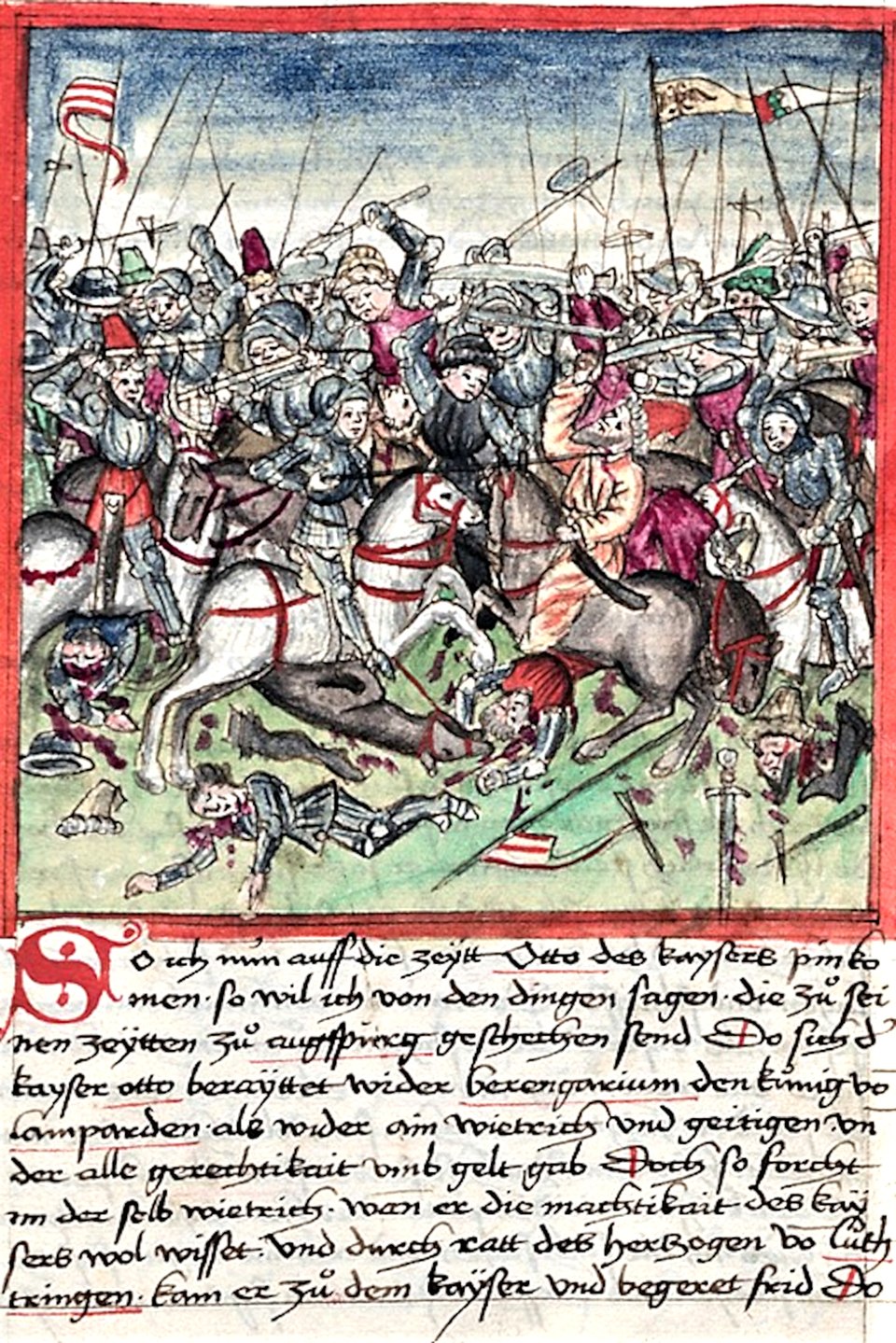
955 - Battle of Lechfeld (All Facts)
Battle in which Otto the Great and his German forces decisively defeated the Magyars and consolidated his nobles as a result
Battle in which 50K Magyar troops besieged the city of Augsburg in Bavaria, but its bishop had held them off until Otto the Great arrived with only 10K German troops
Battle in which Otto the Great’s mail-clad cavalry inflicted heavy losses on the lightly-protected Magyar army, which fled in disarray as its survivors limped back to their homeland
982 - Battle of Stilo (All Facts)
Battle in which Otto II and the Germans and Holy Roman Empire were defeated by the Fatimid Caliphate, who had called a Holy War against the Germans to provoke the conflict
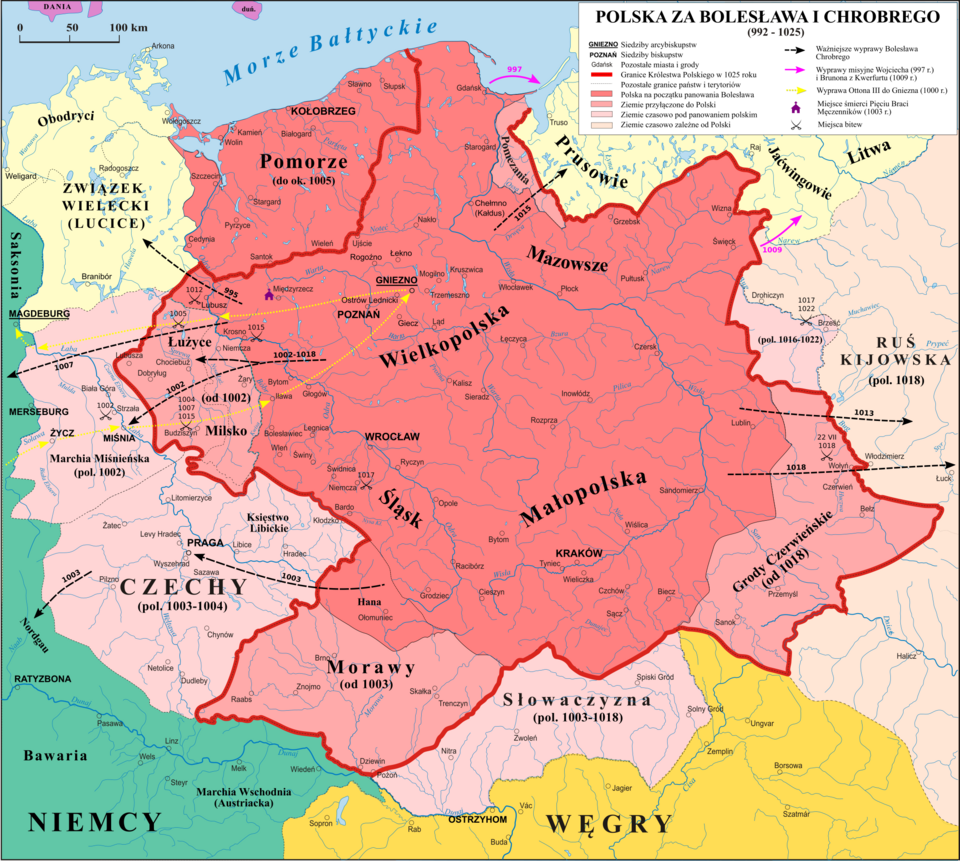
1003 - 1018 - German-Polish Wars (All Facts)
Series of conflicts fought between Boleslaw and his namesake forces and kingdom and Henry II and his forces of the Holy Roman Empire
Series of conflicts which ended with the Peace of Bautzen
1018 - Peace of Bautzen (All Facts)
Treaty signed between Boleslaw of Poland and Henry II of Germany / the Holy Roman Empire which ended the German-Polish Wars of 1003
Treaty in which Boleslaw of Poland consolidated his territorial gains from the War
1076 - 1122 - Investiture Controversy (All Facts)
Conflict between the Church and the Holy Roman Empire over the ability to choose and install bishops, abbots of monasteries, and the Pope himself
Involved disputes between the Popes (religious leaders) and Holy Roman Emperors (secular leaders) and whether religious or secular leaders could appoint bishops and other ecclesiastical positions with the symbols of office
A series of popes, beginning with Pope Gregory VII, sought to curb the power an authority of the Holy Roman Emperors, beginning with Henry IV, from being able to appoint bishops, abbots, and the Pope
Conflict which began with the power struggle between Pope Gregory VII and Holy Roman Emperor Henry IV
Conflict which ended with the Concordant of Worms, where the Church essentially achieved autonomy from secular authorities and was allowed to appoint bishops and other ecclesiastical positions with symbols of office
1083 - Siege of Rome (All Facts)
Battle in which Holy Roman Emperor Henry IV conquered a part of the namesake city
1084 - Sack of Rome (All Facts)
Event in which Holy Roman Emperor Henry IV came to the namesake city and besieged and conquered a part of it as part of a continued power struggle and waged attack on Pope Gregory VII after he had dealt with his rivals in Germany
However, Pope Gregory VII held out in the Castel Sant’Angelo until he was rescued by Robert Guiscard and the Normans
When he realized he was outnumbered by the Norman invaders, he fled from the namesake city and took his antipope Clement III, which he had initially installed there, with him
Event which saw a pall of smoke cover the namesake city as thousands of bodies lie putrefied in the streets
1159 - 1160 - Siege of Crema (All Facts)
Battle in which Frederick Barbarossa and the Holy Roman Empire attacked the namesake city, in which Barbarossa ordered
Prisoners, including children, to be tired to huge siege machines and hurled at the walls of the namesake city
The mass hanging of prisoners, only to see his own soldiers swinging from gallows
Child hostages to be brought to the front line
Battle which ended the namesake city’s status as one of the many powerful independent Italian city-states at the time
When the namesake city opened its gates, its inhabitants watched as their city was razed to the ground
Battle in which the namesake city’s inhabitants, shocked by the sight of the heads of decapitated prisoners being thrown around by Barbarossa’s troops, fiercely retaliated by tearing their prisoners literally limb from limb on the city walls
1167 - Battle of Tusculum (All Facts)
Battle in which Frederick Barbarossa and his Holy Roman forces defeated the Romans and papal forces and captured the Vatican
Battle in which 10K knights and mercenaries set out in two columns to fiercely defeat the Romans and papal forces
Battle after which antipope Paschal III was enthroned
However, the Holy Roman army was soon decimated by malaria and 2,000 of Frederick Barbarossa’s knights were believed to have died as a result
Battle after which Barbarossa submitted to Pope Alexander III and papal authority and kissed his feet in symbolism of his acceptance of that papal authority as thousands watched him do so in St. Mark’s Square
1176 - Battle of Legnano (All Facts)
Battle in which Frederick Barbarossa and his forces were defeated by the Lombard League over control of Lombardy in modern-day Italy
Battle whose terms of peace was completed between Frederick Barbarossa and Pope Alexander III at Agnani
Battle after which Frederick Barbarossa acknowledged Pope Alexander III as the one and only true pontiff
Barbarossa finally succumbed to papal authority and accepted Pope Alexander III after he had kissed the feet of the pope as thousands watched him do so in St. Mark’s square
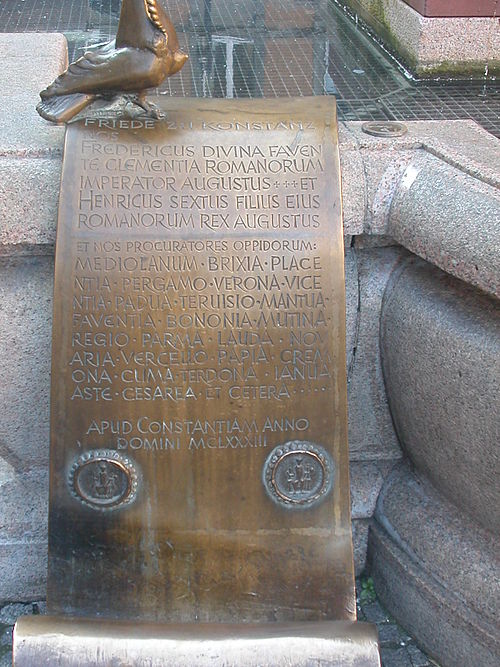
1183 - Peace of Constance (All Facts)
Peace treaty which ended conflict between Frederick Barbarossa and the Holy Roman Empire and the Lombard League
1189 - 1192 - Third Crusade (All Facts)
Crusade organized by Frederick Barbarossa of the Holy Roman after it was declared by Pope Gregory VIII
Crusade whose troops were assembled by Frederick Barbarossa of the Holy Roman Empire along with Philip Augustus of France and Henry II of England
Crusade in which Frederick Barbarossa and his Holy Roman forces left the Dardanelles straits only to be constantly harried by Turkish tribesmen and whom suffered badly from hunger and intense heat
Crusade in which Frederick Barbarossa of the Holy Roman Empire died, and upon his death, his forces, demoralized, turned back
Crusade which thus failed
1217 - 1221 - The Fifth Crusade (All Facts)
Crusade called by Pope Innocent III
Crusade in which Al-Kamil offered to surrender Palestine to the Crusaders if they gave them back control of the Port of Damietta in Egypt
Crusade in which the Crusaders were trapped in the marshes of the Nile River Delta and were forced to buy retreat by conceding the Port of Damietta
1229 - Treaty of Jaffa (All Facts)
Treaty signed between Frederick II of the Holy Roman Empire and Al-Kamil of the Ayyubid Sultanate which ended the Sixth Crusade
Treaty in which Frederick II of the Holy Roman Empire forced Al-Kamil of the Ayyubid Sultanate to concede Bethlehem, Nazareth, and a corridor of Jerusalem to the Crusaders / Holy Roman Empire; effectively making Jerusalem and nearby territories under the control of Frederick II and the Holy Roman Empire
1246 - Battle of Nidda (All Facts)
Battle in which Henry Raspe and his forces with the help of Pope Innocent IV and his forces defeated Conrad IV, the rightful heir to the throne and son of Holy Roman Emperor Frederick II
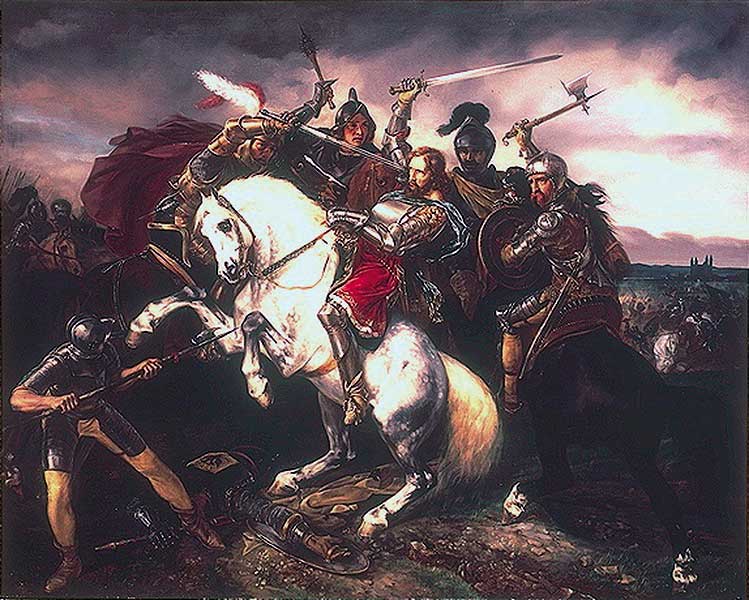
1298 - Battle of Gollheim (All Facts)
Battle in which Albert of Habsburg and his forces defeated Adolf of Nassau and his forces, thus allowing Albert of Habsburg to succeed Adolf of Nassau as King of Germany
1349 - Erfurt Massacre (All Facts)
Large-scale massacre of Jews encouraged by and associated with the activities of the Flagellants / Flagellant Brethren
Many Jewish survivors of the massacre fled to Poland
1356 - Diet of Nuremberg (All Facts)
Diet under which the Golden Bull of Holy Roman Emperor Charles IV was issued
1370 - Treaty of Stralsund (All Facts)
Peace Treaty between the Hanseatic League and the Kingdom of Denmark which ended the Danish-Hanseatic War
Peace Treaty between the Hanseatic League and the Kingdom of Denmark which gave the Hanseatic League of German towns trading privileges with and in the Kingdom of Denmark
1474 - Treaty of Utrecht (All Facts)
Treaty which gave the Hanseatic League generous trading privileges within England
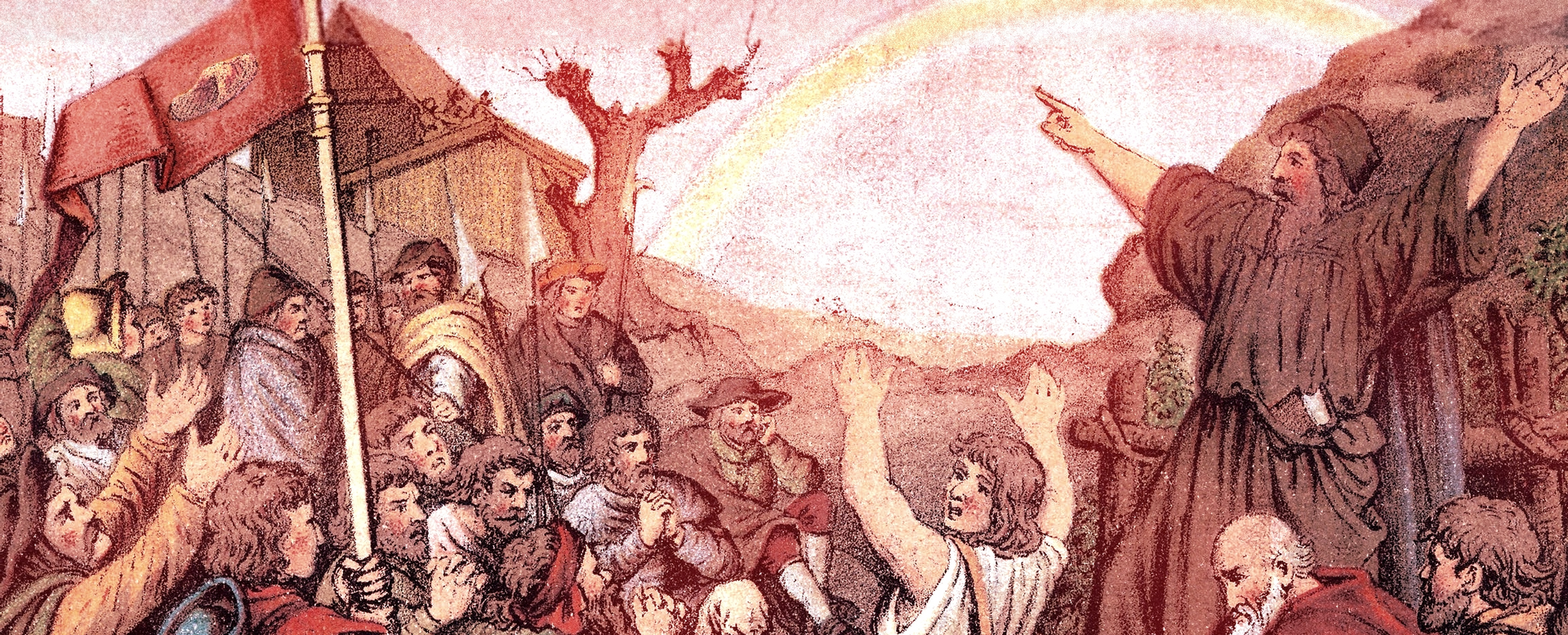
1493 - 1527 - Bundschuh Movement (All Facts)
Series of peasant rebellions that led to the Peasants’ War, named as the namesake due to the rebels’ symbol of a laced boot
In 1502, it broke out in the bishopric of Speyer
1494 - 1559 - Italian Wars (All Facts)
Series of conflicts between the Valois (France) and the Habsburgs (Spain and Holy Roman Empire) that began with the First Italian War and ended with the Ninth Italian War and mostly took place in (Northern) Italy
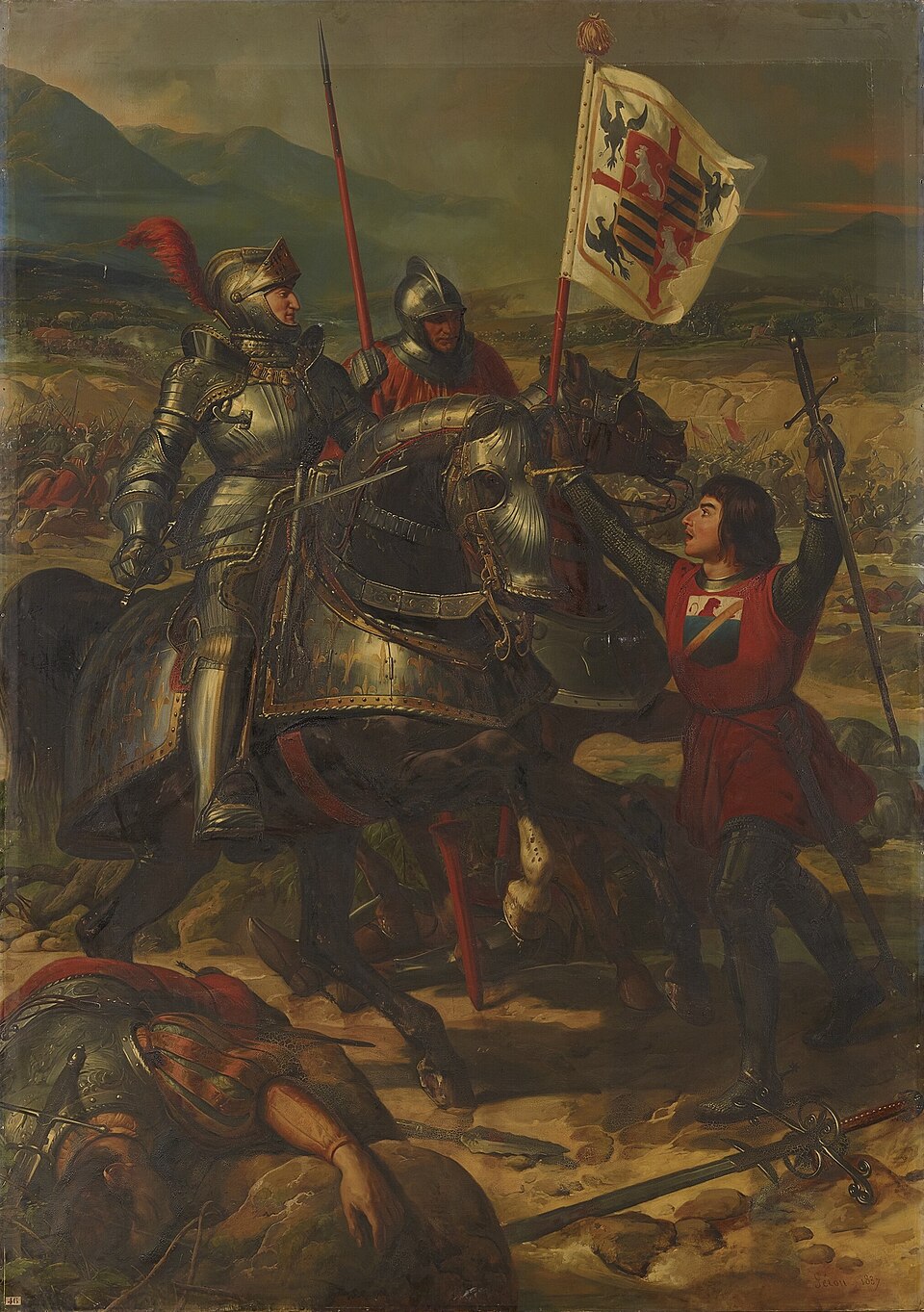
1494 - 1498 - First Italian War (All Facts)
Conflict in which the Habsburgs (Spain), with support from the Papacy and League of Venice, defeated the Valois (France)
Conflict that began with King Charles VIII of France’s invasion of the Kingdom of Naples
Conflict in which King Charles VIII and his army infected the Kingdom of Naples with the “French Pox” disease
Conflict in which King Charles VIII and his army was forced to retreat from Italy, thus halting French expansion and preventing France from securing a permanent foothold in the Kingdom of Naples

1508 - 1516 - Fourth Italian War / War of the League of Cambrai / War of the Holy League (All Facts)
Conflict in which the Valois (France) and Venice defeated the Habsburgs (Spain and the Holy Roman Empire) and England
Conflict in which the Valois (France) and Venice defeated the Habsburgs (Spain and the Holy Roman Empire) and England
Conflict which began when King Louis XII of France, Pope Julius II and the namesake league sought to punish the Republic of Venice for annexing papal provinces on the Adriatic Sea and thus attacked and defeated the Republic of Venice as a result in the Battle of Agnadello
Conflict in which Pope Julius II and the namesake league (including Venice, Spain, and Switzerland) then turned against France, whose foothold in northern Italy became too strong for the papacy and namesake league
Conflict in which Pope Julius II raised the cry to “clear the Barbarians out of Italy” (the French under King Louis XII), turning against the King of France after previously lifting the excommunication of Venice
Conflict which saw protracted war in Lombardy, the Romagna, and Veneto in northern Italy
Conflict in which King Francis of France secured the Duchy of Milan for the French
Conflict triggered by a Genoese revolt against French forces that had occupied the city
Conflict during which Matthäus Schiner dissuaded the Swiss (the Old Swiss Confederacy) from forming an alliance with the French against Pope Julius II
Conflict which saw the following battles take place including
Battle of Agnadello
Siege of Mirandola
Battle of Ravenna
Battle of the Spurs
Siege of Tournai
Battle of Novara
Battle of Marignano
Conflict which ended with
The Treaty of Fribourg
The Concordant of Bologna
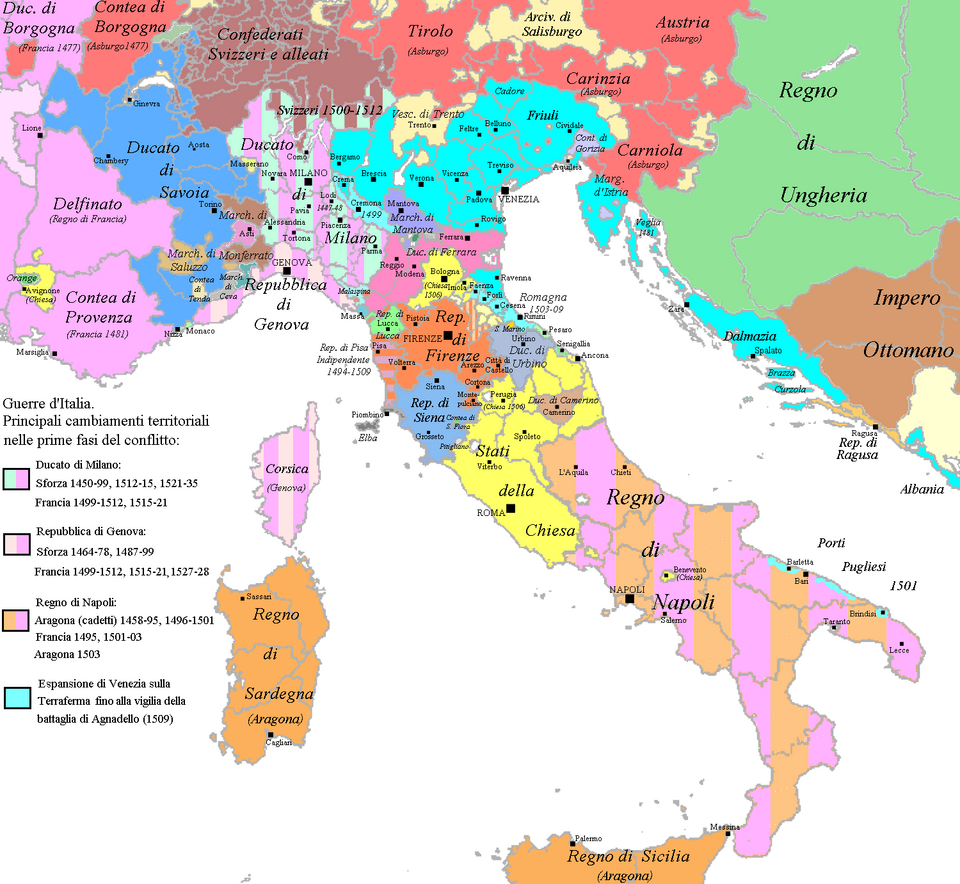
1508 - 1511 - League of Cambrai (All Facts)
(Temporary, short-lived) Military Alliance between King Louis XII of France, Maximilian of the Holy Roman Empire, Pope Julius II and the Papacy, and King Ferdinand of Spain aimed at conquering the Republic of Venice and its Italian possessions that initiated the Fourth Italian War / namesake War
Alliance which was the brainchild of Pope Julius II, ostensibly set up as a “Holy League” against the Ottoman Turks
The pope’s more immediate use for the league was to recover for the papacy the towns of the Romagna region under Venetian rule
However, the French gained too strong a foothold in northern Italy; and the namesake league eventually turned against France during the Fourth Italian War / namesake War
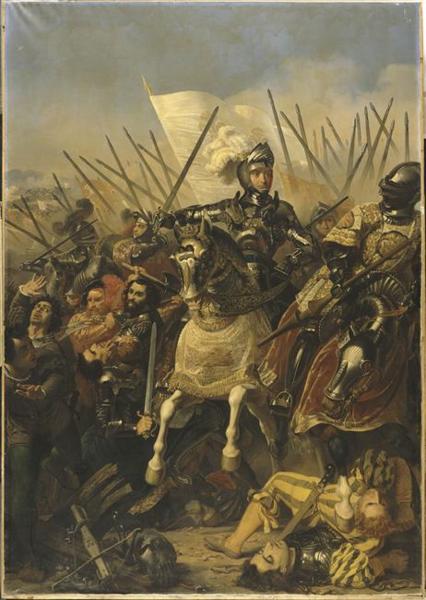
1509 - Battle of Agnadello (All Facts)
Battle in which Louis XII and his French forces, with support from France’s allies in the League of Cambrai (the Holy Roman Empire, the Papacy, and Spain) defeated the Republic of Venice during the Fourth Italian War / War of the League of Cambrai
Battle which allowed Pope Julius II to reoccupy the Romagna
Venice would eventually ally with France in the Fourth Italian War / War of the League of Cambrai
Battle which gave France a much stronger foothold in northern Italy
Battle after which the League of Cambrai turned against France, recognizing how strong it was becoming in the region of northern Italy
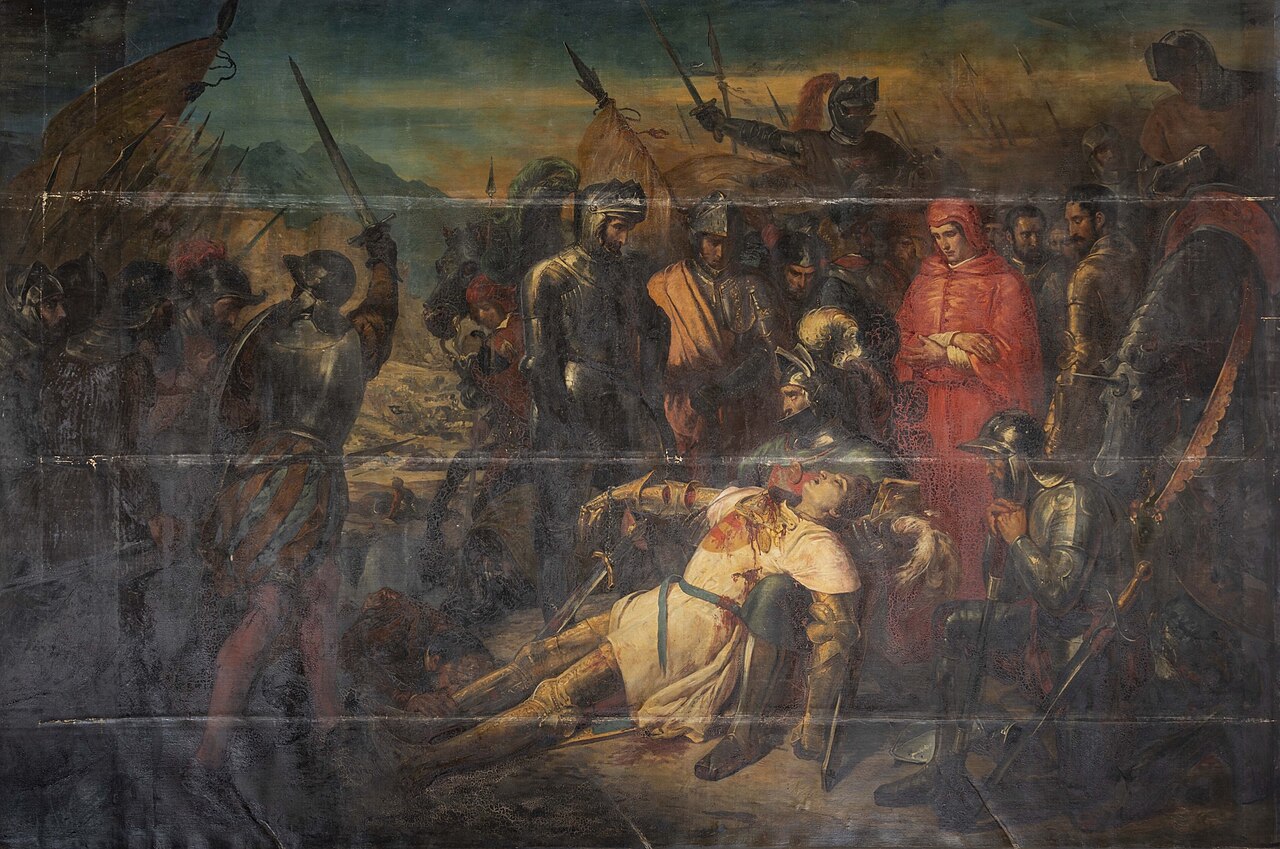
1512 - Battle of Ravenna (All Facts)
Battle in which France defeated Spain and the League of Cambrai / Holy League during the Fourth Italian War
Battle in which honors were declared even
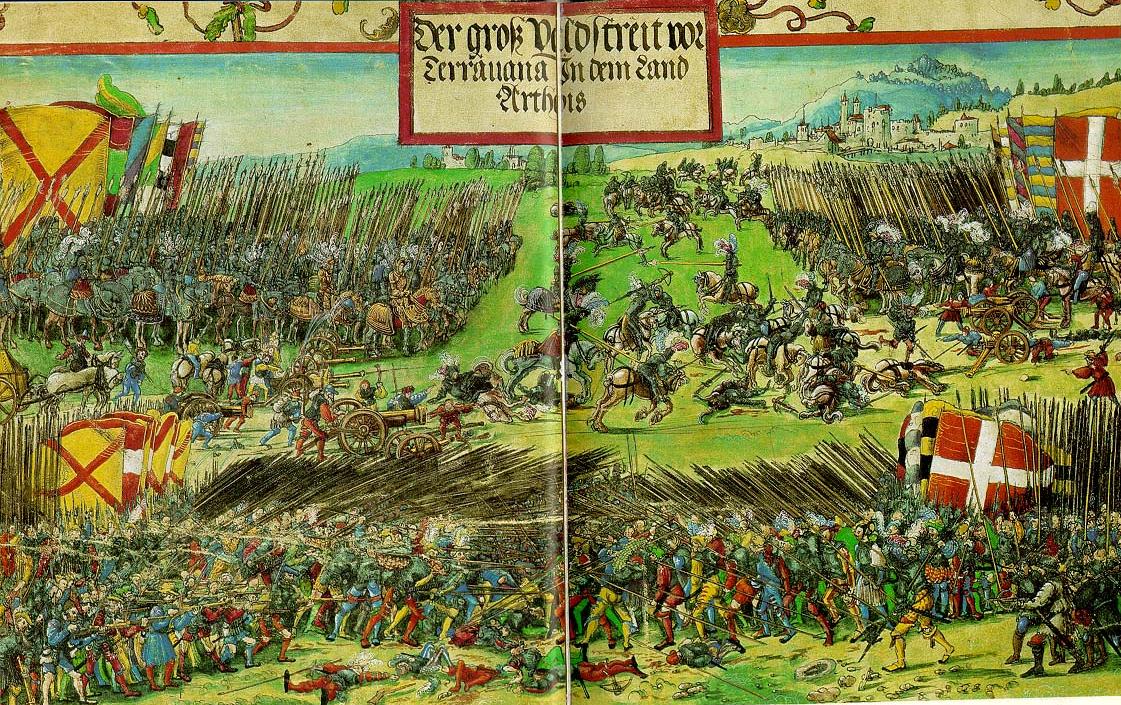
1513 - Battle of the Spurs (All Facts)
Battle in which Henry VIII of England and Holy Roman Emperor Maximilian and their forces defeated France during the Fourth Italian War / War of the League of Cambrai
1513 - Siege of Tournai (All Facts)
Battle in which King Henry VIII and England and Maximilian and the Holy Roman Empire defeated France during the Fourth Italian War / War of the League of Cambrai
Battle in which the namesake city, along with the city of Therouanne was captured

1513 - Battle of Novara (All Facts)
Battle in which Milan, with help from Pope Leo X and his Holy League, along with Cardinal Matthäus Schiner and his Swiss forces, defeated France and the Republic of Venice during the Fourth Italian War / War of the League of Cambrai
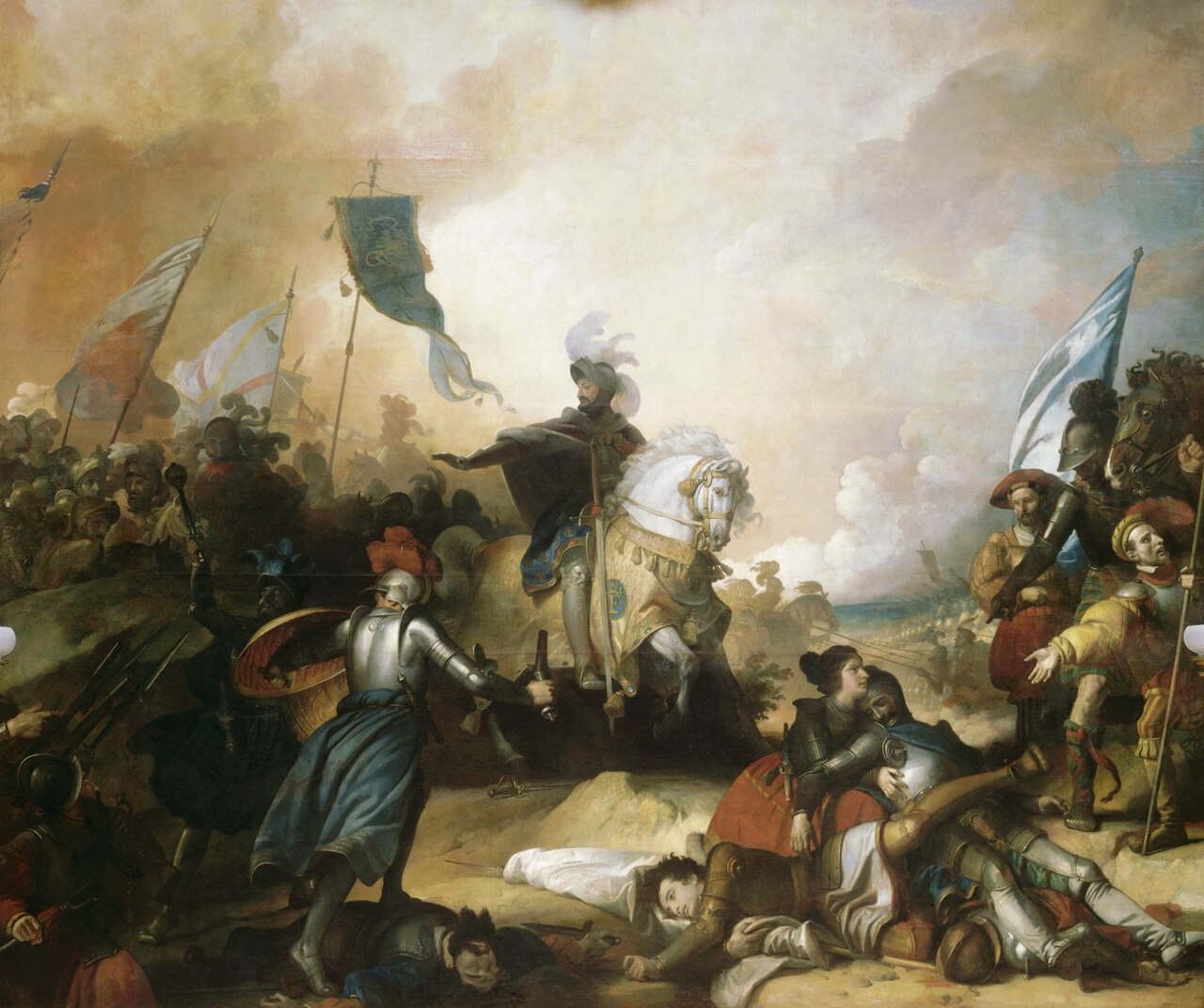
1515 - Battle of Marignano (All Facts)
Battle in which King Francis and France defeated Cardinal Matthias Schiner and Switzerland during the Fourth Italian War / War of the League of Cambrai
Battle in which King Francis
initially tried to bribe the Swiss to avoid fighting them, but that approach failed and cemented the legacy of French kings as bad at bribing
thus planned to fight against the Swiss carefully knowing he was forced to fight
negotiated treaties with England, Austria, and Venice prior to it
assembled an army of 40K French artilleryman and German light infantry
crossed the Alps with his forces and drove the Swiss back into Lombardy, where he tried but failed to set up a last-ditch negotiation with the Swiss at Gallarate where he demanded the recognition of French claims to Lombardy and Milan and the withdrawal of the Swiss from Italy
Battle in which the Swiss pikemen fought hard, but ultimately were defeated
Battle after which King Francis and his forces marched towards and seized Milan in Italy
Battle after which King Francis of France and Switzerland signed the Treaty of Fribourg
1518 - (First) Diet of Augsburg (All Facts)
Imperial Diet at which martin Luther refused to retract his then-widely-circulated 95 Theses
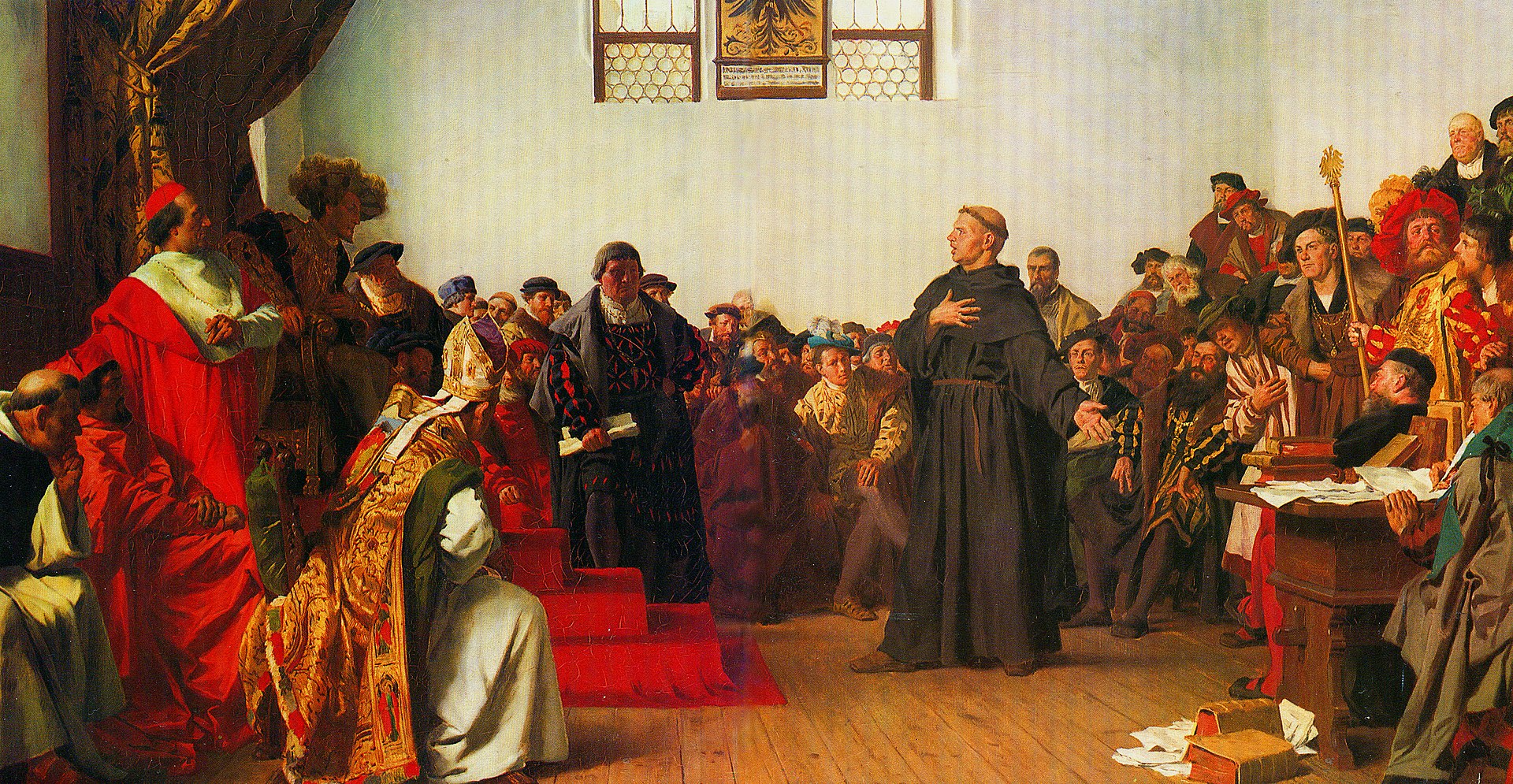
1521 - Diet of Worms (All Facts)
Imperial Diet called by Holy Roman Emperor Charles V
Imperial Diet during which Martin Luther
challenged the papal claim that the Papacy was to be the sole authority on the scriptures
questioned many of the rights of the priests
rejected the belief that bread and wine become the body and blood of Christ
affirmed Christians’ personal right to faith
Imperial Diet in which
friends of Martin Luther feared for his life as he confronted the young Holy Roman Emperor Charles V and refused to retract his theological views
the welcome of the German crowd showed that he struck a popular chord
Holy Roman Emperor Charles V feared that the revolutionary spirit of Luther’s speech might affect his power
Imperial Diet in which, as a result of Luther’s refusal to retract, denounced him and tried to have him executed
As a result, Luther was “kidnapped” for his own safety by Duke Frederick of Saxony a few weeks later
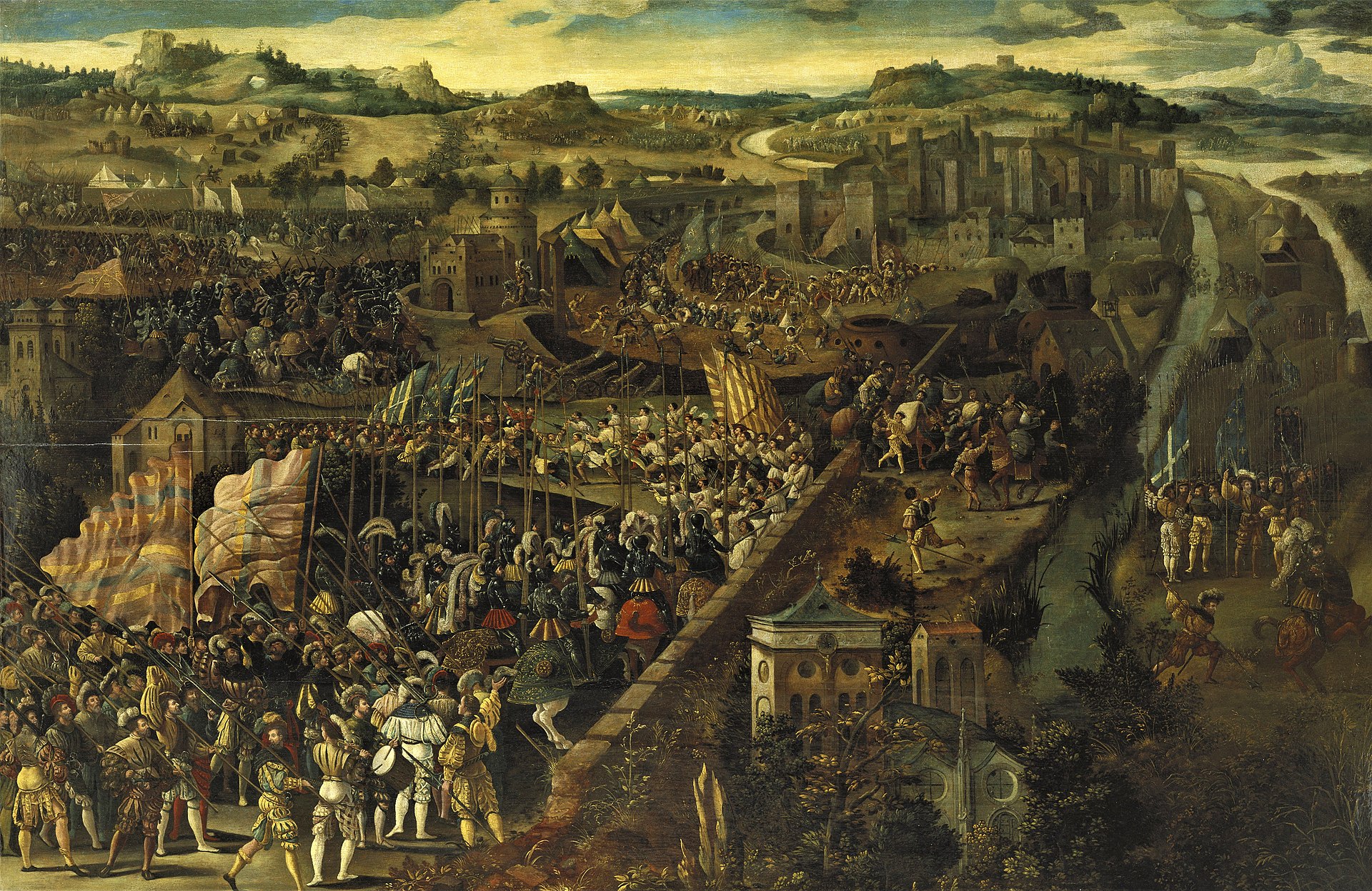
1521 - 1526 - Fifth Italian War / Four Years’ War (All Facts)
Conflict in which Charles V and the Habsburgs (the Holy Roman Empire and Spain) defeated King Francis and the Valois (France)
Conflict upon which King Francis of France lost his war with Holy Roman Emperor Charles V for supremacy in Europe
Conflict which saw the
Holy Roman Empire’s invasion of Champagne
Battle of Bicocca
Siege of Marseilles
Battle of Pavia
Conflict which saw
a modernization of European military forces, especially with regards to new arms (guns), defenses (Bastion Fort), and tactics / strategies
new tactics being developed for mounted troops using new carbines (arquebus) and horse pistols, which became the masters of the battlefield, replacing and eventually contributing to the elimination of armored cavalry and knights in armor
the implementation of the Bastion / Star Fort (“trace italienne;” a circuit of low, thick walls punctuated by square bastions), which
replaced the high and thin walls of the Middle Ages as new defenses
were designed to absorb the punishment of the heavy siege guns which were a part of every successful army by that time
changed the entire pattern of warfare because the cities protected by them could no longer be taken by traditional methods of blowing a hole in the walls and pouring infantry through the breach and instead forced towns to be encircled by siege-works and batteries and starved and frightened into submission
essentially made warfare more a matter of engineering and logistics
the advent of the gun bring about great changes at sea since
ships no longer rammed and boarded each other, but pounded each other with formidable arrays of guns firing through ports in ships’ sides
gunships eventually set the pattern which all maritime nations must have followed if they wanted to avoid facing inevitable defeat
Conflict which ended with the Treaty of Madrid
1522 - Battle of Bicocca (All Facts)
Battle in which the Habsburgs (Spain and the Holy Roman Empire), supported by the Papacy and the Duchy of Milan, defeated the Valois (France), supported by the Republic of Venice and Switzerland, during the Fifth Italian War / Four Years’ War
Battle after which the imperial army of the Holy Roman Empire occupied the Republic of Genoa, where a doge who supported Holy Roman Emperor Charles V was appointed
1522 - 1523 - Knights’ War / Knights’ Revolt (All Facts)
Failed Revolt of small, landowning German Knights within but against the Holy Roman Empire led by Ulrich von Hutten and Franz von Sickingen
They revolted over the loss of their power due to
changes in the art of war, with growing emphasis on
firearms and artillery
the use of mercenaries
the German princes’ growing political influence through their
councils
chancelleries
The German Knights’ forces were eventually scattered at Landstuhl and their leaders fled
However, this conflict most likely inspired the German Peasants’ War a few years after it

1524 - 1525 - German Peasants’ War / German Peasants’ Revolt (All Facts)
Failed Popular Revolt in some German-speaking areas in Central Europe, especially in Germany (the Holy Roman Empire) amongst the peasants and common people against the German Princes and the Holy Roman Empire
Revolt which was the largest and most widespread popular uprising in Europe prior to the French Revolution
Revolt which
began in Bavaria and spread rapidly to Hesse, Franconia, Thuringia, Saxony, and Tyrol
Revolt which consisted of a series of local uprisings against oppression by
German princes
German landlords
the German Catholic Church
was inspired by
Martin Luther’s teachings
the radical Christian communities springing up at the time like the one set up at Allstedt based on common ownership
Revolt during which the “Twelve Articles” were drafted up by the peasants whom fought in it
Revolt supported by Thomas Muntzer
Revolt in which Thomas Muntzer was beheaded
Revolt in which peasants speared the Count of Helfenstein in front of his wife and child at Weinsberg
This atrocity caused Martin Luther to condemn the namesake conflict in his work, “Against the Murdering Thieving Hordes of Peasants”
1524 - Siege of Marseilles (All Facts)
Battle in which Charles de Bourbon, a Frenchman, became lieutenant for Holy Roman Emperor Charles V and the Habsburgs and defeated the Valois (France) after invading Provence

1525 - Battle of Frankenhausen (All Facts)
Battle in which Thomas Muntzer and the German Peasants’ Army was defeated by the Holy Roman Empire and German princes during the German Peasants’ War / German Peasants’ Revolt
Battle after which Thomas Muntzer was beheaded

1525 - Battle of Pavia (All Facts)
Battle in which the Habsburgs (Spain and the Holy Roman Empire) defeated King Francis and the Valois (France) during the Fifth Italian War / Four Years’ War
Battle which took place in Lombardy in Italy
Battle before which
Pope Clement VII tried and failed to mediate between its two parties and battle was joined before first light in the morning
Battle which began when
King Francis of France decided to lay siege to the namesake city; with an army of French and Italian infantry, German and Swiss mercenaries, and a strong train of artillery
Battle during which
the siege initially went well; the French guns having broke down the defenses and King Francis’s regiments having stormed into the breaches
Antonio de Levya, the Spanish governor of the namesake town, had built new fortifications inside the walls, making it so that the French were routed by the namesake town’s defenders
the French forces retreated to mount a classic siege throughout the winter
King Francis, reinforced by Venetian troops, became sure of victory as the namesake town ran short of food and ammunition
the imperial forces of the Holy Roman Empire had been gathering at the town of Lodi, near the namesake, and had had marched on the namesake earlier in the month catching King Francis between the anvil of the namesake and the hammer of the attacking imperial army
the French guns have King Francis and France the advantage at first, but, he eventually ordered his forced to cease fire, since he believed in chivalry rather than guns
King Francis led his knights in a disorganized charge without waiting for the infantry and in the shambles that ensued 6K Frenchmen died
Battle which ended when
King Francis of France had his horse shot from under him by an arquebus (a new type of gun at the time) and demounted, fought on foot, only to have his face blooded and his having surrendered his sword to the enemy
Battle after which
King Francis of France was held captive by Lannoy (the viceroy of the Kingdom of Naples)
King Francis of France essentially lost his war with Holy Roman Emperor Charles V for supremacy in Europe
King Francis of France was forced to sign a humiliating peace treaty with Holy Roman Emperor Charles V
1526 - Treaty of Madrid (All Facts)
Peace Treaty signed between King Francis of France (Valois) and Charles V of the Holy Roman Empire and Spain (Habsburgs), which ended the Fifth Italian War / Four Years’ War
Peace Treaty in which
Holy Roman Emperor Charles V agreed to
release King Francis of France from captivity
King Francis of France agreed to
abandon and concede Burgundy to the Holy Roman Empire
give up claims to Flanders, Artois, Tournai, and all of Italy
pardon the rebel Charles of Bourbon
Peace Treaty which was declared null and void by King Francis of France following his release from captivity
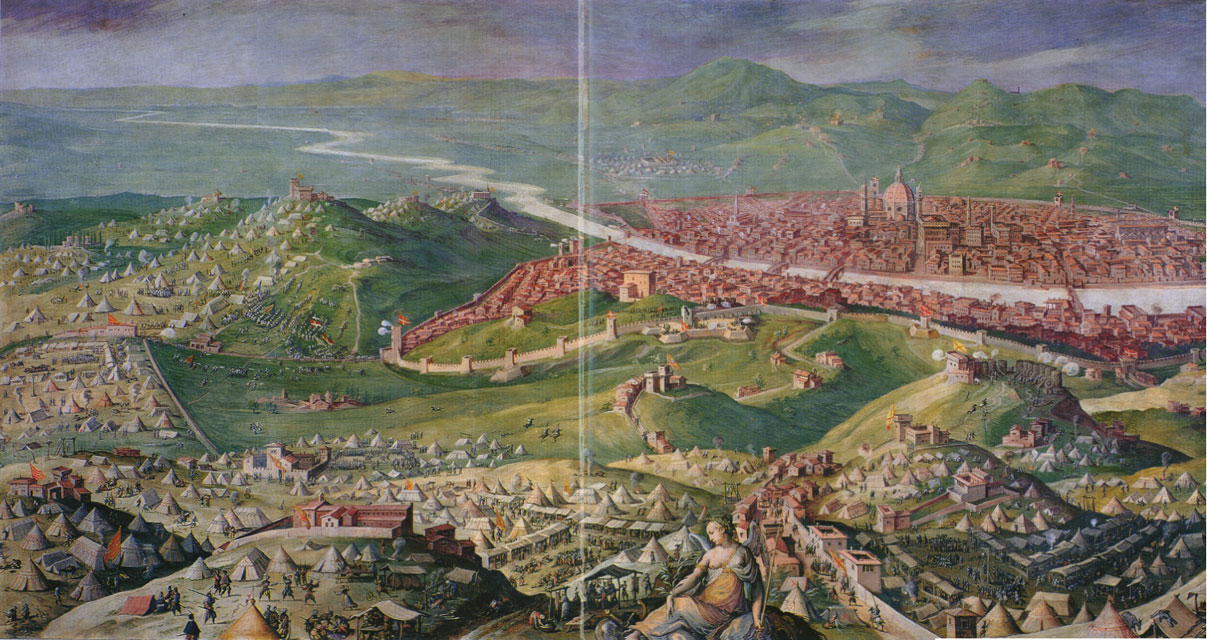
1526 - 1530 - Sixth Italian War / War of the League of Cognac (All Facts)
Conflict in which Holy Roman Emperor Charles V and the Habsburgs (the Holy Roman Empire and Spain) defeated King Francis and the Valois (France), supported by the League of Cognac (England, Switzerland, and the Italian city-states of Florence, Venice, Milan, and Genoa)
Conflict which ended the Republic of Florence (it was no longer a republic after the namesake conflict)
Conflict during which the Papacy switched sides, initially supporting the League of Cognac against Charles V and the Holy Roman Empire, but then defecting to the Habsburgs and Charles V and the Holy Roman Empire
Conflict which saw
The Sack of Rome
Conflict which ended with
The Treaty of Cambrai / Ladies Peace / “Pax de Daimes”
1526 - 1529 - League of Cognac (All Facts)
Anti-Habsburg military alliance formed by France, Venice, Florence, and Milan; as well as England, Switzerland, and most importantly, the Papacy, to curb the overwhelming dominance in Italy of Charles V and the Holy Roman Empire, Spain, and Italian city-states that supported him
It was initially formed by the Papacy, but the Papacy, by the end of the namesake conflict / Sixth Italian War, switched to the side of Charles V and the Holy Roman Empire
1526 - (First) Diet of Speyer (All Facts)
Imperial Diet which allowed each prince to decide the religious allegiance of his state
Imperial Diet which found that because an agreement could not be obtained in the prior Imperial Diet of Worms, each city and territory involved was still independent from the authority of the empire via their prince’s decision of religious allegiance and thus could allow Protestantism to continue unaffected if the prince deemed it so
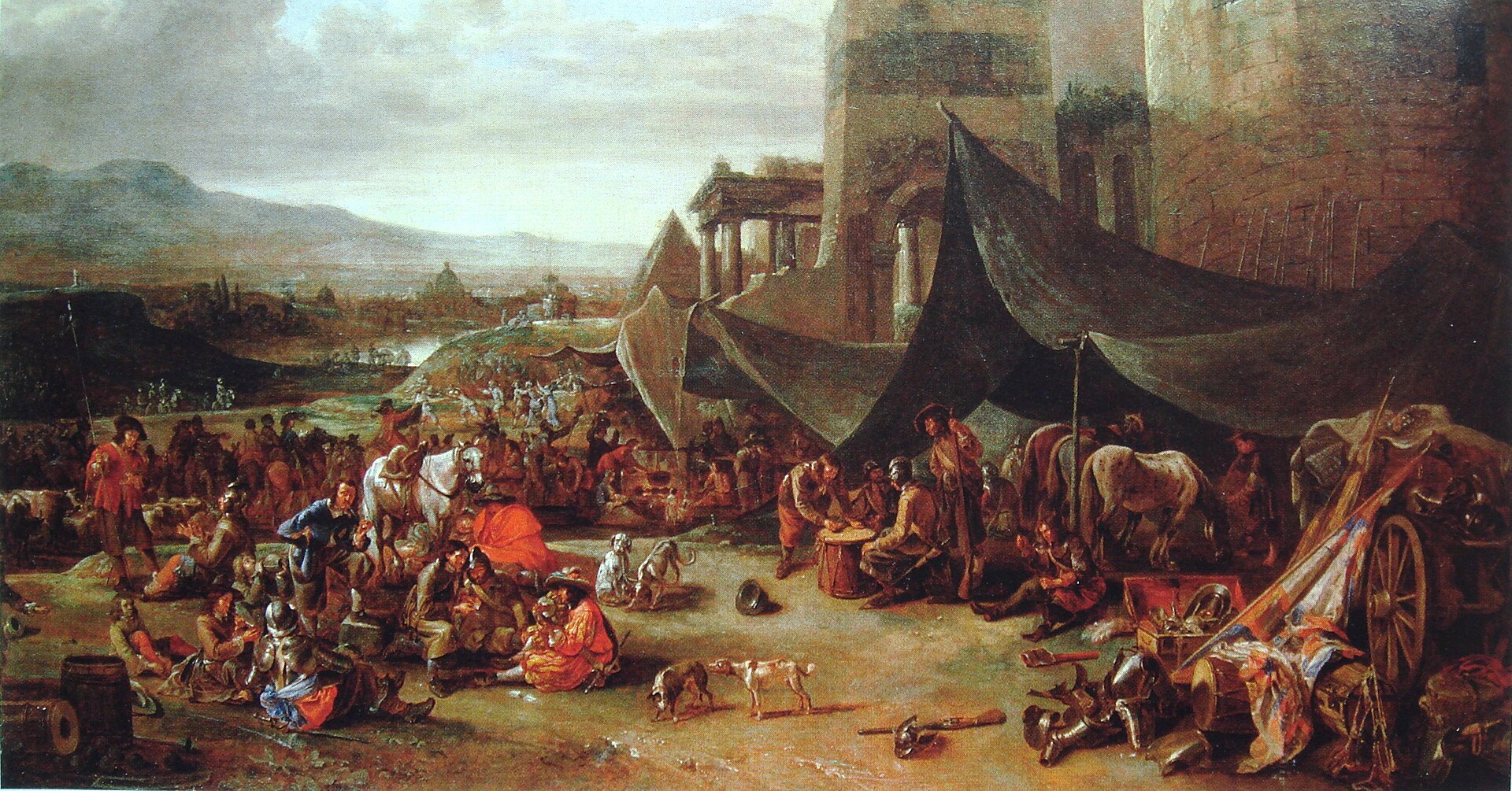
1527 - Sack of Rome (All Facts)
Conflict in which 15K German mercenaries sacked the namesake city and burned, looted, and raped in an orgy of destruction there
Conflict in which the Vatican Palace was occupied by Lutheran troops, in which
its chapels were used as stables
Raphael’s paintings in the papal apartments were covered with graffiti
Conflict in which Pope Clement VII beseeched Holy Roman Emperor Charles V to call of the men who were destroying the city
It was too late, however, as the imperial militias there mutinied as a result of not being paid, fed, or led by the Holy Roman Empire or any of its surviving commanders and fell upon one of the wealthiest cities in the world
The commanders of the armies sent to Italy had left before Pope Clement VII and Holy Roman Emperor Charles V had signed a truce
1529 - Treaty of Cambrai / Ladies Peace / “Pax de Daimes” (All Facts)
Peace Treaty signed between Louise of Savoy (on behalf of King Francis of France) and Margaret of Austria (on behalf of Holy Roman Emperor Charles V) which ended the Sixth Italian War / War of the League of Cognac
Peace Treaty in which
King Francis of France
renounced all its rights in Italy, Flanders, and Artois
agreed to pay a ransom of two million crowns
Charles V of the Holy Roman Empire
renounced any claims to Burgundy
1529 - (Second) Diet of Speyer (All Facts)
Imperial Diet during which the “Protestation at Speyer” occurred and the term “Protestantism” / “Protestants” was coined
Imperial Diet dominated by Catholics which condemned the First Diet of its kind and that Diet’s results and thus prohibited future reformation
Imperial Diet in which 19 reformed states protested against the repeal of the edict that came out of the (First) Diet of Speyer

1529 - 1533 - First Habsburg-Ottoman War (All Facts)
War in which Suleiman and his Ottoman forces defeated Ferdinand and the Habsburgs (Holy Roman Empire and Spain)
War which saw
The Siege of Vienna
The Siege of Kőszeg

1529 - Siege of Vienna (All Facts)
Battle in which the Holy Roman Empire and Spain and their combined forces (nearly) defeated Suleiman and his Ottoman forces in the Habsburg-Ottoman War
Battle before which the Imperial Holy Roman Diet assembled in Innsbruck and voted 120K Rhenish guilders for defense against the Ottoman forces
In addition, the Diet of Speyer had promised an army of 16K men and 4K cavalry, despite opposition of Philip of Hesse and other German Protestant Princes
Battle in which the Ottoman troops were first met by a garrison of seasoned veterans, and, wave after wave Suleiman and his forces were beaten back and made no significant breach into the city walls
Battle in which Suleiman and his Ottoman forces lost a month battling through heavy storms, building bridges across rivers, and leading his troops through treacherous terrain of streams and marshes
Battle in which bad weather and disease had been the crucial factors in preventing the Ottomans from gaining control of Austria, not Christian arms or strategies
Battle in which Suleiman and his forces lost horses and men from hunger and disease
Battle after which the Ottoman forces, which were encamped beneath the namesake Austrian city walls for three weeks, were ordered by Suleiman to retreat, and headed back towards Belgrade
1529 - Protestation at Speyer (All Facts)
Incident in which the letter, “A Protestation,” was signed by six of Germany’s (Protestant) Princes and the burghers of 14 cities, thus rejecting the (Second) Diet of Speyer and in which the signatories of the letter were dubbed “Protestants”
Incident in which a petition was signed against an imperial ban of Martin Luther, as well as the proscription of his works and teachings, and called for the unhindered spread of the evangelical faith
Incident which was seen as a challenge to the authority of the Holy Roman Emperor Charles V
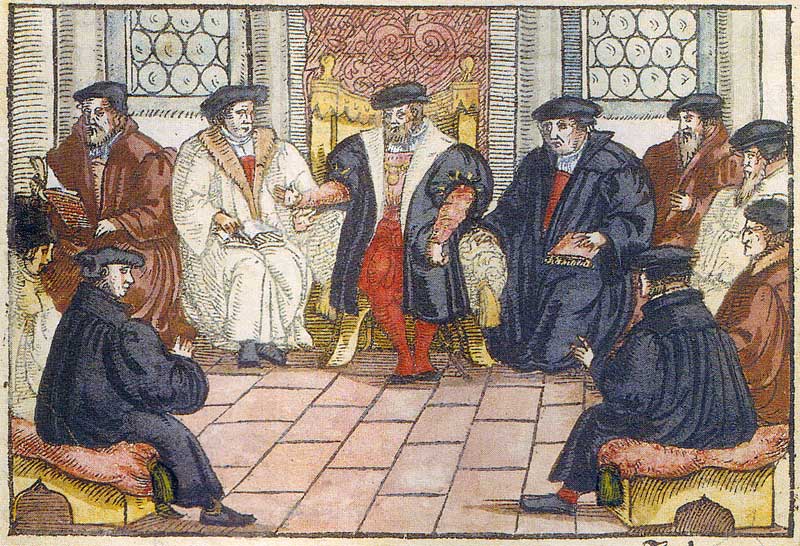
1529 - Marburg Colloquy (All Facts)
Meeting organized by Philip of Hesse which sought to close the emerging gap in Protestant theology between Martin Luther and Ulrich Zwingli
Meeting in which Philip of Hesse invited the reformers of Wittenberg, Strasbourg, and Zurich to meet in the namesake castle and tried (and ultimately failed) to resolve their theological differences which emerged as divisions within the Protestant Reformation
Meeting in which Philip of Hesse managed to persuade Martin Luther and Ulrich Zwingli to visit his castle in the namesake town in Germany to discuss their views, along with other Protestant reformers of the time including
Philip Melanchthon
Johannes Oecolampadius
Meeting in which they all signed off on fifteen articles, agreeing on all items of doctrine except the Eucharist
Meeting in which Luther and Zwingli agreed and
renounced transubstantiation
renounced the belief that the eucharist was a sacrifice for the living and the dead
insisted on communion in both kinds of Christ
Meeting in which Luther and Zwingli disagreed on
whether or not Christ's body and blood are present in the Eucharist
Meeting which ended badly, as Luther and Zwingli remained divided politically
Luther refused to move against Holy Roman Emperor Charles V
Zwingli was keen for the Swiss to revolt against the Holy Roman Empire
1529 - Treaty of Barcelona (All Facts)
Treaty between Holy Roman Emperor Charles V and Pope Clement VII of the Papacy, in which the two leaders settled their differences
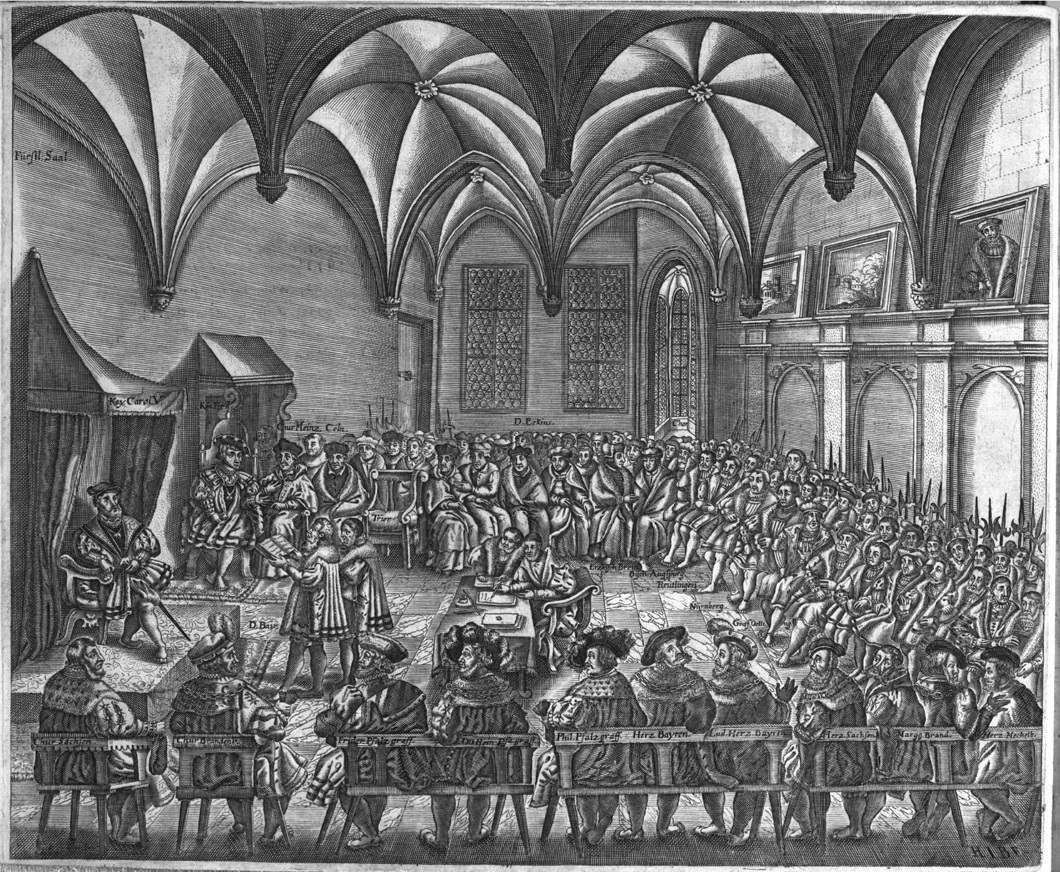
1530 - (Second) Diet of Augsburg (All Facts)
Imperial Diet in which the Catholics defeated the Protestants and decided that the Protestants (Lutherans) must recognize the Pope or would be threatened with force if they failed to do so
As a result, the more moderate Lutherans united with the more militant and radical Zwinglians (Swiss)
Imperial Diet in which Holy Roman Emperor Charles V and the Catholics and Philip of Melanchthon and the Protestants both wanted to achieve unity
They were keen on compromise and unity in order to defend themselves against the Muslim Ottoman Turks who had just besieged Vienna a year prior
However, close observers saw this as nothing more than window-dressing as their religious differences remained much deeper in reality
Imperial Diet in which the namesake Confession was presented in an (failed) attempt to avoid a permanent split and thus achieve reconciliation with the Catholic Church
Imperial Diet attended by Philip Melanchthon as Martin Luther was still in exile from the Holy Roman Empire
1532 - Peace of Nuremberg (All Facts)
Treaty signed between Holy Roman Emperor Charles V and the Schmalkaldic League in which the principalities in the League were granted freedom of worship in exchange for military aid of the Holy Roman Empire against the Ottoman Turks
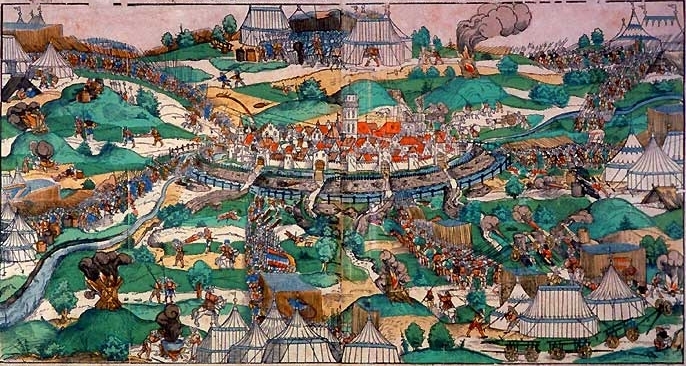
1534 - 1535 - Anabaptist Munster Rebellion (All Facts)
Incident in which the town of Munster was taken by an alliance of Catholic and Protestant troops after it had been controlled by the Anabaptist revolutionaries for two years
Incident in which Anabaptists
killed anyone unbaptized
seized property
proclaimed world rebellion
Incident in which the town of Munster’s Anabaptist inhabitants were massacred or forced into hiding as a tidal wave of disgust swept Germany as well as the Netherlands (where the Anabaptist movement spread) and Switzerland (where the Anabaptist movement started)
Incident in which the Anabaptist Movement’s ringleaders were seized, including John of Leyden

1535 - Conquest of Tunis (All Facts)
Conflict in which King and Holy Roman Emperor Charles and his forces defeated Hayreddin Barbarossa and his Ottoman forces and takes the namesake city from him during the
Conflict in which 60K allied troops took the namesake city, along with the port of La Goleta and the bulk of Barbarossa’s fleet of 80 galleys
Conflict in which King and Holy Roman Emperor Charles allowed his soldiers five days of pillaging and 30K inhabitants were reported to have been killed
Conflict which began when King and Holy Roman Emperor Charles chose to invade after Barbarossa’s fleet had ravaged southern Italy at the behest of the Turkish sultan
As a result, King and Holy Roman Emperor Charles believed that Spanish possession of the namesake would effectively cut off Barbarossa from Constantinople
Conflict in which a combined fleet of Spanish and Genoan galleys sailed from Barcelona to Sardinia, where more ships joined their fleet with 22K German and Italian troops
Conflict in which King and Holy Roman Emperor Charles’ shock troops, the formidable “tercio” were the first to land at La Goleta, followed by artillery and a detachment of cavalry
Conflict in which Barbarossa chose to remain behind the walls, trusting the extreme heat to wear down the enemy
War in which many of King and Holy Roman Emperor Charles’s forces dying of dysentery
Conflict in which Barbarossa had not reckoned with the firepower of the fleet and land-artillery who pounded the walls for five hours before the infantry broke through, causing the namesake to fall more easily
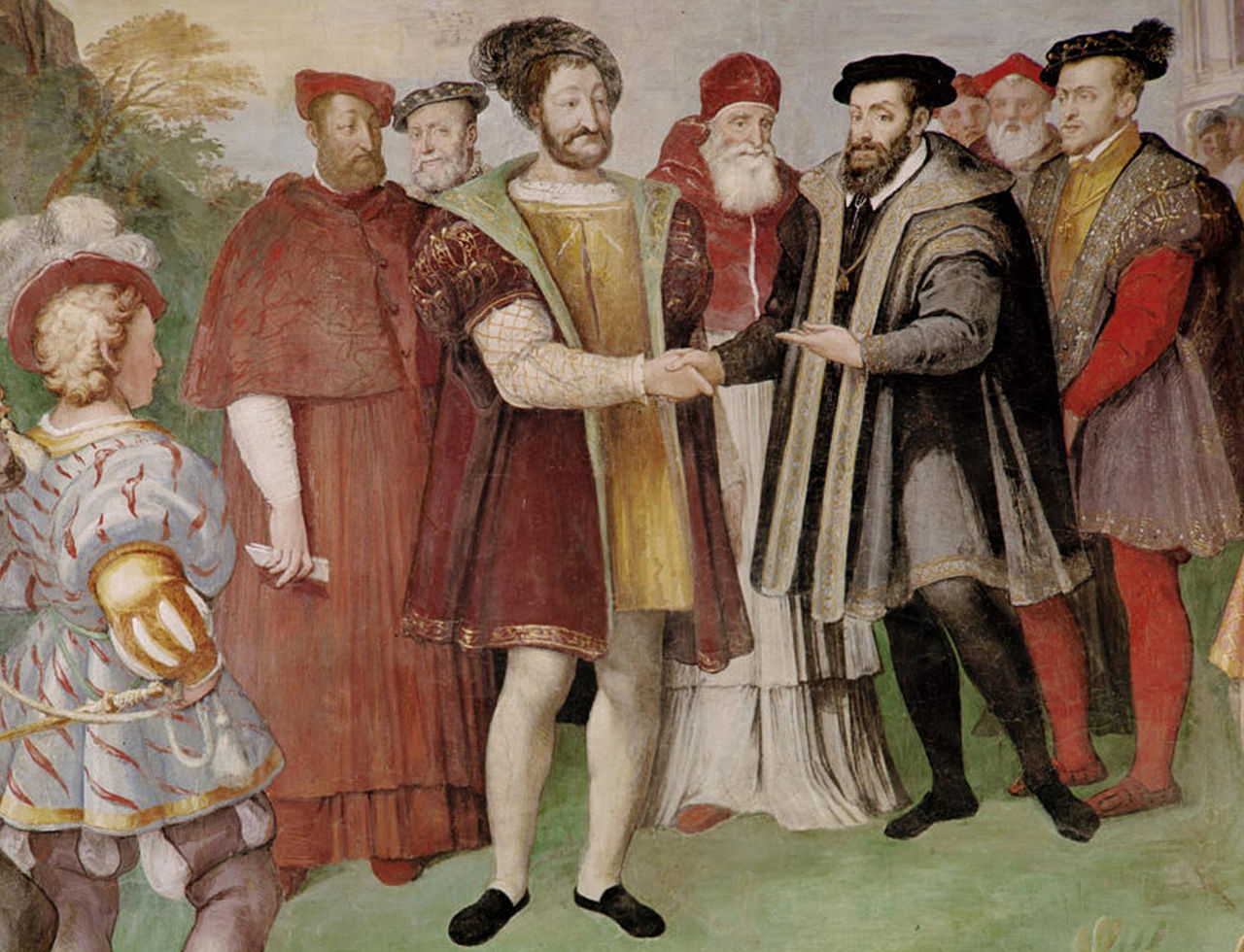
1536 - 1538 - Seventh-Italian War (All Facts)
Conflict between King Francis of France (Valois), with support from the Ottoman Turks; and Charles V of Spain and the Holy Roman Empire (Habsburgs) which ended in a stalemate
Conflict which began when
King Francis of France tried to invade and pursue Piedmont
Holy Roman Emperor Charles V’s troops invaded Provence, in pursuit of the army of King Francis of France
Conflict during which
Anne of Montmorency drove back Holy Roman Emperor Charles V and his forces, having applied scorched-earth tactics
Conflict which ended with the Truce of Nice
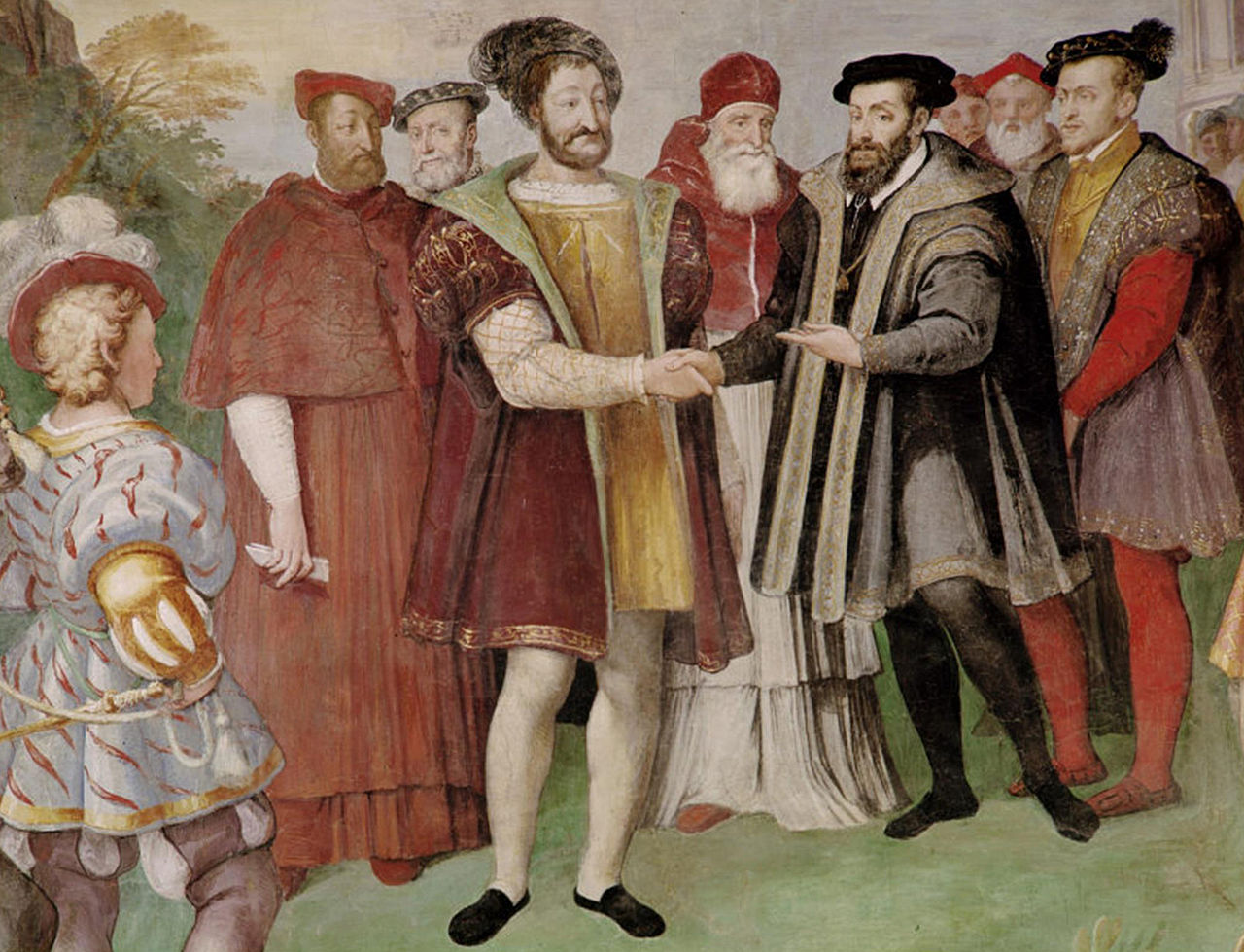
1538 - Truce of Nice (All Facts)
Truce made between King Francis of France (Valois) and Charles V of the Holy Roman Empire and Spain (Habsburgs), which ended the Seventh Italian War / Four Years’ War
Truce in which France gained Piedmont and Savoy from the Holy Roman Empire
1538 - Holy League (All Facts)
Alliance of Pope Paul III and the Papacy, Charles V and the Holy Roman Empire, and the Republic of Venice formed to counteract the Ottoman Turks during the Third Venetian-Ottoman War
1539 - Treaty of Toledo (All Facts)
Treaty between King Francis of France and Charles V of the Holy Roman Empire, in which they agreed that neither of them would form future alliances with England; given King Henry VIII’s split with the Roman Catholic Church
1539 - Treaty of Frankfurt / Truce of Frankfurt (All Facts)
Peace Treaty between Holy Roman Emperor Charles V and the Catholics and Philip Melanchthon and the Protestants at the namesake German city

1540 - 1547 - Third Habsburg-Ottoman War (All Facts)
War in which Suleiman and his Ottoman forces defeated Ferdinand and the Habsburgs (Holy Roman Empire and Spain)
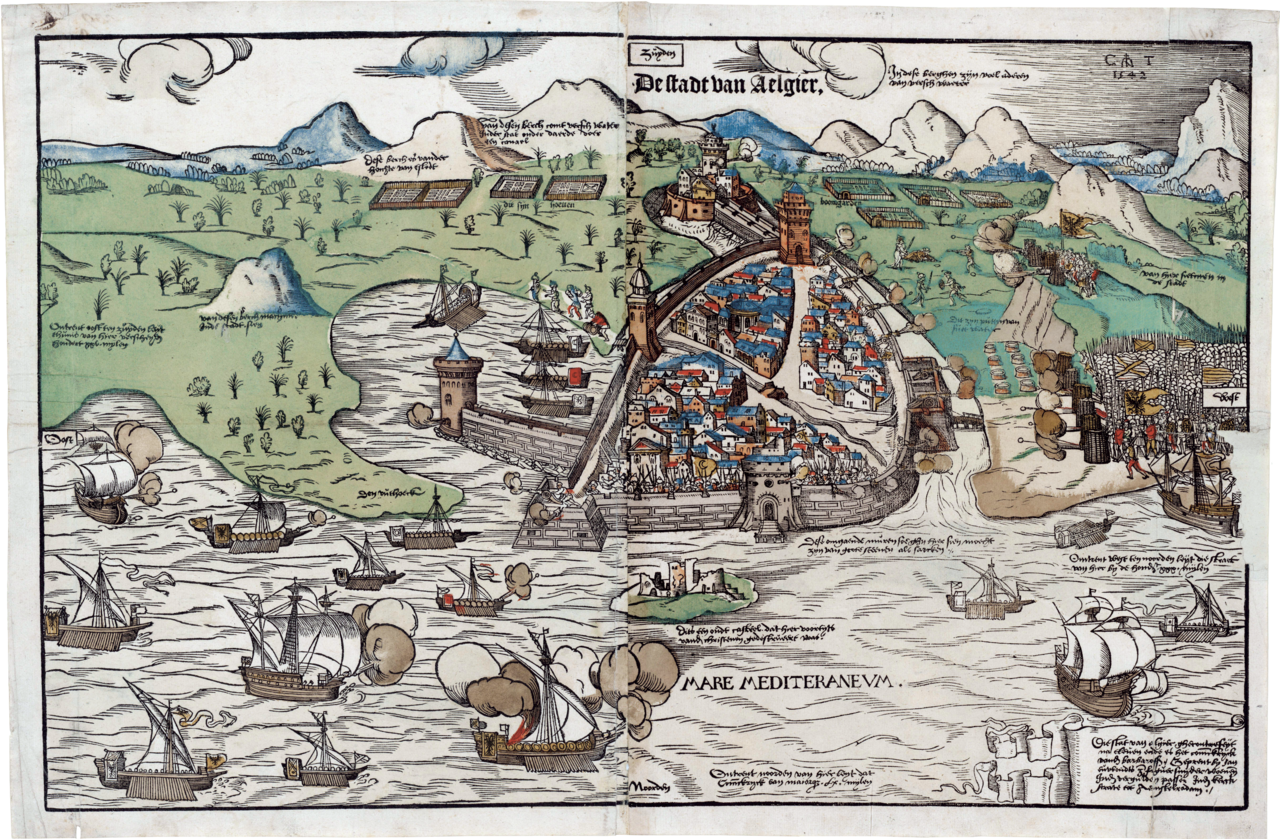
1541 - Battle of Algiers (All Facts)
Battle in which Holy Roman Emperor Charles V and his forces were defeated by the Ottomans of the Regency of Algiers during the Ottoman-Habsburg Wars
1542 - Treaty of Nuremberg (All Facts)
Peace Treaty between Holy Roman Emperor Charles V and the Duke of Lorraine at the time
Peace Treaty which made the Duchy of Lorraine become independent of the Holy Roman Empire

1542 - 1546 - Eighth Italian War (All Facts)
Conflict between King Francis of France (Valois), with support from the Ottoman Empire; and Charles V of Spain and the Holy Roman Empire (Habsburgs), with support from Italy and King Henry VIII and England; which ended in a stalemate
Conflict which began when
King Francis of France reopened hostilities with Holy Roman Emperor Charles V after he had appointed his son Philip to claim the Duchy of Milan
Holy Roman Emperor Charles V violated the Treaty of Toledo and allied with King Henry VIII of England against King Francis and France
Conflict which saw the
Siege of Nice
Battle of Ceresole
Siege of Saint-Dizier
Siege of Boulogne
Conflict which contributed to the delay of the convention of the Council of Trent
Conflict which ended with the Treaty of Crepy
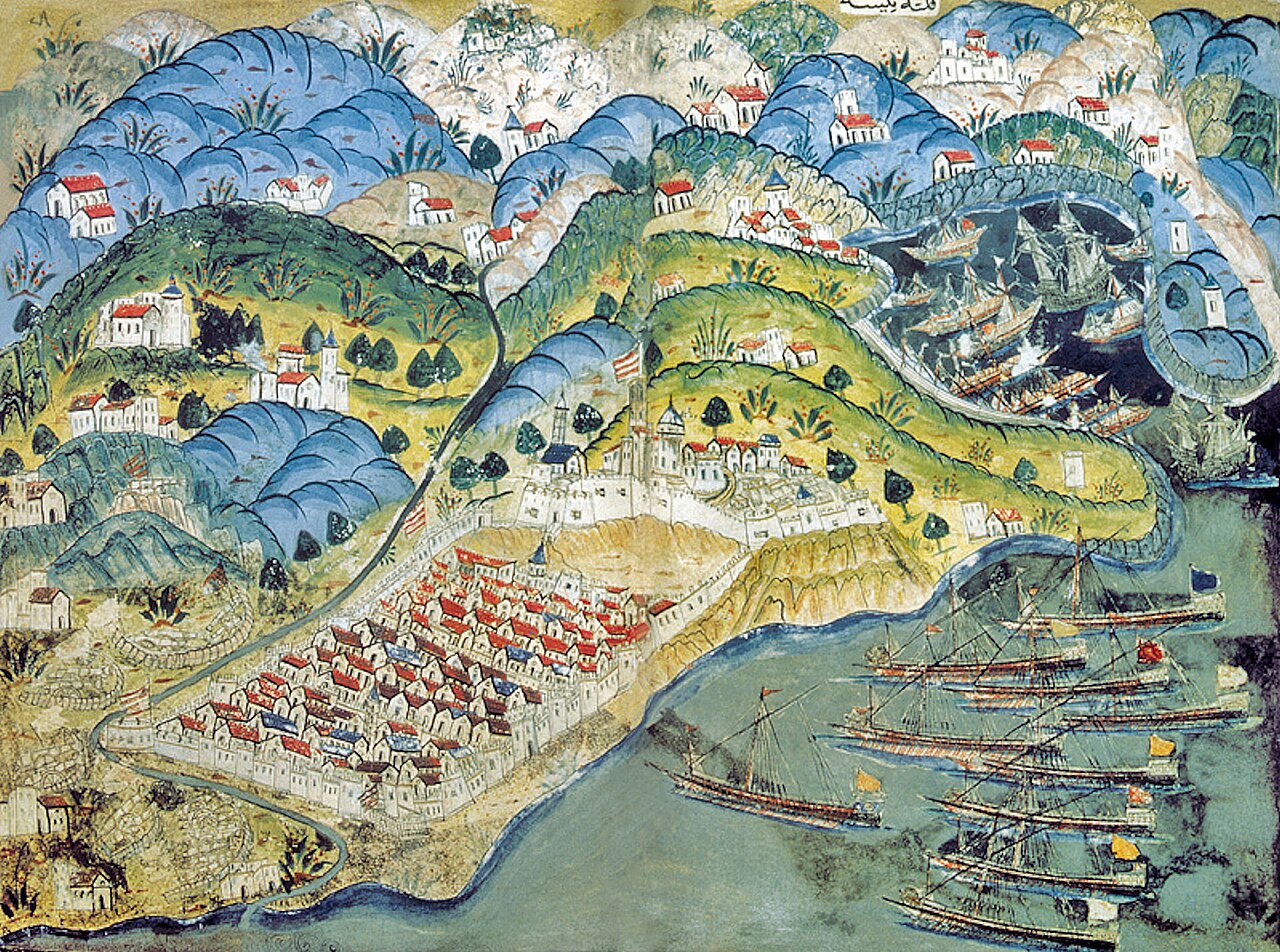
1543 - Siege of Nice (All Facts)
Battle in which the Holy Roman Empire, Spain, and Italy (Habsburgs) defeated France and the Ottoman Empire during the Eighth Italian War
Battle during which
Hayreddin Barbarossa and his Ottoman forces bombarded, besieged, and sacked the namesake Holy Roman imperial town in France, capturing the namesake gateway to Italy from France
the namesake town was captured and sacked by Hayreddin Barbarossa and Turkish pirates rampaged through its burning ruins, looting and raping and setting it ablaze
Battle which strained relations between the French and Ottoman Turks given that the Turkish pirates violated the agreement made between the governor of the town and the joint French and Turkish forces, in which the French blamed the Turks and the Turks blamed the French
Battle during which Muslims paced the decks of Hayreddin Barbarossa’s ships while Christian slaves, some of which were French, were chained to the galley’s oars and rowing benches
Battle during which the Ottoman forces took to raiding French villages, carrying off peasants to replace rowers killed by the fever
Battle during which the Ottoman forces took Christian slaves and sold them in the marketplace as the muezzin called for Muslim prayer in Christian Toulon
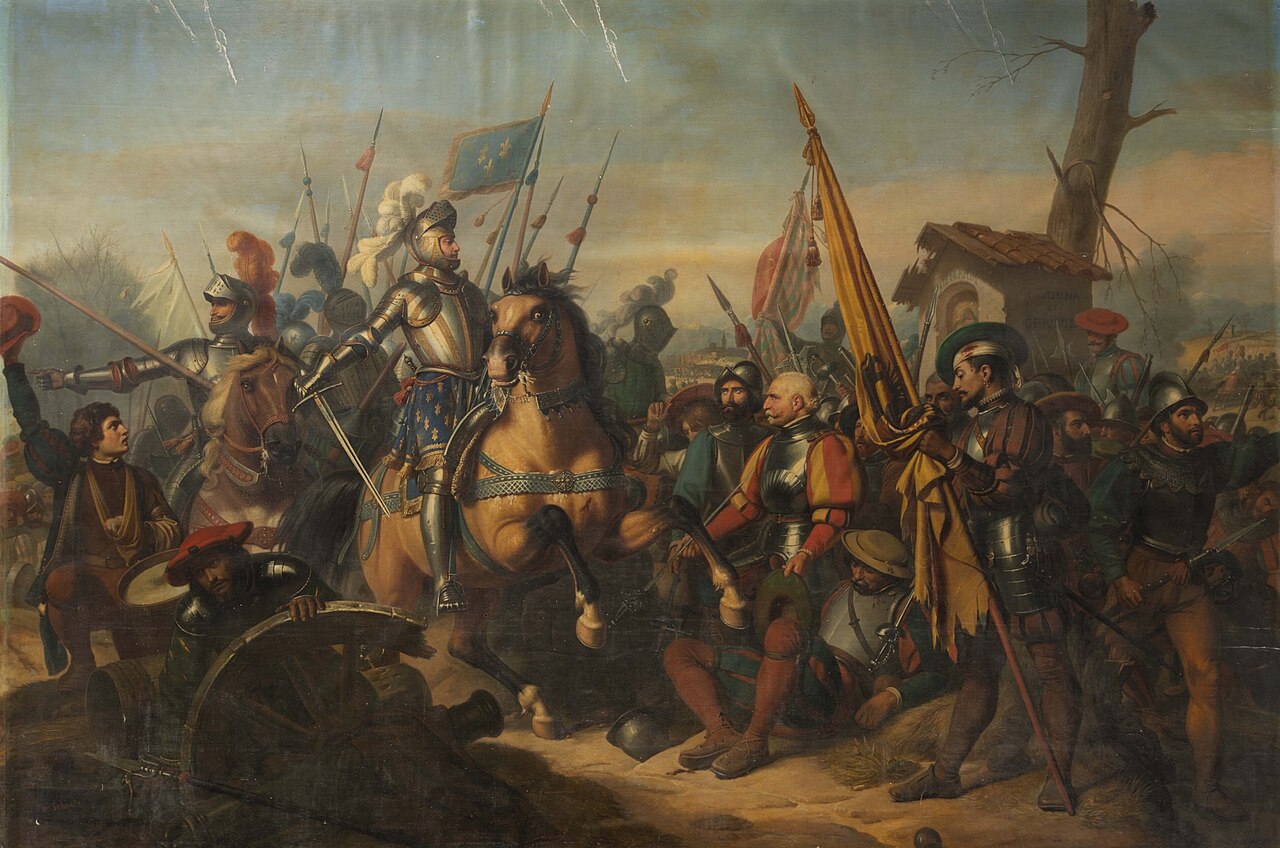
1544 - Battle of Ceresole (All Facts)
Battle in which France defeated the Holy Roman Empire and Spain (in in the namesake city south of Turin, in Italy) during the Eighth Italian War
1544 - Siege of Saint-Dizier (All Facts)
Battle in King Henry VIII and Holy Roman Emperor Charles V and their combined forces defeated France and took the namesake city (having threatened Paris at the time) during the Eighth Italian War
1544 - Treaty of Crepy (All Facts)
Peace Treaty signed between King Francis of France (Valois) and Charles V of the Holy Roman Empire and Spain (Habsburgs), which ended the Eighth Italian War
which was made in an effort to restore Catholic unity in Europe
in which King Francis of France
promised to support Holy Roman Emperor Charles V against the Protestants if they rejected the decisions made in the Council of Trent
had his son, the Duke of Orleans, be promised to be married to a Habsburg princess, either
Mary, daughter of Holy Roman Emperor Charles V with a dowry that is the Netherlands
Anne, daughter of Habsburg King Ferdinand of Bohemia, Hungary, and Croatia with a dowry that is Milan
agreed to support Holy Roman Emperor Charles V in his war against the Ottoman Turks
in which a secret between them was agreed in which King Francis of France promised to help Holy Roman Emperor Charles V
reform the church
work towards bringing the German Protestants back into the Catholic fold, lending his army for the purpose if necessary
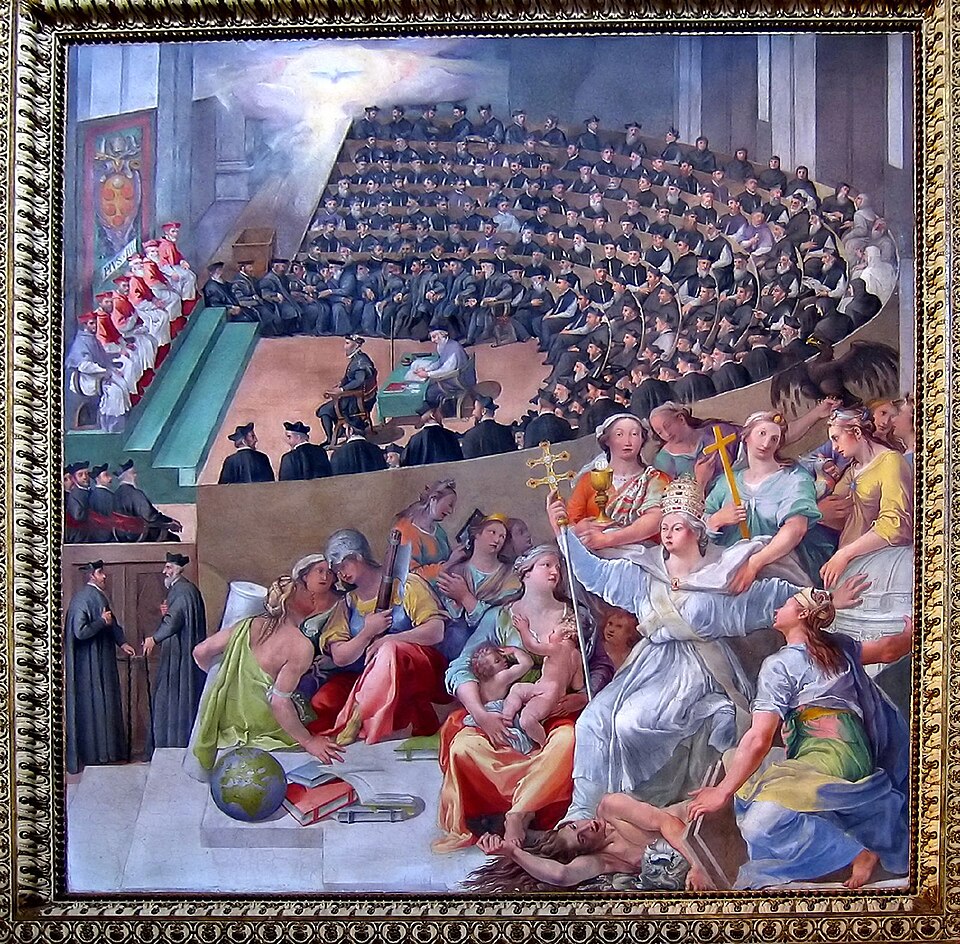
1545 - 1563 - Council of Trent (All Facts)
First Council of the Catholic Church since the start of the Protestant Reformation
Council presided over by Pope Paul III and maintained by his successors until Pope Pius IV
Council which
initiated the Catholic Counter-Reformation, reaffirming traditional Catholic theology
debated the doctrinal controversies raised by the Protestant Reformation, which had been influential even within the Catholic Church including
sola fide (justification by faith)
Council which saw much disagreement even among Catholics as to whether man may receive grace by his own efforts and good works or receive grace by faith alone, as Protestants (Lutherans) argued
redefined Catholic dogma
worked to reunite Christendom
framed decrees which disdained any and all compromise with the Protestants (Lutherans)
Council which decreed, in favor of Catholics, that
the scriptures are not the only source of divine revelation, as Protestants (Lutherans) claimed
the scriptures can only by interpreted by clergy, not by ordinary people
apostolic tradition handed down by the Catholic Church is (was) sacred
Martin Luther’s doctrine of original sin is heretical
Calvin’s doctrine of predestination was heretical
Council which asserted, in favor of Catholics,
the importance of the Mass
the authority of tradition
the authority of the bishops
Council which, in favor of Protestants and Reformers
proposed radical reforms in church organization, such as the proper training and education of the clergy
urged that bishops reside in their dioceses
prohibited the accumulation of wealth by clergymen
decreed that the Bible would be reproduced based on St. Jerome’s Latin version and that this new reproduction of the Bible would be the ultimate scriptural authority
Council attended by various groups who debated each other on these doctrinal issues including
Dominicans
Augustinians
Jesuits, who argued in this Council that man may attract divine mercy by his own efforts
Council in which Holy Roman Emperor Charles V wished for the Papacy and Christendom to reconcile the Protestants (Lutherans), who were dividing Germany (the Holy Roman Empire) at the time by
reforming the Catholic Church’s practices
possibly permitting clergy to marry
Council
which
was attended by 60 or more Catholic bishops and approximately 200 delegates including those from
Spain
France
Italy
had no Protestant (Lutheran) representatives at its start and only a few by its end
dashed the hopes of the Protestant Reformers who sought decentralization of papal power into the hands of the bishops
whose verdict reflected the views of the majority of the 200 delegates and Catholic bishops in attendance
Council which was postponed for several years due to the Italian Wars fought between King Francis of France and Holy Roman Emperor Charles V, not starting until they were settled
Council which took place in the namesake city and prince-bishopric of the Holy Roman Empire (Germany), chosen because, while close to Italy, it lay within the Holy Roman Empire and therefore met the demand that the council had to be on German soil
However, it was transferred to Bologna (in Italy) two years into its session
Its first session in Bologna was then closed by the Pope
Its second session opened two years later
Its third session opened a few years later
This session was quickly galvanized into action after news of Pope Pius IV’s severe and potentially fatal illness
In this session, the series of votes were carried out rapidly in the last few days, in which the voters emphatically asserted the authority of the head of the Roman Catholic Church so much so that the delegate bishops that were present expressed their votes as propositions, which the Pope had to approve of in order to be effective
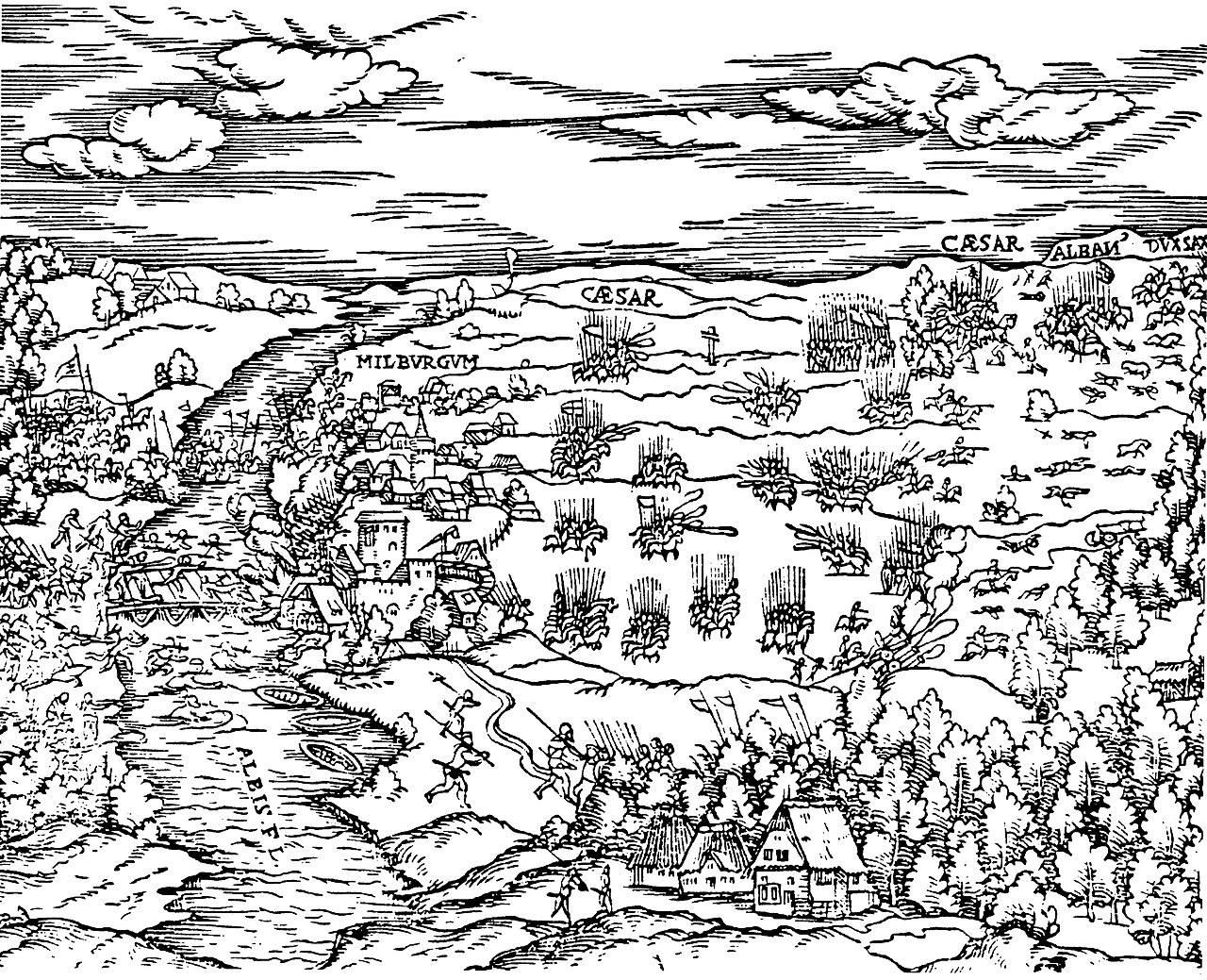
1546 - 1547 - (First) Schmalkaldic War (All Facts)
Civil War which began when Holy Roman Emperor Charles V formed an alliance with Maurice of Saxony against the namesake League of German Protestant princes and outlawed Philip of Hesse and John Frederick, two heads of the namesake league
Civil War which caused the namesake league to dissolve
Civil War in which the namesake league’s Protestants
at the outset, dominated the Danube River, capturing castle after castle as they advanced onto the County of Tyrol
had a plan to block the passes, ensuring that Italian troops could not get through to join Holy Roman Emperor Charles V’s forces
However, this plan failed due to lack of organization as most of Charles V’s opponents (Henry VIII of England, Francis of France, Martin Luther, and Barbarossa of the Ottoman Empire) by that time had died
Civil War after which Holy Roman Emperor Charles V
assumed peak stature over Europe
systematically began to take German cities until his armies came to the banks of the Elbe River
Civil War which saw
The Battle of Muhlberg

1547 - Battle of Muhlberg (All Facts)
Battle in which Charles V and his Holy Roman forces defeated John Frederick of Saxony and his forces during the Schmalkaldic War
Battle in which Charles V’s outnumbered army defeated and captured John Frederick of Saxony
Battle after which John Frederick of Saxony was court martialed and sentenced to death but later imprisoned along with Philip of Hesse
1547 - Truce of Adrianople (All Facts)
Truce made between Holy Roman Emperor Charles V and Suleiman of the Ottoman Empire
1548 - (Third) Diet of Augsburg (All Facts)
Imperial Diet in which the namesake “Interim” decree was issued by Holy Roman Emperor Charles V
The Schmalkaldic League representatives at the namesake diet reluctantly accepted the “Interim” agreement which had a strongly Catholic bias

1551 - 1559 - Ninth Italian War (All Facts)
Conflict in which Charles V and Philip II and the Habsburgs (the Holy Roman Empire and Spain) defeated King Henry II and the Valois (France), ending the Italian Wars
Conflict which began when
King Henry II of France declared war against Holy Roman Emperor Charles V, with the intent of recapturing parts of Italy and ensuring French, rather than Habsburg, domination of European affairs
King Henry II of France publicly disavowed the Council of Trent
Conflict which saw
The Siege of Metz
The Battle of Marciano
The Siege of Siena
The Battle of St. Quentin
The Siege of Calais
The Siege of Thionville
The Battle of Gravelines
Conflict which included the Siege of Siena, a brutal 15-month blockade in which Cosimo de Medici and the Habsburgs (Holy Roman Empire) defeated the Valois (France) and took Siena from the French, during the namesake war
Conflict which ended with the Treaty of Cateau-Cambresis
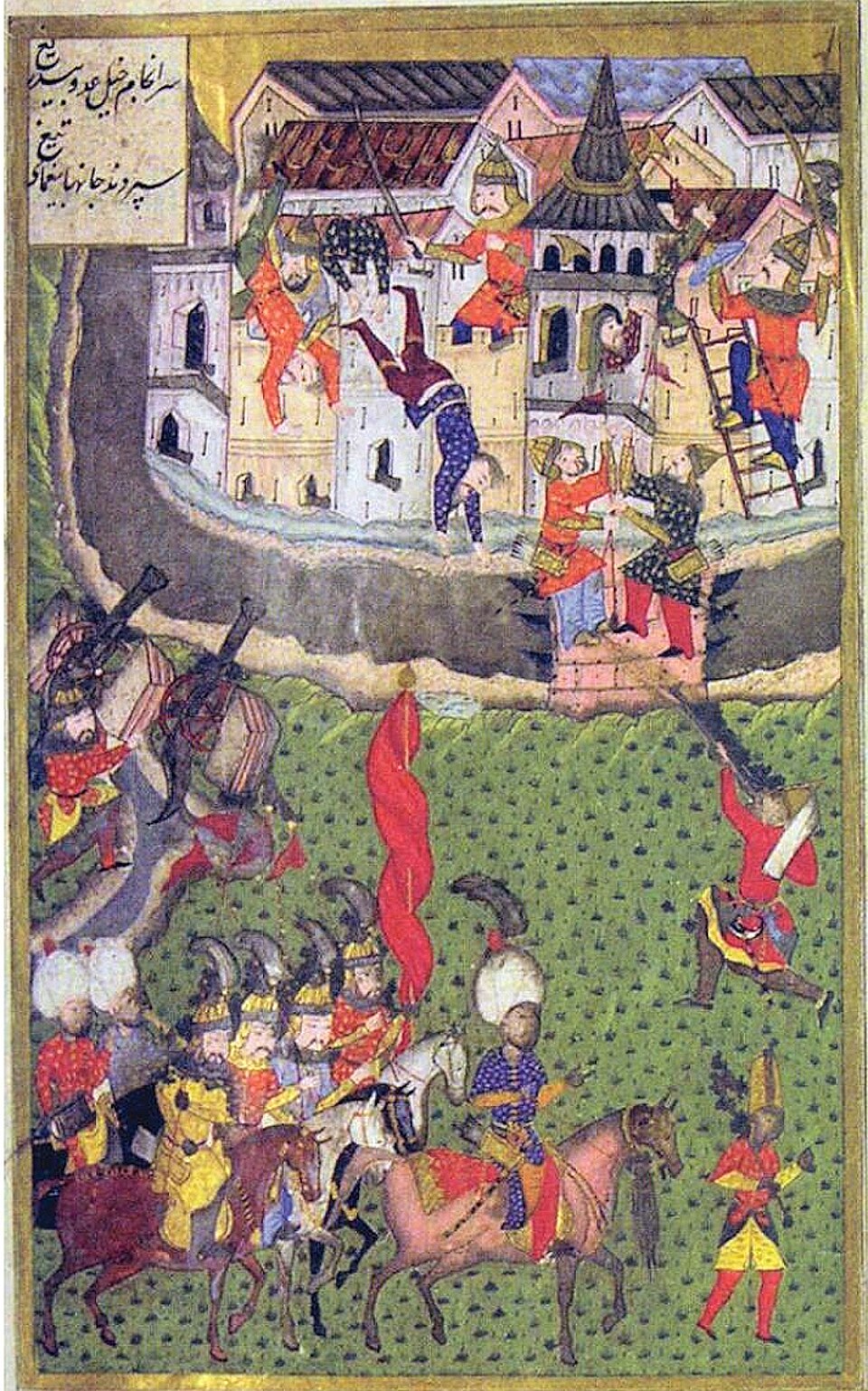
1551 - 1562 - Fourth Habsburg-Ottoman War (All Facts)
War in which Suleiman and his Ottoman forces defeated the Habsburgs (Holy Roman Empire and Spain)
1552 - Treaty of Chambord (All Facts)
Treaty signed between King Henry II of France and Maurice of Saxony, in which they agreed to ally against Holy Roman Emperor Charles V
Treaty in which
Henry II promised to prove Maurice of Saxony with troops and money
Maurice of Saxony promised to provide the formal possessions of the bishoprics of Metz, Toul, and Verdun; formerly captured by the French in the prior year
Treaty which forced Charles V to be beaten and forced to flee across the Alps
1552 - (Second) Schmalkaldic War / Princes’ Revolt (All Facts)
Civil War in which Maurice of Saxony, with help from King Henry II of France, and their combined forces defeated Holy Roman Emperors Charles V and his forces
Civil War which began with
The Treaty of Chambord
Civil War which saw
Maurice of Saxony and his forces take Augsburg
Maurice of Saxony and his forces nearly capture Holy Roman Emperor Charles V at Innsbruck, who fled in time
Civil War which ended with the Treaty of Passau
1552 - Peace of Passau (All Facts)
Peace Treaty signed between Ferdinand of Habsburg, on behalf of Holy Roman Emperor Charles V, and Maurice of Saxony, which
revoked the Augsburg Interim
thus promised religious freedom to the Protestant German princes
1552 - 1553 - Siege of Metz (All Facts)
Battle in which Francois de Lorraine and his French forces defeated Holy Roman Emperor Charles V and his forces, thus preventing the Holy Roman Empire’s capture of the namesake city, during the Ninth Italian War
1552 - 1555 - Second Margrave War (All Facts)
Civil War instigated by Albert of Brandenburg-Kulmbach

1553 - Battle of Marciano (All Facts)
Battle in which the Habsburgs (Holy Roman Empire) defeated the Valois (France) in Tuscany during the Ninth Italian War

1553 - Battle of Silvershausen (All Facts)
Battle in which Maurice of Saxony and his forces defeated Albert of Brandenburg-Kulmbach and his forces during the Second Margrave War
Battle in which Maurice of Saxony was wounded and eventually died
1554 - 1555 - Siege of Siena (All Facts)
Battle in which Cosimo de Medici and his Holy Roman forces defeated the namesake Italian Republic and its French forces during the Ninth Italian War, thus ending the namesake Italian Republic

1555 - Peace of Augsburg (All Facts)
Peace Treaty signed between Holy Roman Emperor Charles V and the German Protestant Princes (Schmalkaldic League), which
ended the religious struggle between Catholics and Lutherans in the Holy Roman Empire
ended the Schmalkaldic Wars
established the “cuius regio, eius regio” principle (“to each kingdom its own religion), which
allowed rulers to choose Catholicism or Lutheranism as the official administrative religion
gave German Princes power over the bodies and souls of their subjects
did NOT give ordinary people their religious freedom, but did allow them to move to adjoining states if their own prince does not permit their religion
did NOT allow rulers to choose Calvinism, as Calvinists were excluded from the agreement
thus advocated that the religion of a prince should determine the faith of his subjects
thus sanctioned the existence of Lutheran states
established the “reservatum ecclesiasticum” (“ecclesiastical reservation”) principle, which
meant that the religion of the ruler would be the religion of the country and of its people, those being his possessions by inheritance
represented a clear recognition by Catholics of the co-existence for the new Protestant churches throughout Europe
represented a clear recognition by Holy Roman Emperor Charles V to grant power and rights to the German Princes
thus allowed Catholicism to continue in some of the German principalities (states), as the Catholic German Princes were driven by different political motives but could never have withstood the surging popularity of Lutheranism on their own
decided that there should be an equal number of Lutherans and Catholics in the imperial chamber
1556 - Truce of Vaucelles (All Facts)
Peace Treaty signed between King Henry II of France and Holy Roman Emperor Charles V during the Ninth Italian War, temporarily halting the war
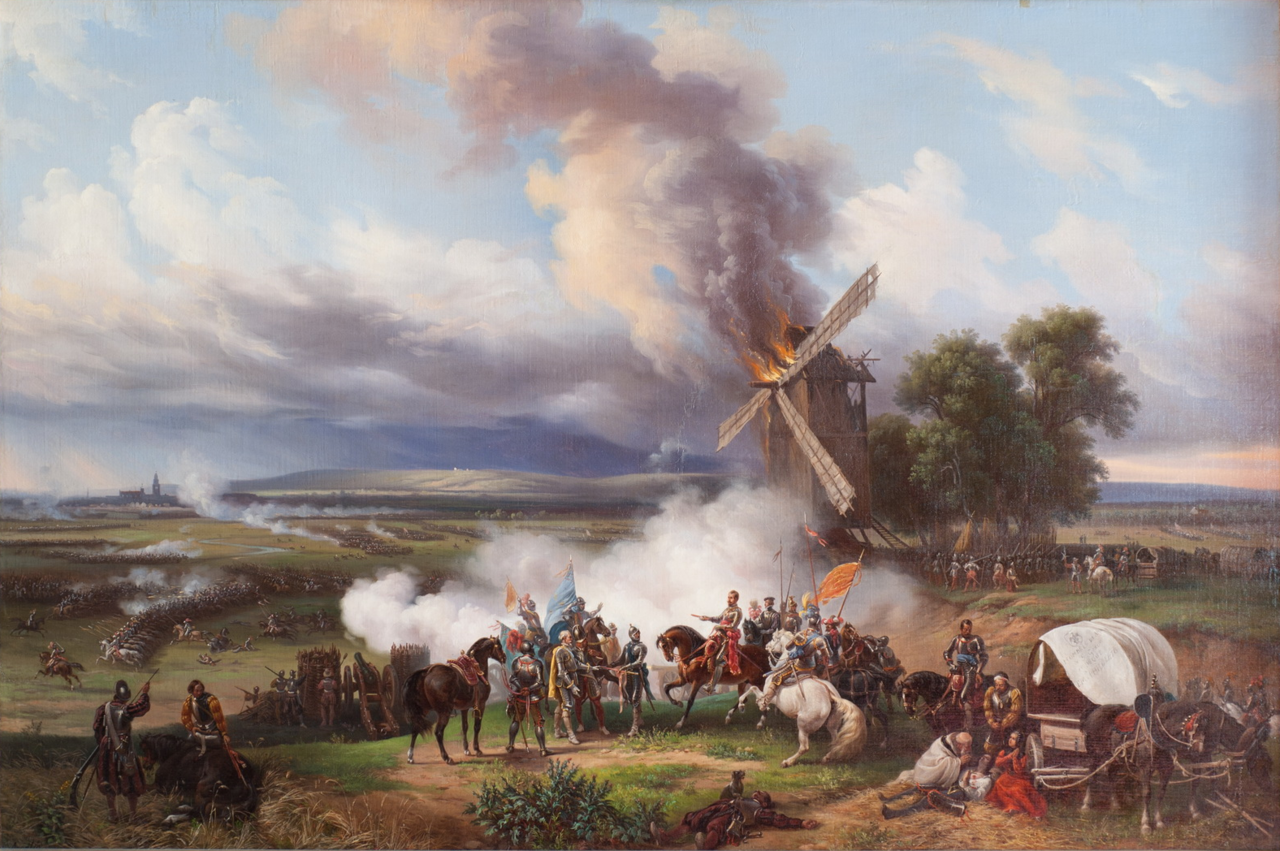
1557 - Battle of St. Quentin (All Facts)
Battle in which Duke Emmanuel Philibert of Savoy and his Spanish forces defeated Anne de Montmorency and his French forces during the Ninth Italian War
Battle after which King Philip II of Spain promised to construct a magnificent building to commemorate the victory over the French
1558 - Siege of Thionville (All Facts)
Battle in which Francis of Guise and the Valois defeated the Habsburgs and took the namesake city back from the Habsburgs during the Ninth Italian War
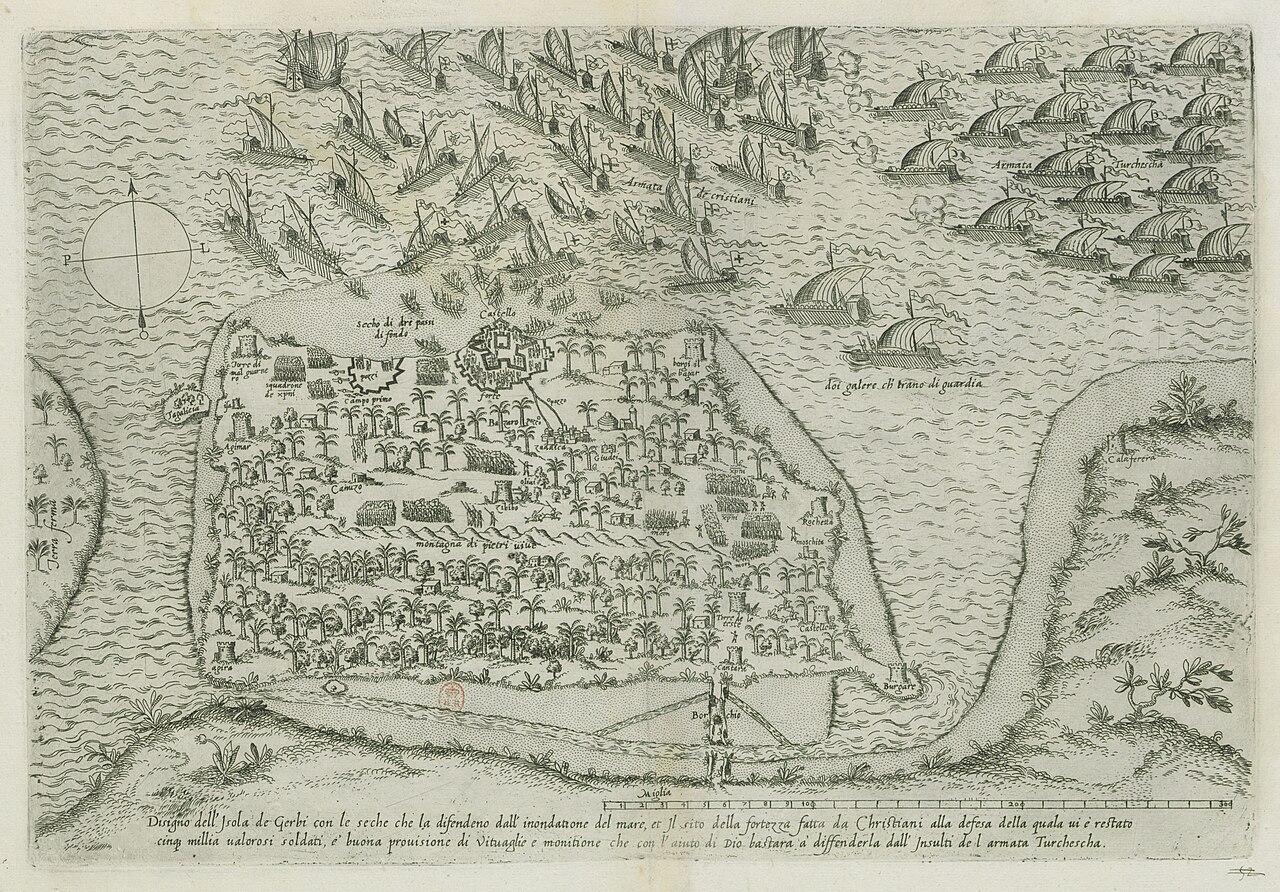
1560 - Battle of Djerba (All Facts)
Battle in which Dragut, Piali Pasha, and their Ottoman forces defeated Spain, the Knights of Malta (the Knights Hospitaller), and their Christian coalition forces
Battle in which the Ottoman fleet wrecked King Philip II of Spain’s fleet
Battle after which Dragut, Piali Pasha, and the Ottoman Corsairs established control of most of the coast of North Africa

1563 - 1570 - Northern Seven Years’ War (All Facts)
War in which Sweden fought against Denmark, Norway, Poland, Lithuania, and Lubeck
War which ended with the Treaty of Stettin
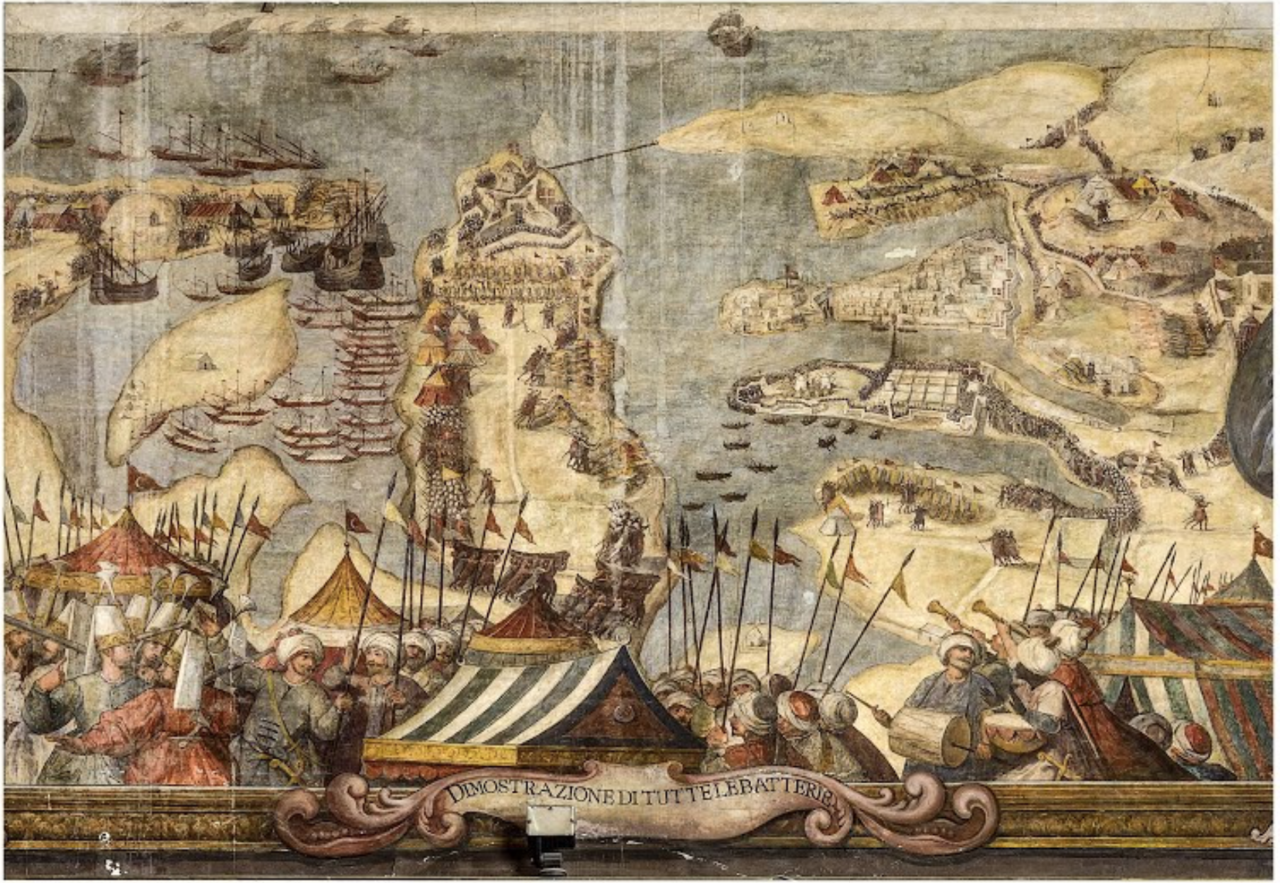
1565 - Siege of Malta (All Facts)
Battle in which the namesake Knights Hospitaller Order and Spain and their combined Christian forces, defeated the Ottoman Empire
Battle which was one of the most heroic defensive actions in the history of warfare, as the Turks were repelled from the namesake, which was a major setback for Suleiman and the Ottoman Empire’s hopes of establishing control over the Mediterranean Sea
Battle during which the Ottoman forces became divided as Piale Pasha, head of the navy, and Mustafa Pasha, head of the land forces, diverged amongst each other
Battle during which the Knights Hospitaller fought with extraordinary courage, notably in holding the fortress of St. Elmo for more than a month with only a few hundred men
When St. Elmo fell, only nine defenders remained alive
Battle during which Dragut, the leader of the Ottoman Corsairs in the namesake battle, was killed by the Knights Hospitaller
Battle which ultimately ended when a Christian fleet from Sicily arrived to reinforce the namesake inhabitants and the Knights Hospitaller, with the Ottoman forces being too demoralized to continue
Battle in which ¾ of the Ottoman forces were killed, as only a quarter of their forces returned to Istanbul afterwards

1565 - 1568 - Fifth Habsburg-Ottoman War (All Facts)
War in which Suleiman and his Ottoman forces defeated Holy Roman Emperor Maximilian II and his Habsburg forces

1591 / 1593 - 1606 - Long Turkish War / Thirteen Years’ War / Fifteen Years’ War / Sixth Habsburg-Ottoman War (All Facts)
War in which Murad III, Mehmed III, and Ahmed and their Ottoman forces fought against Holy Roman Emperor Rudolf II and the Habsburgs (Holy Roman Empire and Spain) and their allies; which ended in a stalemate
War during which Ottoman forces captured the fortress of Raab in Hungary

1595 - Siege of Esztergom (All Facts)
Battle in which Habsburg forces defeated Ottoman forces during the Long Turkish War Thirteen Years’ War / Fifteen Years’ War / Sixth Habsburg-Ottoman War

1595 - Battle of Giurgiu (All Facts)
Battle in which Sigismund Bathory and his Habsburg forces defeated Ottoman forces during the Long Turkish War / Thirteen Years’ War / Fifteen Years’ War / Sixth Habsburg-Ottoman War
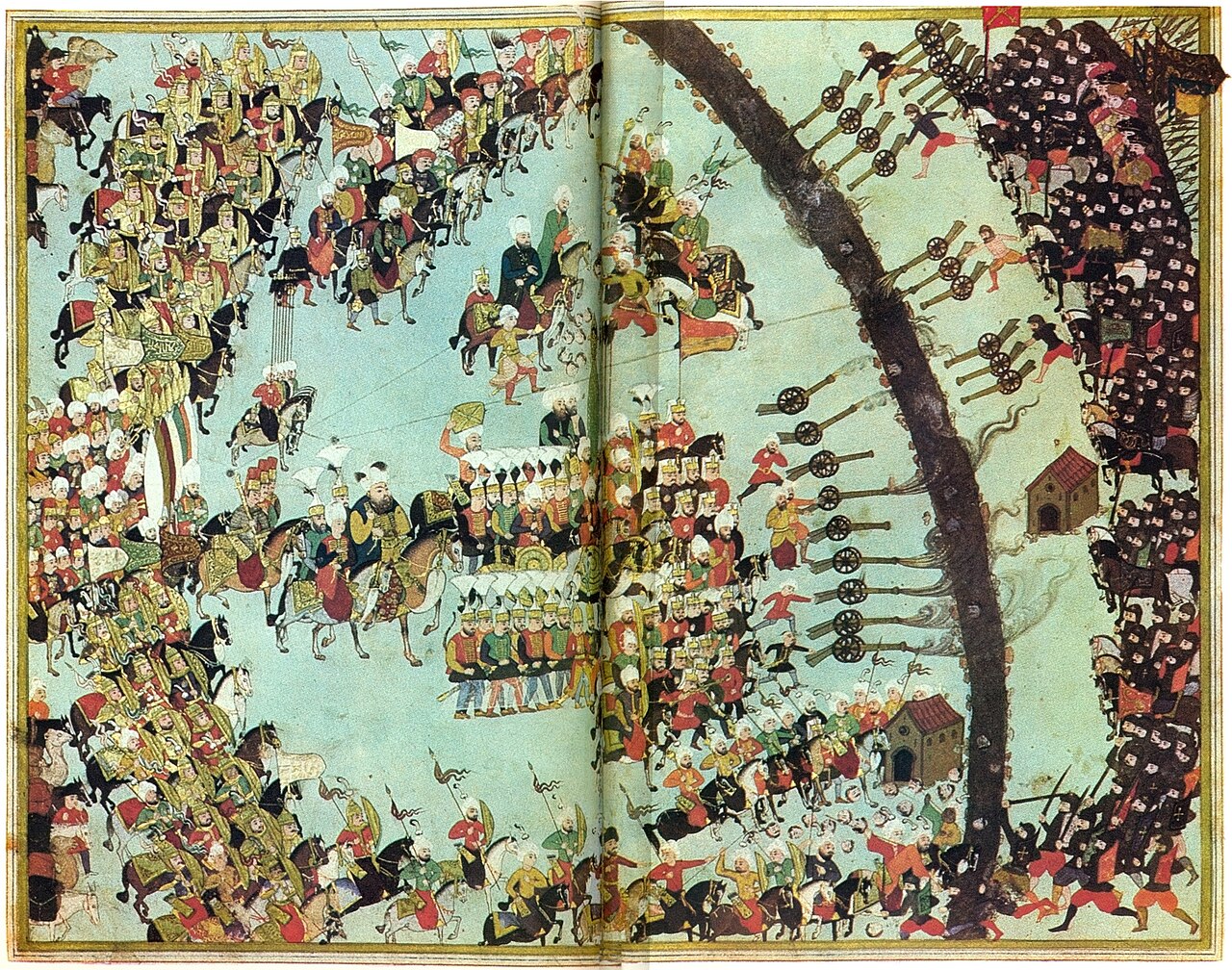
1596 - Battle of Mezőkeresztes (All Facts)
Battle in which Mehmed III and his Ottoman forces defeated Sigismund Bathory and his Habsburg forces and allies during the Long Turkish War / Thirteen Years’ War / Fifteen Years’ War / Sixth Habsburg-Ottoman War
Battle in which Mehmed III
was personally responsible for turning the tide of battle, despite a mass desertion by the Ottoman Turkish infantry
in one fell swoop, saved a huge swathe of territory for the Ottoman Empire, saving its possessions in Macedonia, Bulgaria, and Hungary despite a string of previous Hungarian military victories
tried to follow the “siphahis” when they walked off the battlefield, but his generals held a council of war to persuade him to stay with the rest of his army
Battle which
began badly for the Ottoman forces, when early reverses caused the “sipahis,” the fief-holding backbone of the Ottoman forces, to simply walk off the battlefield
Battle in which the overconfident Christian Habsburg forces broke rank to plunder the Ottoman Turkish camp, only for the Ottoman cavalry to kill them and take enormous booty including a hundred cannons
Battle in which 30K Hungarians and Germans died
1600s / 1500s - German Witch-Hunts / German Witch Trials (All Facts)
Series of trials and executions of the namesake “mental disease” throughout the Holy Roman Empire (Germany) which was as widespread and as terrifying as the plague (Black Death) whose only cure was death by trial and execution, with the accused’s confessions being extracted through torture
Period which saw the archbishop-elector of Trier burn 368 of the namesake accused persons in just six years
On a single day, 133 witches were executed at the convent of Quedlinburg
Period which saw church dignitaries having been the most ferocious persecutors of the namesake accused persons, but the secular powers were nearly just as keen
Period whose origins and justifications were (and are still) heavily debated
Some of the methodology is laid out in the work “Malleus Maleficarum” by Jakob Sprenger
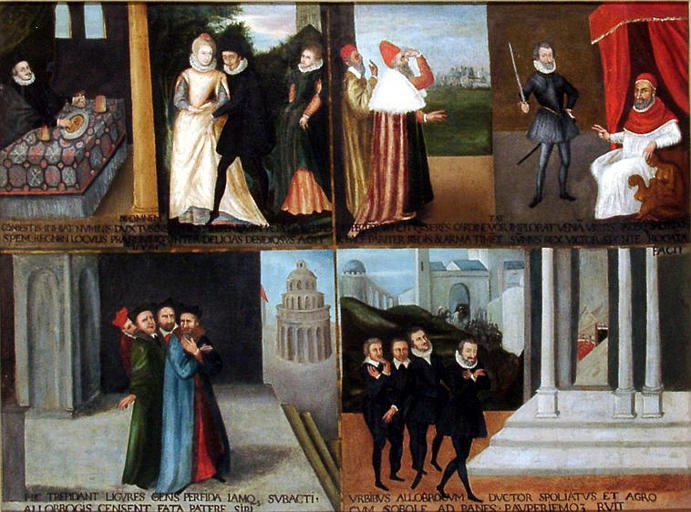
1600 - 1601 - Franco-Savoyard War (All Facts)
War in which King Henry IV of France and his French forces defeated the Duchy of Savoy
War in which the “Battle of Chambery” took place in which King Henry IV and his French forces defeated the Duchy of Savoy during the namesake war
War which ended with the Treaty of Lyons
1601 - Treaty of Lyons (All Facts)
Peace Treaty signed between King Henry IV of France and the Duchy of Savoy, it ended the Franco-Savoyard War
Peace Treaty in which
France gained land near the Swiss frontier
Savoy gained Saluzzo and French lands beyond the Alps