11- Posterior Tooth Selection for RPDs
 Call Kai
 Learn
Learn Practice Test
 Spaced Repetition
 Match
Match Flashcards
 Knowt Play
1/24

There's no tags or description
Looks like no tags are added yet.
Name | Mastery | Learn | Test | Matching | Spaced | Call with Kai |
|---|
No analytics yet
Send a link to your students to track their progress
25 Terms
Choice of tooth form, material, and occlusal arragement depends on what?
Type of opposing dentition and partial denture support
What are the 4 main considerations when choosing posterior teeth to set?
A max complete denture / mand rpd (CD/RPD)
Max and mand natural teeth with tooth-supported partial denture in one or both arches
Opposing natural teeth with a free end partial denture in one or both arches
An immediate denture in one or both arches
In a CD/RPD, occlusion balanced in all jaw positions is maintained how?
Centric occlusion must coincide with centric relation. Tooth contact must be evenly distributed bilaterally and should not have any interceptive contacts
In a CD/RPD, why shouldn’t the mandibular anterior teeth contact the maxillary anterior teeth (in CO)?
So forces against the vulnerable maxillary anterior ridge are reduced. Where posterior natural teeth are present, the maxillary denture teeth should have at least a centric occlusal contact with those natural teeth so there will be an occlusal stop.
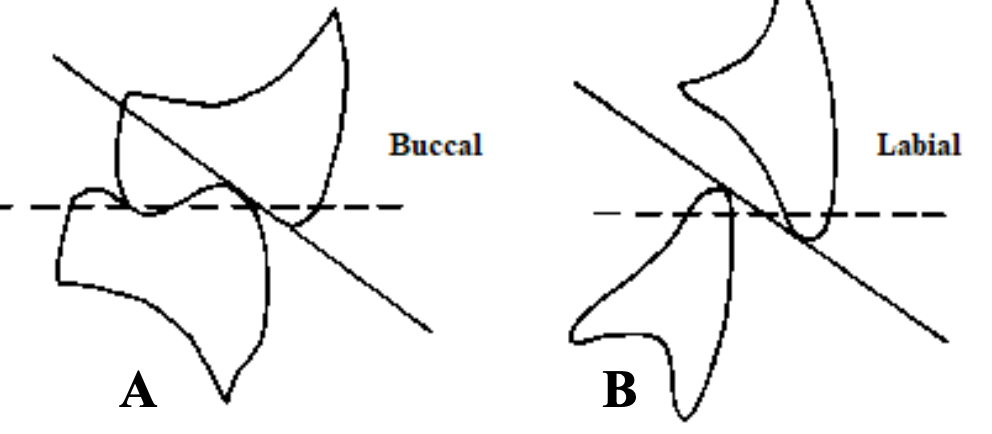
In an CD/RPD case, when are cusped teeth used (Dentsply 33˚)?
When the incisal guidance (horizontal and vertical overlap) is greater than 10˚
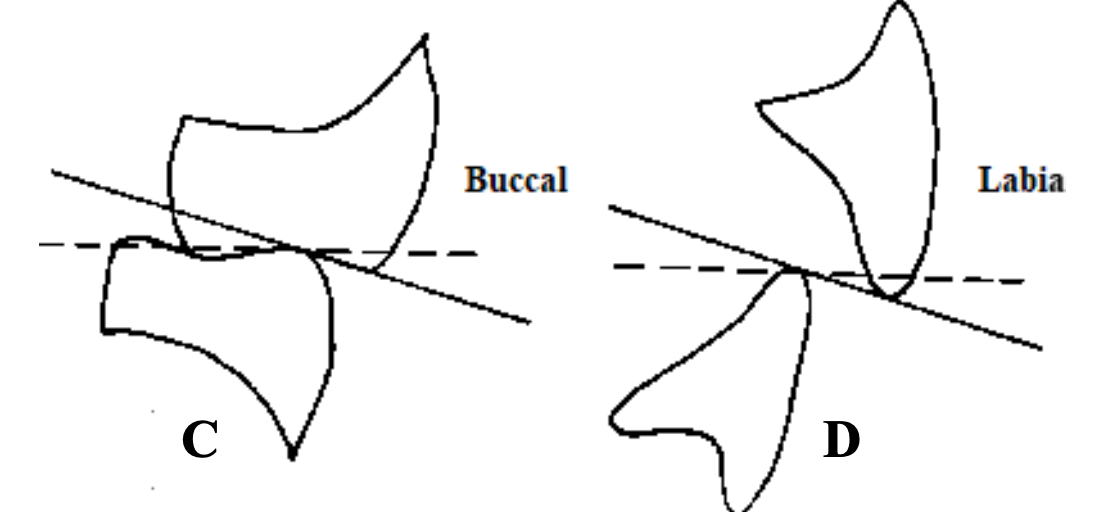
In an CD/RPD case, when are nonanatomic teeth used (Dentsply Anatoline)?
When the incisal guidance is 0-5˚
If there is a crossbite
If there is a Class II jaw relationship
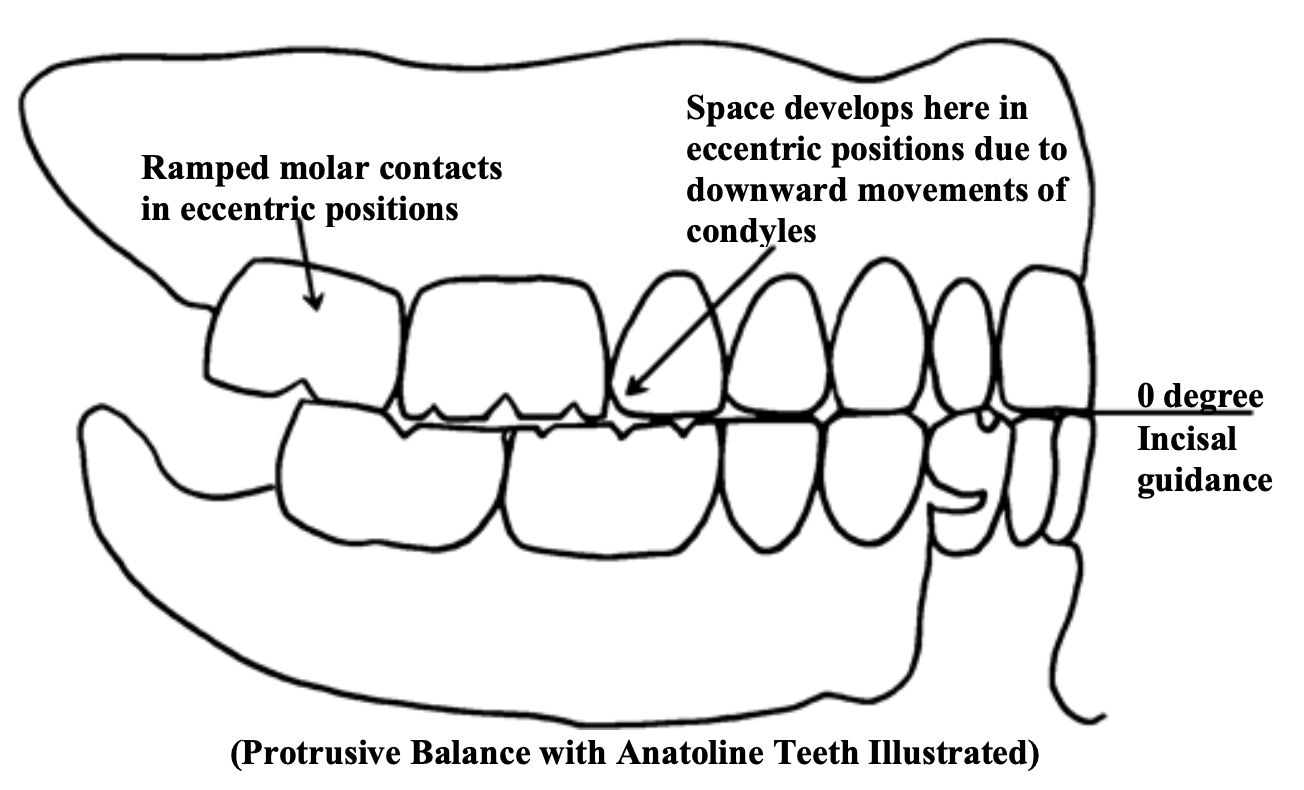
In a CD/RPD case, why should you reduce the incisal guidance whenever possible?
In order to reduce horizontal forces generated during excursive jaw movements.
What tooth material should you use in a CD/RPD caser?
Resin (IPN) posterior teeth because they are cross-linked methyl methacrylate and have 25% more abrasion resistance than regular resin teeth (wear of plastic teeth can be a problem)
Why are porcelain denture teeth not used in CD/RPD?
Because they severely abrade opposing natural teeth, as well as plastic, gold, porcelain and even Cr-Co restorations. They also fracture easily and can’t be readily adapted around minor connectors
In a tooth supported (Class III) RPD in one or both arches, what kind of contacts do you need?
The natural and artificial teeth must contact simultaneously with evenly distributed centric and working contacts
T/F: Balancing and protrusive contacts are very useful and may become premature contacts as the teeth wear
False
In a tooth supported (Class III) RPD in one or both arches, it is preferred that CO of remaining natural teeth match CR of the jaws. But many pts have a CO that is anterior to CR. What to do?
When only 3-4 teeth need to be replaced and the natural teeth and soft tissues present no pathology, there is no need to adjust the occlusion. Just mouth and set the teeth in CO (pts normal occlusion)
What tooth form should you use in a tooth supported (Class III) RPD in one or both arches?
An artificial tooth that has a cusp form similar to the remaining natural dentition. Either Dentsply 33˚ or Anatoline teeth
What tooth material should you use n a tooth supported (Class III) RPD in one or both arches?
Plastic teeth
Teeth with gold occlusal surfaces to prevent abnormal wear of opposing dentition
Many tooth-supported RPDs (Class III) have limited space for teeth. What material of artificial tooth works best?
Plastic teeth because they can be contoured to fit without loss of retention
In a distal extension RPD (Class I or II) in one or both arches, what kind of contact should natural teeth have with artificial teeth?
There should be contact on the artifical teeth ONLY in centric relation.
In a distal extension RPD (Class I or II) in one or both arches, what if you have contact on a distal extension base in working, balancing ro protrusive?
It would place functional loads on the abutment teeth in other than an axial direction and with much leverage.
In a distal extension RPD (Class I or II) in one or both arches, the teeth should contact in centric ONLY. However, the only exception is if there is no anterior tooth guidance. Then, what do you want?
The posterior artificial teeth must provide centric and working contacts. There should be no contact on the balancing or non-functional side during jaw excursions
In a distal extension RPD (Class I or II) in one or both arches, there should not be any deflective occlusal contacts between NAT and opposing when mand is closed in CR. But, there are some exceptions. What are they?
If there is a favorable crown:root
Index areas have good tissue resistance
Pt has used a distal extension RPD for years without harming perio support of abutment teeth
In a distal extension RPD (Class I or II) in one or both arches, when should you adjust the natural occlusion, if necessary?
BEFORE making the RPD(s)
In a distal extension RPD (Class I or II) in one or both arches, what tooth form and material should you use
Either Dentsply 33˚ or Anatoline teeth may be used
In an immediate CD/RPD, bilateral balance is necessary. However, it is often found that protrusive and balancing contacts cannot be maintained. Why?
Due to the degree of incisal guidance present in many dentitions
What is “long centric”?
When you spot grind some incisors to lessen the incisal guidance. It is helpful because it provides ~2mm of movement
Cusped teeth should be used in immediate CD/RPD cases when?
There is reasonable incisal guidance
Adequate cusp height of remaining teeth
Absence of class II jaw relation or crossbite
What material of teeth are used in immediate CD/RPD cases?
Plastic teeth because much grinding may be necessary.