MGT280 Final Flash Cards
 Call Kai
 Learn
Learn Practice Test
 Spaced Repetition
 Match
Match Flashcards
 Knowt Play
1/68

There's no tags or description
Looks like no tags are added yet.
Name | Mastery | Learn | Test | Matching | Spaced | Call with Kai |
|---|
No analytics yet
Send a link to your students to track their progress
69 Terms
Promotional strategy
A plan that incorporates advertising, public relations, personal selling, sales promotion, and social media
Personal explanation of marketing
The unique and strategic way that a company advertises their products and services to customers and markets in a way that makes them feel inclined to engage with their brand.
SMART goals
Goals that are Specific, Measurable, Achievable, Relevant, and Time-bound; used to set clear promotional objectives.
Goals of promotion - I, PRC
to Inform, Persuade, Remind, and Connect
Marketing communications process
The process of getting a message from the sender (brand) to the receiver (consumer). There is noise (distractions) and the message can get lost.
4 P’s of marketing
Price, Promotion, Place, Product
Promotional mix
The set of tools a company uses to communicate with the target market and achieve its goals.
The 5 marketing tools - APPSS
Advertising, Public Relations, Personal Selling, Social Media, Sales Promotion
Advertising
Paid, Non-personal message to a large audience
ex. TV Ads, online ads, billboards
Public Relations
Managing the brand’s image & relationships
ex. press releases, events, media coverage
Personal Selling
Direct, person to person communication to make a sale
ex. sales reps, in-store associates
Sales Promotions
Short term incentives to boost sales
ex. coupons, discounts, free sample
Social Media
engaging and communicating with customers online
ex. Instagram, TikTok, Twitter, replies, content
Paid media
Brand pays for promotion
Ads (TV, IG, Google), billboards, sponshorships (YT)
Earned media
Promotion that’s earned and not owned or paid for by a brand
word of mouth, buzz, influencer using a product, PR
Owned media
Brand-controlled channels such as websites, blogs, email, and social media accounts.
Integrated marketing communications (IMC)
The coordination of all promotional messages to ensure consistency across every consumer touchpoint.
Ensures one, unified, clear message across all contact points
Push vs. Pull strategies
Strategies that decide who promotion is aimed at
Push strategy
A marketing strategy that promotes to retail and wholesalers with the goal to get them to stock and sell the product and push the product through the channel.
Company —> Retailer —> Customer
What will a push strategy use to promote?
Personal selling, Trade ads, incentives to stores
Pull strategy
A marketing strategy that promotes directly to consumers with the goal to make customers ask stores for the product. consumer demand to obtain product distribution.
Company —> Customer —> Retailer
What will a pull strategy use to promote?
Advertising, social media, PR
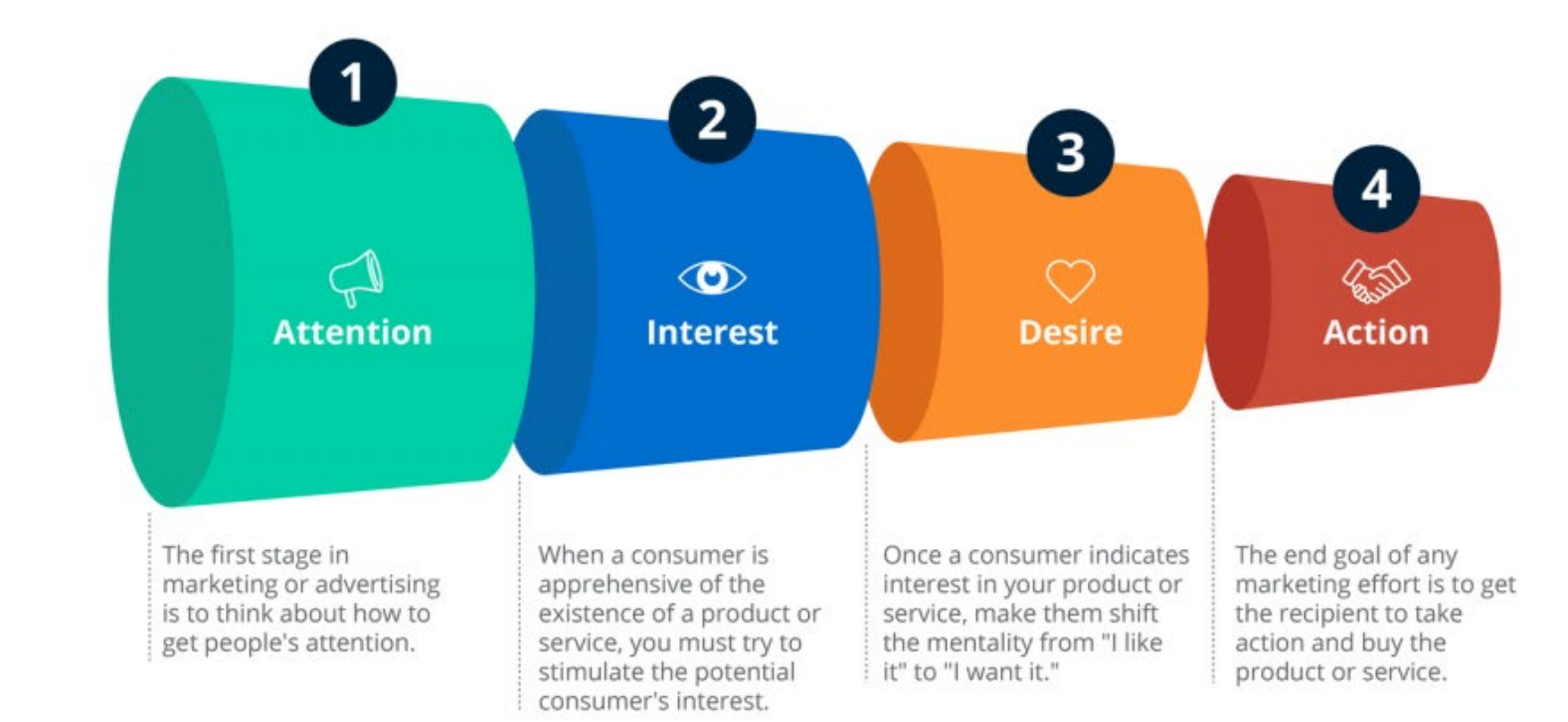
AIDA model
The steps a customer goes through when interacting with a promotional message. This helps shape promotion strategies.
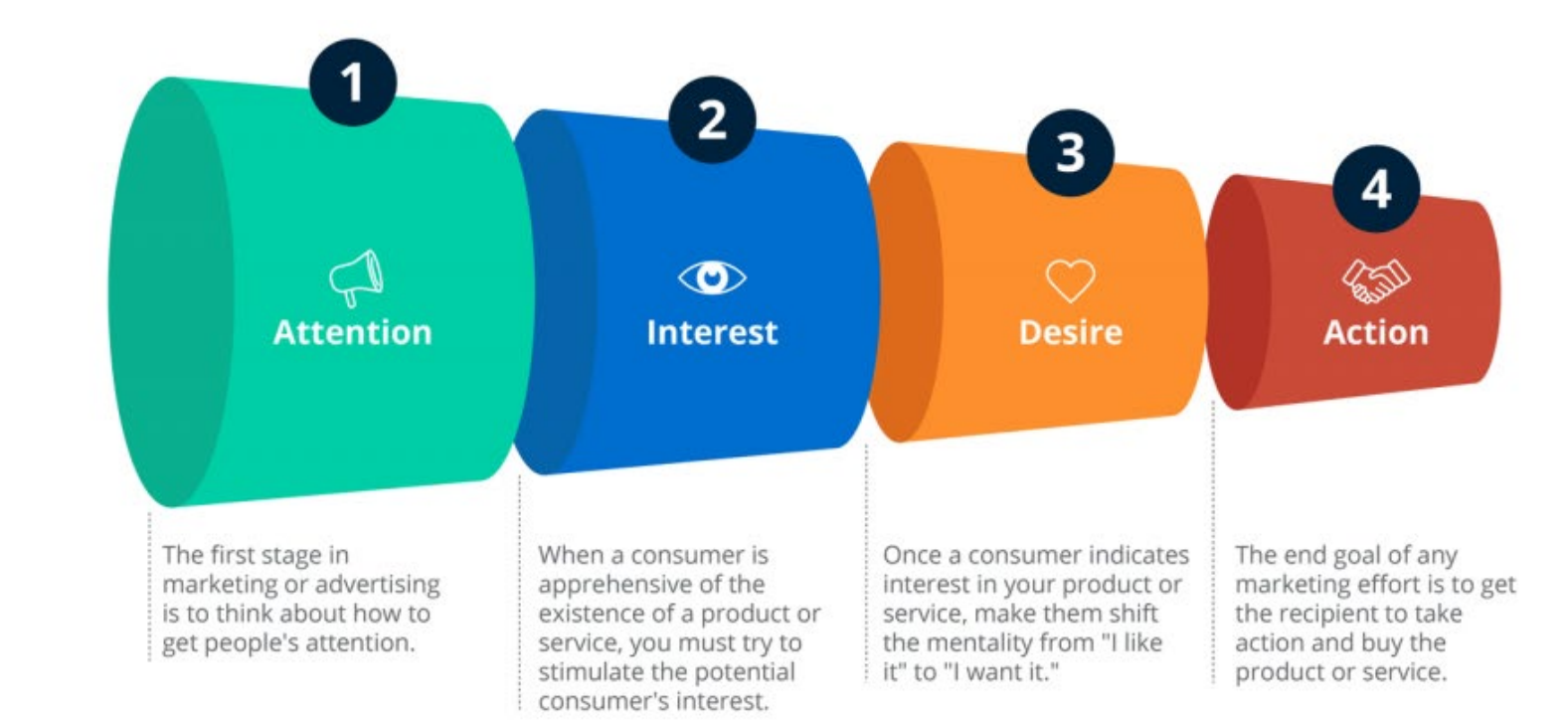
What does “AIDA” stand for?
Attention, Interest, Desire, Action
Public relations
The marketing function that manages how the public views your brand and building trust and acceptance.
Publicity
Public information about a company, product, service, or issue appearing in the mass media as a news item
Product placement
PR strategy placing a product in another form of media, including movies, TV, music videos, games, or events to increase awareness.
Sponsorship
A public relations strategy in which a company spends money to support an issue, cause, or event that is consistent with company objectives, such as improving brand awareness or enhancing corporate image

Experiential marketing
Involves engaging with consumers in a way that enables them to feel the brand—not just read about it

Brand activations
Experiential events designed to create memorable interactions with the brand.
Think: Coachella houses, Polly Pocket house, Rhode popup
Press releases (purpose)
A written statement sent to media outlets sharing newsworthy information.
Press release best practices
Be newsworthy, concise, include quotes, answer 5Ws, and provide clear contact info.
Advertising
Impersonal, one-way mass communication about a product or organization that is paid for by a marketer
Types of advertising
Newspapers, magazines, radio, TV, digital, social, mobile, outdoor.
Advertising pros
Can reach large audiences, strong creative opportunities, measurable digital performance
Advertising cons
Expensive; clutter; short message life; limited targeting in some media.
Online ad elements
Branding, product imagery, design, promotion, and clear call-to-action.
Ad–landing page alignment
Branding, messaging, visuals, and CTA should match between the ad and landing page.
Sales promotions
Short-term marketing activities that stimulate consumer buying and dealer effectiveness.
Purpose of sales promotions
To increase short-term demand, encourage trial, or reward loyalty.
Personal selling
A purchase situation involving a personal, paid-for communication between two people in an attempt to influence each other
Personal selling process
Generate leads → pre-approach → presentation/handling objections → closing → follow-up.
Tradeshows
Events where companies exhibit products to generate leads and network.
Price
The amount given up in exchange for a good or service.
Price–quality association
Consumers often infer higher quality from higher prices, especially under uncertainty.
Value-based pricing
Pricing based on the actual or perceived value of goods/services.
Competitive pricing
Pricing based on price points of competitors’ and similar products in the market.
Cost-plus pricing
Pricing based on the cost to make a product and the ideal markup you’d like to make for profit.
Everyday low pricing (EDLP)
Consistent low prices without frequent sales. (ex TjMaxx, Marshalls)
High/low pricing
High regular prices with periodic deep discounts.
Market penetration pricing
Low introductory price to quickly gain market share.
Price skimming
High initial price to target early adopters willing to pay more.
Dynamic pricing
Pricing based on how, when, and where a product is sold. A way to maximize profits.
Surge pricing
Extreme form of dynamic pricing where prices rise during peak demand.
Influencer marketing
Partnering with influencers to promote products through authentic content.
Mega influencers
Celebrities with 1M+ followers.
Micro & nano influencers
Micro: 10k–50k followers; Nano: 1k–10k followers.
Value of influencers
High engagement, authenticity, niche audiences, strong persuasion.
Engagement rate
(Likes + comments) ÷ followers × 100; measures content effectiveness
Vetting influencers
Evaluate niche fit, authenticity, engagement, past partnerships, and follower quality.
Measuring marketing effectiveness
Determines whether marketing efforts achieved goals and ROI.
Value of measurement
Helps optimize strategy, justify spending, and improve future campaigns.
Determining KPIs
Choose KPIs that directly match marketing goals
Google Analytics
Tool that works best for tracking website traffic, behavior, conversions, and campaign performance.
Social media insights
Platform analytics showing engagement, reach, impressions, follower growth, etc.
Code of ethics
A guideline to help marketing managers and other employees make better decisions
Common ethical grey areas
Native advertising, misleading food labels, influencer disclosure, data privacy.
Native Advertisement
Any paid media where the ad experience matches the form and function of the user experience in which the ad is placed.
Role of regulation in marketing
FTC, FDA, and FCC regulate advertising, labeling, and communication practices.