Psych 161 Prejudice and Stereotype
 Call Kai
 Learn
Learn Practice Test
 Spaced Repetition
 Match
Match Flashcards
 Knowt Play
1/56

There's no tags or description
Looks like no tags are added yet.
Name | Mastery | Learn | Test | Matching | Spaced | Call with Kai |
|---|
No analytics yet
Send a link to your students to track their progress
57 Terms
(Cognition Aspect)Stereotype Myers Belief
A belief about the personal attributes of a group of people.
(Cognition Aspect)Stereotypes Derine belief
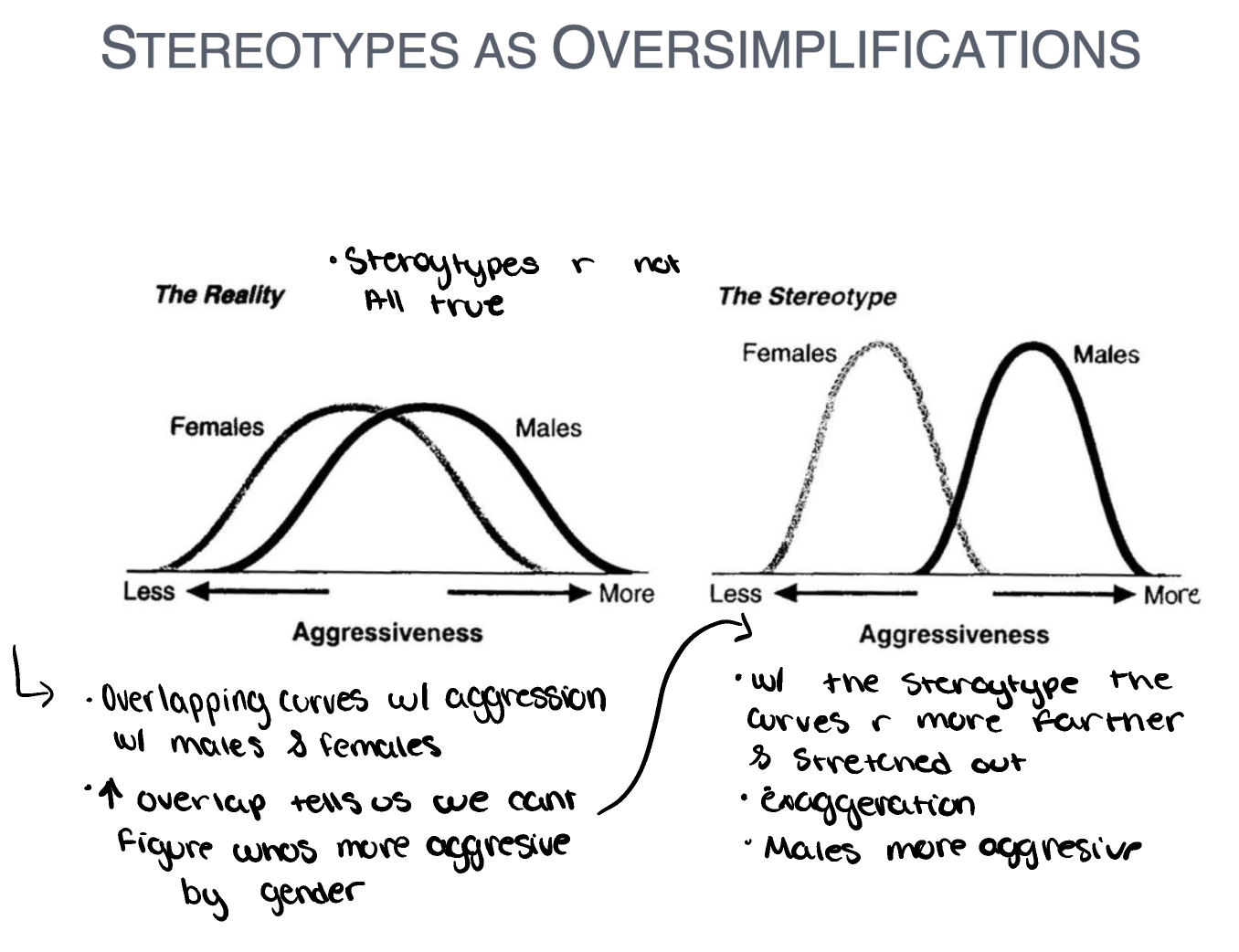
Stereotypes exaggerate things and make them look worse than they are, impacting statistics and people's views.
Stereoytypes as Oversimplifications
Stereotypes exagerate things & make them look worser then they are
(Affect Aspect)Prejudice
A preconceived negative judgment of a group and its individual members.
Discrimination
Unjustified negative behavior toward a group or its individual members.
Sources of Stereotypes
historichal,political,cultural
Social Categorization
The tendency to classify people into groups.
--> we do this w/ any social category
Ingroup-Outgroup Categorization
The tendency to classify people as ingroup or outgroup to decide if they belong to our social group.
--> decide if people are in our social group or not
Social & ingroup/outgroup Categorization what is similar about the 2?
Both of these are natrual automatic tendencies, as cognitive
Outgroup Homogeneity Bias
The tendency to perceive outgroup members as being more similar to each other than members of one's ingroup.
--> broad category
Ingroup-Outgroup Bias
The tendency to have more negative attitudes towards outgroup members than towards ingroup members.
--> more descriptive categories
Cognitive Misers
The concept that we simplify everything due to our natural automatic tendencies.
Favoring Ingroup
We tend to favor our ingroup more than outgroup and apply self attributes to ingroup.
Minimal Group Procedure Method for studying Group Bias
1. Assighn group membership based on trivial criteria
2. Rate fellow group members
Minimal Group Procedure Method for studying Group Bias Result
- Rate in group members favorably that outgroup members
- Allocated mopre money to ingroup
-minimal relating things still cognitivly enough for in group bias
Social Identity Theory
1 .we all have basic need to maintain/ehance self esteem
--> make onself feel good
2. Self esteem influenced by personal & Social identities
-->personal: grounded in our achievments
--> Social:Grounded in our social group achievments
3. Therefore, were motivated to evaluate in groups more possitively
than outgroups
-->This is b/c we we have personal self esteem thats apart of the in group we want to protect
Social Identity reserach
1. ingroup bias experience --> increase SE
-->doing something positive that eleveates group identity
2.SE Threat --> increase ingroup bias
-->we use in group identity to raise SE when our personal SE is down
3.Lower status group show more ingroup bias
-->people w/ low SE are in more ingroup bias
4.Basking in reflected glory ("BIRGing")
-->Boast about someone ur closse to in a high status/SE group
How do stereotypes Affect Us
- effecrt social judgment & behavior
- effect on stereotyped individual
Allport & PostMan 1947 (Expiriment)
1. shown picture of black man next to whit eman who had a razor
2. Telephone game: Ask to tell next person what picture shows
3.Sixth subject describes scene
Q:Does razor change hands?
Allport & PostMan 1947 (Expiriment) Results
50% of sessions, 6th participamt said black man holding razor
what do stereotypes do
Stereotypes effect social judgment which drives emotion and behavior
Self fufilling prophecy with Stereotypes what is it?
When someone has a stereoytype of u u tend to confirm to that stereoytype
Stereotype Threat
self confirming fear that ones behavior wil verify a negative group stereotype
Stereotype Threat How does it work?
1. stereotype group members know about the stereotype
2. in situation that may confirm the streotype they may becime anxious
3.Anxiety interferes w/ optimal functioning,harming performance & confirming stereotype
Anxiety & stereotype what does it do?
Anxiety makes you confirm a stereotype about urself
Spencer & Steele 1997 Expiriment
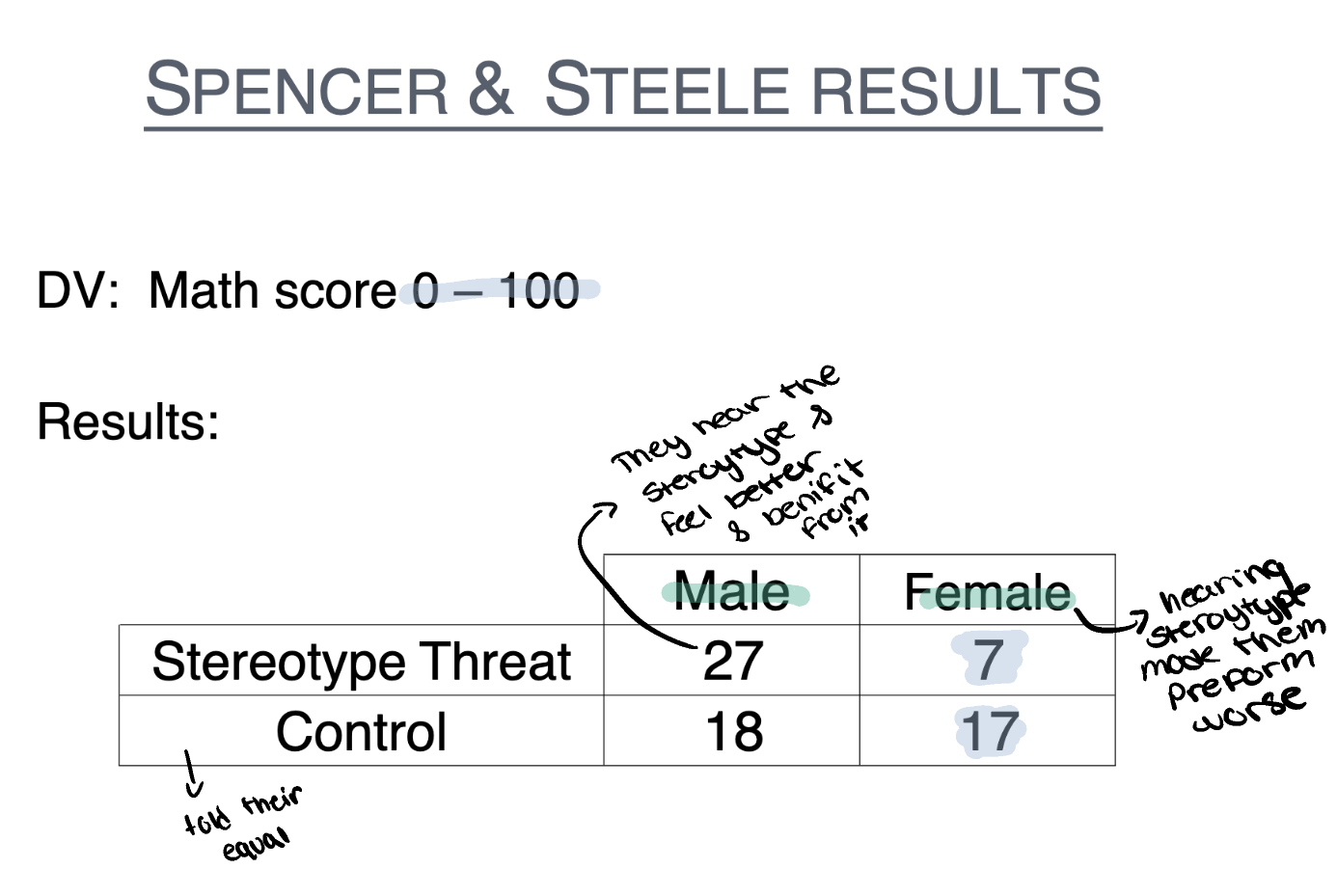
1.women/men(equal math ability) told would be given math test
2.Two condition
a. stereotype threat-noted women usally inder perform men in math
b.Control-noted women usally perform as well as men in math
Spencer & Steele 1997 Expiriment Results
when stereotype present makes individuals that are being stereotyped preform worse
Steele & Aronson 1995 expiriment
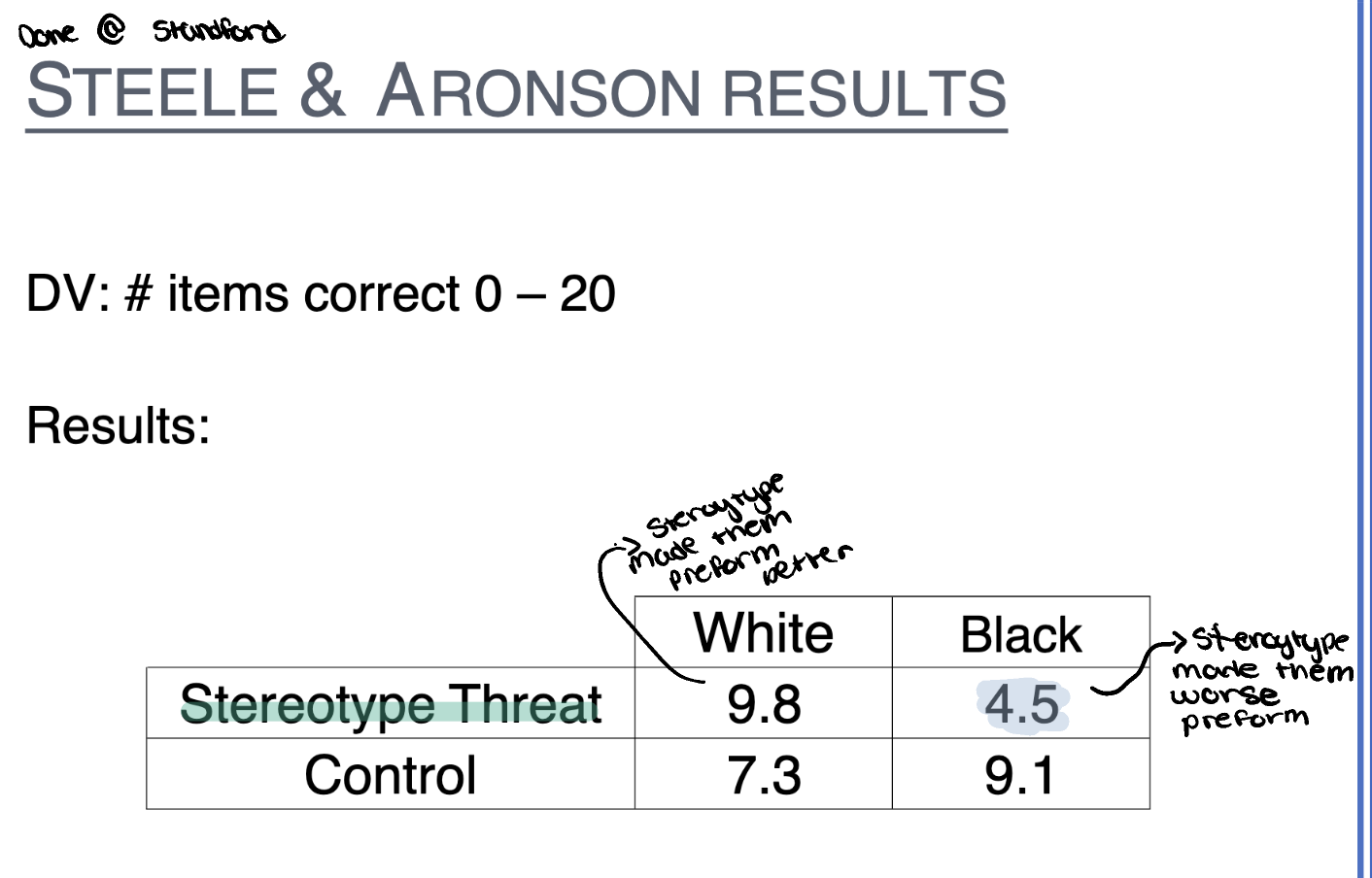
1.whites/blacks told would take an SAT lk etest
2.Two Conditions
a,stereotype threat - report race
b.Control condition-do not report race
3.took test
Steele & Aronson 1995 expiriment Result
stereotype made them preform worse -->behavior impact
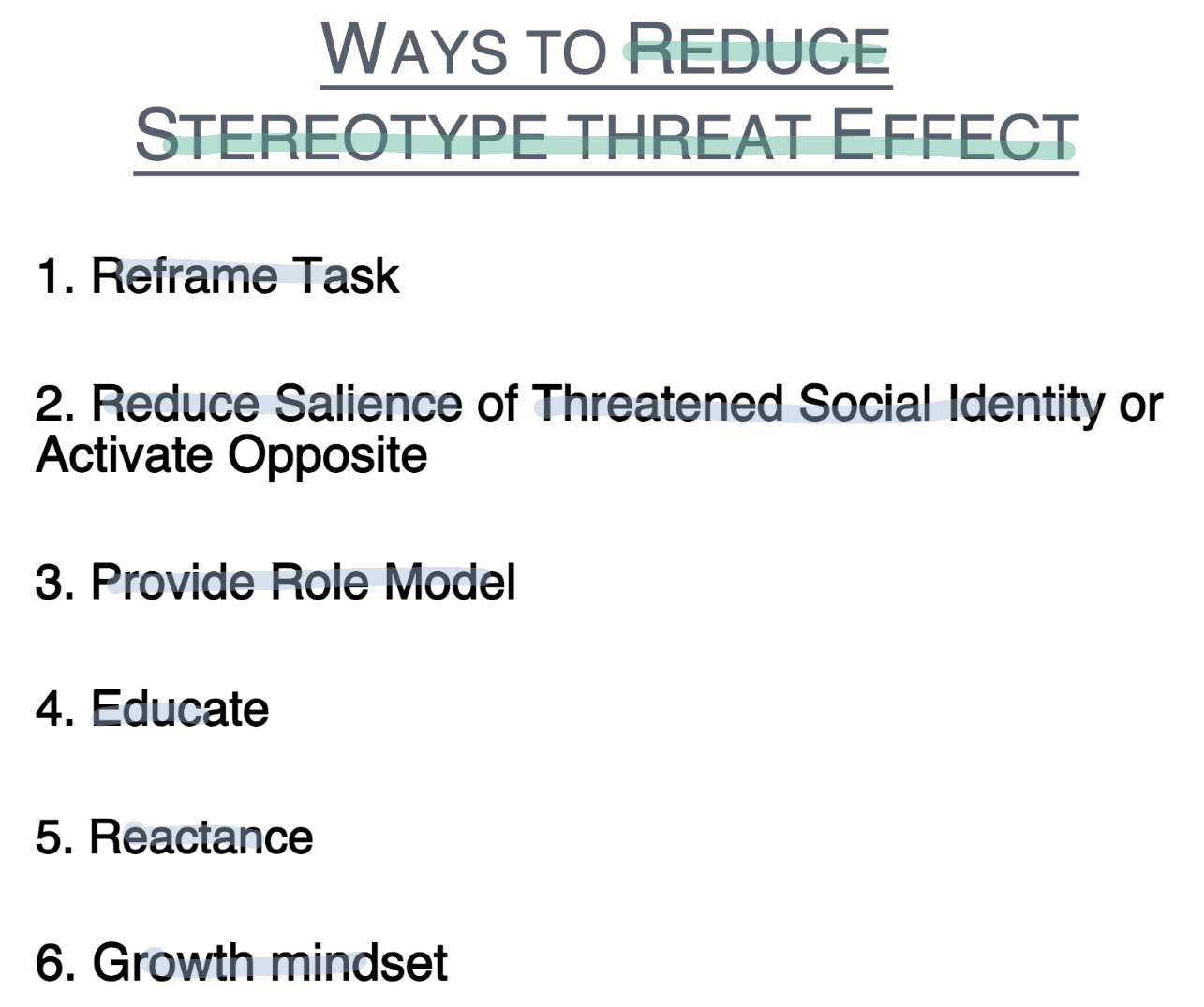
Ways to reduce stereotype threat affect
picture
Prejudice vs. Discrimination
Prejudice is an attitude, while discrimination is a behavior.
Impact of Stereotypes
Stereotypes can distort perceptions and influence social interactions.
Consequences of Stereotyping
Stereotyping can lead to negative outcomes for both individuals and groups.
Ways 2 Reduce stereotype Threat Effect #1: Reframe Task Approach
Approach: Modify task description so that stereotype isnt activate —> stereotype effect
What study was done for Reduce stereotype Threat Effect #1: Reframe Task
Describing math test as gender-fair reduced ST effect (Quinn & spencer,2001)
Ways 2 Reduce stereotype Threat Effect #2: Reduce Salience of Threatened Social Identity or activate opposite Approach
Approach: Eliminate procedures that activate stereotype relevant identity or include procedures that activate counter-stereotype identity
—> ask for identity @ end of task
What study was done for Reduce stereotype Threat Effect #2: Reduce Salience of Threatened Social Identity or activate opposite
Study: -
1. Moving demographics at end of test (Sticker & ward,2004)
2. reminding female undergraduates there smart and from a prestigious school (Rydell et al, 2007)
What is Biracial identity?
More likely to believe race us socially constructed — Don’t show ST effects
Ways 2 Reduce stereotype Threat Effect #3: Provide A role Model Approach
Approach:Provide role Model that does well in stereotype —Relevant domain
—> giving role models that do good reduce stereotypes & Effects
What study was done for Reduce stereotype Threat Effect #3: Provide A role Model Approach
study 1: women reading essay about succesful women( Mclntyre et al 2005)
study 2 : black students less affected by ST when given test by black administrators (Mark & Golf,2005)
Ways 2 Reduce stereotype Threat Effect #4: Educate Approach
Approach: Explain ST effect and explicitly state anxiety may be due to stereotypes, not ability issue
—> be aware of stereotypes of your group & know its not true
What study was done for Reduce stereotype Threat Effect #4: Educate
study: Women given education intervention showed reduced ST effect (johns et al. 2005)
Ways 2 Reduce stereotype Threat Effect #5:Reactance Approach
Approach: When stereotype is explicit, react against it by doing everything possible to show it is false.
—> Make people mad about stereotype
What study was done for Reduce stereotype Threat Effect #5: Reactance
study: When women → emotion → poor negotiation performance is made explicit, females work hard to show that this isnt true & Outperform others (Krey,Thompson & Galinsky 2001)
Ways 2 Reduce stereotype Threat Effect #6: Growth Mindset Approach
Approach: Encourage individuals to view intelligence as malleable(easily influenced/shaped) not fixed
What study was done for Ways 2 Reduce stereotype Threat Effect #6 Growth Mindset
study: Black students encouraged toward growth mindset had higher
Are stereotype/prejudice Changing (changing overtime)
optimistic Position
Pessimistic Position
Mixed Position —> Teacher is in mixed
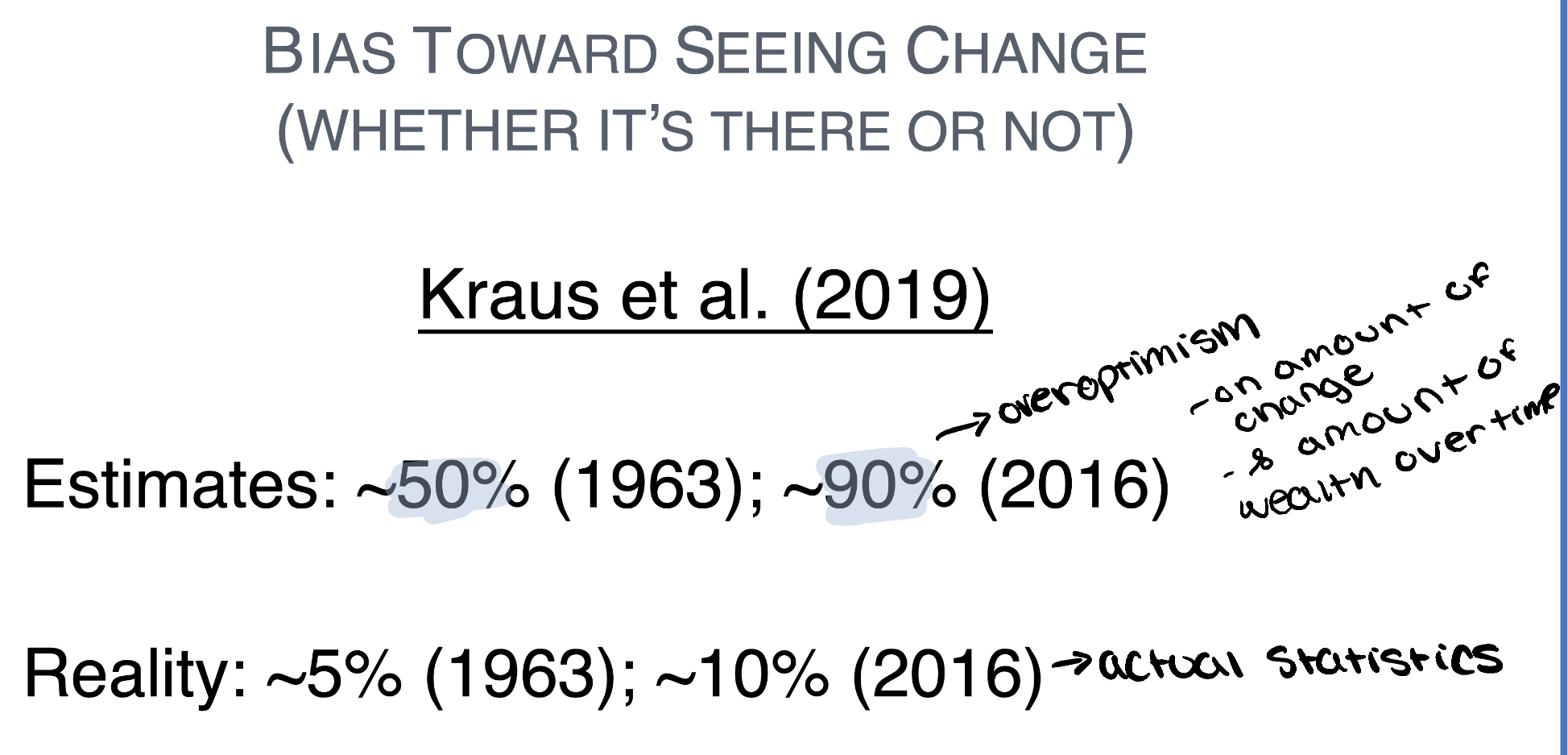
Bias Toward seeing Change (whether its there or Not) (Kraus et al. 2019) Wealth Expiriment
in 1963, the average Black family had —— % of the wealth of the average white family?
Today (2016), the average Black Family Has —— % of the wealth of the average white family
asking for societal perceptions on societal issues
Bias Toward seeing Change (whether its there or Not) (Kraus et al. 2019) Wealth Experiment Results
over optimism on amount of change & amount of wealth over time
actual statistics is way lower 5% & 10%
what are the 3 stereotypes/prejudice changing
Optimistic Position
Pessimistic Position
Mixed Position
Optimistic Position?
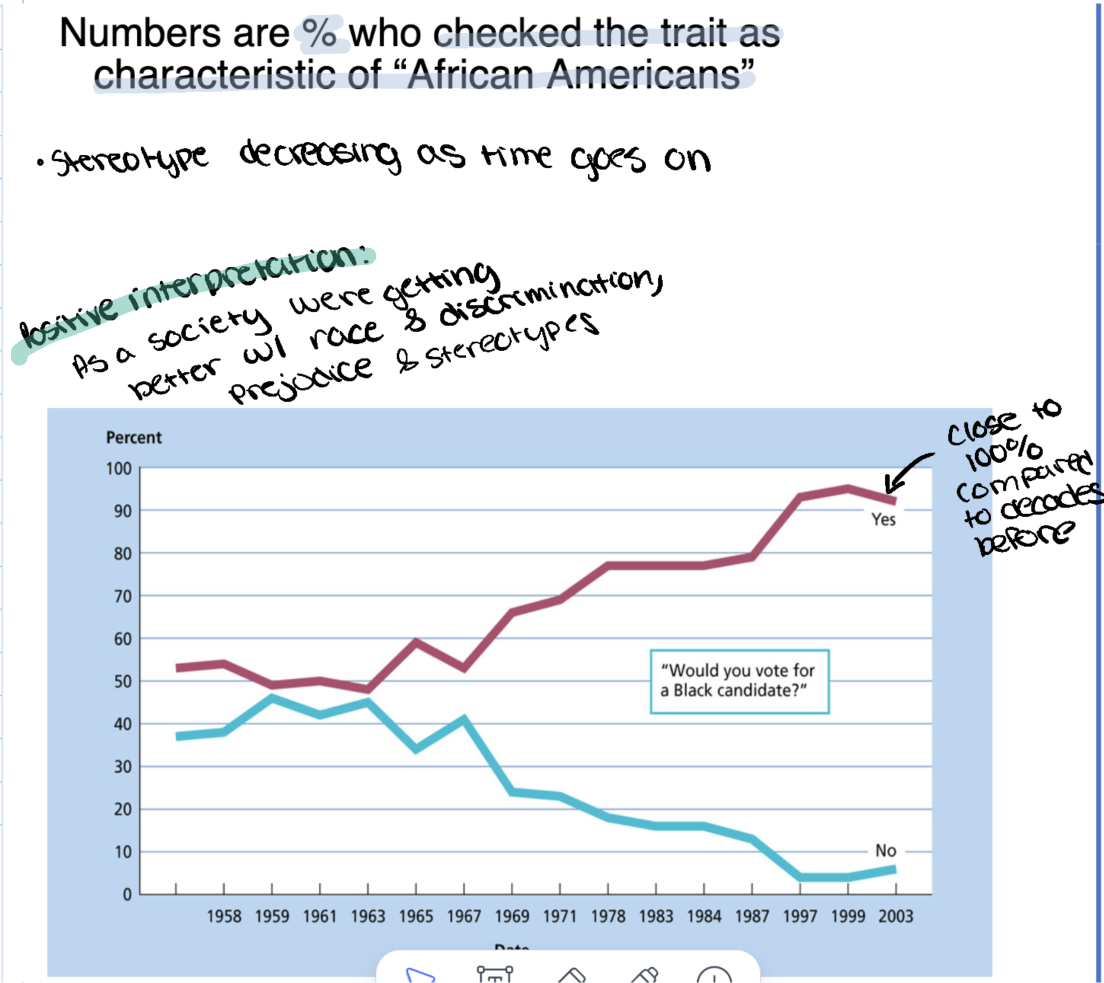
Explicit Reports
getting positive over the years
Pessimistic Position?
Implicit Reports
Mixed Position
both explicit and implicit
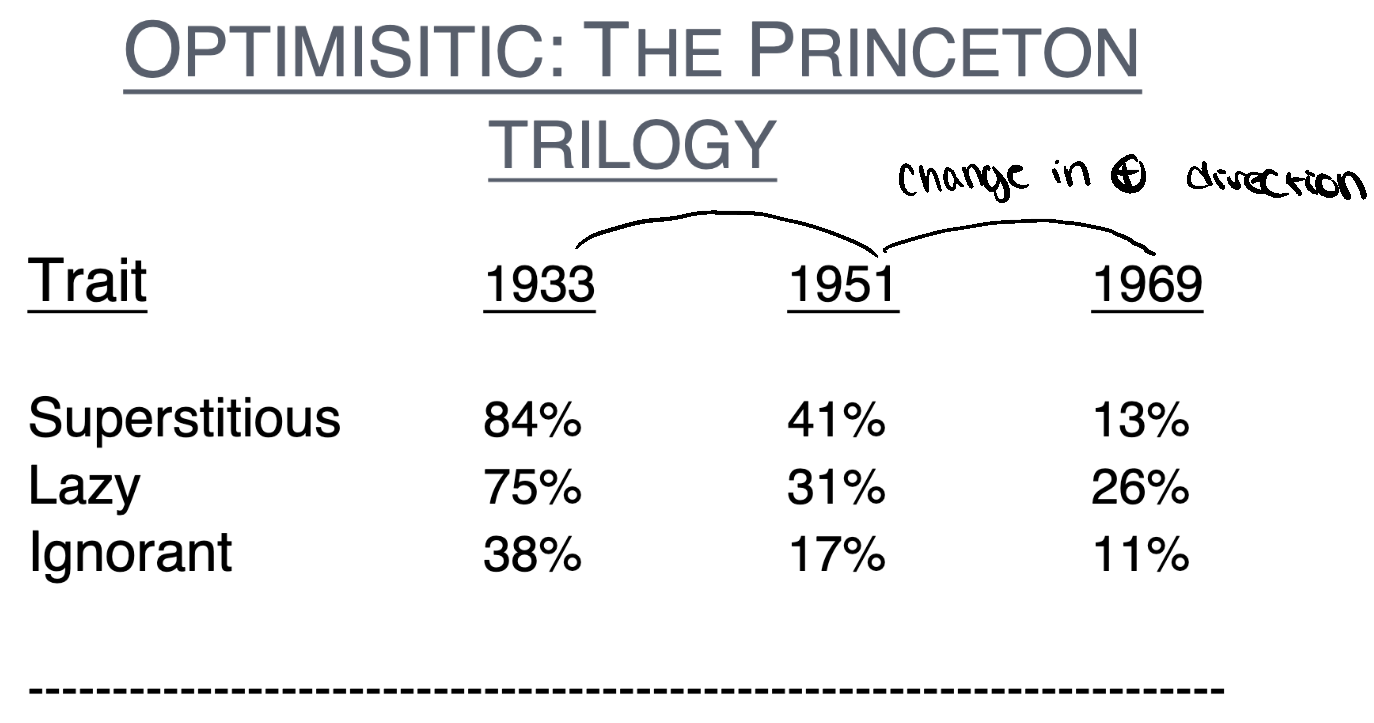
Katz and Braly Technique (adjative checklist)
Participant handed a list of 40 adjectives checklist
Given a social category (Asian,hispanic,black etc)
Then told to check the lost of adjectives for each categoru
same population princeteon students
Katz and Braly Technique (adjative checklist) was it a longitudinal or cross secitional study
Cross sectional
Optimistic position with Princeton trilogy study
as the years go on the stereotypes are becoming less
Crossby & Bill Study
People say 1 thing in public but in private when no ones aware they say something different