Adaptations for Pollination
 Call Kai
 Learn
Learn Practice Test
 Spaced Repetition
 Match
Match Flashcards
 Knowt Play
1/36

There's no tags or description
Looks like no tags are added yet.
Name | Mastery | Learn | Test | Matching | Spaced | Call with Kai |
|---|
No analytics yet
Send a link to your students to track their progress
37 Terms
Pollination
Transfer of pollen from anther to stigma
Insect‑pollinated flower
Flower adapted to attract insects for pollination
Wind‑pollinated flower
Flower adapted to release and catch pollen carried by wind
Nectar
Sugary liquid that attracts insects
Scent
Smell produced to attract insects
Bright petals
Colourful petals that attract insects
Sticky pollen
Heavy pollen grains that attach to insects
Light pollen
Small, smooth pollen easily carried by wind
Large anthers (wind)
Exposed anthers that release pollen into the air
Feathery stigma (wind)
Large surface area to catch airborne pollen
Sticky stigma (insect)
Helps trap pollen brought by insects
Petals (wind)
Small or absent because insects are not needed
What is pollination?
Transfer of pollen from anther to stigma
Why do insect‑pollinated flowers have bright petals?
To attract insects
Why do insect‑pollinated flowers produce nectar?
To attract insects for feeding
Why do insect‑pollinated flowers have sticky pollen?
So it attaches to insects
Why do wind‑pollinated flowers have light pollen?
So it can be carried by the wind
Why are wind‑pollinated anthers exposed?
To release pollen into the air easily
Why do wind‑pollinated flowers have feathery stigmas?
To catch airborne pollen
Why do insect‑pollinated flowers have sticky stigmas?
To trap pollen from insects
Why don’t wind‑pollinated flowers have bright petals?
They do not need to attract insects
Which type of flower produces more pollen?
Wind‑pollinated flowers
Which type of flower has larger, more colourful petals?
Insect‑pollinated flowers
Which type of flower has a strong scent?
Insect‑pollinated flowers
Which type of flower has small, dull petals?
Wind‑pollinated flowers
Why do wind‑pollinated flowers produce so much pollen?
To increase chances of successful pollination
Insect-pollinated flower structure
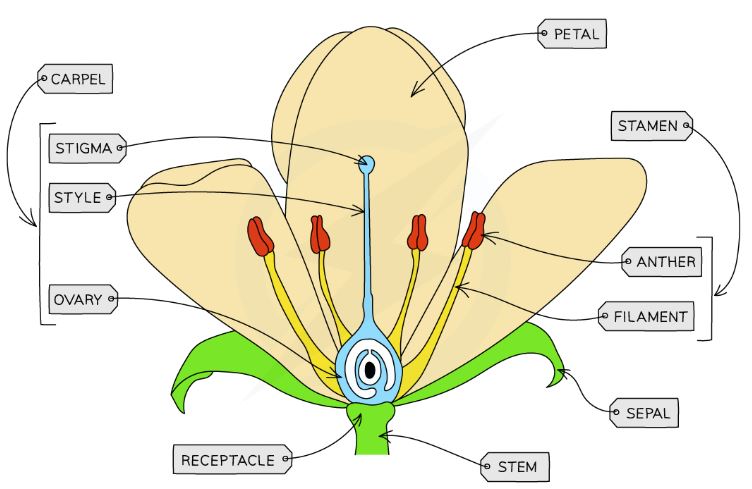
Sepal
Protects unopened flower
Petals
Brightly coloured in insect-pollinated flowers to attract insects
Anther
Produces and releases pollen
Filaments
Provides support to the anther
Stigma
Sticky top of the female part of the flower which collects pollen grains
Style
A tube that connects the stigma and ovary
Ovary
Contains the ovules
Ovule
Structures inside the ovary that contain the female gametes
Carpel
Stigma + Style + Ovary
Stamen
Anther + Filament