1.1.4 -SUBSKILLS 3
 Call Kai
 Learn
Learn Practice Test
 Spaced Repetition
 Match
Match Flashcards
 Knowt Play
1/23

Earn XP
Description and Tags
8. Reading Subskills
Name | Mastery | Learn | Test | Matching | Spaced | Call with Kai |
|---|
No analytics yet
Send a link to your students to track their progress
24 Terms
Should you use the Task Cycle in a Reading lesson?
Yes.
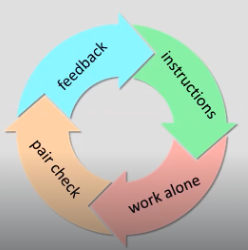
Always use a task cycle for each stage/activity.
Set the task
Work alone
Work in pairs
Whole class feedback
Should you ask Ss to read aloud?
No.
Never ask Ss to read aloud.
It's ineffective. Creates anxiety or disengagemnt in Ss. Is not authentic as we don't typically read aloud in our day to day lives. It is a bad use of lesson time.
Why should you put questions in the same order in which they appear in the text?
Yes.
It helps comprehension.
Should you change the wording in the question slightly so that it's not exactly as it appears in the text?
Yes.
This proves to you that the Ss actually understands what they are reading.
During Whole Class Feedback (WCFB) should you screen share the text on a slide?
Yes.
This ensures all Ss are following along and understanding the answers.
When you elicit answers during WCFB, should you highlight where in the text the answers are found?
Yes.
So that all Ss know where the answers are found.
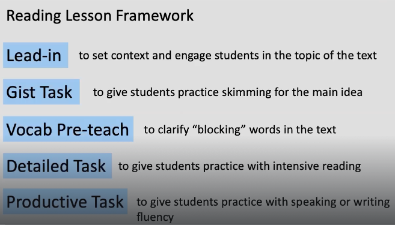
Lead-in, Gist Task, Pre-teach Vocab, Detailed Task, Productive Task
.
In the Reading lesson framework, which of the stages actually have anything to do with reading?
GIST Task: skimming for main idea;
DETAILED task: intensive reading
What are the reading sub skills?
Skimming
Scanning
Reading for Detail
What is the purpose of the various reading sub skills?
When we read, we do so for different purposes.
Eg: reading for pleasure vs reading to find a particular piece of information vs reading for deeper understanding.
Skimming / Scanning / Reading for Detail
When would we use SKIMMING?
We want to get an idea of what the text is about before we decide to read it (SKIMMING for GIST).
Skimming / Scanning / Reading for Detail
When would we use SCANNING?
Or We may need to find a certain factual piece of information such as a name or date (SCANNING).
Skimming / Scanning / Reading for Detail
When would we use READING FOR DETAIL?
Or we may need to understand the nuance, or something not quite spelled out for us that will required deeper reading and processing of the information to come to a conclusion (READING FOR DETAIL).
How many words should you pre-teach, if any?
5 is good.
6-7 is the maximum
What if you think there are more blocking words than you can cover in the reading lesson?
It’s not a vocab lesson so don’t teach too many words unless Ss specifically ask for them. However, be prepared in case they do.
.
DO: Prepare MEANING, FORM, PRONUNCIATION for each word in advance. Have it ready if Ss ask. Otherwise don’t use it.
.
DON’T spend too much time teaching vocabulary when the true aim of the lesson is reading.
When would you use a glossary?
To deal with potentially blocking words that are quite context-specific.
.
A glossary lets Ss understand the word without having to take too much time away from the reading lesson.
How would you make a glossary?
Create a small box with potentially blocking words and their definitions that students can reference as they read the text.
.
Make sure this is visible as students read - either on the text itself or on the slide you're sharing on your screen.
If you use a glossary, do you still need to do a full vocabulary pre-teach for the words in the glossary?
No.
If they are in the glossary, you don’t have to teach them. Ss can quickly read it for themselves.
.
Do point out the glossary so Ss are aware of it if they need it.
When should you pre-teach vocab? Before or after the initial reading task?
The initial reading task is usually a GIST task.
You can stage the pre-teach vocab either before or after this task.
How to decide where in the lesson to stage the pre-teach vocab, if at all?
Words are essential to whole lesson: pre-teach in the Lead-in.
.
Words are essential to Gist task? pre-teach before Gist task.
.
Words are essential to Detailed task, not Gist Task? pre-teach after Gist task.
T/F
Reading lessons and Listening lessons essentially have the same lesson framework?
True.
Reading and Listening are both RECEPTIVE skills.
What is the main difference between a Reading Lesson and a Listening Lesson?
The only difference is how the lesson is conducted due to the audio aspect.
.
This is covered in the Listening Lesson flashcards.
Do we use the same framework for both a Reading lesson and a Listening lesson? Why?
Yes.
.
These are both Receptive Skills.
If we use the same framework for both Reading and Listening lessons, what type of framework do we call this?
.
A ___________________ ____________ lesson framework.
A RECEPTIVE SKILLS lesson framework.
Therefore, what is the framework for a RECEPTIVE SKILLS lesson?
Lead-in
Gist Task
Pre-teach Vocab
Detailed Task
Productive