Physics Unit 3: Light
 Call Kai
 Learn
Learn Practice Test
 Spaced Repetition
 Match
Match Flashcards
 Knowt Play
1/9

There's no tags or description
Looks like no tags are added yet.
Name | Mastery | Learn | Test | Matching | Spaced | Call with Kai |
|---|
No analytics yet
Send a link to your students to track their progress
10 Terms
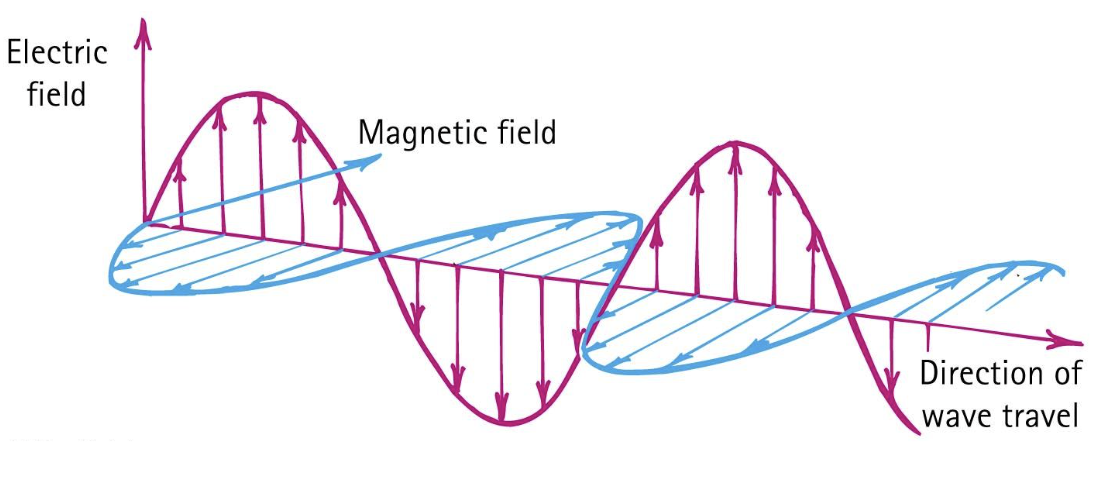
Electromagnetic waves
Electric and magnetic fields are perpendicular to each other and to the direction of motion of the wave
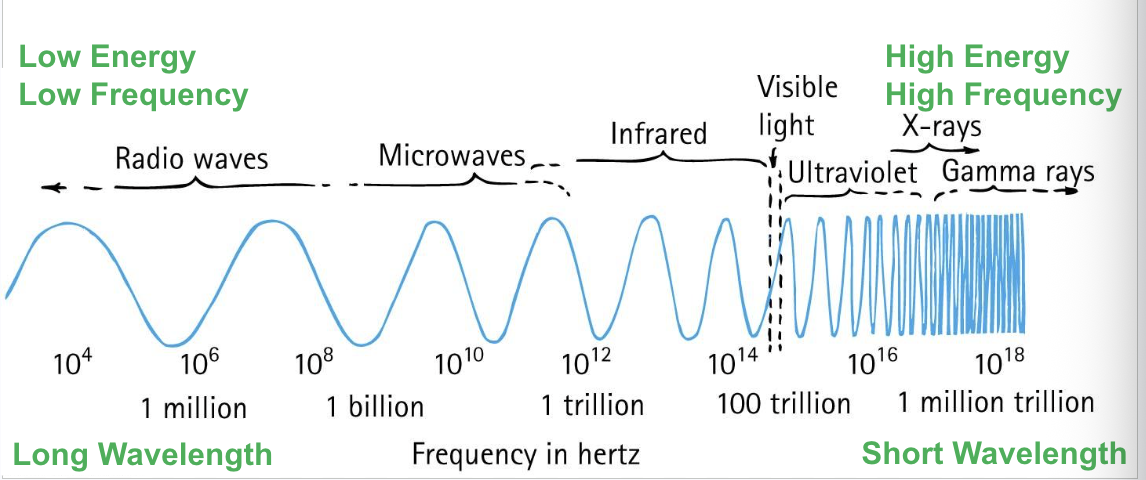
Electromagnetic Spectrum, from low frequency (long wavelength) to high frequency (short wavelength)
Radio waves, microwaves, infrared, (visible light), Ultraviolet, X-rays, gamma rays
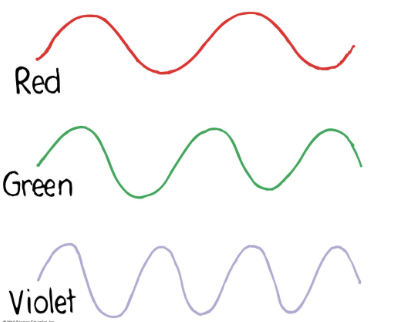
EM Spectrum: colors
Red - lowest frequency and longest wavelength
Frequency increases as light goes through the colors: red, orange, yellow, green, blue, violet
Violet light has nearly 2x the frequency of red light, and half the wavelength
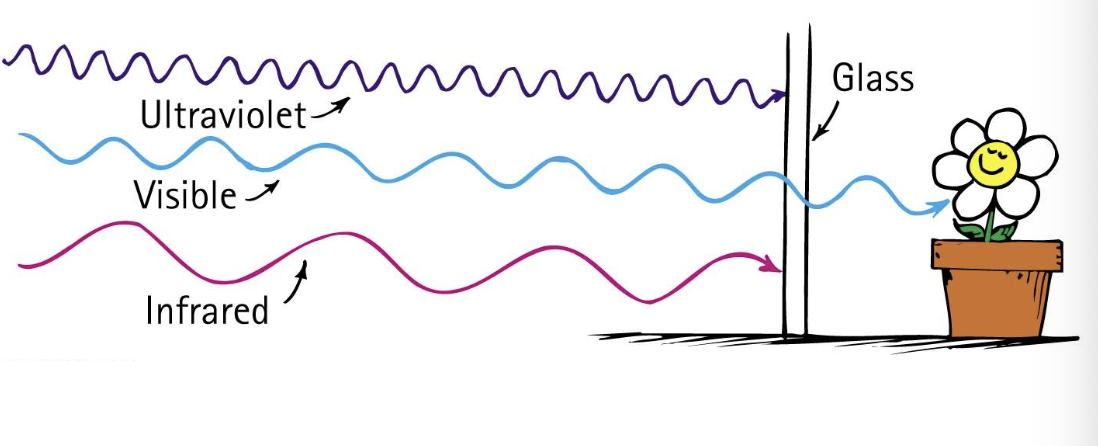
Transparent
Glass blocks both infrared and ultraviolet, but it is transparent to visible light
Light through matter
Speed of light through different materials:
Vacuum - c = 300,000,000 m/s
Atmosphere - slightly less than c
Water - 0.75c
Diamond - 0.41c
Change in speed causes the path of light to change - refraction
Path can be altered by shape of the material (lenses)
Opaque materials
Opaque - absorb light without re-emitting it
Matter converts light into random KE in the matter - into thermal energy
These materials become slightly warm
Opaque materials - metals
Light shining on metal forces free electrons in the metal into vibrations that emit their own light as reflection
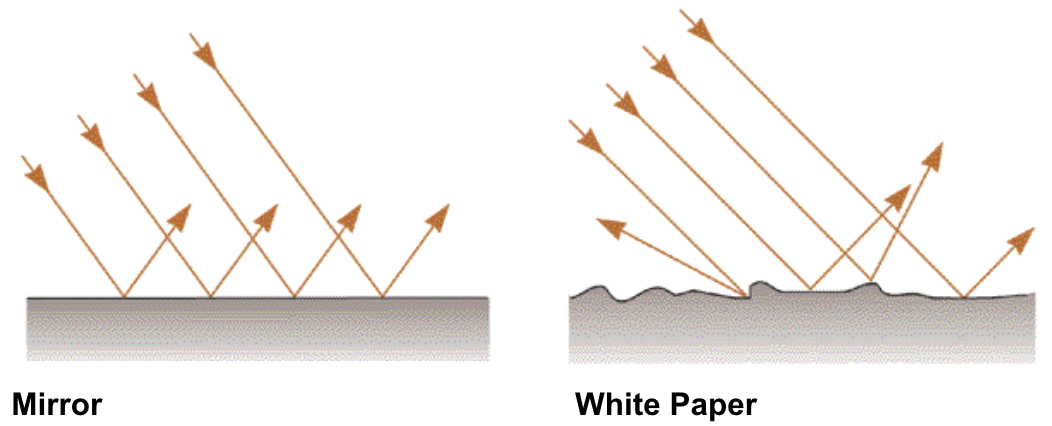
Mirror vs White Paper
Mirror
The surface is flat at distance scales near or above the wavelength of light
Looks “shiny”, and you can see images in it
White paper
Surface is rough at distance scales near or above the wavelength of light
Most surfaces reflect this way
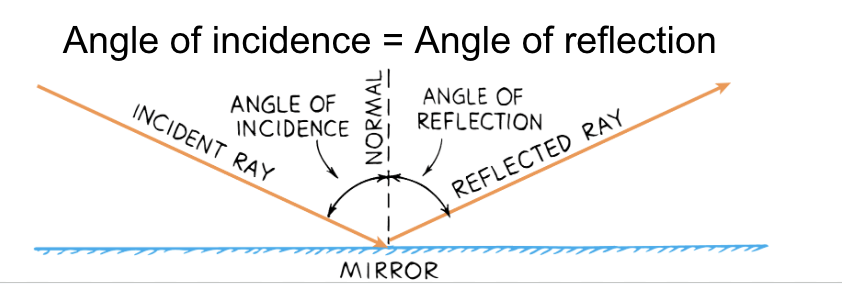
Law of Reflection
Incident rays and reflected rays make equal angles with a line perpendicular to the surface, called the normal
Angle of incidence - the angle between the incident ray and the normal
Angle of reflection - the angel between the reflected ray and the normal
Angle of incidence = angle of reflection
Partial reflection
Some materials are not as rigid to light waves
When light shines perpendicularly on the surface of still water, about 2% of its energy is reflected and the rest is transmitted
When light strikes glass perpendicularly, about 4% of its energy is reflected
The rest is transmitted