LING 201 (final)
 Call Kai
 Learn
Learn Practice Test
 Spaced Repetition
 Match
Match Flashcards
 Knowt Play
1/62

There's no tags or description
Looks like no tags are added yet.
Name | Mastery | Learn | Test | Matching | Spaced | Call with Kai |
|---|
No analytics yet
Send a link to your students to track their progress
63 Terms
Rule Schema
a frame work
XP is the _____ of X
maximal projection
X’ is the _____ of X
intermediate projection
complement
the thing that’s selected by a V A P or N
head
the V A P or N itself
subcategorisation / selection
head is in charge of selecting its complement
c(category)-selection
head selects the category of its complement
l(lexical)-selection
head selects the head if its complement
s(semantic)-selection
ex: ask wants its complete to express a question
what are adjuncts
APs and PPs
Adjuncts
never elected by heads
freely repeatable
what does adjuncts help us do?
helps get rid of stars in the grammar
how does the specifier schema look-like?
XP —> (Specifier) X’
whats the specifier of AP?
Deg
whats the specifier of VP?
T
whats the specifier of NP?
D or PossP
whats the specifier of PP?
right, straight or clear
Functional Heads
special kind of head
all of our single-word specifiers
is the X’ theory just for English?
nope
whats another form of the X’ schema?
X’ —> Complement X
what allows for different forms of the X’ schema?
Headedness Parameter
Headedness Parameter
is this language head-initial or head-final
Head-initial languages
have the head on the left and complement on right
head-final languages
have the head on the right and complement on left
parametrically
grammar switches from one set to another
a generative grammar framework where human languages share universal, innate grammatical principles but differ based on binary "switches" or parameters
where can T only occur?
at the left edge of S if there is no T in the middle
(T is usually Q word)
Transformations
an operation that makes a new tree out of an old one
inversion transformation (preliminary)
move the leftmost T to the left edge of sentence
a [aux] verb move?
yes it can move to the left edge
inversion transformation (better)
move the leftmost [aux] into the nearest C containing [Q]
deep structure
first tree generated by the PS rules and x’ schemata
surface structure
the final tree, the one that’s actually pronounced
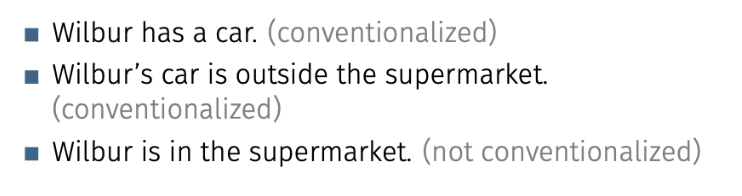
conventionalised
basic meaning of words and sentences

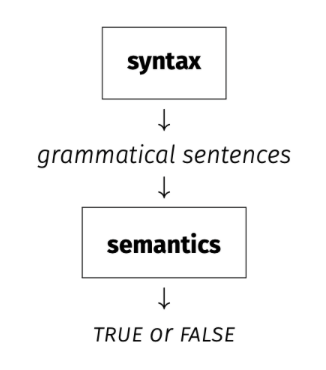
semantics
basic, fixed/conventionalised meaning of words and phrases
pragmatics
worked-out, additional meaning associated with the circumstances of use
entailment
Conventionalised meaning of a sentence
have to be true if the sentence is true
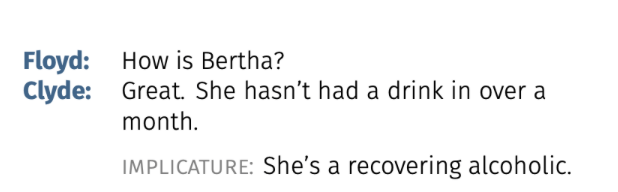
implicatures
worked out by listener on the basis on entailments
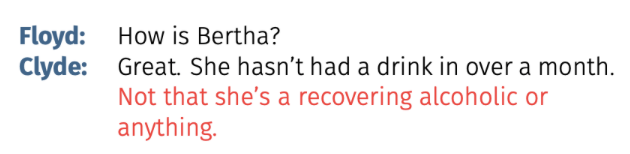
can turn out to be false even if the sentence is true
what is cancelable? implicatures or entailments?
implicatures
truth conditions
requirements that must be met for a sentence to be true
principle of compositionality
the meaning of a sentence/constituent is determined by the meanings of its parts/daughters
how do we want to read meaning?
from the top down (XP level and down)
model
a representation of the world

non branching nodes rule
if a node in a tree has only one daughter, it has the same meaning as its daughter
rule for A
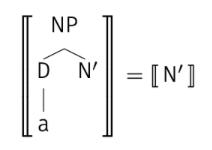
rule for IS
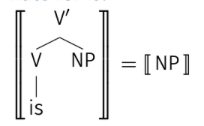
IFF
if and only if
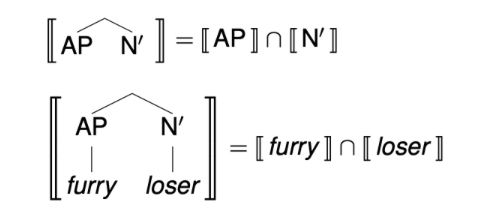
intersective modification
the set of members that the the 2 sets have in common
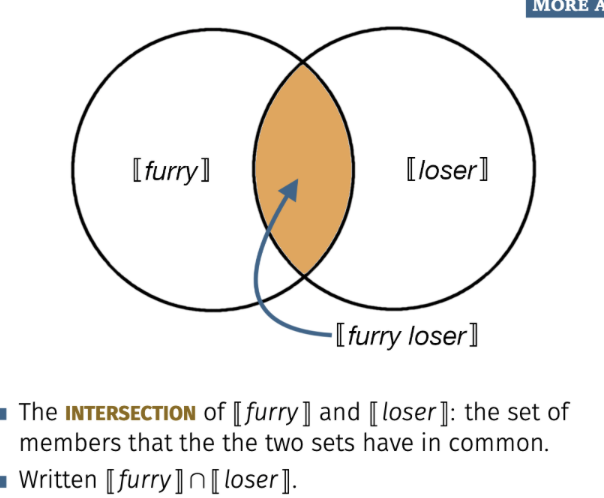
what does the interactive modifier look like
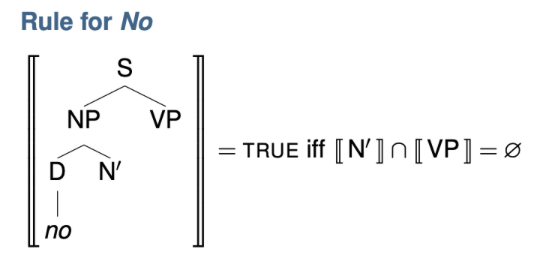
what does the rule for no look like?
Maxim of Quality
say only things that they believe to be true and have evidence for
Maxim of Quantity
make every statement as strong—that is, informative—as possible
Maxim of Relevance/Relation
say only what is relevant
Maxim of Manner
say things in a sensible manner: clever, brief, orderly
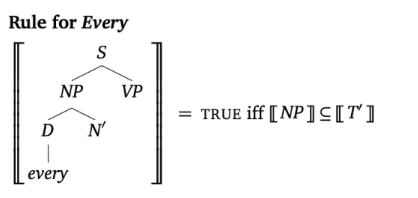
what does the rule for every look like?
membership
something is a member of a set if it is one of the basic parts from which the set is built
Subset
one set is a subset of another if all its members are also member son the other set

singleton set
a singleton ser is a set with one member, not the same as the member itself
complement, set difference - A\B

cardinality |A|
the number of members in A