Foundations of Theology: New Testament Synoptic Gospels, John, Acts, and Revelation
 Call Kai
 Learn
Learn Practice Test
 Spaced Repetition
 Match
Match Flashcards
 Knowt Play
1/85

There's no tags or description
Looks like no tags are added yet.
Name | Mastery | Learn | Test | Matching | Spaced | Call with Kai |
|---|
No analytics yet
Send a link to your students to track their progress
86 Terms
Four-Source Hypothesis
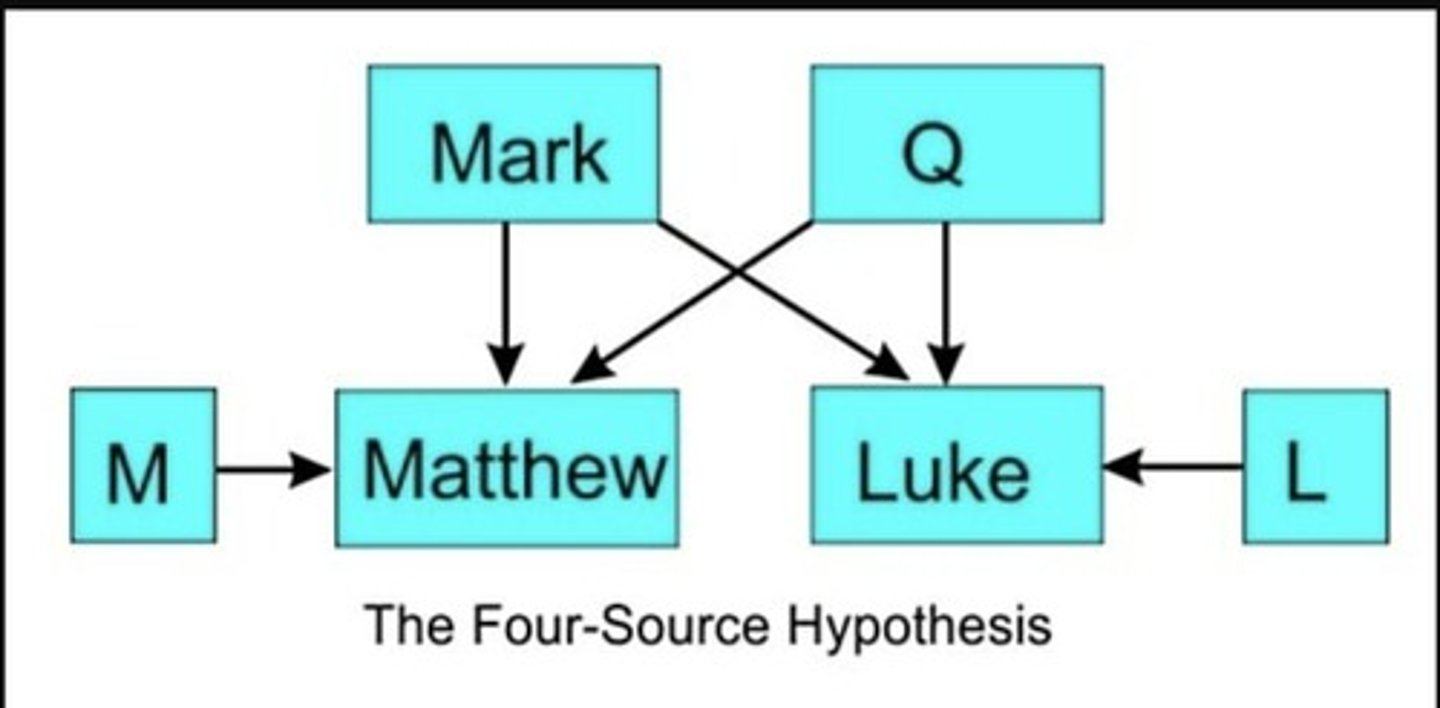
Matthew and Luke didn't just copy one source—they used FOUR different ones.
The Synoptic Problem
The problem of how to explain the wide-ranging agreements and disagreements among these three Gospels.
Synoptic Gospels vs. Johannine Gospel
Comparison between the Synoptic Gospels (Matthew, Mark, Luke) and the Gospel of John.
Meaning of 'synoptic'
Greek: Seeking Together, Meaning: seen together.
Arguments for Markan Priority
1. Patterns of agreement 2. The Sequence of Narrative 3. Characteristics of the Changes 4. The Q Source 5. The M and L Sources.
Methodological Significance of the Four Source Hypothesis
From the insights gained by literary-historical and redaction criticism, we can understand how the synoptic gospel writers altered their source material.
Joyful Mysteries
1. Annunciation 2. Visitation of Mary 3. Nativity 4. Presentation of Jesus at the Temple 5. Finding Jesus at the Temple.
Luminous Mysteries
1. Baptism of Jesus 2. Wedding at Cana 3. Message of Jesus 4. Transfiguration 5. Last Supper.
Sorrowful Mysteries
1. Jesus sweats drops of blood 2. Jesus is scourged 3. Jesus is crowned with thorns 4. Jesus carries the cross 5. Jesus is crucified.
Glorious Mysteries
1. The resurrection of Jesus 2. Ascent of Jesus into heaven 3. Descendent of the Holy Spirit at Pentecost 4. Assumption of Mary into heaven 5. The coronation of Mary in heaven.
Mark's Literary Characteristics
1. Highly structured and organized 2. Teaching-oriented; long discourses 3. Frequent 'fulfillment' formulas 4. More formal, polished style.
Mark's Intended Audience
Primarily Jewish Christians, readers familiar with Hebrew Scriptures and Jewish law.
Mark's Identity & Personality
Traditionally identified with Matthew; comes across as systematic, instructional, almost like a teacher or scribe.
Mark's Relationship to Judaism
Deeply rooted in Jewish tradition; presents Jesus as the new Moses and fulfillment of prophecy.
Luke's Literary Characteristics
1. Most polished Greek 2. Narrative-driven with attention to detail 3. Includes parables unique to Luke.
Luke's Intended Audience
Educated Gentile audience, addressed to Theophilus.
Luke's Identity & Personality
Traditionally Luke, a physician; emphasizes compassion, inclusion, and social concern.
Luke's Relationship to Judaism
Acknowledges Jewish roots but expands beyond them; emphasizes salvation for all people.
John's Literary Characteristics
1. Theological and symbolic 2. Long discourses instead of short parables 3. Uses metaphor and imagery.
John's Intended Audience
Broader Christian community, likely later audience.
John's Identity & Personality
Traditionally John the Apostle; reflective, philosophical, deeply theological.
John's Relationship to Judaism
More interpretive than direct; shows increasing separation between Christian and Jewish communities.
Early Galilean Ministry
Jesus begins his ministry by preaching the gospel on the kingdom of God and performs many healings.
Late Galilean Ministry
A multitude follows Jesus; includes the announcement of the unpardonable sin and various parables.
Parable of the Sower
A farmer scatters seeds on different types of ground, representing different responses to the word of God.
Parable of the Hidden Lamp
Truth is meant to be revealed; what is hidden will be made known.
Parable of the Growing Seed
A man scatters a seed, it grows on its own, even while he sleeps.
Kingdom of God
Signifies the kingdom of God growing mysteriously, humans don't control it, God does.
Parable of the Mustard Seed
A tiny mustard seed grows into a large plant.
Jesus Calms a Storm
An event where Jesus demonstrates his authority over nature.
Jesus Heals a Gadarene Demoniac
An instance of Jesus casting out demons from a possessed man.
Jairus' Daughter
A story of Jesus raising a synagogue leader's daughter from the dead.
Woman Who Touched Jesus' Garment
A woman is healed from a bleeding condition by touching Jesus' clothing.
Jesus is Rejected at Nazareth
Jesus faces disbelief and rejection in his hometown.
Mission of the 12
The sending out of Jesus' twelve disciples to preach.
Herod Antipas Kills John the Baptist
The execution of John the Baptist ordered by Herod.
Jesus Feeds Five Thousand
A miracle where Jesus multiplies loaves and fish to feed a large crowd.
Jesus Walks on Water
Jesus demonstrates his power by walking on the sea.
Jesus Heals the Sick in Gennesaret
Jesus performs healings in the region of Gennesaret.
Jesus Heals the Daughter of a Syrophoenician Woman
A story of Jesus healing a Gentile woman's daughter.
Jesus Heals a Deaf and Dumb Man
Jesus restores hearing and speech to a man who could not hear or speak.
Jesus Feeds the Four Thousand
A miracle where Jesus feeds another large crowd with limited food.
Pharisees Demand a Sign
The religious leaders challenge Jesus to perform a miracle as proof.
Jesus Warns About the Leaven of the Pharisees and Herod
A warning against the corrupting influence of religious leaders.
Jesus Heals a Blind Man at Bethsaida
Jesus restores sight to a blind man in Bethsaida.
Peter Confuses Christ at Caesarea Philippi
Peter mistakenly identifies Jesus' mission and purpose.
Jesus Foretells His Death
Jesus predicts his own death on three separate occasions.
Transfiguration
An event where Jesus is transformed and speaks with Moses and Elijah.
Coming of Elijah
A reference to the prophetic return of Elijah before the Messiah.
Jesus Heals a Boy with Unclean Spirit
Jesus casts out a demon from a boy who suffers from seizures.
Jesus Blesses Little Children
Jesus welcomes and blesses children, emphasizing their importance.
The Rich Young Ruler
A story about a wealthy man who struggles to follow Jesus' teachings.
Jesus Warns About the Danger of Riches
A cautionary message about the spiritual risks of wealth.
Triumphal Entry
Jesus' entry into Jerusalem, celebrated by crowds.
Cursing of the Fig Tree
An act symbolizing judgment against unfruitfulness.
Jesus Cleanses the Temple
Jesus drives out merchants from the temple, asserting its sanctity.
Destruction of the Temple and Signs Before the End
Prophecies regarding the temple's destruction and end-time signs.
The Passion of the Lord
The events leading to Jesus' crucifixion and resurrection.
The Acts of the Apostles
A continuation of the Gospel of Luke, detailing the early church.
Pentecost
The descent of the Holy Spirit on the apostles, empowering them.
The Martyrdom of St. Stephen
The first Christian martyr, stoned for his faith.
Conversion of Paul
Paul's transformation from persecutor to major Christian missionary.
Jewish law
The legal code that governs Jewish life and practice.
Council of Jerusalem
Major meetings of church leaders that decided gentiles do not need to fully follow Mosaic law.
St. Paul
Born in Tarsus around AD 10, originally named Saul, a Roman citizen and Pharisee who converted around AD 34.
Epistles
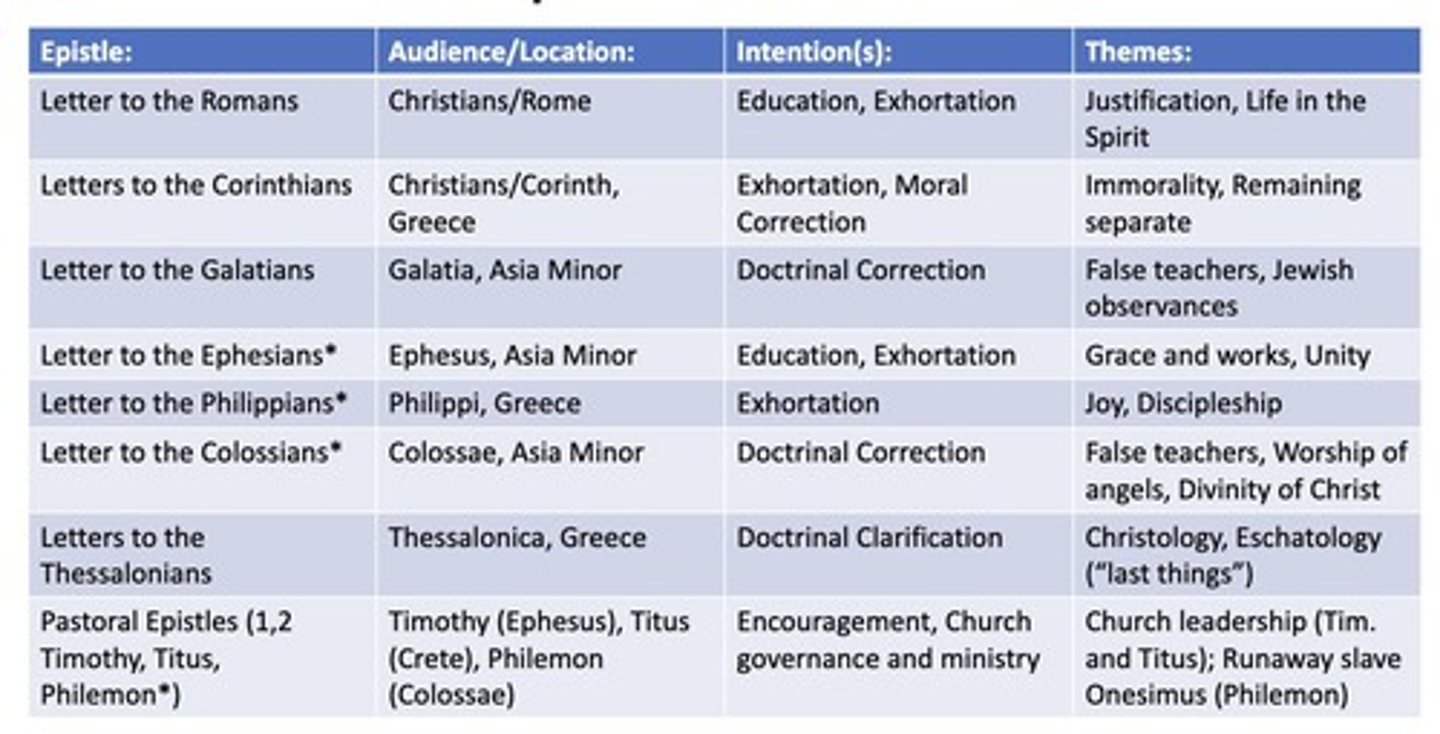
Letters written by Paul that are vital for developing Christian theology and vocabulary.
Status of Jews in the Roman Empire
Rome was a religious haven with certain protections for Jews, including judicial rights.
Edict of Claudius
Prohibited Jewish gatherings and synagogue attendance while extending rights to Jews throughout the empire.
Pauline epistles
Authentic letters written by St. Paul himself, showing his personal voice and theology.
Pseudo-Pauline epistles
Letters likely written by disciples of Paul after his death, using his name to continue his teachings.
Universal teaching
Applies to all Christians at all times, such as salvation through Christ.
Context-dependent situational teaching
Written for specific communities addressing specific problems.
Theological themes of Romans
Includes human guilt, God's righteousness, justification through faith, and the hope of resurrection.
Kenosis
Greek term meaning 'emptying'; refers to Christ's self-emptying in becoming human.
Authorship of Hebrews
Debate over authorship with most modern scholarship contending it is anonymous.
Destination of Hebrews
Most scholars argue it was written to Jewish Christians in Rome.
Midrash
Jewish method of interpreting scripture, re-reading Old Testament texts for contemporary meaning.
Levitical priesthood
Priestly system from the tribe of Levi, characterized by human imperfection and mortality.
Melchizedekian priesthood
Based on the figure Melchizedek, described as eternal and greater than Abraham.
Abraham's deference to Melchizedek
Abraham gives a tithe to Melchizedek, receiving a blessing, indicating Melchizedek's superiority.
Christ Jesus as priest
Jesus is a priest in the order of Melchizedek, offering himself as the perfect high priest.
The Book of Revelation
Apocalyptic literature that reveals a transcendent reality and the end of history.
Importance of John the Baptist
Connects to the message of repentance and judgment, bridging Old Testament prophecy and Revelation's fulfillment.
Evil is conquered
Central message of Revelation that evil powers are defeated.
New heavens, new earth, new Jerusalem
At the end, creation is renewed and a perfect city comes down from heaven.
All things new
God's promise that everything broken is restored to its intended state.