AP WORLD HISTORY MODERN
 Call Kai
 Learn
Learn Practice Test
 Spaced Repetition
 Match
Match Flashcards
 Knowt Play
1/59

Earn XP
Description and Tags
SPRING 2026 SEMESTER EXAM REVIEW
Name | Mastery | Learn | Test | Matching | Spaced | Call with Kai |
|---|
No analytics yet
Send a link to your students to track their progress
60 Terms
the Neolithic Revolution
Dramatic shift from hunting and gathering to farming and domestication animals (8000 B.C. - 3500 B.C.E)
agriculture changed the lifestyles of societies by . . .
Allowing hunter gatherers or hunter-foragers to settle down in one place (nomadic → sedentary).
lifestyles of farmers vs pastoralists
Farmers - sedentary; domesticate animals & agriculture
Pastoralist - nomadic/semi-nomadic; only domesticate animal
original purpose of writing (an advantage for Sumerian society)
Original purpose - record keeping; allowed the Sumerians to efficiently manage their complex society – improving administration, trade, and taxation
Hammurabi & contributions made to Mesopotamia
A significant Babylonian emperor who established a code of laws (Hammurbi’s code), unified city-states within the empire.
“Era of the Warring States”
A period of time where people were not united and there was no religion or political system that brought the peoples together in China.
Mandate of Heaven & its purpose
A Chinese political idea where Heaven granted a ruler the divine right to govern:
New dynasty arises, takes control of China
Strengthens rule, reestablishes prosperity, peace
Weakens, becomes lazy, problems arise (lose the mandate of heaven)
Invasions, revolts toss out reigning dynasty
*repeat cycle forever
Purpose; to justify overthrowing the corrupt e.g. Shang Dynasty
ideas of Confucianism
Believed social order, harmony and good government should be based on family relationships.
Education is important
Has secular views of political virtue & good government
Lacks a spiritual side because of secular views
Role of women in Confucian society
Due to strict gender roles, a woman's duty was to be subject to her husband, foster and nurture children, and household chores e.g. foot binding
two religions impacted Japanese society the most (one is native to Japan)
Shintoism
Based on respect for natural forces & the worship of ancestors.
They believed that kamis live within all people, animals, and nature(native to Japan)
&
Buddhism
Japanese Feudal society
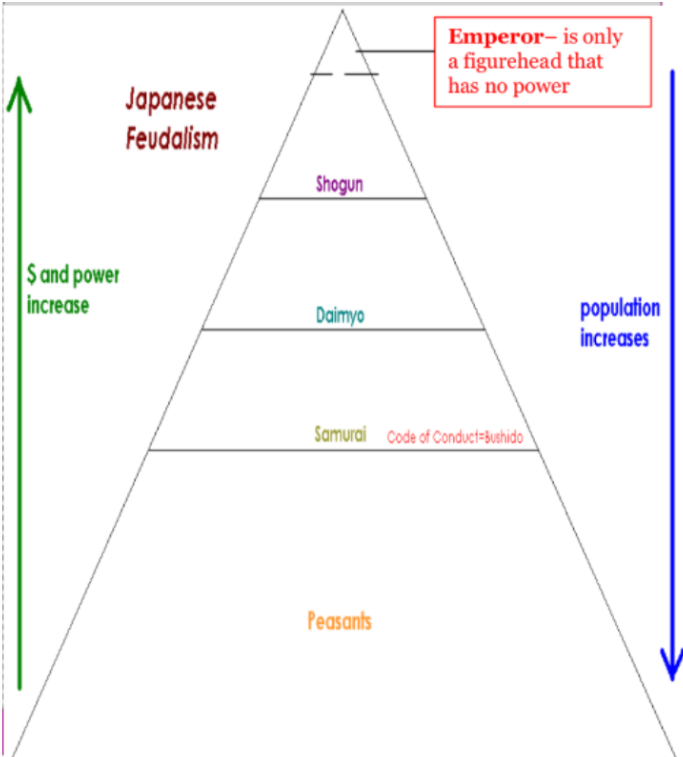
Hinduism
Oldest religion, which is polytheistic, and views religion as a way of liberating the soul from suffering.
Caste system in India & purpose when combined with Hinduism
Brahmins (Priests)
Kshatriyas (Rulers and Warriors)
Vaisyas (peasant merchants)
Shudras (peasants and Laborers)
* The Dalit or Untouchables
Purpose: intended to create a disciplined society with clear roles, where people performed duties (dharma)
Siddhartha Gautama
A former prince who became a spiritual leader
renounced his rich life to seek the meaning of sufferment → achieving enlightenment.
Founder of Buddhism, later became known as the Buddha
tenets/beliefs of Buddhism
Four Noble Truths
All life involves suffering
Desire is the cause of suffering
Elimination of desire brings an end to suffering
The Noble Eightfold Path brings the elimination of desire
buddhism spread throughout Asia through . . .
Silk Road/Routes
Judaism
Monotheistic religion of the Jews founded by Abraham and Moses
10 Commandments
Laws based on ethics/morals & new covenant with God; became the basis for civil & religious laws of Judaism.
Christianity (tenets) & where did it derived its basic beliefs from
Jesus’s teaching, Hebrew Bible (Old Testament), and Apostolic writings
* derived from Judaism
Muhammad
A prophet/messager of Allah god; founder of Islam
Islam: a unifying force for who . . .
Provided a religion that Arab in origin which erased clan divisions & brought an end to clan feuding; provided ethical system
office created for the political & religious successor of Muhammad after his death
Caliph
Muslims preserve ___________ during the “Golden Age of Islam”
Preserved ancient greek, persian, and india texts by translating into arabic
areas the Muslims added to the sciences.
Mathematics, astronomy, medicine, optics, chemistry, and natural philosophy
innovations Muslim merchant sailors introduce to Europe from China
Magnetic compass and rudder
invaders that destroyed Bagdad in 1258, bringing an end to the Abbasid Caliphate
The Mongols
How Islam first introduced to North Africa
Muslim armies of 650 pushed westward from Arabia, military power and gunpowder
Mongols & their accomplishment
A nomadic East Asian ethnic group who, under Genghis Khan and his successors in the 13th century, created the largest contiguous land empire in history
the Chinese dynasty that was controlled by Mongols in the late 13th century
Yuan Dynasty
Feudalism
a dominant social, economic, and political system in medieval Europe (9th–15th centuries) where land was granted by lords to vassals (landholders) in exchange for loyalty, military service, and labor
defining characteristics of the Ottoman Empire. (SPICE-T)
Social – multi-ethic/religious empire; millet system allowed non-Muslim communities to have their own religious and legal autonomy – if they paid a tax
Political – an absolute monarchy which meant the sultan had complete power and control over people; government; military (basically everything), was both political & religious leader
Interactions (human/environmental) – relied heavily on agriculture and use of natural resources (e.g. timber, water, and minerals) to sustain their economy and military conquests.
Culture – a syncretic blend of Turkic, Islamic, Persian, and Byzantine traditions; cosmopolitan society
Technology – GUNPOWDER EMPIRE
conflict between the Ottoman and Safavid Empires.
a brutal, long-term struggle driven by intense religious rivalry (Sunni vs. Shia) and geopolitical competition for territory, notably Iraq and the Caucasus
European motives for exploring the seas
acquiring wealth (spices, silk, gold), spreading Christianity, competing for colonial dominance, and satisfying Renaissance curiosity (basically God, Gold, and Glory)
the Renaissance & its origins.
a fervent "rebirth" of European culture, art, and intellect that bridged the Middle Ages and modern history, roughly spanning the 14th to 17th centuries. It began in Italy, focusing on humanism
Renaissance man
a well-rounded individual with deep knowledge, proficiency, or expertise in a wide range of, often unrelated, fields, such as arts, sciences, and physical pursuits.
three artists that were considered Renaissance men.
Leonardo da Vinci
Michelangelo Buonarroti
Raffaello Sanzio (Rapheal)
the first full-sized book the Gutenberg press copied
The Gutenberg Bible
Protestant Reformation
a 16th-century religious, political, and cultural upheaval that split Western Christianity, challenging the authority of the Pope and the Roman Catholic Church; initiated by Martin Luther in 1517
Causes of the Reformation
dissatisfaction with corruption in the Roman Catholic Church, specifically the sale of indulgences
rise of Renaissance humanism
invention of the printing press
political desires for independence from papal authority
Identify the founder of each of the first Protestant Churches:
Lutheran – Martin Luther, a German monk, initiated the Reformation in 1517 by questioning Catholic practices (95 Theses). Lutheranism developed from his teachings.
Calvinist – John Calvin
Anglican – King Henry VIII
Presbyterian – John Knox
Isaac Newton
laws of motion
universal gravitation
The Enlightenment
a 17th–18th century intellectual and cultural movement in Europe and the Americas that championed reason, individualism, and scientific empiricism over tradition, superstition, and faith
philosophies associated with the following Enlightenment thinkers:
John Locke – natural rights (life, liberty, and property); social contract; consent of governed
Jean Jacques Rousseau – social contract, general will, popular sovereignty
Montesquieu – separation of powers, critique of absolutism, environmental determinism
Voltaire – religious tolerance, freedom of speech and thought, rationalism and empiricism
Wollstonecraft – of women’s equality, critique of patriarchy
revolutionary document included enlightenment ideas e.g. the right to life, liberty, and the pursuit of happiness and the consent of the governed
The Declaration of Independence written by Thomas Jefferson (honorable mention: John Locke)
divine right
The idea that rulers have God’s blessing and are seen as god’s messengers which legitimizes their power
Estates System
A system of social stratification that divided French Society into three estates: the clergy, nobility, and the commoners
Napoleon’s effort to stabilize France after the Revolution
centralized the French government, reformed the education system, created the Bank of France, and established the Napoleonic Code to stabilize France after the Revolution.
Napoleonic code
a civil code established by Napoleon Bonaparte in 1804 that served as a model for the civil law codes adopted in many countries.
Nationalism.
an ideology and movement holding that the nation—a group sharing a common culture, language, or history—should be congruent with a sovereign state, placing the interests of the nation above other concerns
Industrial Revolution
a pivotal period of transition (roughly 1760–1840) from agrarian, handicraft economies to machine-driven, centralized manufacturing and industrialized urban societies
impact technological advances had on the industry
driving massive productivity gains, shifting from manual labor to automation. Key impacts e.g. mass production via assembly lines
proletariat and the bourgeoisie
Bourgeoisie: capitalist class who own the means of production (factories, mines, land, banks)
Proletariat: the working class who own no property and must sell their labor to the bourgeoisie to survive.
Laissez faire capitalism & proponent of this philosophy
an economic system advocating for minimal or zero government intervention, allowing free markets to operate based on self-interest, competition, and supply and demand promoted by Adam Smith
Karl Marx’s communist theory.
posits that capitalism is inherently exploitative and unstable, driven by a class struggle between owners (bourgeoisie) and workers (proletariat). He predicted a working-class revolution would abolish private property, leading to a stateless, classless society where the means of production are commonly owned
impact of worldwide industrialization effects the relationship between industrialized nations and non-industrialized nations.
shifted global power dynamics, creating a, often exploitative, core-periphery relationship where industrial nations (the core) dominated non-industrialized regions (the periphery) through imperialism, economic dependency, and forced trade imbalances
purpose of the Berlin Conference of 1884-1885
To regulate European colonization and trade in Africa, aiming to prevent conflict between competing European powers during the "Scramble for Africa"
immediate cause of WWI
The assassination of Archduke Franz Ferdinand
“total war”
a military conflict in which combatants are willing to make any sacrifice in lives and resources to achieve complete victory, blurring the lines between combatants and civilians
event that effectively brought the United States into WWI
The Zimmermann Telegram: Intercepted by British intelligence, this message revealed a German proposal to Mexico to form an alliance against the U.S., promising to help Mexico reclaim Texas, New Mexico, and Arizona.
the peace treaty that brought an end to WWI
Treaty of Versailles