[WIP] 15 Adaptive Immune Response
 Call Kai
 Learn
Learn Practice Test
 Spaced Repetition
 Match
Match Flashcards
 Knowt Play
1/8

There's no tags or description
Looks like no tags are added yet.
Name | Mastery | Learn | Test | Matching | Spaced | Call with Kai |
|---|
No analytics yet
Send a link to your students to track their progress
9 Terms
Primary Response
The first response to an antigen
May take a week or more to develop
Secondary Response
This is the immune response when the immune system remembers a pathogen on subsequent exposure
Vaccines exploit this phenomenon of immunologic memory
» Under [__], memory B cells differentiate into plasma cells
→ rapid production of antibodies
Adaptive Immunity
Third line of defense, acquired throughout lifetime.
A specific response against a specific pathogen
humoral: eliminates extracellular pathogens
cell-mediated: eliminates intracellular pathogens
Humoral immunity
Subdivision of adaptive immunity that eliminates extracellular pathogens
(humor means “fluids” → mediates invades in blood/tissue fluids)
Mediated by B cells
mature in bone marrow
some differentiates into plasma cells → produce antibodies
antibodies: Y-shaped proteins that bind to specific antigens and mark them as invaders to be eliminated
some differentiate into memory cells → allows rapid secondary response if encountering antigen again

Cell-mediated immunity
Subdivision of adaptive immunity that eliminates intracellular pathogens
Mediated by T cells
mature in thymus
differentiates into:
cytotoxic T cells → delivers “death packages” that activate apoptosis of cell
Helper T cells → delivers cytokines to macrophages to increase their killing power; helps B cells proliferate into plasma cells
regulatory T cells (suppressor T cells)
for every T cell, there’s a B cell that produces specific antibodies
Antigen
Any compound that elicits an immune response (immunogen) → antibody production. Antibody generator.
Epitropes
Antigenic determinants on surface of microbes that trigger response; are macromolecules (proteins, lipids, polysaccharides)
When an antibody binds to an antigen, it is actually binding to an [__] of the antigen!

Antibodies
[__] are also called immunoglobulins
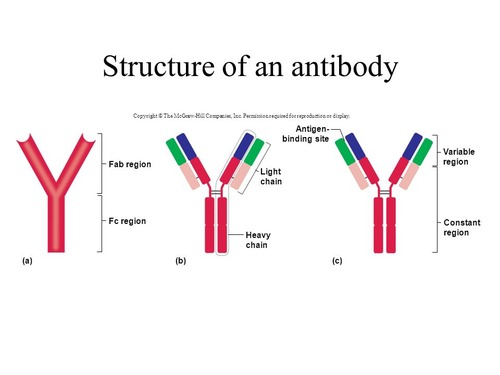
Structure
4 amino acid chains held together by disulfide bonds
Y-shaped proteins with two general parts
Fc region: stem portion of [__]; serves as a constant “red flag" that sticks out from the surface of all antibody-bound antigen → tags antigen
Fab region: arms that attach to antigen→ variable region
» unique to each Antibody (Ab)
» recognizes and binds to a specific Antigen (Ag)