EXSS 288- Mechanics and Classification of Injuries
 Call Kai
 Learn
Learn Practice Test
 Spaced Repetition
 Match
Match Flashcards
 Knowt Play
1/107

There's no tags or description
Looks like no tags are added yet.
Name | Mastery | Learn | Test | Matching | Spaced | Call with Kai |
|---|
No analytics yet
Send a link to your students to track their progress
108 Terms
what is an acute injury?
mechanical failure of soft tissue due to excessive force occurring in a single bout
describe the onset and duration of an acute injury
sudden onset of short duration
what is a chronic injury?
mechanical failure of soft tissue due to repeated micro-trauma occurring over an extended period of time
decribe the onset and duration of a chronic injury
gradual onset and prolonged duration
what is an open fracture?
exposed
breaks the surface of the skin
what is a closed injury?
unexposed
any injury that does not involve disruption of the skin surface
what is stress?
external or internal force acting on the tissue
what is strain?
the extent of deformation under loading
what does the degree of deformation depend on?
tissue composition
speed of applied load
frequency of loading
direction of loading
what is the yield point?
load is greater than mechanical capabilities of the tissue; where mechanical failure begins to occur
what are the six primary mechanical forces that cause injury?
tension
compression
shear
bending
torsion
combined
what is tension?
creates a pulling action trying to elongate the structure
what is compression?
creates a pushing action tending to shorten the structure
what is shear force?
forces that acts parallel to the cross section or surface of a body
two forces are in opposite directions
what is bending force?
loading about an axis
combination of tension and compression
what is torsion?
load applied causing structure to twist about an axis
what is combined loading?
tissue is seldom loaded in one mode only
subjected to multiple indeterminate loads
geometric structure is irregular
what are the two main parts of the bone?
epiphysis
diaphysis
what increases as bone mass increases?
bone strength
why is bone size important?
distribution of mechanical stresses
what is Wolff’s law?
healthy bones remodel and adapt to the mechanical loads (stresses) placed upon them
where are mechanical stresses most concetrated?
where there are sudden shape changes in the bone
in what order does the direction of loading tend to go for bone?
compression → tension → shear
what is considered when naming a fracture based on site?
bone name
diaphysis, epiphysis
how do you describe a fracture based on extent?
partial
complete
how do you describe a fracture based on configuration?
transverse
oblique
spiral
etc.
how do you describe a fracture based on relationship of fragments?
displaced
nondisplaced
how do you describe a fracture based on relationship to environment?
open
closed
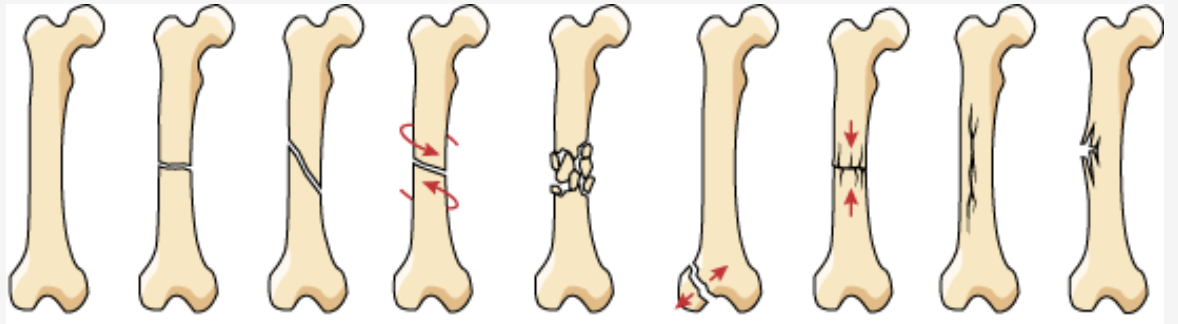
what is the first fx called?
transverse
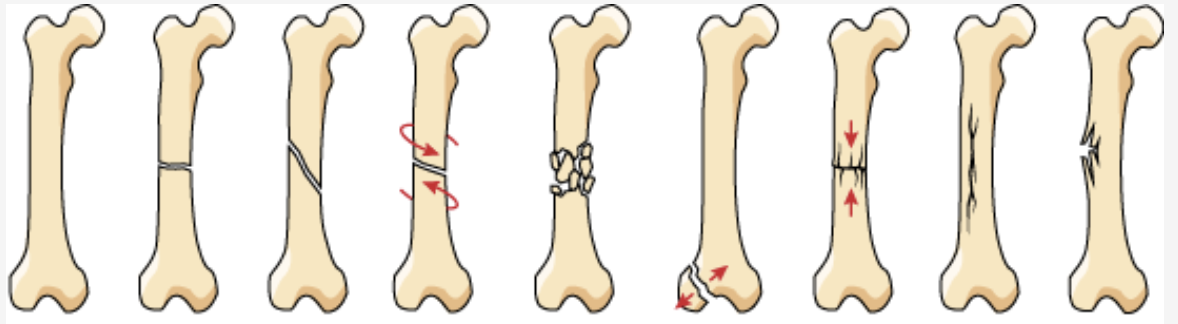
what is the second fracture called?
oblique
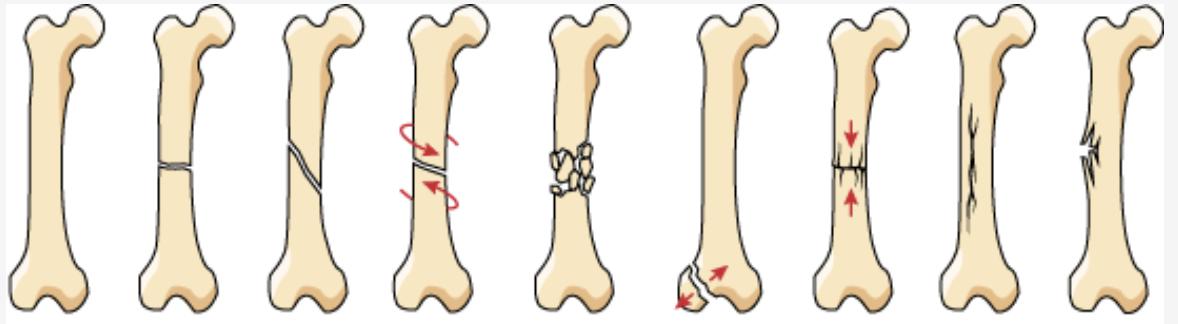
what is the third fracture called?
spiral
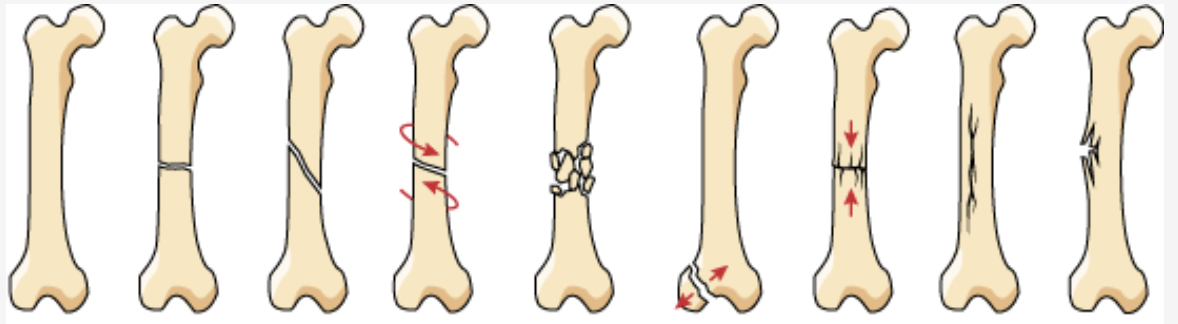
what is the fourth fracture called?
comminuated
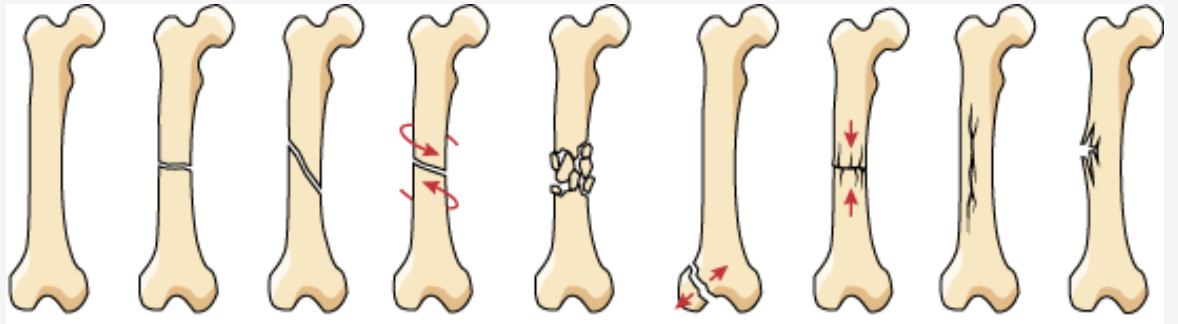
what is the fifth fracture called?
avulsion
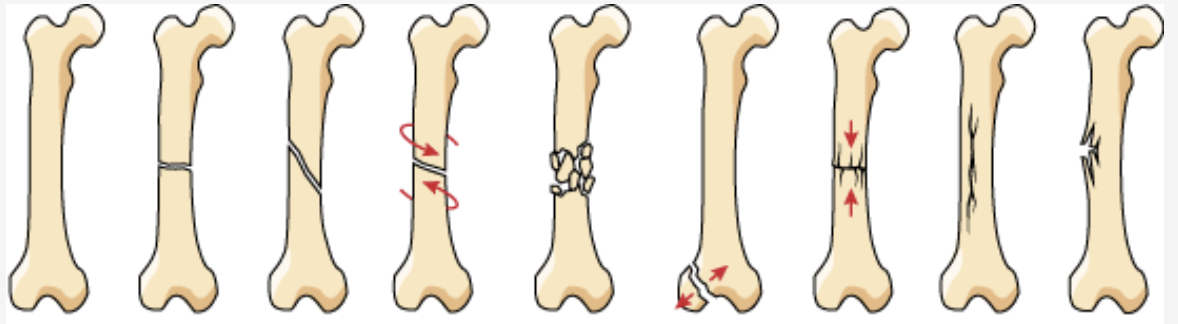
what is the sixth fracture called?
impacted
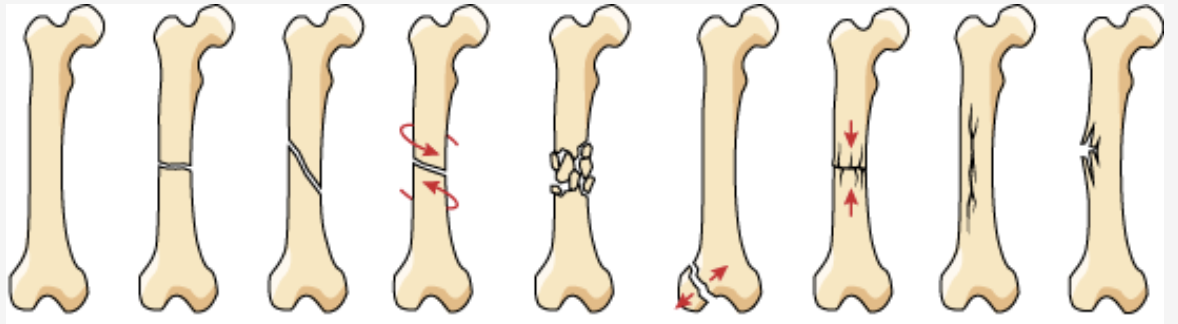
what is the seventh fracture called?
fissure
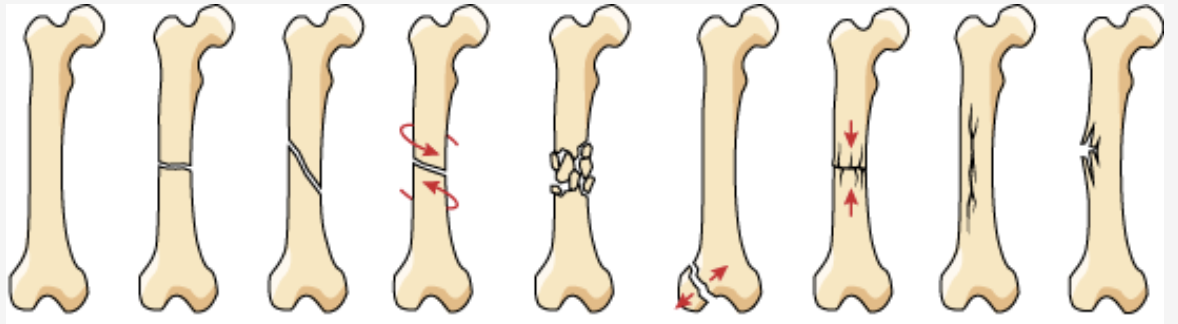
what is the eighth fracture called?
greenstick
what is the etiology of a transverse fracture?
direct blow
what is the etiology of spiral fx?
rotation on planted foot
what is the etiology of an oblique fx?
one end fixed, other sudden torsion
what is the etiology of a comminuted fx?
blow or fall in awkward position
what is the etiology of a depressed fx?
flat bones, direct blow
what is the etiology of a greenstick fx?
incomplete Fx, skeletally immature (convex)
what is the etiology of longitudinal fx?
splits along length, jumping from height
what is the etiology of a serrated fx?
direct blow, jagged edges
what is the etiology of a contrecoup?
ide opposite to point of impact
what is the etiology of impacted fx?
compressive force on long axis of bone
what is typically involved in fracture healing?
immobilization for most cases
casting/splinting/ORIF
what does length of immobilization time depend on?
vascularity of bone
stress on bone
what is the typical healing timeline for a fx?
6-8 weeks
what is the healing process of fx healing?
osteoblasts lay extra bone called “callus”
need stimulus to re-gain compressive, tensile strength
osteoclasts reshape bone
what is a dislocation?
bone is forced out of the joint
where is dislocation more common?
the upper extremity
what is subluxation?
partial dislocation
what is the S/S of dilocations?
deformity; almost always present
what can happen with deformity from a dislocation?
occasionally obscured by heavy musculature; requires palpation to determine normal contours
what are the additional concerns with a dislocation?
avulsion fractures
growth plate separation
“once a dislocation, always a dislocation”
how should dislocations be considered?
should always be considered and treated as fracture until ruled out
what is the only absolute diagnostic technique for dislocations?
x-ray
what is return to play determined by?
extent of soft tissue damage
what is the function of a tendon?
execute joint motion by transmitting mechanical forces from muscles to bones
what is the function of ligaments?
join bones and provide stability to joints
what are passive tissues?
non-contractile structures
what are inert structures?
unable to actively generate forces
what is a sprain?
disruption of a ligament
what is a strain?
disruption of a muscle/tendon
what does tendon attach?
muscle to bone
what does a tendon usually do?
usually double the strength of the muscle it serves
what are tendons in composition?
highly collagenous
what are tendons highly resistant to?
tensile forces
where are tendons strongest?
mid-substance
where are tendons weakest?
myo-tendinous and osteo-tendinous junctions
what are the two MOIs for tendons?
high magnitude, single load, tensile forces
low magnitude, repetitive load, tensile forces
what are compressive forces wit tendons?
bony structures
external compression
what are more rare MOIs for tendons?
vascular “wringing out” (prolonged compression)
friction
what are five common tendon injuries?
tendinitis
tenosynovitis
tendinosis
strain/rupture
contusion
what are common MOIs for ligaments?
high magnitude, single load, tensile forces
low magnitude, repetitive load, tensile forces
what do constant tensile forces lead to?
ligamentous deterioration
what forces mainly impact the ACL and intercondylar notch?
compression/shear
what is the etiology, end feel, and instability of a first degree sprained ligament?
mild overstretching, no tissue disruption
firm
none
what is the etiology, end feel, and instability of a second degree sprain?
partial disruption or macro tearing of the ligament
definite (soft)
slight to moderate
what is the etiology, end feel, instability of a third degree sprain?
complete disruption
none
severe
what are the 4 MOIs for ligaments?
high magnitude, single load, tensile forces
low magnitude, repetitive load, tensile forces
contraction induced
compressive forces
what is another name for muscle guarding?
spasm
what is the MOI of muscle guarding?
neurological, repetitive trauma, other injury
what is a special consideration for muscle guarding?
myofascial trigger points
what is another name for muscle soreness?
DOMS
what is the MOI for DOMS?
eccentric muscle contraction
when do you feel DOMS?
2 days after working out
what is a special consideration for DOMS?
Rhabdomyolysis
what is another name for muscle cramping?
heat cramps
what is the MOI for muscle cramping?
dehydration, electrolyte imbalance, fatigue
what are two skeletal muscle acute injuries?
contusions and strains
what is a contusion?
sudden traumatic blow with compressive force
superficial or deep tissue affected
rated by the ability of muscle to produce ROM
what is a strain?
stretch or tear in muscle
abnormal muscle contractions
what can cause a strain?
mineral imbalance from sweat
fatigue
strength imbalance
what are the S/S of a first degree strain?
mild loss of strength, swelling, ecchymosis, point tenderness
what are the S/S of a second degree strain?
symptoms are more severe, greater function loss
what are the S/S of a third degree strain?
severe symptoms, loss of muscle function, possible palpable defect
what are three chronic muscle injuries?
myositis
fasciitis
myositis ossificians
what is myositis?
inflammation of muscle