Chemistry CT3+4 revision
 Call Kai
 Learn
Learn Practice Test
 Spaced Repetition
 Match
Match Flashcards
 Knowt Play
1/61

There's no tags or description
Looks like no tags are added yet.
Name | Mastery | Learn | Test | Matching | Spaced | Call with Kai |
|---|
No analytics yet
Send a link to your students to track their progress
62 Terms
independant variable
What you change
Dependant variable
What is being measured
Control variable
What stays the same
What do you use a bar chart for?
Discrete data - can only take certain values e.g. shoe size, Categoric data - e.g. type of shoe
What do you use a scatter graph for?
Continues data - can take any value within a range e.g. water temperature
Precision
Measurements have high precision if repeats are close together
Accuracy
Measurements are accurate if they are close to the true value
Instrument precision
An instrument gives more precise readings if the scale graduations are smaller
How can someone improve their accuracy?
Choice of method
Measure using larger amounts
Repeat readings
How can someone improve their precision?
Identify the control variables and keep them constant
Use more sensitive measuring instruments
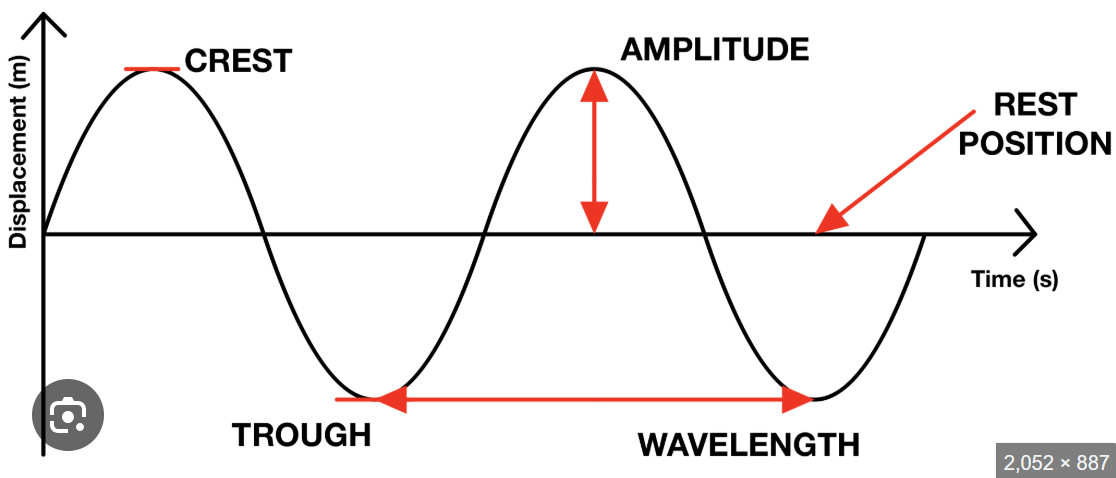
What is the meaning of wavelength?
The distance between one wave peak and the next wave peak along the path of a wave.
What is the meaning of frequency?
The number of wave peaks that pass a point in one second (Number of oscillations per second).
What is the meaning of amplitude?
The maximum displacement of the wave from the rest position.
What is the meaning of time period?
The time taken for a source to produce one wave.
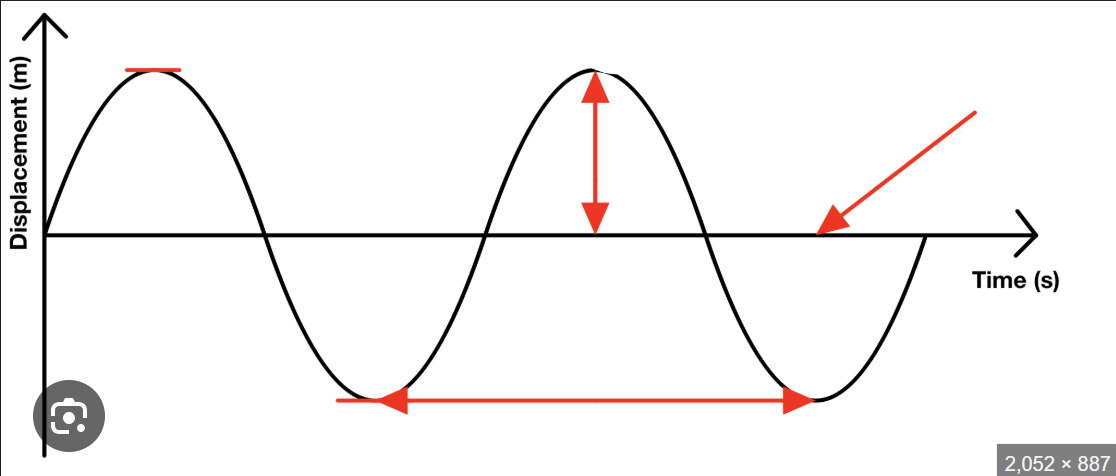
Label this diagram
Labelled diagram
What’s the units of measurement for wavelength?
Metres
What’s the units of measurement for frequency?
Hz
1 kilohertz = 1kHz = 1 000 Hz
1 megahertz = 1MHz = 1 000 000 Hz
1 gigahertz = 1GHz = 1 000 000 000 Hz
1 terahertz = 1THz = 1 000 000 000 000 Hz
What’s the units of measurement for wave speed?
Metres per second (m/s)
What’s the units of measurement for time period?
Seconds (s)
What's the symbol for wave speed
V
What’s the symbol for wavelength
λ
What’s the symbol for frequency
f
equation for wave speed using frequency and wavelength
v = f x λ
equation for frequency using wave speed and wavelength
f = v / λ
equation for wavelength using wave speed and frequency
λ = v / f
equation for time period using frequency
1/f
equation for frequency using time period
1/t
what is a transverse wave
The direction of vibrations at 90 degrees to the direction of energy transfer
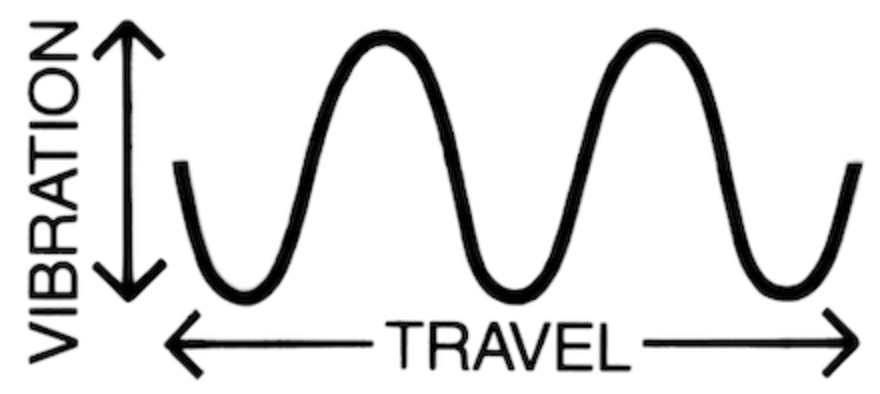
what is a longitudinal wave
the vibrations of the particles are parallel to the direction of energy transfer
examples of transverse waves
ripples on the surface of water
vibrations in a guitar string
a Mexican wave in a sports stadium
the waves on the electromagnetic spectrum
examples of longitudinal waves
sound waves
ultrasound waves
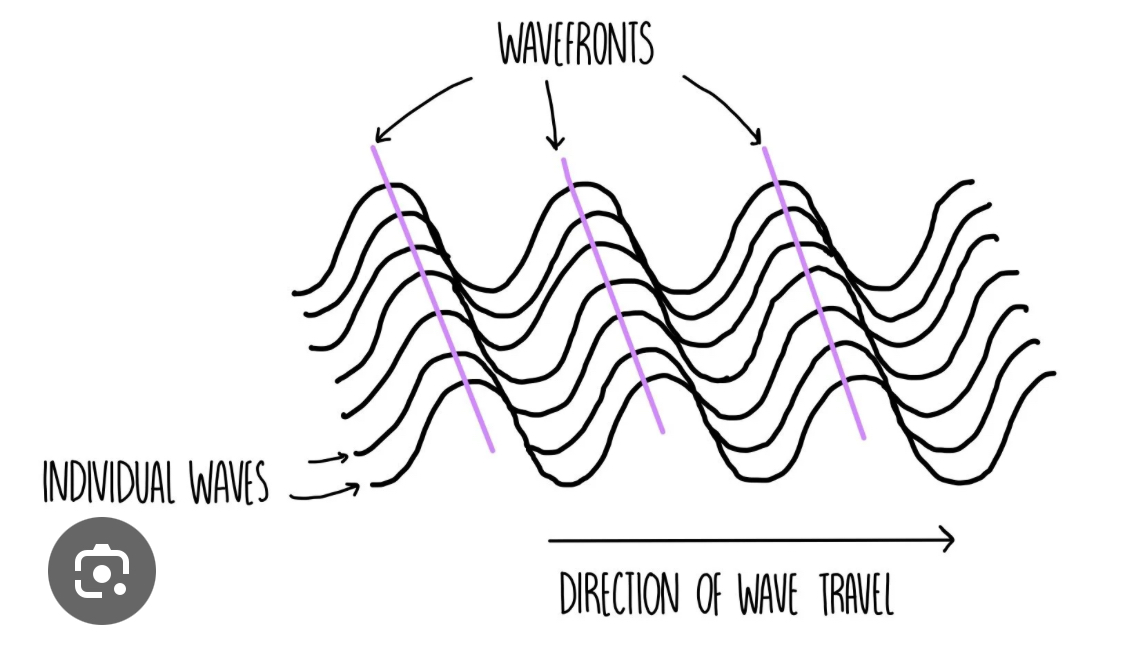
What is a wavefront
an imaginary line or surface representing all points on a wave that are in the same phase (e.g., all crests or all troughs) at a specific time
Waves do or don’t transverse energy
Do
Waves do or don’t transverse information
Do
Waves do or don’t transverse matter
Don’t
What does it mean by light is a part of a continuous spectrum
that white light is not just one thing, but a smooth, unbroken blend of all the colours of the rainbow—from red to violet—merged together.
Is light part of a continuous or non continuous spectrum
Continuous
What is the order of the electromagnetic spectrum with the wavelength decreasing and the frequency increasing (including the colours on the visible spectrum)
Radio waves, microwaves, infrared, visible light (red, orange, yellow, green, blue, indigo, violet), ultraviolet, x-rays, gamma rays
What and why are radio waves used for?
Communication: Broadcasting TV, radio, and satellite transmissions, and they are used because of their ability to travel through the air, space and solid materials, meaning they can be used for radiocommunication.
What and why are microwaves used for?
Communication in mobile phones and satellites, and for cooking food. High frequency microwaves have frequencies which are easily absorbed by molecules in food. The internal energy of the molecules increases when they absorb microwaves, which causes heating. Microwaves pass easily through the atmosphere, so they can pass between stations on Earth and satellites in orbit.
What and why is infrared used for?
Night vision equipment, cooking, thermal imaging, and remote controls for TV. it's relatively inexpensive to implement, which contributes to its widespread use in consumer electronics. Furthermore, infrared signals are secure, as they typically require line-of-sight communication, reducing the risk of interception or interference.
What is visible light used for?
Light-sensitive cells in eyes and by photographic film.
What and why is ultraviolet used for?
Fluorescent lighting and security marking for bank notes. Ultraviolet light is used because it causes certain materials to fluoresce (glow), making it useful for fluorescent lighting and for revealing hidden security markings on banknotes to make banknotes hard to fake.
What and why is X-rays used for?
To observe the internal structure of objects in engineering, airport security, and medicine. X-rays are used because they can pass through soft materials but are absorbed by dense materials, allowing images of internal structures to be formed.
What and why are gamma rays used for
To sterilise medical equipment and food, and radiotherapy. Gamma rays are used because they have high energy and can kill cells and microorganisms, making them useful for sterilisation and for treating cancer in radiotherapy.
What are some harmful effects from radio waves
No damage
What are some harmful effects from micro waves
Burns to human tissue
What are some harmful effects from infrared
burned by infrared radiation
What are some harmful effects from visible light
Eye damaged to exposure from very bright lights
What are some harmful effects from ultraviolet
Sunburn, skin cancer, and cataracts
What are some harmful effects from X-rays
Ionising radiation leading to cancer
What are some harmful effects from Gamma rays
Ionising radiation leading to cancer
What are some simple protective risks we can do to protect ourselves from the damage of radio waves
Nothing - no damage
What are some simple protective risks we can do to protect ourselves from the damage of microwaves
microwaves: burns to human tissue
protection: keep a safe distance from microwave sources, do not use damaged microwave ovens, ensure doors are properly sealed, follow safety instructions when using devices that emit microwaves
What are some simple protective risks we can do to protect ourselves from the damage of infrared
infrared: burned by infrared radiation
protection: avoid prolonged exposure to strong heat sources, wear protective clothing, use heat-resistant gloves, keep a safe distance from hot objects
What are some simple protective risks we can do to protect ourselves from the damage of visible light
visible light: damage to eyes (especially very bright light such as lasers)
protection: do not look directly at very bright lights or lasers, wear protective eyewear when needed, reduce exposure to intense light sources
What are some simple protective risks we can do to protect ourselves from the damage of ultraviolet
ultraviolet: damage to surface cells, sunburn, increased risk of skin cancer, eye damage (can lead to blindness)
protection: wear sunscreen, wear protective clothing, use sunglasses, avoid direct sunlight for long periods, stay in the shade
What are some simple protective risks we can do to protect ourselves from the damage of X-rays
x-rays: damage to cells, increased risk of cancer
protection: limit exposure, use shielding such as lead, only use when necessary, wear protective equipment
What are some simple protective risks we can do to protect ourselves from the damage of Gamma rays
Gamma rays: damage to cells, increased risk of cancer
protection: limit exposure, use shielding such as lead, only use when necessary, wear protective equipment
when should you use a curve or a line of best fit in an investigation
If you can see a pattern in the data but it is not linear, then you should draw a curve of best fit.
are all electromagnetic waves transverse or longitudinal
transverse because the vibration direction is perpendicular to the direction of energy transfer.
Do all electromagnetic waves travel at the same speed - and if so what speed
All electromagnetic waves travle at the same speed (3×10^8 m/s) in a vacuum (air).