Nutrition and Metabolism
 Call Kai
 Learn
Learn Practice Test
 Spaced Repetition
 Match
Match Flashcards
 Knowt Play
1/48

There's no tags or description
Looks like no tags are added yet.
Name | Mastery | Learn | Test | Matching | Spaced | Call with Kai |
|---|
No analytics yet
Send a link to your students to track their progress
49 Terms
Nutrition meaning
composition of your diet as it pertains to both building and overall health
most of the nutrients you ingest are used for metabolic fuel
- some for cel structures and molecular synthesisenergy value measured in kilocalories (kcal) (these are the calories in food)
-calory: heat needed to raise temperature of 1mL H20 by 1 degree C
- 1 kcal= 1000 calorysamino acids and fats all provide cell structure
vitamins and minerals assist proteins in their enzymatic activities
water helps all this dissolve
diet
an adult needs about 1200 calories to sustain your current weight (just to exist, not workout, move, etc)
- if you are doing an activity such as walking to class or going to work or cleaning the house, all of this energy is expended above the basal 1200 caloriesif you are trying to lose weight and do a restrictive diet you will lower the 1200 calories to maybe 1000 a day then calculate your energy expenditure above that so you will be in a chloric deficit where then you will consume your adipose tissue to then provide energy to help sustain yourself
- can only restrict your diet so much before it becomes a major health problem (long term or accutely
Metabolism
converting energy from your diet to energy in the form of ATP and heat
Nutrition
Nutrient: substance in food for growth, maintenence, and repair
Macro Nutrients: bulk of ingested food (nurtients in our diet that are present in large qualitites)
- carbohydrates, lipids, and proteins, where we get our energy ad helps construct structures within the bodyother (micro) nutrients: required in small amounts
- vitamins and mineralswater is required so technically.a nutrient
Food Groups
fruits
vegetables (large portion of this)
grains (large portion of these complex carbohydrates)
protein
dairy
Essential nutrients
this is a nutrient that our bodies cannot synthesize in sufficient quanitity for our biological needs
- AKA: we can not sustain our health and well being without taking these nutrients in through our diet because our body is incapable of producing it at large enough quantities to maintain our overall health and well being
- must be in diet
- possibly 50 molecules
- ex: fatty acids, amino acids, other vitamins and minerals that we must take in through our diet since we can not produce them on our own
Non-essential nutrients
nutrients that are not required in our diet but they are usually present in our diet anyways
- our bodies have the capacity to synthesie these nutrients in large enough quantities that if they are not present in our diet it has no impact on our overall health and well being
- ex: vitamin D
- warm climates that experienced sun for large portions of the year typically do not experience vitamin D deficiency, only people that live in climates with long winters with little light exposion where we do not have the light to sythesize vitamin D from its inactive to active state which is when vitamin D deficiency occurs
- nutients that we can produce on our own
Carbohydrates
very important source of calories so that we can produce ATP to sustain our celluar and biological needs
simple carbohydrates: refined sugars like table sugars that you get from sugar cane and sugar beets, sugar that is associated with foods with low nutrient density
- rich in calories but have few meaningful nutrients
- ex: cakes and candycomplex carbohydrates: made up of strings of these simple sugars
- larger molecules which take longer to break down and longer to get into your bloodstream
- ex: flour, cereal, pasta (these also contain fiber and starches, not all carbs are created equal)
Simple sugars
sugars you typically think of as either mono or disacchardies
ex: lactose, honey, fruits, fine sugar from sugar cane or sugar beets
Complex sugars
this is where we find the starches
- starches are associated with grains, can find them in vegetables and even fruit, and most meat since its usually skeletal muscle and we store little bits of glycogen in meat, the more meat you eat, the more meat eaten, the more glycogen consumedthese take longer to break down into your bloodstream therefore you do not have a rapid spike in blood sugar
Fiber
indigestible starch
- starch is a complex sugar we can access to carbohydrates and break it downin fiber the sugars are the same but the way they are structured in this molecule, we can not break it down for energy
the “bulk” in our diet
- ex: lettuce, stalk of cauliflower or brocoliassociated with attracting water which is what helps food move through the gastrointestinal tract
Insoluble fiber
what you find in the hard crunchy vegetables and plays a really important role in helping to make you regular and moving food through your digestive system and allowing you to defecate on a regular basis
Soluble fiber
may also help with keeping you regular
associated with pectin which is found in fruits
associated with decreasing your blood cholesterol
The cholesterol in your diet gets associated with the pectin and never enters your body, it stays in your gastrointestinal tract and moves through
Carbohydrates: Uses in Body
3 types of monosaccharides
1. Fructose
2. Glucose
3. Galactosecarbohydrates are made from monosaccharides
our bodies are only capable of using glucose (the structure in the middle)
- if we do not have enough glucose in our blood, we deprive our brain and our red blood cells of the fuel source that they depend on
- if we have low blood glucose our brain will experience low access to its energy source, you will produce ATP at a slower rate and you will also feel sluggish/tired and if your brain doesn’t get this you will not be able to produce ATP and you will enter a coma which could lead to death
- glucose is the fuel used by cells to make ATP
- neurons and RBC’s use only glucose for fuelwhen we take in fructose and galactose we convert them to glucose so they can be metabolized
all of these are 6 carbon sugars
all sugars that we take in our diet are made up of these three monosaccharides
- disaccharides which consist of two of the three sugars above, it can be any combination:
- milk sugars: glucose and galactose
- table sugars: fructose and glucose
- maltose: glucose and glucosewe make complex sugar from strings of this such as glycogen that we store in our muscle is made up of polymers of glucose (most common type of sugar)
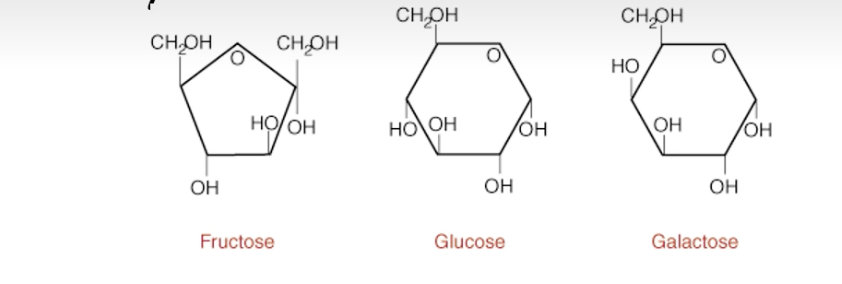
Glucose
we need glucose but excess glucose can be harmful
- excess glucose converted to glycogen or fat and storedwe store glucose in our skeletal muscles and liver and to some extent other tissues in the form of glycogen
when you exercise here is a good chance you are going to use up some of your glycogen, once you eat a meal after you exercise then your glycogen will replenish
we can store glucose in the form of adipose and other cells and particularly adipocytes but we do store some fat within muscle cells
we can break the glucose down and manufacture fatty acids from it so we can store glucose
Fructose and galactose
not metabolically accessible until they get converted to glucose
- this process is done in the liver and once it’s converted to glucose, it can be:
- stored as glycogen
- released in the bloodstream where tissues like the brain can access it for energy
- converted into fats
Lipids
tissues like your heart, much of the skeletal muscle and your liver prefer fat or lipid as opposed to carbohydrate as a fuel source to spare glucose for your brain and the central nervous system
modified triglyceride which is a type of lipid is the major component of your cell membrane
we can get lipids from a variety of different sources such as
- animal sources: rich in saturated fatty acid as saturated fats come from animals not plants
- it is important to limit the amount of saturated fats that you take in as they are more readily available for energy, and they are highly associated with cardiovascular disease riskplant sources are a common source of oil intake:
- safflower
- corn oil
- olive oil
- these are all unsaturated fatty acids which is why they tend to stay as oil at room temperature as opposed to a solid like lard that gets softer
- unsaturated fats take longer to break down and they are less accessible for energy and they are less associted with heart diseaseSUMMARY:
- lipids are important for calories, steroid hormones, blood pressure regulation, inflammatory control
- lipids can contribute to heart disease in excess quantitieshelp absorb fat soluble vitamins
they are importnat fuel sources for many different tissues in the body such as the hepatocytes from the liver, skeletal muscle
precursors for phospholipids that form our cell membranes and the lipids that form the myelin sheath around our neurons
fats are stored in adipose tissue
- kidneys are surrounded by fat which helps with shock absorption since kidneys are so fragile
- maintain heat and they serve to store energy and fat soluble vitamins
- because of this vitamin deficiencies are not super commoncholesterol helps with bile salts which help emulsify fats so we can absorb fat and the fat soluble vitamins in our diet
Essential fatty acids
play key roles in regulatory mechanisms such as the inflammatory response and help regulating blood pressure
are only available through out diet since our body is unable to create them from raw materials
Cholesterol
a lipid but NOT a fatty acid but can be made from fatty acids
extremely hydrophobic like lipids and its commonly a part of our diet although we do not really need it
plays key roles in our cell membrane
can get converted into vitamin D for the absorption of calcium in our diet
can get converted into all steroid hormones which include estrogen and testosterone meaning we would not have reproduction without some cholesterol
lipid not a fatty acid
cholesterol is a molecule that is associated with heart disease
excess cholesterol in the bloodstream can be picked up by white blood cells which then the cholesterol starts to fill these white blood cells up which makes the blood cell expand and block part of your arteries, specifically the arteries to your heart
we get cholesterol from animal products and our bodies make it
- does not come from plant sourcesanimal sources: meats, milk, eggs
our liver produces cholesterol
- cholesterol is a necessary part of your cell membrane and its a precursor to vitamin D and to the steroid hormonesdecreasing your intake in fatty acids will help lower your cholesterol blood levels especially the saturated fatty acids as they serve as a precursor to the synthesis of cholesterol in your body
you can not survive or reproduce without cholesterol
not an essential nutrient
Fat soluble vitamins
we can only access these vitamins if we take in in our diet
we store these vitamins in our adipose tissue which means that some of these fats can be toxic
Saturated Fatty acids
fatty acids are a chloric dense type of nutrient
- ex: in carbohydrates we may get 4 kilocalories per gram and in fats we get 9 kilocalories per gramreadily stored as adipose, process is more straight forward than storing glucose as adipose
fatty acids are a component of a triglyceride
triglyceride molecules are made up of a glycerol backbone with three fatty acids
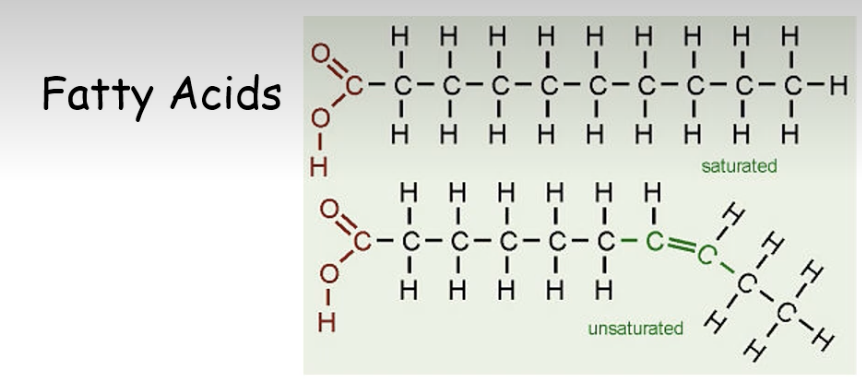
- the three fatty acids can be the same or they can each be differentfatty acids is a string of carbons that has a carboxyl group at one end (in red)
the rest is a bunch of carbons with or without hydrogens
in a saturated fatty acid every carbon has all of its electrons bound to another molecule
- meaning that in a carboxyl group all the carbons are bound to hydrogens to their maximum capacity
- there re no double bonds and there are no other molecules other than hydrogen bound to itthis is the kind of fat you see in lard and animal fat
is a solid at room temperature
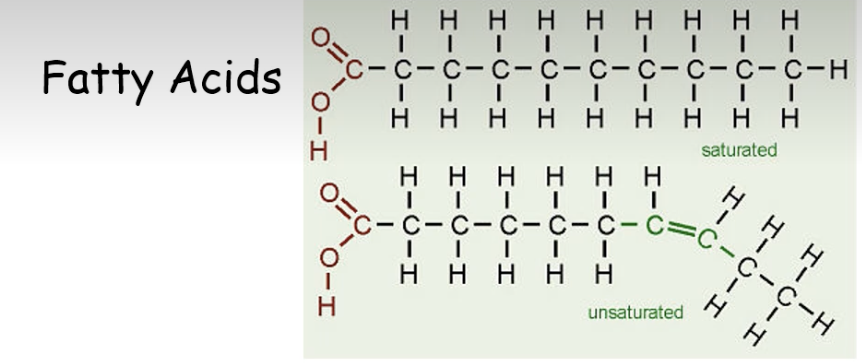
unsaturated fatty acid
also has a carboxyl group and strings of carbons
main difference in structure: double bond between two carbons and the only way that this can occur is that those two carbons have an electron that not bound to a hydrogen and because of this to stabilize the two carbons have to form a second bond
in this image, it is a picture of a mono unsaturated fatty acid because it only has one double bond
- poly unsaturated acid meaning that they have two or more double bondsthese are the fatty acids that you find in plants and thats why the plant sources of lipids are called oils since they are liquid at room temperature
for unsaturated fatty acids to solidify they have to be at a muh cooler temperature then saturated fatty acids
Trans Fatty Acid
trans fatty acid is an unsaturated fatty acid and the trans part of the name refers to the structural formation of that particular fatty acid
Image:
- two fatty acids, same carbon number, each monounsaturated fat at the same carbon
- image shows they are slightly different molecules structurally
- one is a cis fatty acid and one is a trans fatty acid
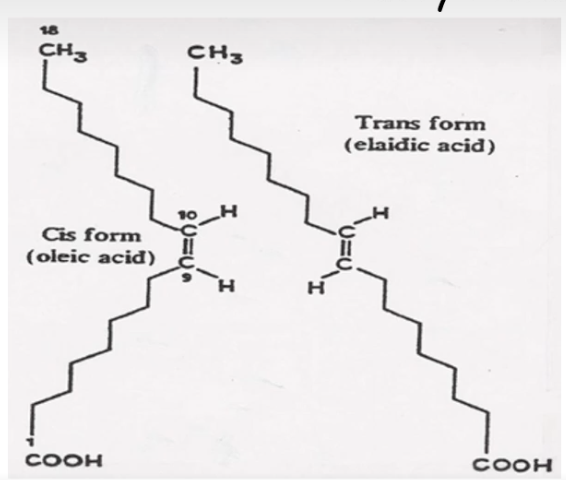
Cis molecule
type of trans fatty acid which means this is an unsaturated fatty acid
image: you can see that of the two strings of carbons on either side of the double bond are facing/moving towards the same direction
when the cis forms of the fatty acid are being cooked with the fatty acid breaks down and they end up getting converted to the trans form
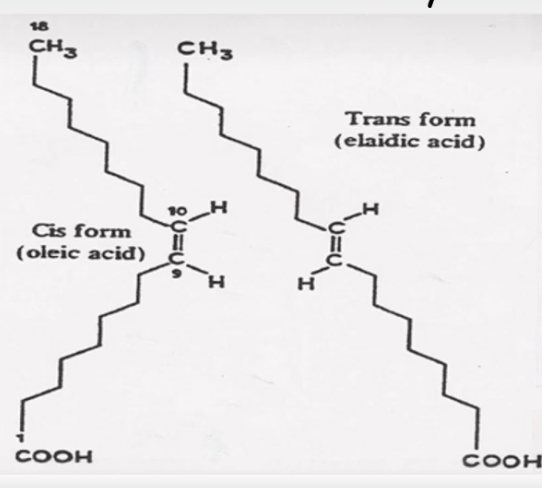
Trans molecule
same number of carbons and the double bond is in the same location as the cis molecule
but the strings of carbons on either side of the double bond are on opposite sides of the carbon associated with the double bond
trans fatty acids are associated with a much higher risk of heart disease than the cis form
- this form may be as high a the saturated fatty acids
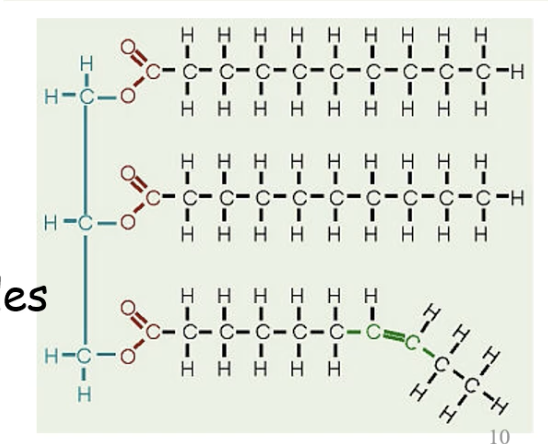
Triglyceride
triglyceride is a glycerol backbone
in the image: three carbon molecule and bluish green that is associated with three fatty acids
- the three fatty acids don’t all have to be the same
- they can be various combinations of saturated and unsaturatedin animals we tend to find high concentrations of saturated fats
How do we produce cholesterol?
we produce acetyl-CoA (co enzyme that connects glycolysis, fatty acid oxidation, and amino acid metabolism to the critic acid cycle (TCA cycle) for energy production) from glucose and from fatty acids and it is the acetyl CoA which can be used in the synthesis of cholesterol within the liver itself
we can decrease cholesterol levels in our blood by your diet and lose body fat
- if we decrease body fat in the body, we also seem to decrease cholesterol synthesis
essential fatty acids
omega 6 fatty acid (linoleic) and omega 3 fatty acid (linolenic)
these are available through vegetable sources and fish
play important role in prostaglandins which are associated with an inflammatory response
- ex: you cut your finger and it turns red, thats because of prostaglandinsplays a role in blood pressure regulation
Dietary requiremnts
fats: 30% or less of total caloric intake
saturated fats: 10% of calories from fats or less of total
cholesterol: no more than 300 mg/day
typical american diet: more than 40% total calories which plays prominent role in obesity heart disease and cancer
- keep blood cholesterol below 200 mg/dl
Lipids: Fat Substitutes
Substitutes:
- beating air into food, creates lighter food with less calories
- forms of complex sugars, using applesauce as oil substitutes
- substitutes milk protiens like wheycommerical fat: olestra: made from cotton seeds
- olestra has a sucrose backbone and has eight different fatty acid coming off of it and our bodies can not break this down, therefore the fatty acids in the sucrose backbone are not accessible for calories
- decreases energy potential and does not serve as a precursor for cholesteroldisadvatages:
- can not be used as cooking oil in restaurants because it breaks down in heat
- it does not taste like traditional oils
- produces large amounts of gas and diarrhea (associated with dehydration and decreased nutrient absorption)
Proteins
take these in as large quantities with the recommended intake per day being 0.8g/kg of body weight
need more protein intake for rapid protein breakdown
certain types of amino acids can stimulate protein synthesis
we get amino acids from proteins
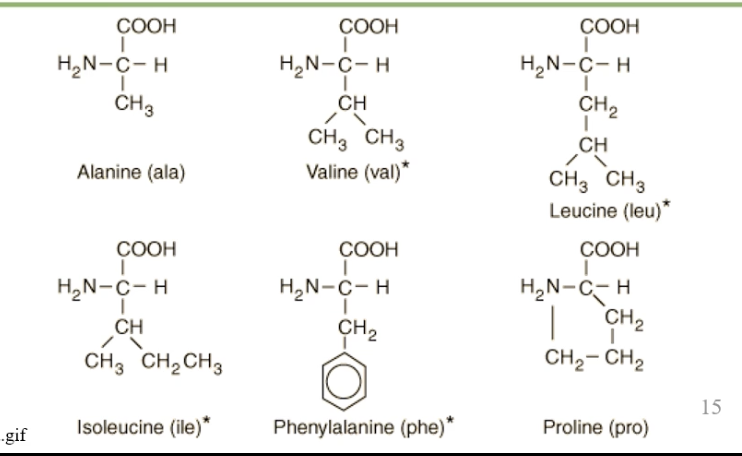
amino acids
four things in common:
1. all have the nitrogen containing group
2. the H2N that is bound to a central carbon
3. central carbon is bound to a carboxyl group, the COOH
4. a hydrogen that is the component of every amino acidvaribale group are the things that differ between the amino acids and these can be a lot of different things
ex: alanine: varibale group is CH3, a methyl group
- valine: methyl group with two other methyl groups
- phenylalanine: methyl group with a benzine ringit is the variable group that defines the amino acid
different functional properties for different amino acids
- some might be hydrophobic whole some are hydrophilic, some basic, some acidic, some neutralwe use these amino acids to build proteins with different qualities:
ex: integral membrane proteins have two regions: region that is hydrophobic and portions that are associated with cytosol or with the intersistual fluid which have to be hydrophlicthere are essential and non essential amino acids
complete protein
animal sources and soybeans
these proteins have access to all the essential and most of the non essential amino acids
incomplete proteins
legumes
nuts
grains
many vegetables
they are missing one or more of the different essential amino acids
if we d not mix these up in our diet we will not get all of the essential amino acids in our diet
- important for veganshistidine: while our bodies produce it it is not produced in sufficient quantity and if you do not take a little bit in through mainly soybeans its difficult to get the full complement of amino acids to build and synthesize proteins properly
Proteins: uses in body
membrane proteins
structural materials
- keratin(skin): collagen and elastin (connective tissue)contractile proteins in skeletal muscle
collagen which is the most abundant protein in the body
when amino acids re building proteins often times they make enzymes
- these enzymes catalyze essential reactions in some cases so we can synthesize the non-essential amino acids or the non-essential carbs
- these amino acids can be the precursor to hormonescan be broken down for stored energy and convert the amino acids back to glucose and use them as a fuel source
Proteins: use of amino acids
amino acids are used as the building blocks for proteins
continually breaking down proteins and turning over amino acids
we have to take in amino acids through our diet since we lose so many
All or none rule
when we are making a protein if the complementary tRNA that is not present protein synthesis will come to a stop and that protein will not be created and this could lead to deficiency
if you are short just one amino acid to build a protein the whole protein does not get built
Adequacy of caloric intake
if you are not taking in enough carbs or enough fats your body will perceive that it is starving and it can break down a certain amount of protein from skeletal muscle to liberate these amino acids as well as any amino acids in your diet will also be used for energy
if amino acids are being broken down for energy purposes its going to be difficult to synthesize proteins because your not going to have the amino acids necessary for the synthesis of the protein
Nitrogen balance
refers to the balance between the synthesis of proteins from amino acids and the breakdown of proteins and the break down of amino acids
the rate of protein sythesis is equal to the rate of protein breakdown and loss
if you are in a neutral nitrogen balance your intake of protein or your intake of nitrogen is equal to your loss of nitrogen
- this is where you want to beintake is measured though diet and loss is measured through urine
positive nitrogen balance means your taking in protein in a fixed amount but your excreting nitrogen at a lower rate
- nitrogen is important here because it is the N group that is part of all amino acids
- this is normal for children because they are growing fast and consuming amino acids at fast rate to build new proteins
- pregnant women: as the child grows in womb
- following injury as tissue is repairing at fast ratenegative nitrogen balance: consuming less protein than we are breaking down and loosing nitrogen
- common for people with chronic stress and elevated cortisol
- common for people that have significant burns, infections, significant injury, poor dietary intake, starvation
- suggest your in an unhealthy state
anabolic hormones
a metabolic, "construction mode" phase where the body builds, repairs, and regenerates tissues—specifically muscle—by synthesizing complex molecules from smaller ones, such as amino acids.
when we are building things (in this case proteins)
anabolic hormones:
- GH and se* hormones accelerate protein synthesis and growth
- these hormones help regulate anabolic stategrowth hormone promotes synthesis of proteins to increase muscle mass and increases the rate of bone growth
testosterone stimulates protein synthesis
put us in a positive nitrogen balance
Catabolic hormones
adrenal glucocorticoids (released during stress) stimulate protein breakdown, conversion of amino acids
cortisol: a glucocorticoid and a complex acting hormone that helps raise blood glucose but it does so at the expense of the breakdown of protein
- one of cortisol actions is to enhance protein breakdown and this leads to negative nitrogen balance because it is promoting not only the breakdown from protein to amino acids but also the conversion of these amino acids to glucose via gluconeogenesis in the liverput us in negative nitrogen balance
non essential amino acids
amino acids that our body can sythniesis on sufficient amounts on its own as long as we have the resources
essential amino acids
amino acids where we do not have the capacity to produce in large enough quantity even if we had enough resources
nine essential amino acids
histidine
isoleucine
leucine
lysine
methionine
phenylalanine
threonine
tryptophan
valine
conditionally essential amino acids
under certain circumstances we need them in larger quantities than we are capable of producing
only 20 amino acids are coded fro in DNA
many times after translation occurs, you will modify some of thee amino acids to be a new amino acid residue and thats where some of the extra amino acids come from
arginine for infants
young infants do not have the ability to produce arginine to meet thier needs
histidine and arginine are amino acids that are not readily available from plant sources, most accessed through animal products
Daily protein needs:
we are not capable of producing or storing certain amino acids in sufficient quantities so our diet represents that
age and body size reflects protein requirement
eating more protein is not necessarily benifical
any protein taken in gets converted to energy or stored as energy
vitamins
organic compounds (contain carbon)
crucial in helping body use nutrients
most function as coenzymes
- allow enzymes to do their job affectivelyvitamins D (skin), some B and K synthesized by intestinal bacteria; beta-carotene (carrots) converted in body —> vitamin A (associated with vision)
- the rest must be obtained through dietno one food group contains all vitamins
vitamin D aids in calcium absorption in the gut
vitamin K is essential for blood clotting
free radicals generated during normal metabolism
- vitamins C, E, and A and mineral selenium are antioxidants
- neutralize free radicals
- brocolli, cauliflower, brussel sprouts are good sources of vitamins A and C, carrots for vitamin A
Water soluble vitamins
B complex and C are absorbed with water across the gastrointestinal tract
B12 absorption requires intrinsic factor
not stored in the body
- any not used within one hour get excreted
- megadoses are useless
fat soluble vitamins
A, D, E and K absorbed and consumed with the same fats
fats act as a carrier facilitating their intake
vitamin K is made by bacteria, still absorbed
Vitamin A: precursor is beta carotene and still has to be absorbed
typically stored within the adipocytes within our body with the exception of vitamin K
you can go a long time without consuming fat soluble vitamins without becoming deffienct
since we do store these vitamins you can have to much and it can reach a toxic level
really high tolerance for vitamin E (no true toxicity)
Minerals
seven required in moderate amounts
- calcium (bone and muscle)
- phosphorus (ATP)
- potassium (membrane potential)
- sulfur (amino acids)
- sodium (membrane potential)
- chlorine (membrane potential)
- magnesium (act as a cofactor)all others required in trace (minoote quantities) amounts
work with nutrients to ensure proper body functioning
uptake and excretion balanced to prevent toxic overload
not stored in any meaningful quantity you must have them on a reguar basis but its difficult to reach toxic levels
Ex:
- iron: component in hemoglobin molecule in red blood cells and is what oxygen binds to and is extremely abundant
- anemia (low hemoglobin)calcium, phosphorus and magnesium slats harden bone
iodine essential for oxygen biding to the hemoglobin
- iodine deficiency is the primary cause of hypothyroidism
- table saltsodium and chloride major electrolytes in blood
mineral rich foods:
- dark vegetables, legumes, milk, some meats (liver, red meats)prenatal vitamins have mega doses of iron
large amounts of iron tends to make you constipated