Chapter 9 Microbiology
 Call Kai
 Learn
Learn Practice Test
 Spaced Repetition
 Match
Match Flashcards
 Knowt Play
1/46

Earn XP
Description and Tags
A collection of flashcards covering key vocabulary and concepts from Chapter 9 in microbiology.
Name | Mastery | Learn | Test | Matching | Spaced | Call with Kai |
|---|
No analytics yet
Send a link to your students to track their progress
47 Terms
Epidemiology
Monitoring and controlling disease occurrence to promote public health.
Etiology
Study of the cause of disease.
Incidence rate
Number of new cases in a population during a specific time.
Source of infection
Object or organism that transfers the pathogen from reservoir to host.
Epidemic
Widespread outbreak in a specific region and time.
Sporadic disease
Isolated infections in a population.
Reservoir of infection
Natural habitat of a pathogen (animate or inanimate).
Pandemic
Epidemic that spreads across multiple countries.
Infectious disease
Illness caused by pathogens.
Endemic infection
Disease routinely detected in a population or region.
Carrier
Asymptomatic person harboring an infectious agent.
Zoonotic disease
Disease transmitted from animals to humans.
Who is the Father of Epidemiology?
John Snow.
Communicable disease
Can be passed from person to person.
Noncommunicable disease
Cannot be passed person-to-person; spread via animals, vectors, or objects.
Signs
Objective indicators of disease.
Example of a sign
Fever, heart rate, blood pressure.
Symptoms
Subjective feelings reported by the patient.
Example of a symptom
Pain, nausea, fatigue.
Endogenous source
Pathogen originates inside the host.
Exogenous source
Pathogen comes from outside the host.
Direct contact transmission
Physical contact with pathogen (e.g., fluids, bites, breastfeeding).
Indirect contact transmission
Transmission via droplets, vectors, needles, droppings without physical contact.
Biological vector
Pathogen undergoes life stage inside vector (e.g., mosquito with Plasmodium).
Mechanical vector
Pathogen is carried without life stage inside vector (e.g., cockroach with fungi).
Incubation period
Time between infection and symptoms.
Prodromal phase
Early, mild symptoms.
Acute phase
Peak of illness and symptoms.
Decline period
Symptoms begin to subside.
Convalescence
Recovery and return to health.
Three factors in the epidemiological triangle
Host factors, Environmental factors, Etiological agent.
Three strategies to break the triangle
Education, Quarantine, Vector control.
Prevalence
Existence of disease in a population at a given time.
Two factors that impact prevalence
Incidence rate, Duration of infection.
Common HAIs
Staphylococcus aureus, Escherichia coli, Clostridium difficile, Pseudomonas aeruginosa.
Practices to reduce HAIs
Hand washing, PPE use, Environmental sanitization, Equipment sterilization.
Additional HAI prevention practice
Limiting patient transport and isolation.
Emerging infection
New or newly identified disease (e.g., SARS, COVID-19).
Reemerging infection
Previously controlled disease now increasing (e.g., measles).
Impact of Tuskegee Syphilis Experiment
Highlighted need for informed consent and patient protection.
Herd immunity
When ~85% of population is immune, protecting those who can't be vaccinated.
How does herd immunity help?
Reduces disease presence and protects vulnerable individuals.
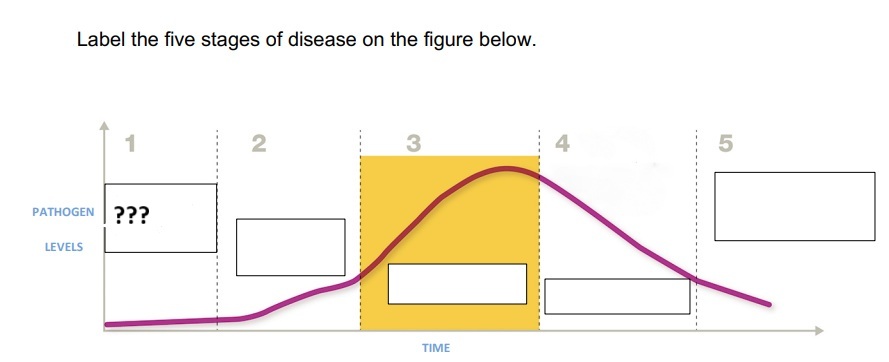
Incubation Period
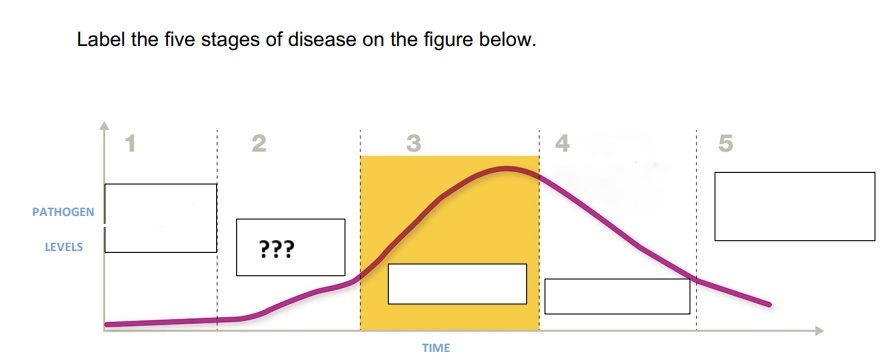
Prodromal Phase
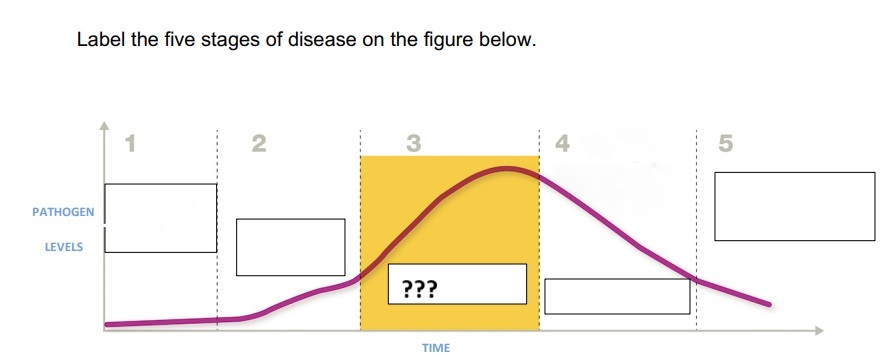
Acute Phase
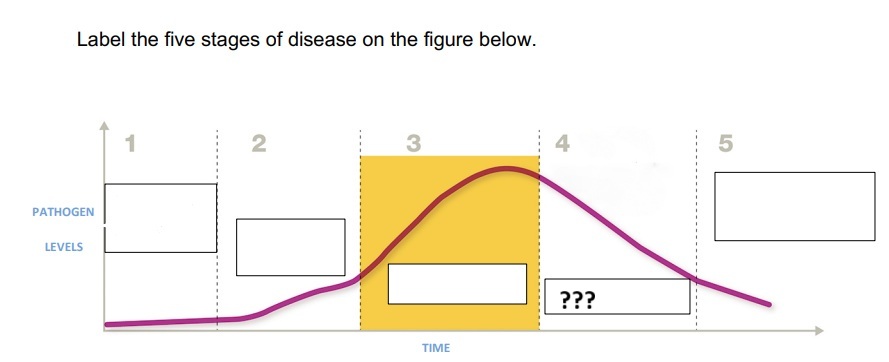
Decline Period
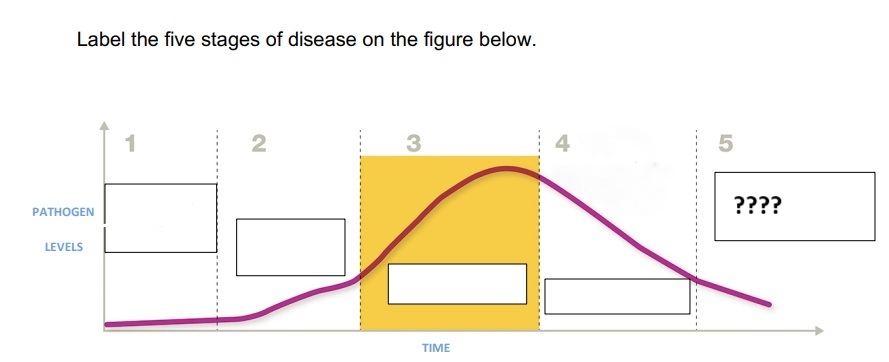
convalescence phase