OB Step Up

0.0(0)
Studied by 0 people
call kaiCall Kai
learnLearn
examPractice Test
spaced repetitionSpaced Repetition
heart puzzleMatch
flashcardsFlashcards
GameKnowt Play
Card Sorting

1/65

encourage image

There's no tags or description

Looks like no tags are added yet.

Last updated 8:03 PM on 4/19/26
Name
Mastery
Learn
Test
Matching
Spaced
Call with Kai

No analytics yet

Send a link to your students to track their progress

66 Terms

1
New cards

Embroyonic and fetal development begins with

fertilizatoin and takes 38 weeks until maturity occurs

2
New cards

Gestational age vs embryonic age

Naegele’s rule

Teratogens will either

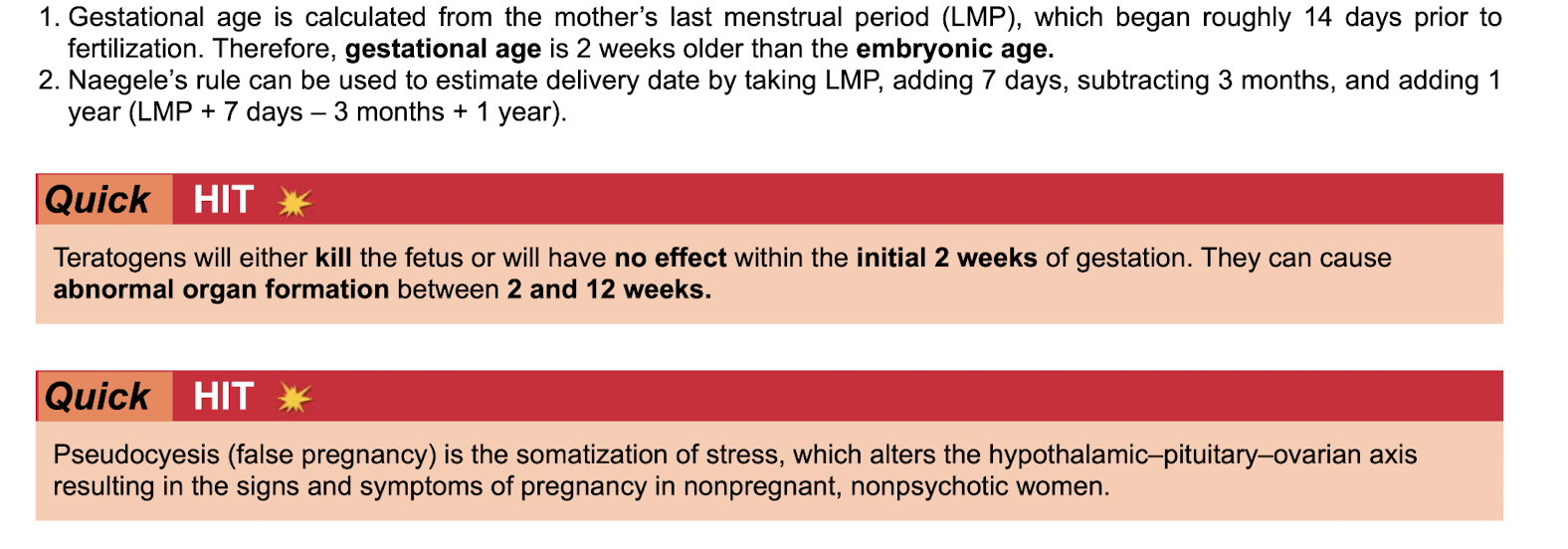
  • Gestational age is calculated from mothers LMP (usually 2 weeks prior to fertilization) 

  • Gestational age is usually 2 weeks older than the embryonic age 

Naegele’s rule can estimate delivery date

  • (LMP+7 days- 3months + 1 year)

Teratogens will either kill the fetus or have no effect within the initial 2 weeks of gestation. 

  • They cause abnormal organ formation between 2-12 weeks
<ul><li><p>Gestational age is calculated from mothers LMP (usually 2 weeks prior to fertilization)&nbsp;</p></li></ul><ul><li><p class="p1">Gestational age is usually 2 weeks older than the embryonic age&nbsp;</p></li></ul><p class="p2"></p><p class="p1">Naegele’s rule can estimate delivery date</p><ul><li><p class="p1">(LMP+7 days- 3months + 1 year)</p></li></ul><p class="p2"></p><p class="p1">Teratogens will either kill the fetus or have no effect within the initial 2 weeks of gestation.&nbsp;</p><ul><li><p class="p1">They cause abnormal organ formation between 2-12 weeks</p></li></ul><p></p>
3
New cards

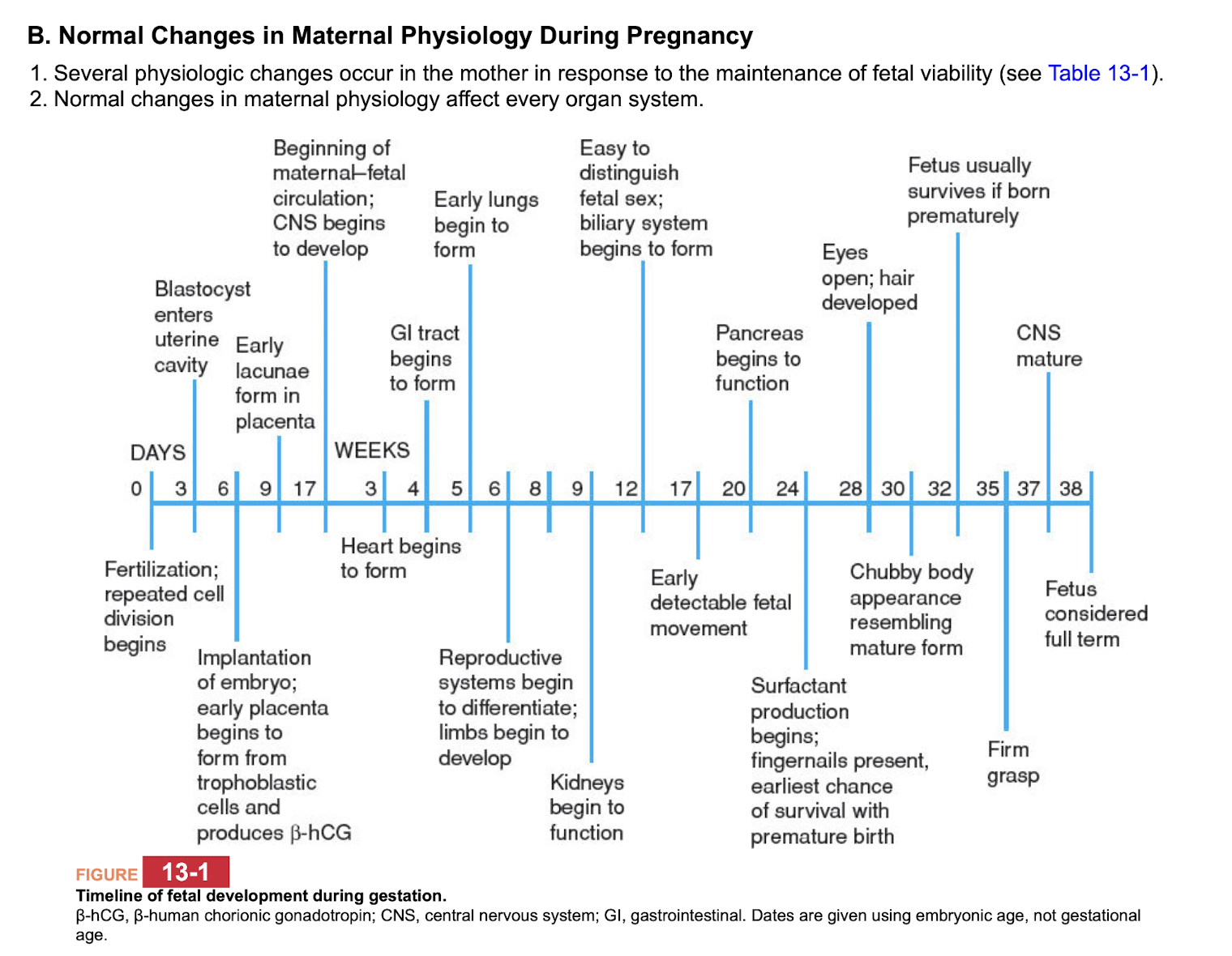
Timeline of fetal development during gestation

3 days after fertilization: blastocysts enters uterine cavity 

6 days: implantation and form trophoblastic cells and produce beta HCG 

3 weeks: heart begins to form 

5 weeks: early lungs form 

9 weeks: kidneys begin to function 

12 weeks: can tell sex; biliary system begins to form 

17 weeks: fetal movement can be detected

20 weeks: pancreas begins to function 

24 weeks: surfactant production, fingernails present, earliest chance of survival for premature birth 

38 weeks: full term 
<p>3 days after fertilization: blastocysts enters uterine cavity&nbsp;</p><p class="p1">6 days: implantation and form trophoblastic cells and produce beta HCG&nbsp;</p><p class="p2"></p><p class="p1">3 weeks: heart begins to form&nbsp;</p><p class="p1">5 weeks: early lungs form&nbsp;</p><p class="p1">9 weeks: kidneys begin to function&nbsp;</p><p class="p1">12 weeks: can tell sex; biliary system begins to form&nbsp;</p><p class="p1">17 weeks: fetal movement can be detected</p><p class="p1">20 weeks: pancreas begins to function&nbsp;</p><p class="p1">24 weeks: surfactant production, fingernails present, earliest chance of survival for premature birth&nbsp;</p><p class="p1">38 weeks: full term&nbsp;</p>
4
New cards

low risk activity during pregnancy

Moderate intensity exercise is encouraged 

Sexual intercourse can be continued unless mother is high risk for

  • spontaneous abortion,

  • premature labor or

  • placenta previa 

<p class="p1"></p><p class="p2">Moderate intensity exercise is encouraged&nbsp;</p><p class="p2">Sexual intercourse can be continued unless mother is high risk for</p><ul><li><p class="p2"> spontaneous abortion, </p></li><li><p class="p2">premature labor or </p></li><li><p class="p2">placenta previa&nbsp;</p></li></ul><p class="p1"></p>
5
New cards

Changes in pregnancy

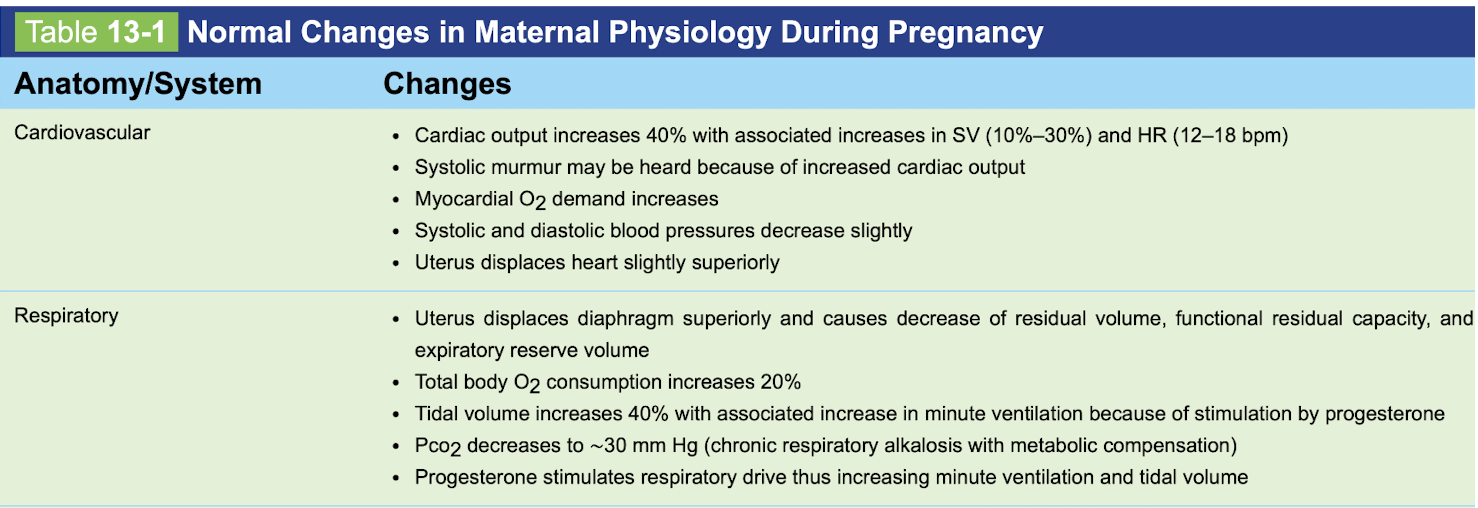
CV

Respiratory

CV: 

-CO increased 

-SV increases 

-Systolic murmur increases if present 

-O2 demand on heart increases

-BP increases

-Uterus can displace heart slightly superiorly 

Respiratory: 

-Diaphragm displaces superiorly 

-RV decreased

-FRC decreased 

-Expiratory residual volume decreased 

-Total body O2 consumption increases 

-Tidal volume increases 

-minute ventilation increases 

-PCO2 decreases (chronic respiratory alkalosis with metabolic compensation) 

-progesterone stimulates respiratory drive 
<p><strong>CV:&nbsp;</strong></p><p class="p1">-CO increased&nbsp;</p><p class="p1">-SV increases&nbsp;</p><p class="p1">-Systolic murmur increases if present&nbsp;</p><p class="p1">-O2 demand on heart increases</p><p class="p1">-BP increases</p><p class="p1">-Uterus can displace heart slightly superiorly&nbsp;</p><p class="p2"></p><p class="p1"><strong>Respiratory:&nbsp;</strong></p><p class="p1">-Diaphragm displaces superiorly&nbsp;</p><p class="p1">-RV decreased</p><p class="p1">-FRC decreased&nbsp;</p><p class="p1">-Expiratory residual volume decreased&nbsp;</p><p class="p1">-Total body O2 consumption increases&nbsp;</p><p class="p1">-Tidal volume increases&nbsp;</p><p class="p1">-minute ventilation increases&nbsp;</p><p class="p1">-PCO2 decreases (chronic respiratory alkalosis with metabolic compensation)&nbsp;</p><p class="p1">-progesterone stimulates respiratory drive&nbsp;</p>
6
New cards

Changes in pregnancy

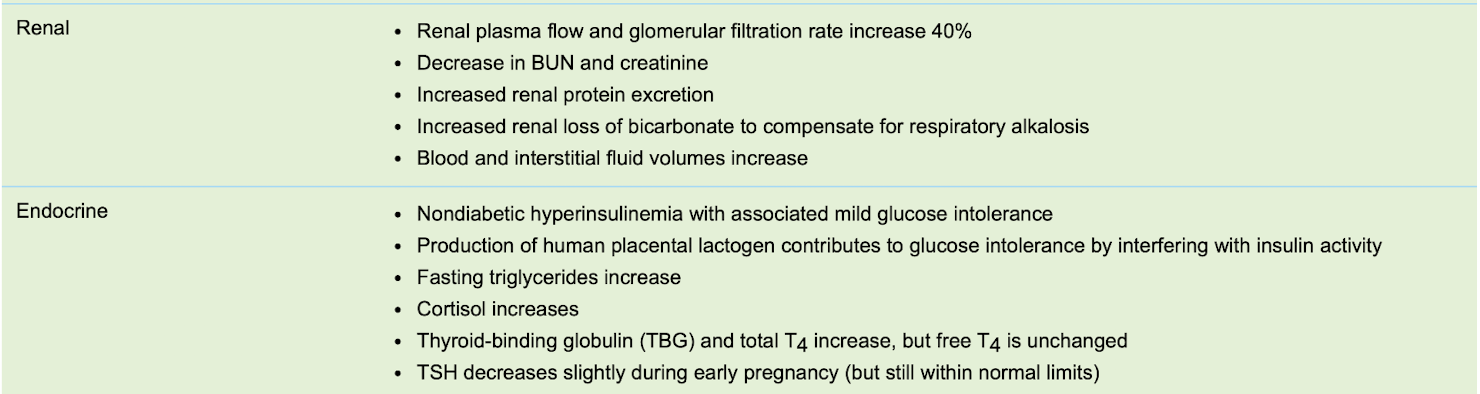
Renal

endocrine

Renal 

-plasma flow and GFR increase

-decrease in BUN, cr 

-increased renal protein excretion 

-increase renal loss of bicarbonate (compensation for respiratory alkalosis) 

-blood and interstitial fluid volume increases 

Endocrine: 

-nonDM hyperinsulinemia 

-mild glucose intolerance 

-human placental lactogen contributes to glucose intolerance 

-fasting TG increases

-cortisol increases 

-TBG and total T4 increases

-Free T4 unchanged 

-TSH decreases slightly during early pregnancy but wnl still 
<p><strong>Renal&nbsp;</strong></p><p class="p1">-plasma flow and GFR increase</p><p class="p1">-decrease in BUN, cr&nbsp;</p><p class="p1">-increased renal protein excretion&nbsp;</p><p class="p1">-increase renal loss of bicarbonate (compensation for respiratory alkalosis)&nbsp;</p><p class="p1">-blood and interstitial fluid volume increases&nbsp;</p><p class="p2"></p><p class="p1"><strong>Endocrine:&nbsp;</strong></p><p class="p1">-nonDM hyperinsulinemia&nbsp;</p><p class="p1">-mild glucose intolerance&nbsp;</p><p class="p1">-human placental lactogen contributes to glucose intolerance&nbsp;</p><p class="p1">-fasting TG increases</p><p class="p1">-cortisol increases&nbsp;</p><p class="p1">-TBG and total T4 increases</p><p class="p1">-Free T4 unchanged&nbsp;</p><p class="p1">-TSH decreases slightly during early pregnancy but wnl still&nbsp;</p>
7
New cards

Changes in pregnancy

heme

GI

Heme: 

-hypercoaguable 

-increased RBC production 

-decreased Hct 

-increased blood volume 

GI: 

-increased salivation 

-decreased gastric motility 

<p><strong>Heme:&nbsp;</strong></p><p class="p1">-hypercoaguable&nbsp;</p><p class="p1">-increased RBC production&nbsp;</p><p class="p1">-decreased Hct&nbsp;</p><p class="p1">-increased blood volume&nbsp;</p><p class="p2"></p><p class="p1"><strong>GI:&nbsp;</strong></p><p class="p1">-increased salivation&nbsp;</p><p class="p1">-decreased gastric motility&nbsp;</p>
8
New cards

Assessment of Gestational age

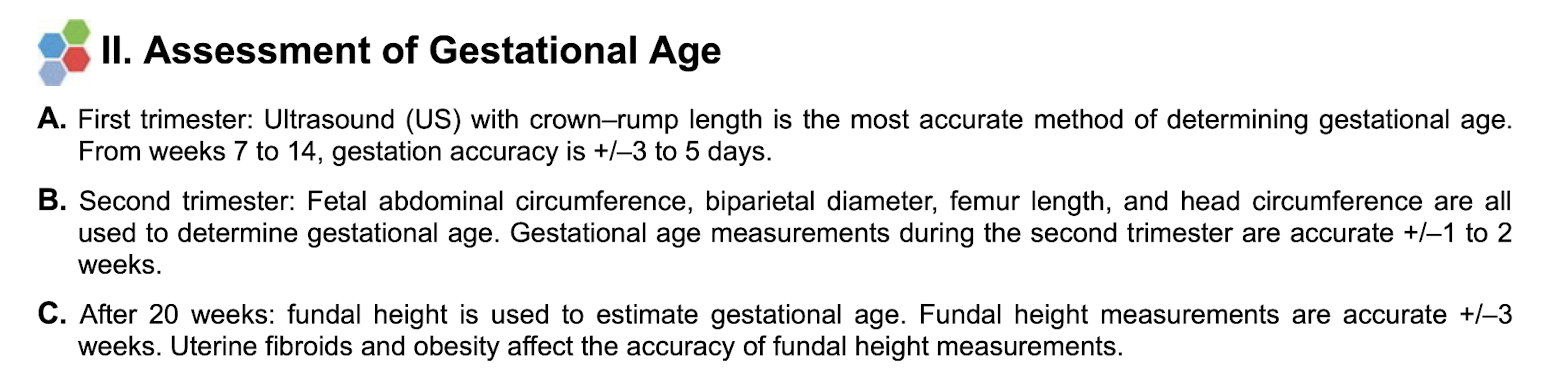
-first trimester

-second trimerster

-after 20 weeks

First trimester

-US with crown-rump length is most accurate

Second trimester: 

-fetal abdominal circumference 

-biparietal diameter

-femur length 

-head circumference  

Afer 20 weeks: 

-fundus height

-note: uterine fibroids and obesity can affect the accuracy of using fundal height measurements 
<p><strong>First trimester</strong></p><p class="p1">-US with crown-rump length is most accurate</p><p class="p2"></p><p class="p2"></p><p class="p1"><strong>Second trimester:&nbsp;</strong></p><p class="p1">-fetal abdominal circumference&nbsp;</p><p class="p1">-biparietal diameter</p><p class="p1">-femur length&nbsp;</p><p class="p1">-head circumference &nbsp;</p><p class="p2"></p><p class="p2"></p><p class="p1"><strong>Afer 20 weeks:&nbsp;</strong></p><p class="p1">-fundus height</p><p class="p1">-note: uterine fibroids and obesity can affect the accuracy of using fundal height measurements&nbsp;</p>
9
New cards

Prenatal care

-nutrition

-weight gain

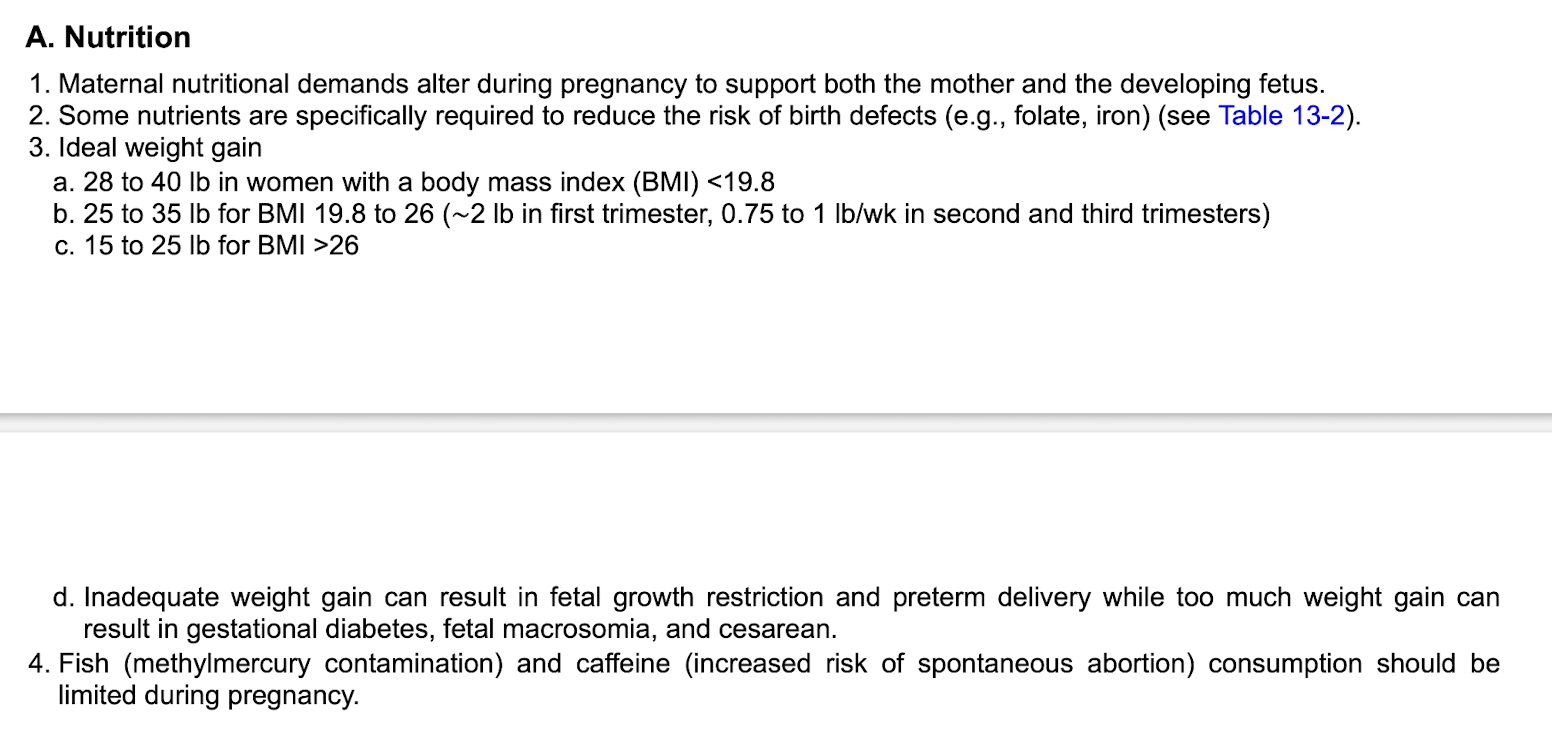
Nutrition

-folate and iron 

-avoid fish and caffeine 

Weight gain 

-Ideal weight gain based on BMI 

  • <19.8 BMI: 28-40 lbs weight gain 

  • 19.8-26 BMI: 25-35 lbs 

  • >26 BMI: 15-25 lbs 

-inadequate weight gain can result in fetal growth restriction and preterm delivery 

-too much weight gain can result in GDM, fetal macrosomia and C-section 
<p class="p1"></p><p class="p2"><strong>Nutrition</strong></p><p class="p2">-folate and iron&nbsp;</p><p class="p2">-avoid fish and caffeine&nbsp;</p><p class="p1"></p><p class="p2"><strong>Weight gain&nbsp;</strong></p><p class="p2">-Ideal weight gain based on BMI&nbsp;</p><ul><li><p class="p2">&lt;19.8 BMI: 28-40 lbs weight gain&nbsp;</p></li><li><p class="p2">19.8-26 BMI: 25-35 lbs&nbsp;</p></li><li><p class="p2">&gt;26 BMI: 15-25 lbs&nbsp;</p></li></ul><p class="p2">-inadequate weight gain can result in fetal growth restriction and preterm delivery&nbsp;</p><p class="p2">-too much weight gain can result in GDM, fetal macrosomia and C-section&nbsp;</p>
10
New cards

Daily caloric intake pregnancy

2500 kcal

11
New cards

Prenatal visits

-Leopold maneuvers

Leopold maneuvers performed in third trimester to determine fetal presentation
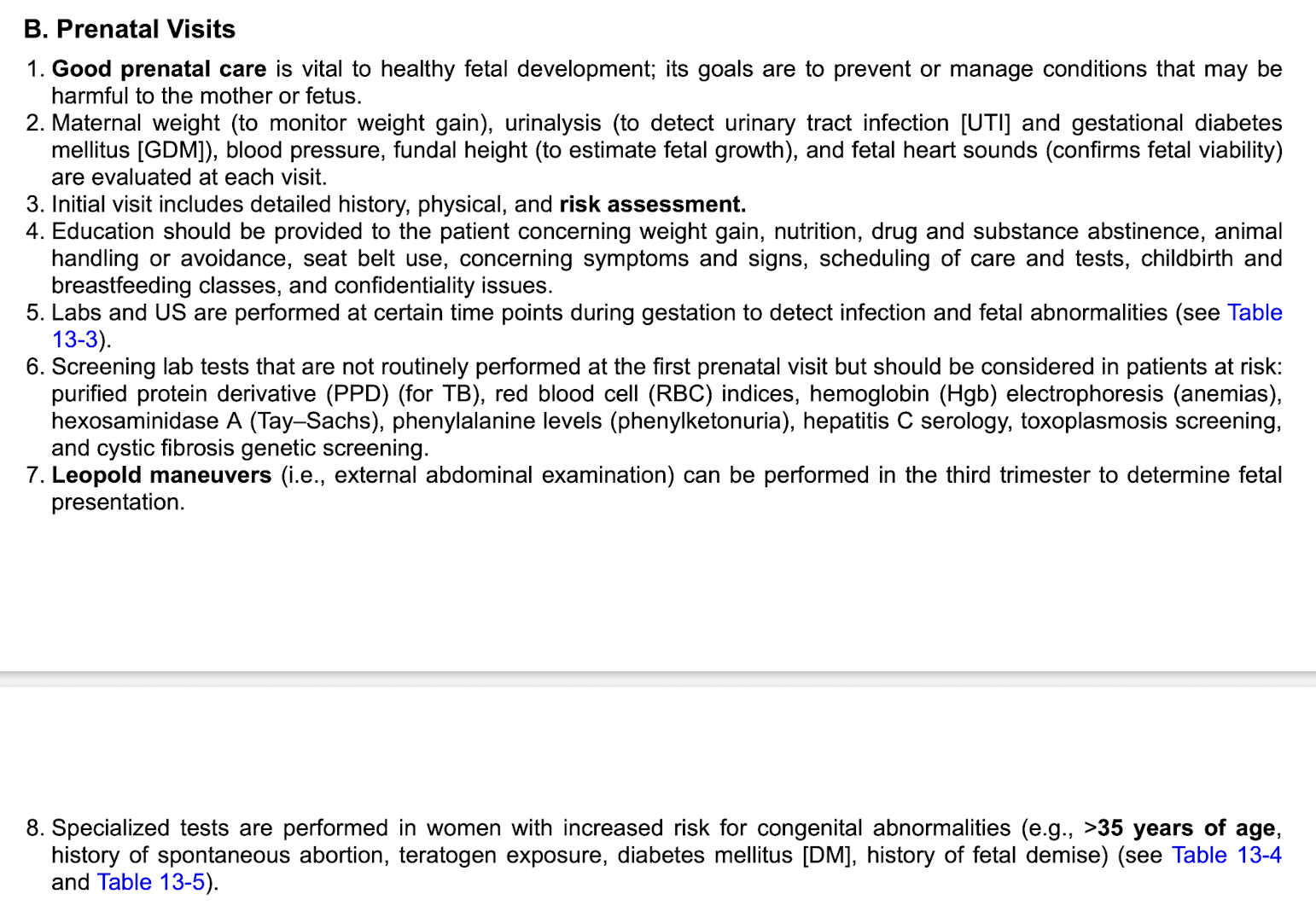
<p>Leopold maneuvers performed in third trimester to determine fetal presentation </p>
12
New cards

Maternal serium alpha protein level test

-Test is only valid if performed during correct gestational window (16-18 weeks gestation) 

-High levels are associated with risk of NTDs, abdominal wall defects, and multiple gestations

-Low levels are associated with inc risk of trisomies 21 and 18 

<p>-Test is only valid if performed during correct gestational window (16-18 weeks gestation)&nbsp;</p><p class="p2"></p><p class="p1">-High levels are associated with risk of NTDs, abdominal wall defects, and multiple gestations</p><p class="p2"></p><p class="p1">-Low levels are associated with inc risk of trisomies 21 and 18&nbsp;</p><p class="p2"></p>
13
New cards

Screening labs vs length of gestatio n

-initial visit

-16-18 weeks

-18-20 weeks

-24-28 weeks

-32-37 weeks

Initial visit: 

-CBC

-Rh typing

-Pap smear

-STI screening 

-UA

-RPR or VDRL

-Rubella and varicella AB titer 

-HBsAG

-HIV screening (with maternal consent) 

16-18 weeks: 

-Quad screen (maternal AFP, hCG, Estriol, inhibin A) 

18-20 weeks: 

-US dating 

-assessment for gross fetal abnormalities 

24-28 weeks: 

-1-hr glucose challenge for GDM 

32-37 weeks: 

-cervical culture for N. Gonnorhea and chlaymdia

-GBS screen 
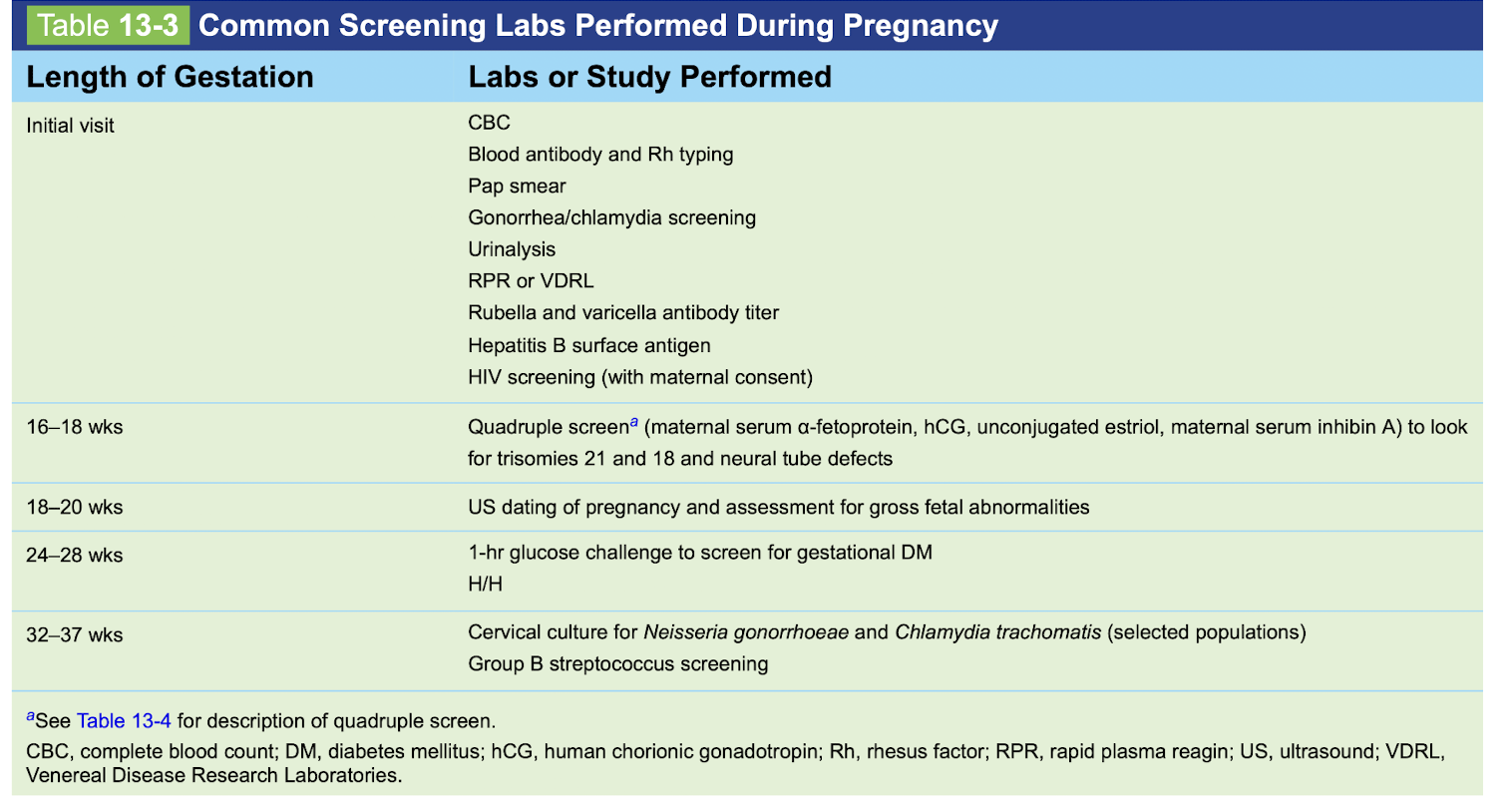
<p><strong>Initial visit:&nbsp;</strong></p><p class="p1">-CBC</p><p class="p1">-Rh typing</p><p class="p1">-Pap smear</p><p class="p1">-STI screening&nbsp;</p><p class="p1">-UA</p><p class="p1">-RPR or VDRL</p><p class="p1">-Rubella and varicella AB titer&nbsp;</p><p class="p1">-HBsAG</p><p class="p1">-HIV screening (with maternal consent)&nbsp;</p><p class="p2"></p><p class="p1"><strong>16-18 weeks:&nbsp;</strong></p><p class="p1">-Quad screen (maternal AFP, hCG, Estriol, inhibin A)&nbsp;</p><p class="p2"></p><p class="p1"><strong>18-20 weeks:&nbsp;</strong></p><p class="p1">-US dating&nbsp;</p><p class="p1">-assessment for gross fetal abnormalities&nbsp;</p><p class="p2"></p><p class="p1"><strong>24-28 weeks:&nbsp;</strong></p><p class="p1">-1-hr glucose challenge for GDM&nbsp;</p><p class="p2"></p><p class="p1"><strong>32-37 weeks:&nbsp;</strong></p><p class="p1">-cervical culture for N. Gonnorhea and chlaymdia</p><p class="p1">-GBS screen&nbsp;</p>
14
New cards

High risk pregnancy tests: description and indications

quadruple screen

full integrated test

amniocentesis

chorionic villi sampling

precutaneoous umbilical blood sampling
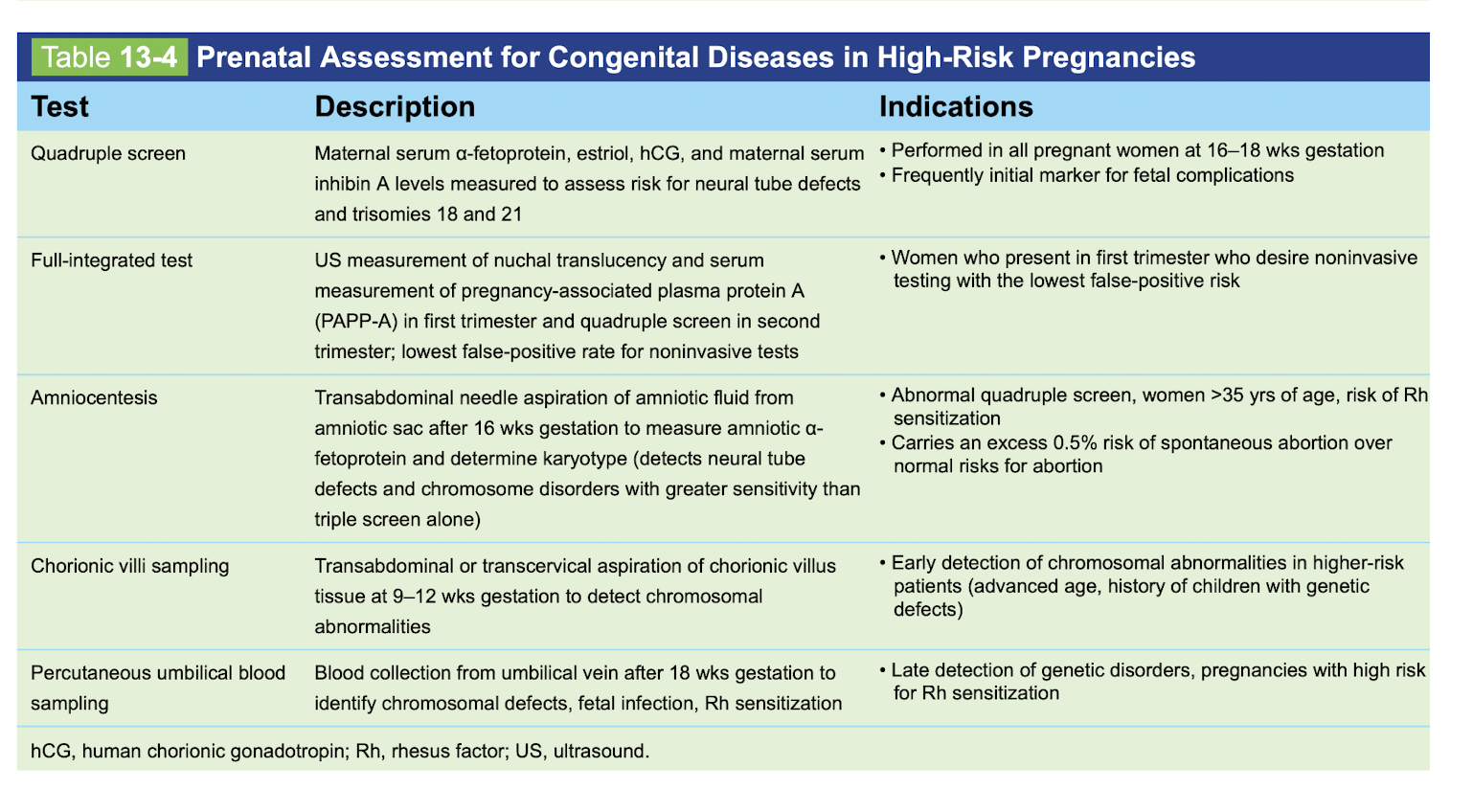
knowt flashcard image
15
New cards

Full integrated test and quad screen

-trisomy 21

-trisomy 18

-trisomy 13
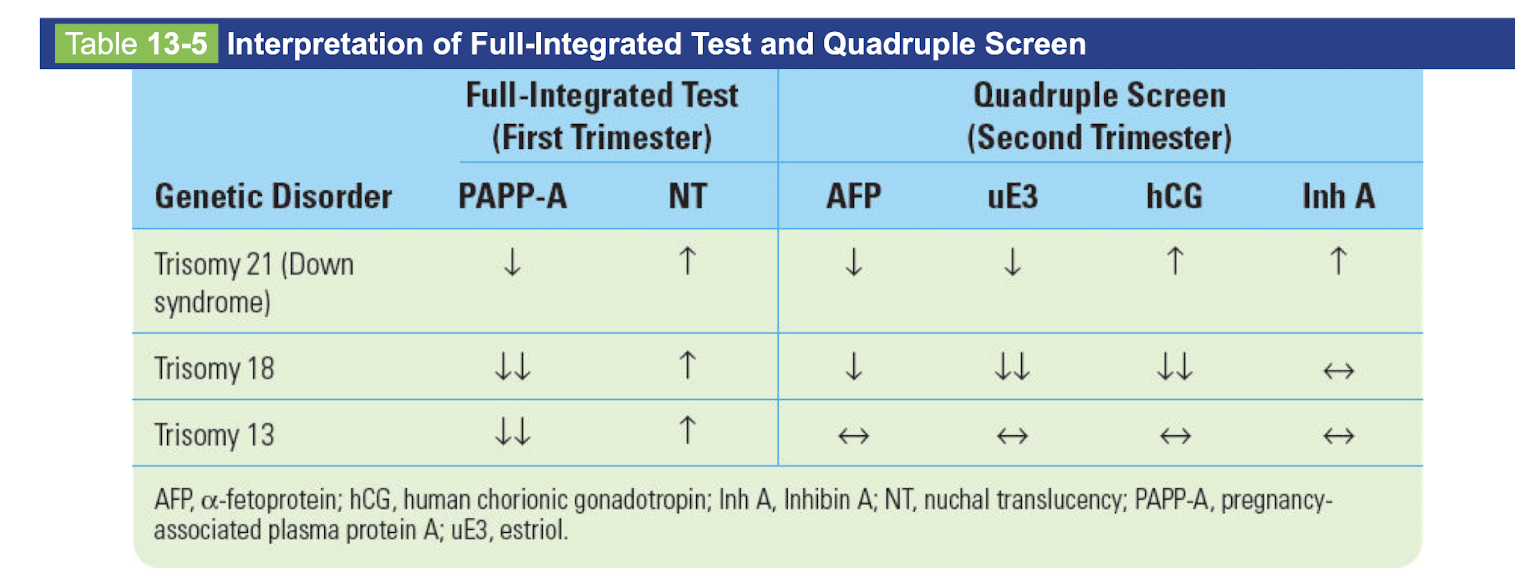
knowt flashcard image
16
New cards

Gestational DM

-most frequently occurs in the

Most commonly occurs in the 2nd and 3rd trimesters 

(Usually if presentation is earlier then suspect non GDM) 
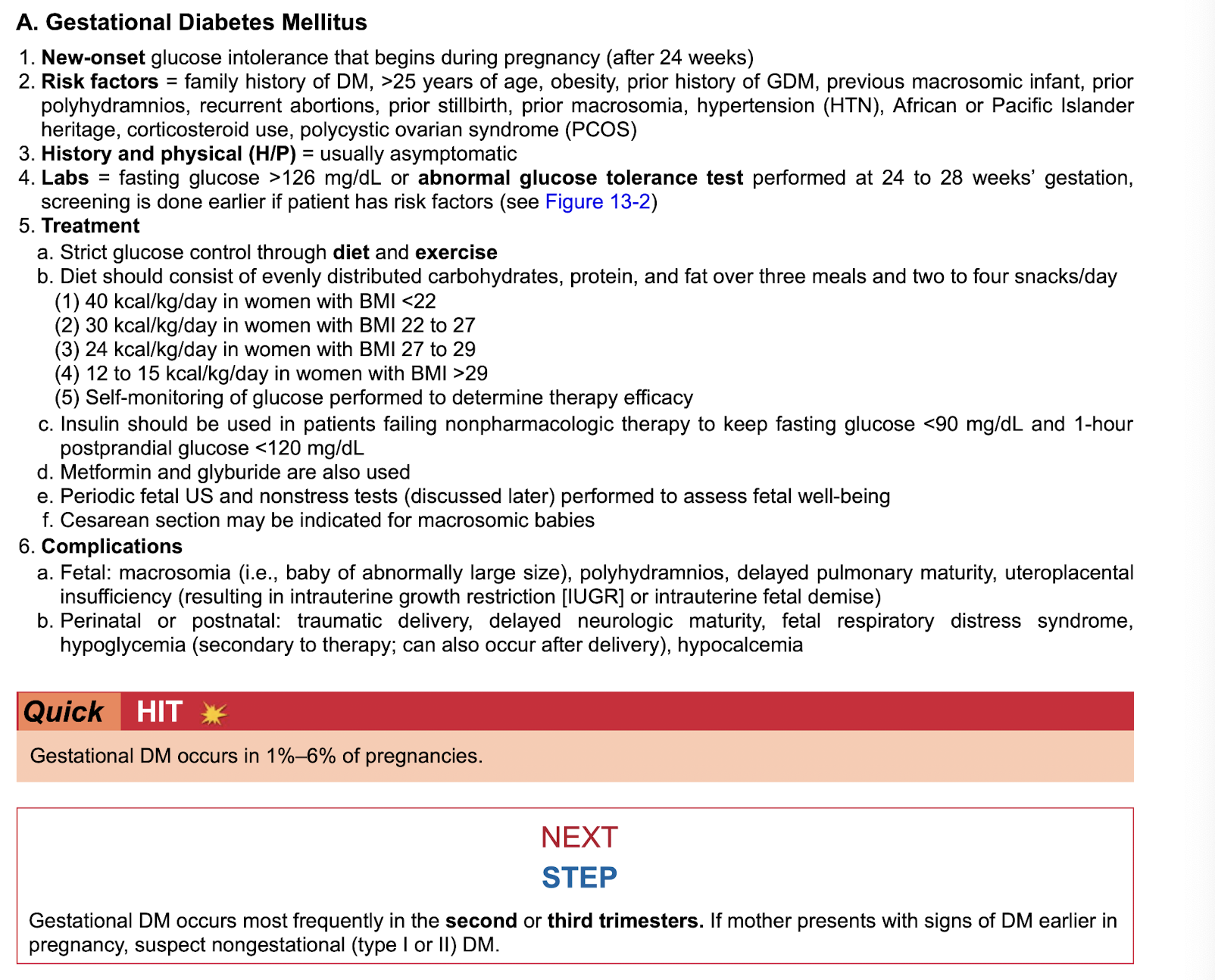
<p>Most commonly occurs in the 2nd and 3rd trimesters&nbsp;</p><p class="p1">(Usually if presentation is earlier then suspect non GDM)&nbsp;</p>
17
New cards

Continue glucose assessment in patients gestational DM

after birth

<p>after birth </p>
18
New cards

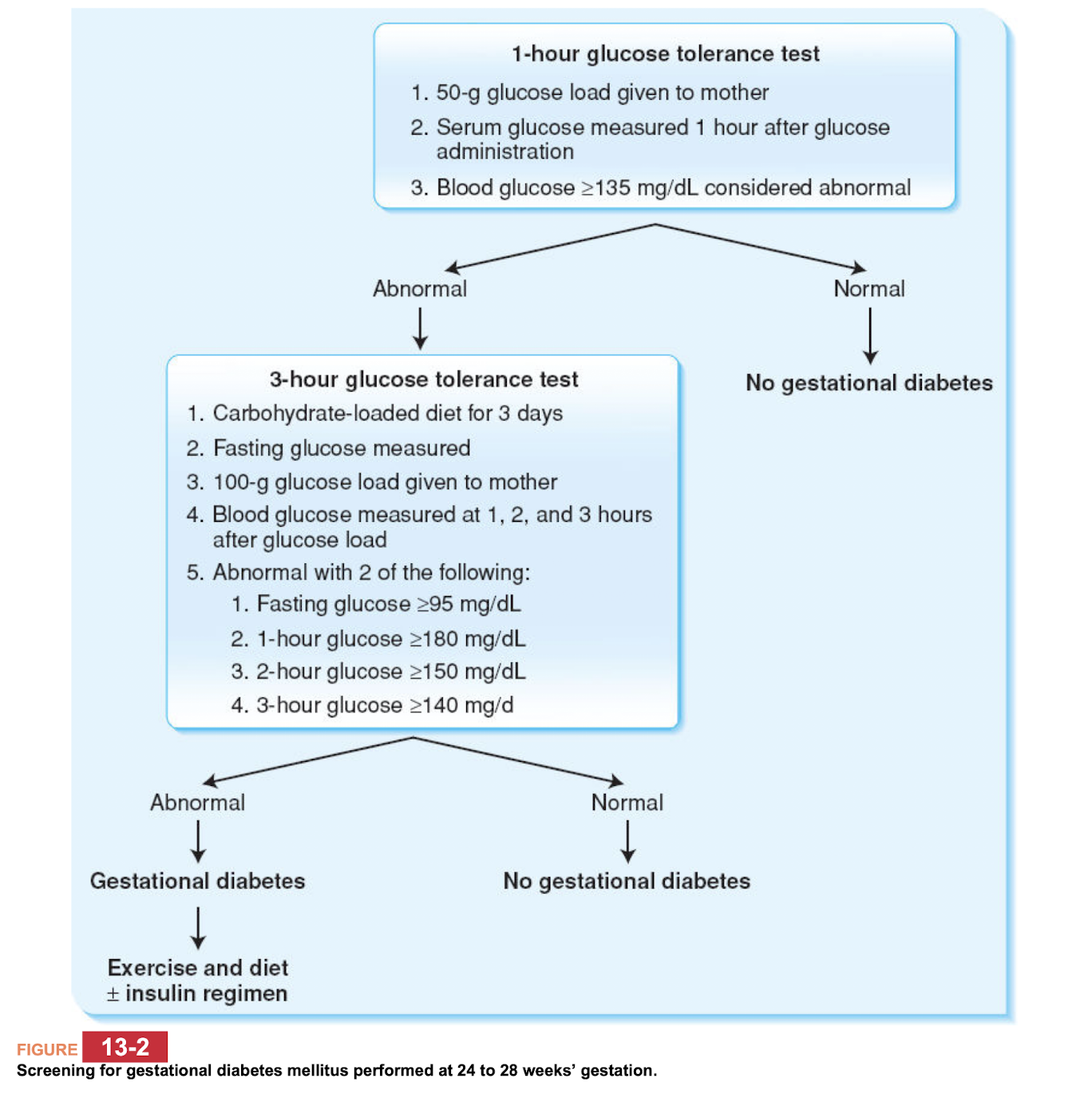
Gestational DM pathway

knowt flashcard image
19
New cards

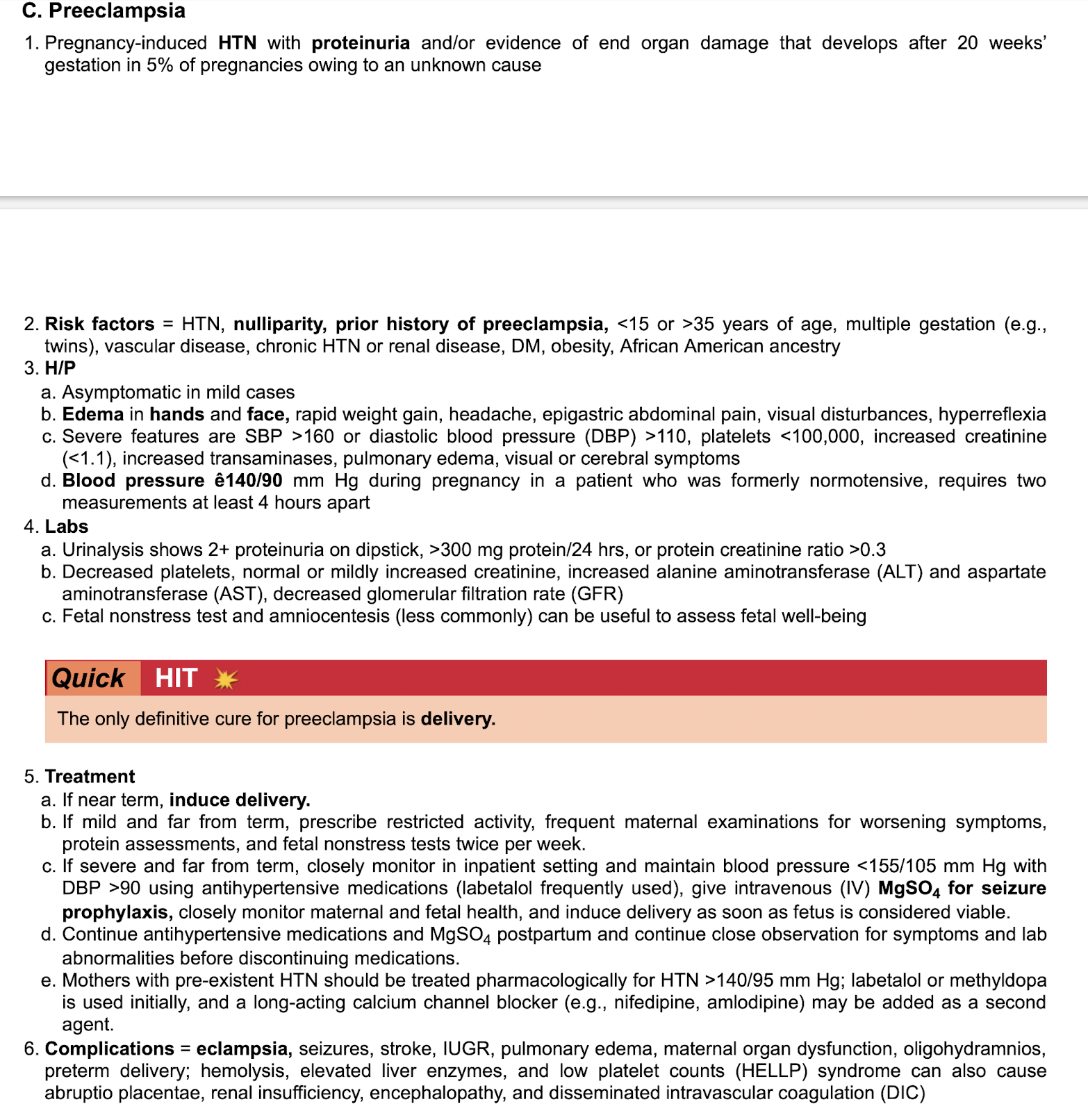
Preeclampsia

-def

-rf

-sxs

-labs

-definitive cure

-tx

-complications
knowt flashcard image
20
New cards

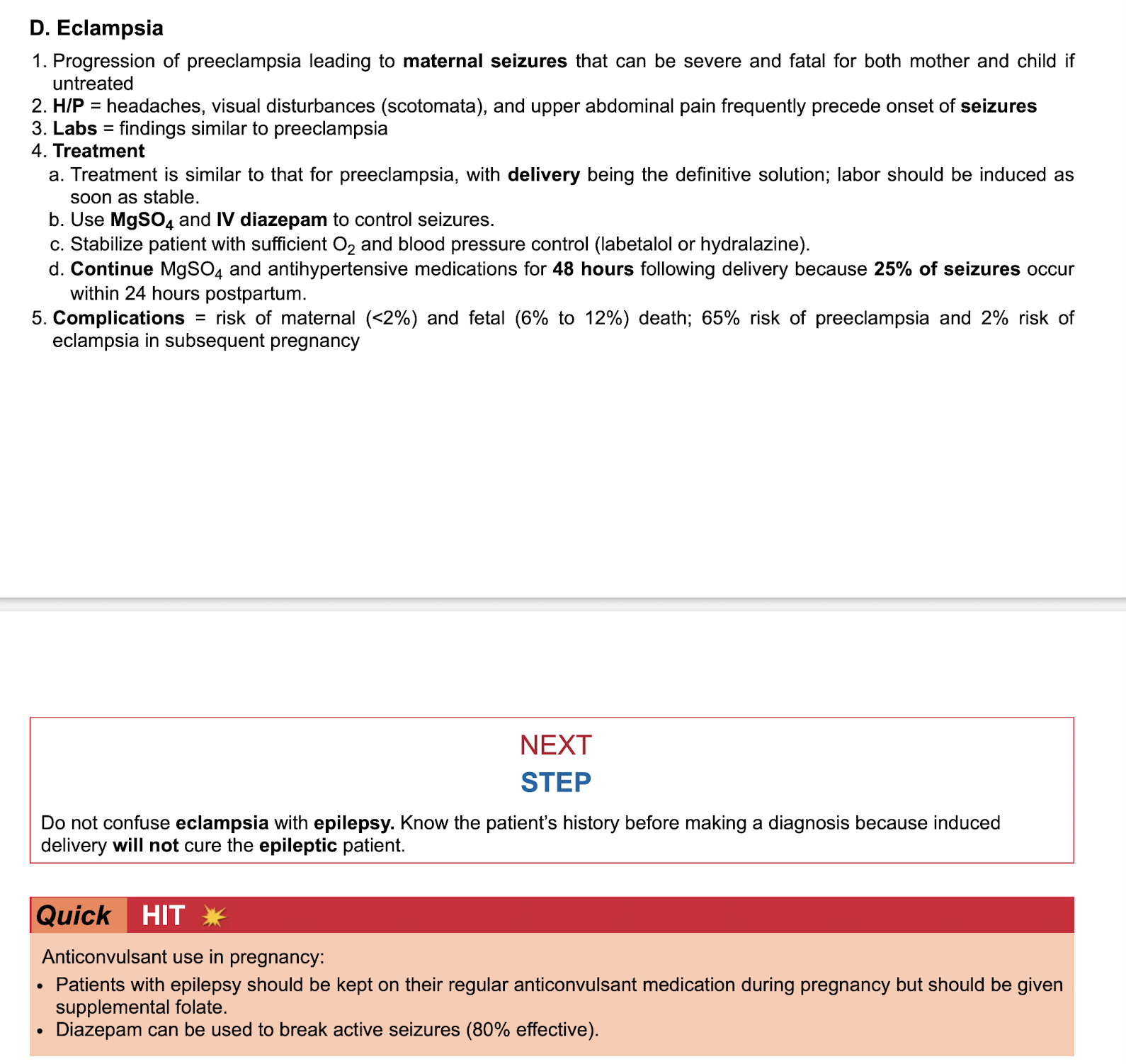
Eclampsia

-def

-sxs

-labs

-tx

-complications

-do not confuse witih

-anticonvulsant use in prgnancy
knowt flashcard image
21
New cards

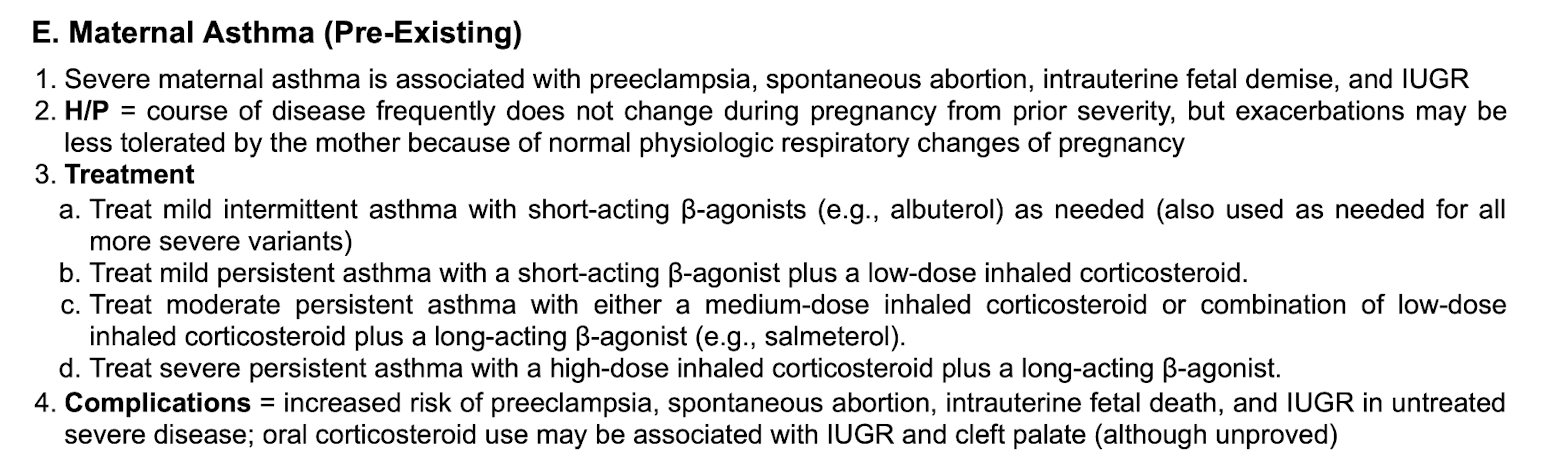
Maternal asthma (pre-existing)

-def

-sxs

-tx

-complications
knowt flashcard image
22
New cards

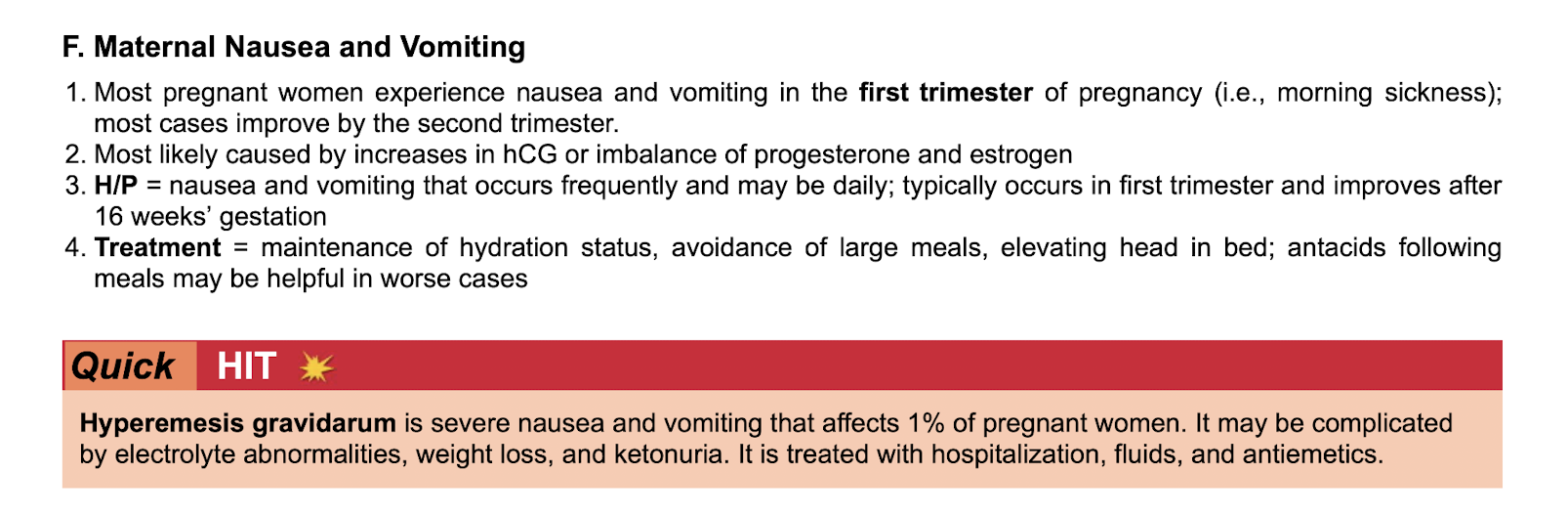
Maternal n/v

-timeline

-caused by

-sxs

-tx

-Hyperemesis gravidum
knowt flashcard image
23
New cards

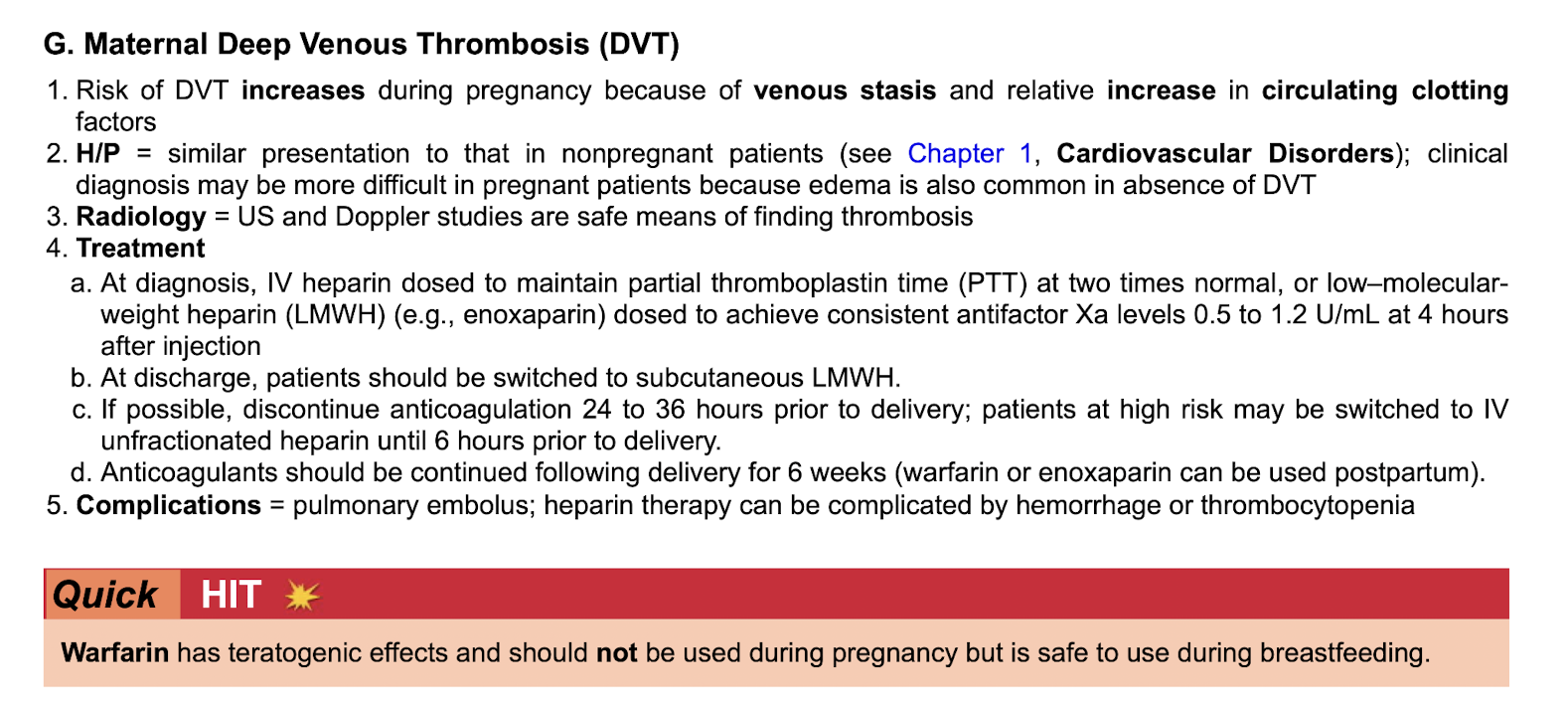
Maternal DVT

-def

-sxs

-dx

-radio

-tx

-complications
knowt flashcard image
24
New cards

Anticoagulation during active labor

stop all anticoagulation during active labor until 6 hours after delivery to prevent severe hemorrhage

25
New cards

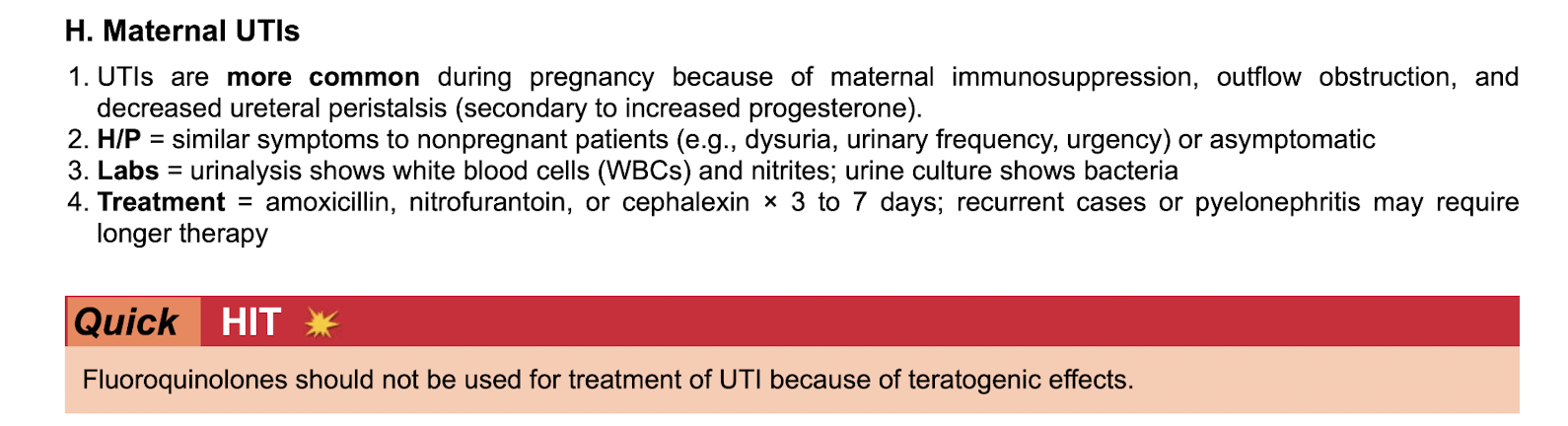
Maternal UTIS

-more common because

-sxs

-labs

-tx

-what should you not use for tx
knowt flashcard image
26
New cards

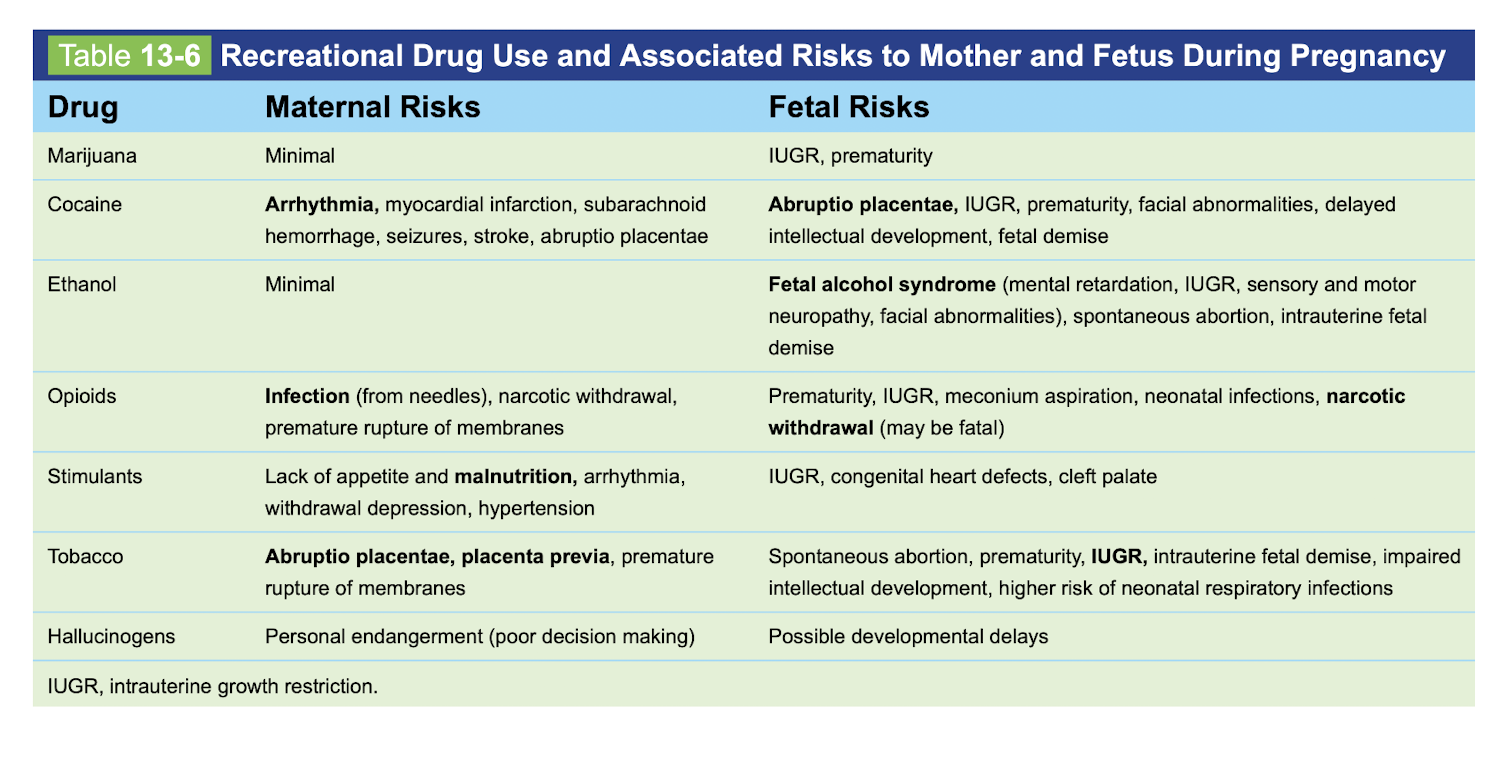
Drug use in mother durign pregnancy

-maternal risks vs fetal risks

  • weed

  • cocaine

  • ETOH

  • opiods

  • stimulants

  • tobacco

  • hallucinogens

knowt flashcard image
27
New cards

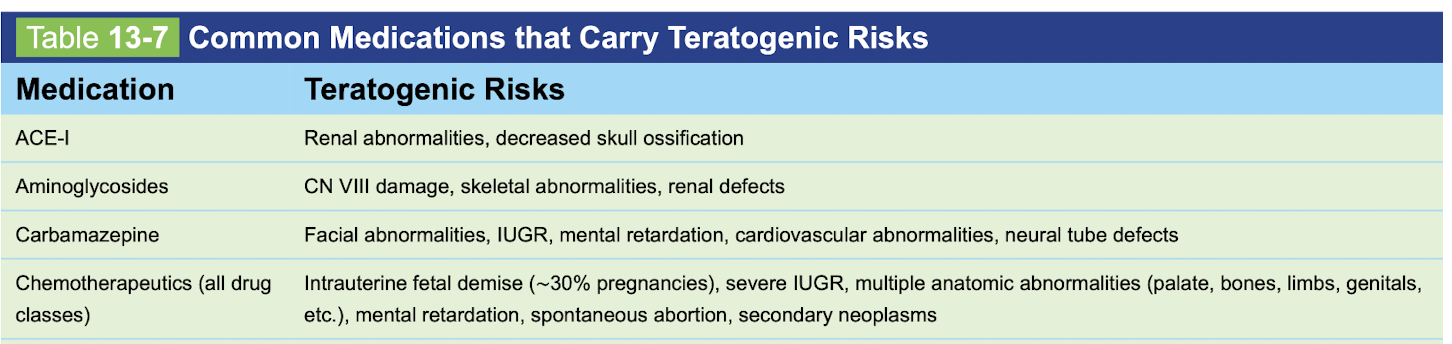
Teratogens

  • ACE-I

  • Aminoglycosides

  • Carbamazepine

  • Chemotherapies

knowt flashcard image
28
New cards

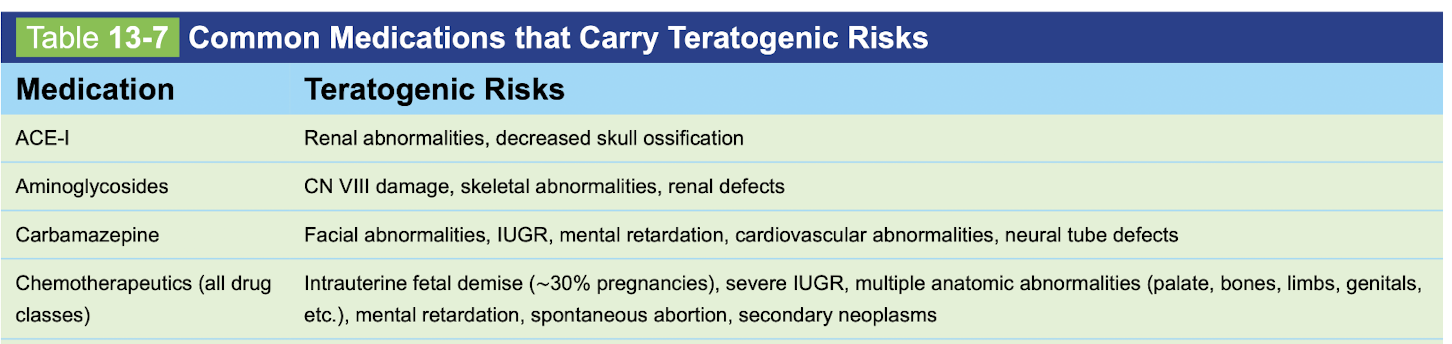
Teratogens

  • ACE-I

  • Aminoglycosides

  • Carbamazepine

  • Chemotherapies

knowt flashcard image
29
New cards

Teratogens

-diazepam

-DES
-Fluroquinolones

-Lithium

knowt flashcard image
30
New cards

Teratogens

-phenobarbital

-phenytoin

-retinoids

knowt flashcard image
31
New cards

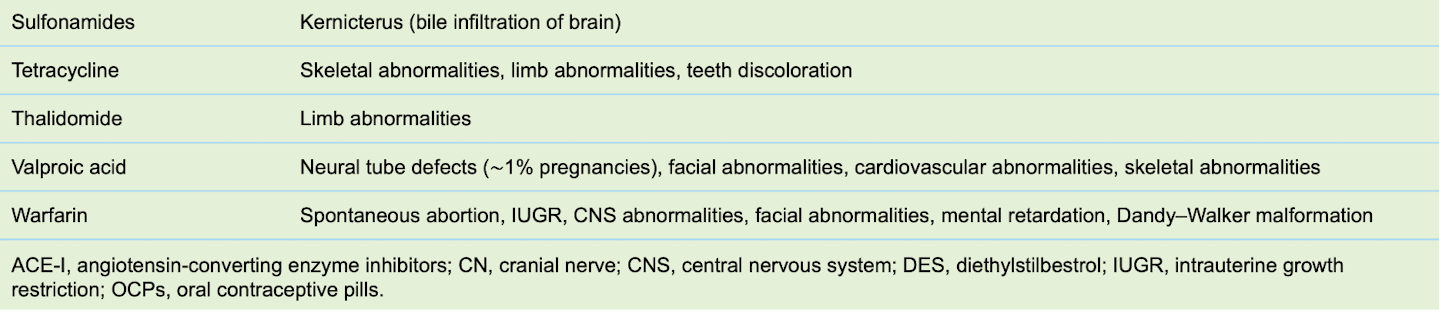
Teratogens

-sulfonamides

-tetracycline

-thalidomide

-valproic acid

-warfarin
knowt flashcard image
32
New cards

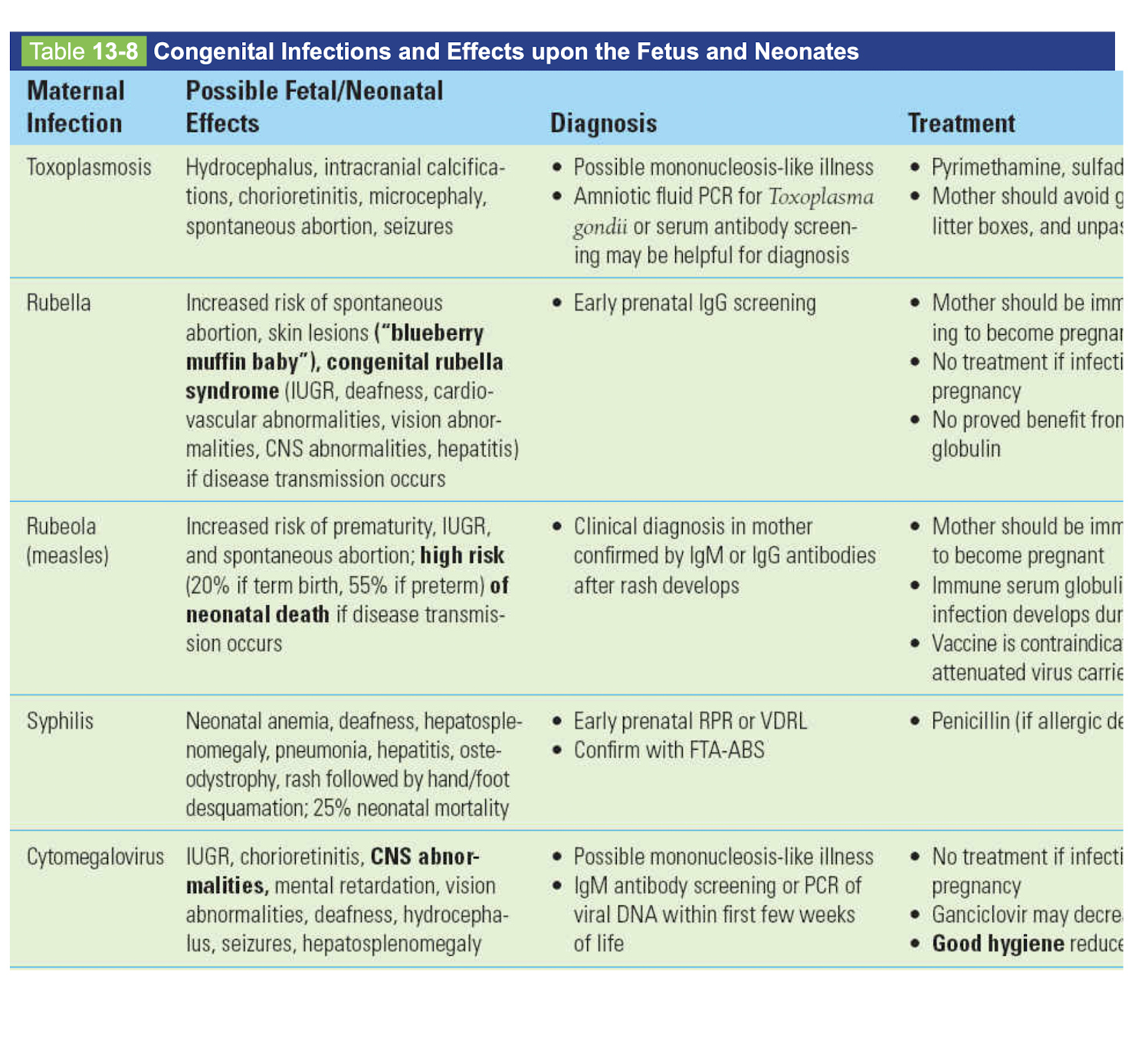
TORCHES

-baby effect

-dx

-tx

  • Toxo

  • rubella

  • rubeola-measles

  • syphilis

  • cmv

knowt flashcard image
33
New cards

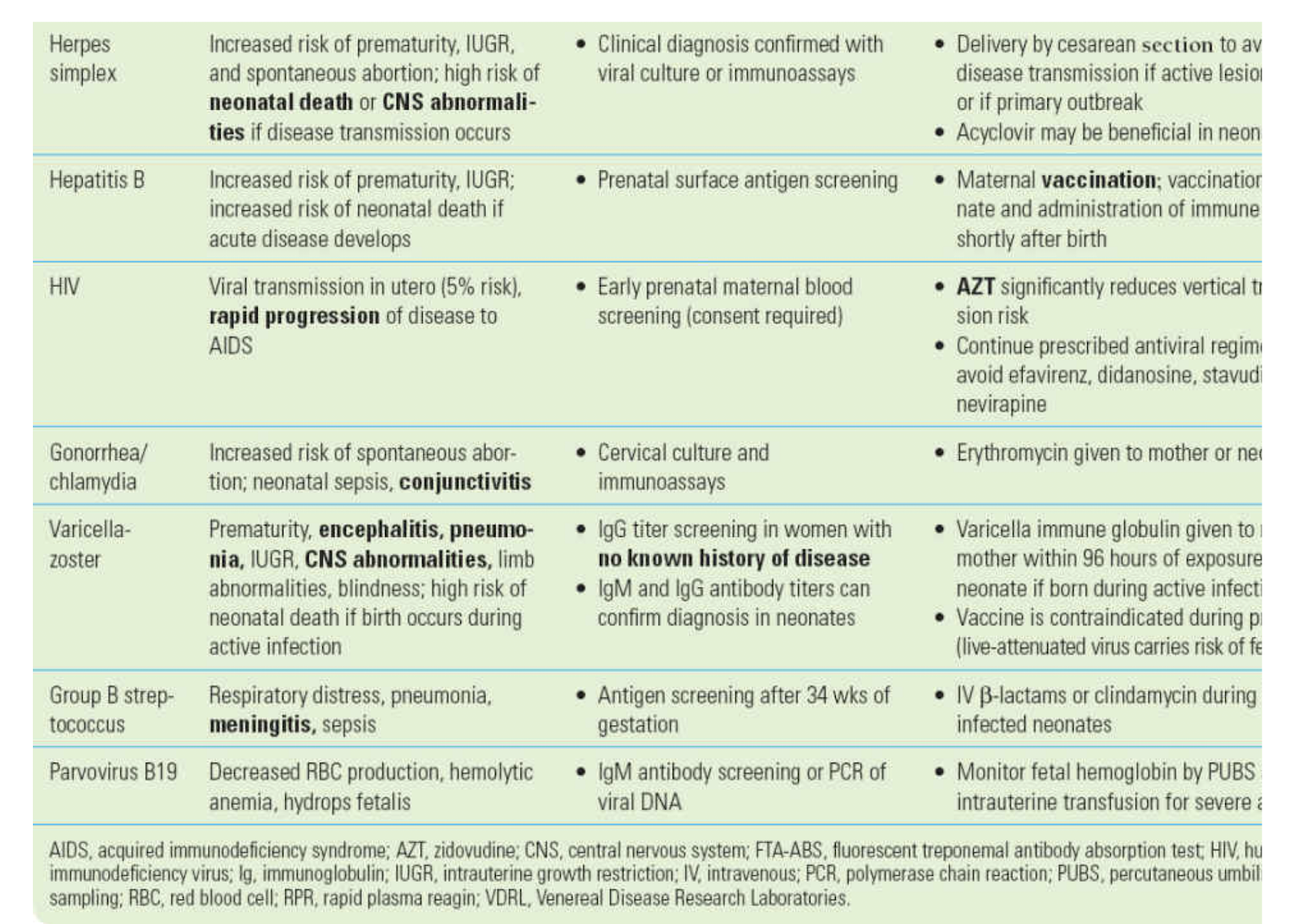
TORCHES

-baby effect

-dx

-tx

  • HSV

  • HBV

  • HIV

  • Gonorrhea/chlaymydia

  • VZV

  • GBS

  • Parvovirus B19

knowt flashcard image
34
New cards

Ectopic pregnancy

-rf

-sxs

-labs

-radio

-tx

-complications
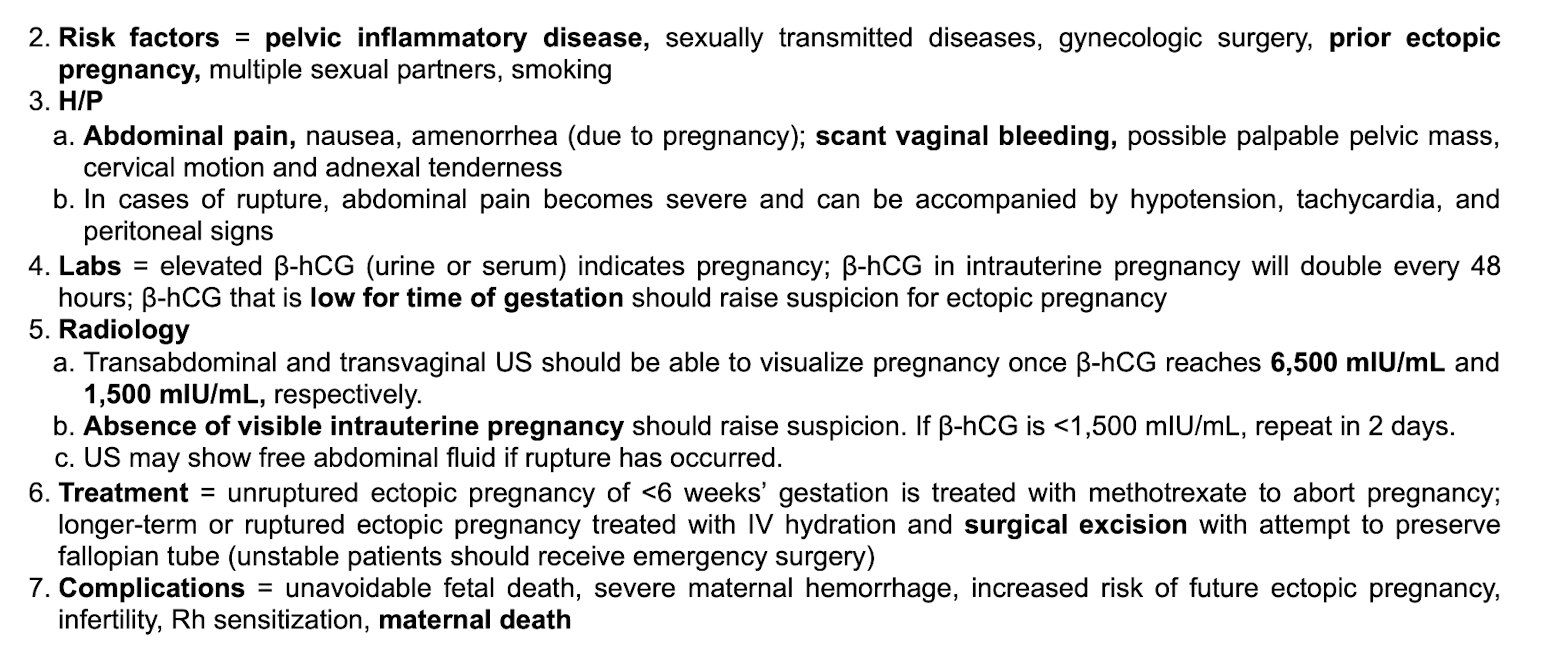
knowt flashcard image
35
New cards

Bhcg is produced by

most common cause of vaginal bleeding in early pregnancy
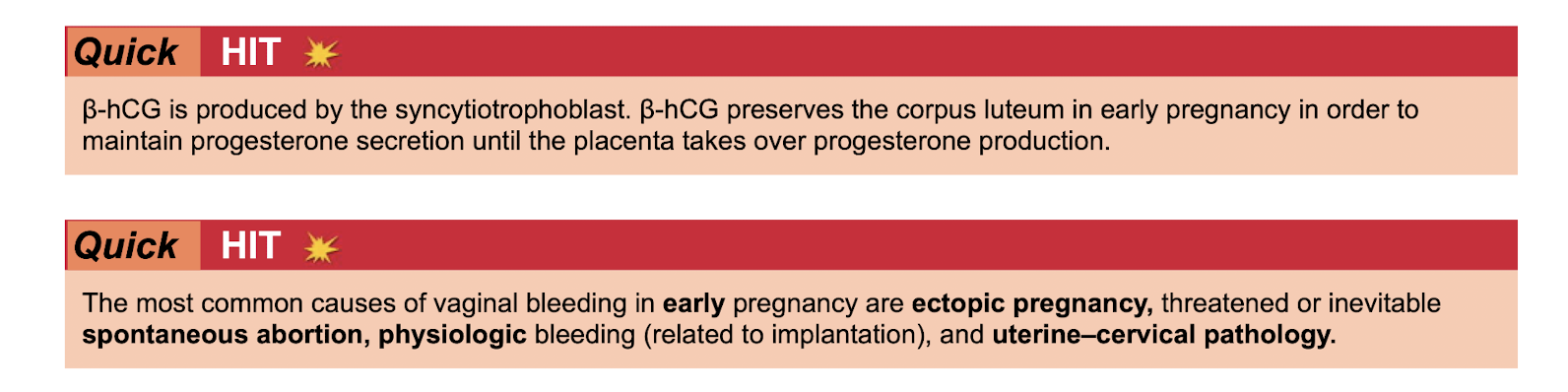
knowt flashcard image
36
New cards

Spontaneous abortion/ Miscarriage

-def

-first tri vs second tri

-rf

-sxs

-labs

-radio

-tx
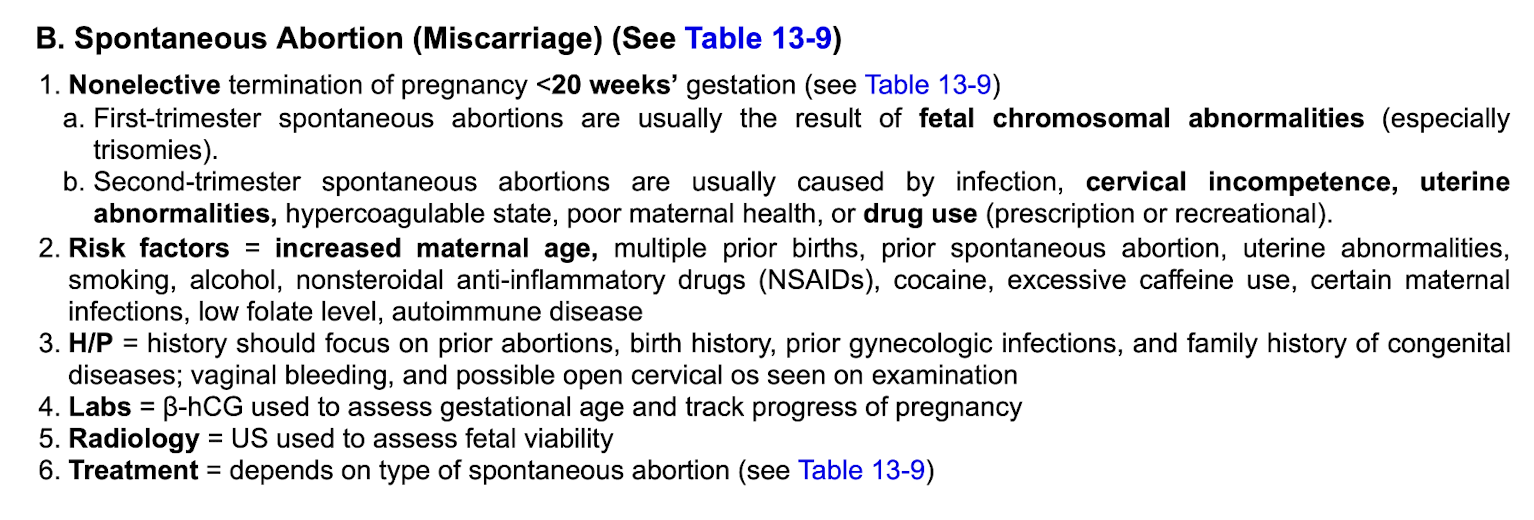
knowt flashcard image
37
New cards

Sxs/Dx/Tx

threatened abortion

missed abortion

inevitable abortion

incomplete abortion
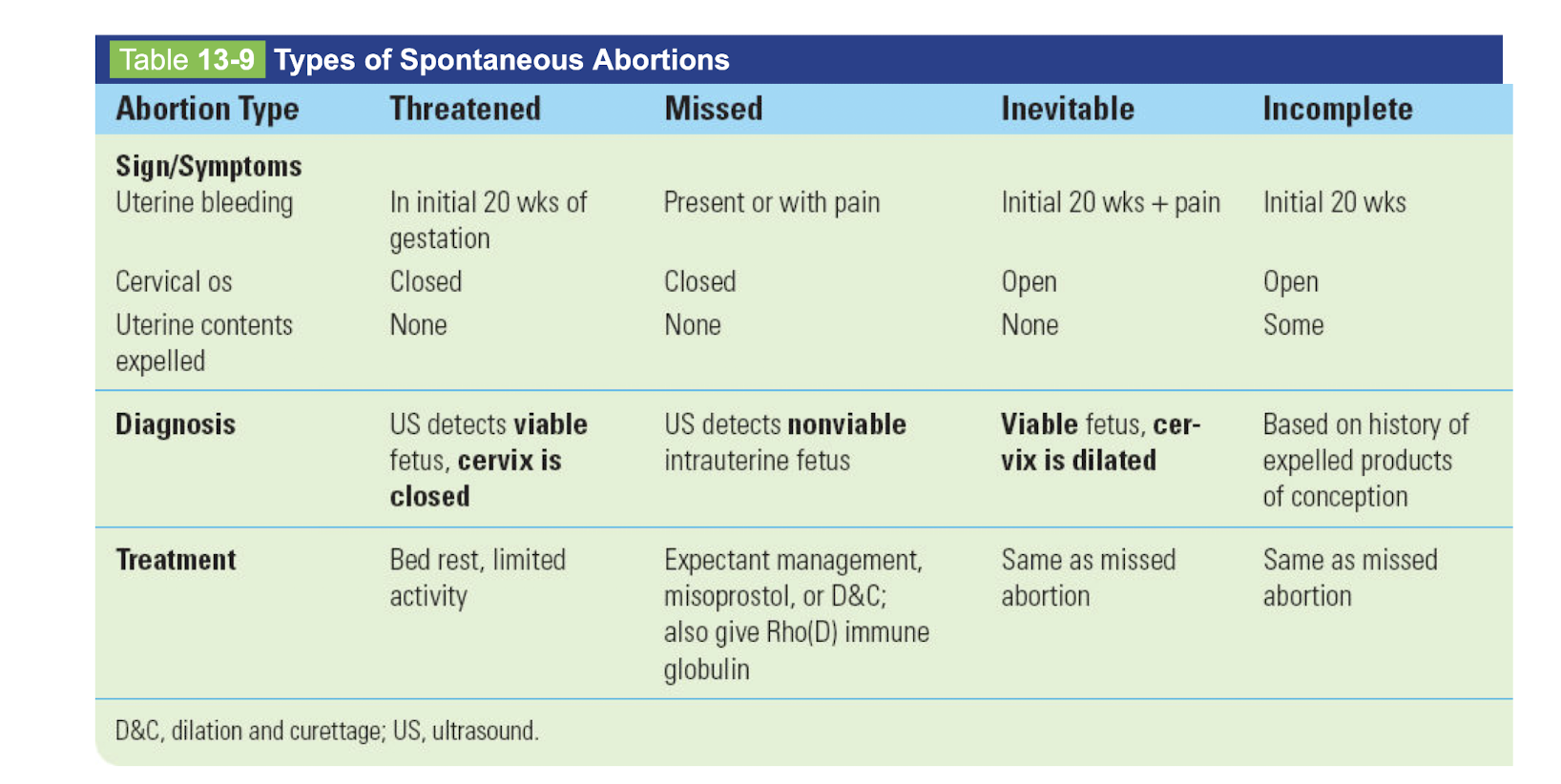
knowt flashcard image
38
New cards

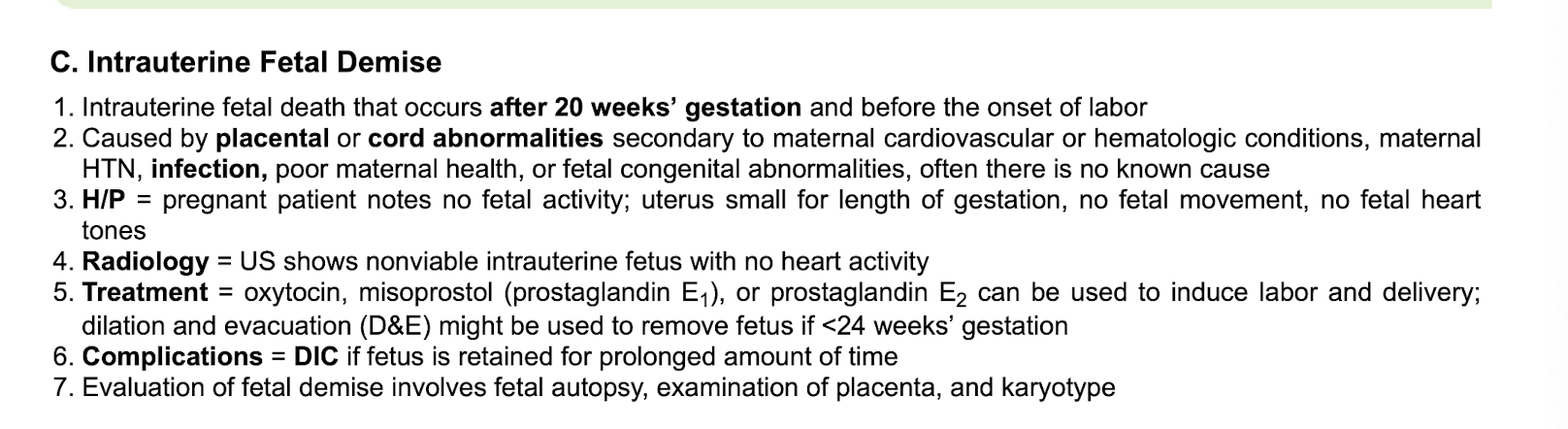
Intrauterine fetal demise

-def

-caused by

-sxs

-radio

-tx

-complications

-evaluation involves
knowt flashcard image
39
New cards

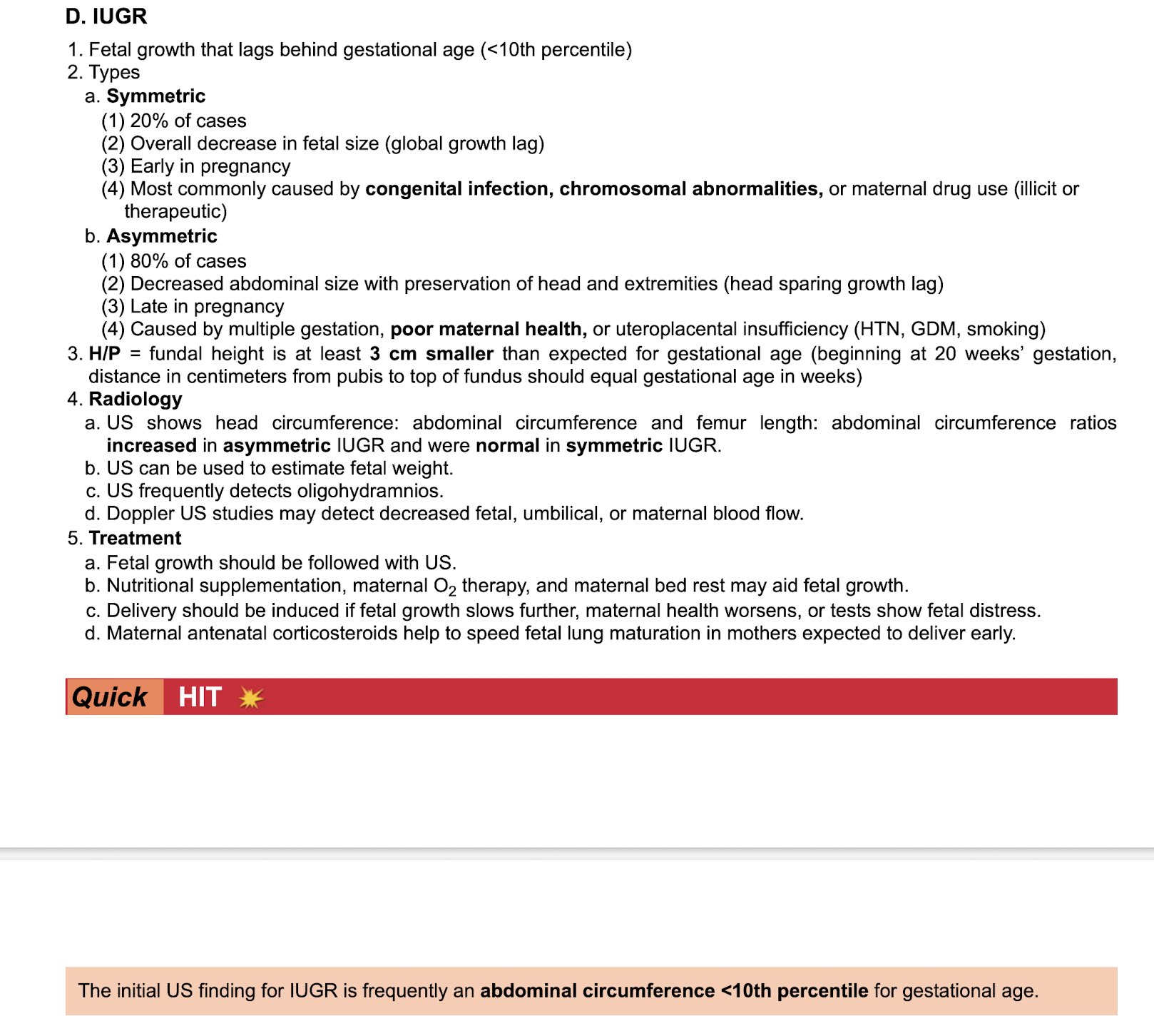
IUGR

-types symmetric vs asymetric

-sxs

-radio

-tx

-initial us finding
knowt flashcard image
40
New cards

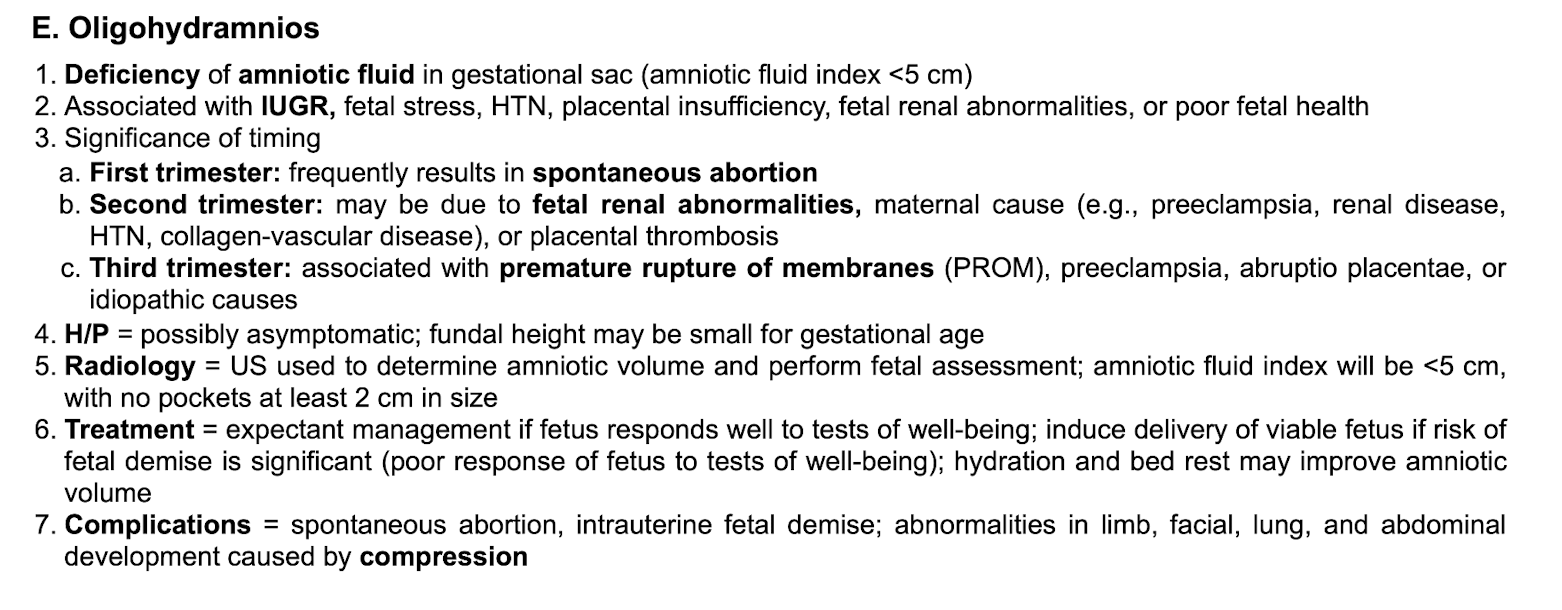
Oligiohydraminos

-def

-associated with

-timing per tri

-sxs

-radio

-tx

-complications
knowt flashcard image
41
New cards

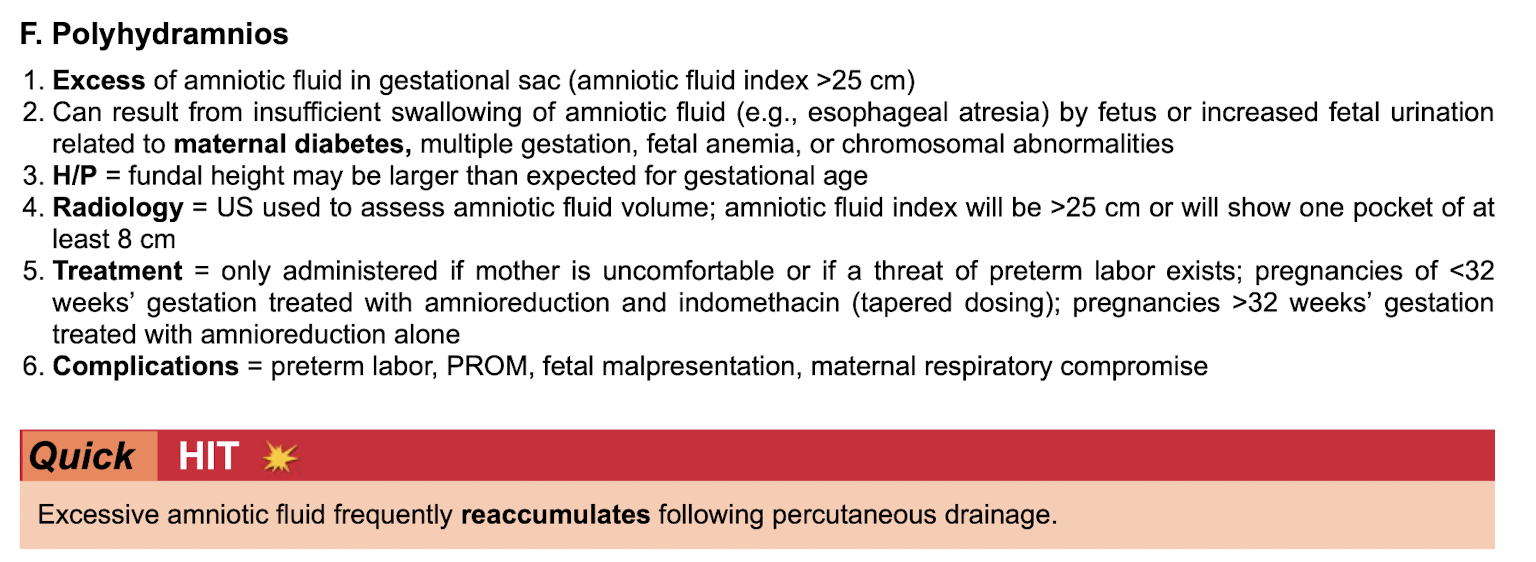
Polyhydraminos

-def

-can result from

-sxs

-radio

-tx

-complications

-can reaccumulate following
knowt flashcard image
42
New cards

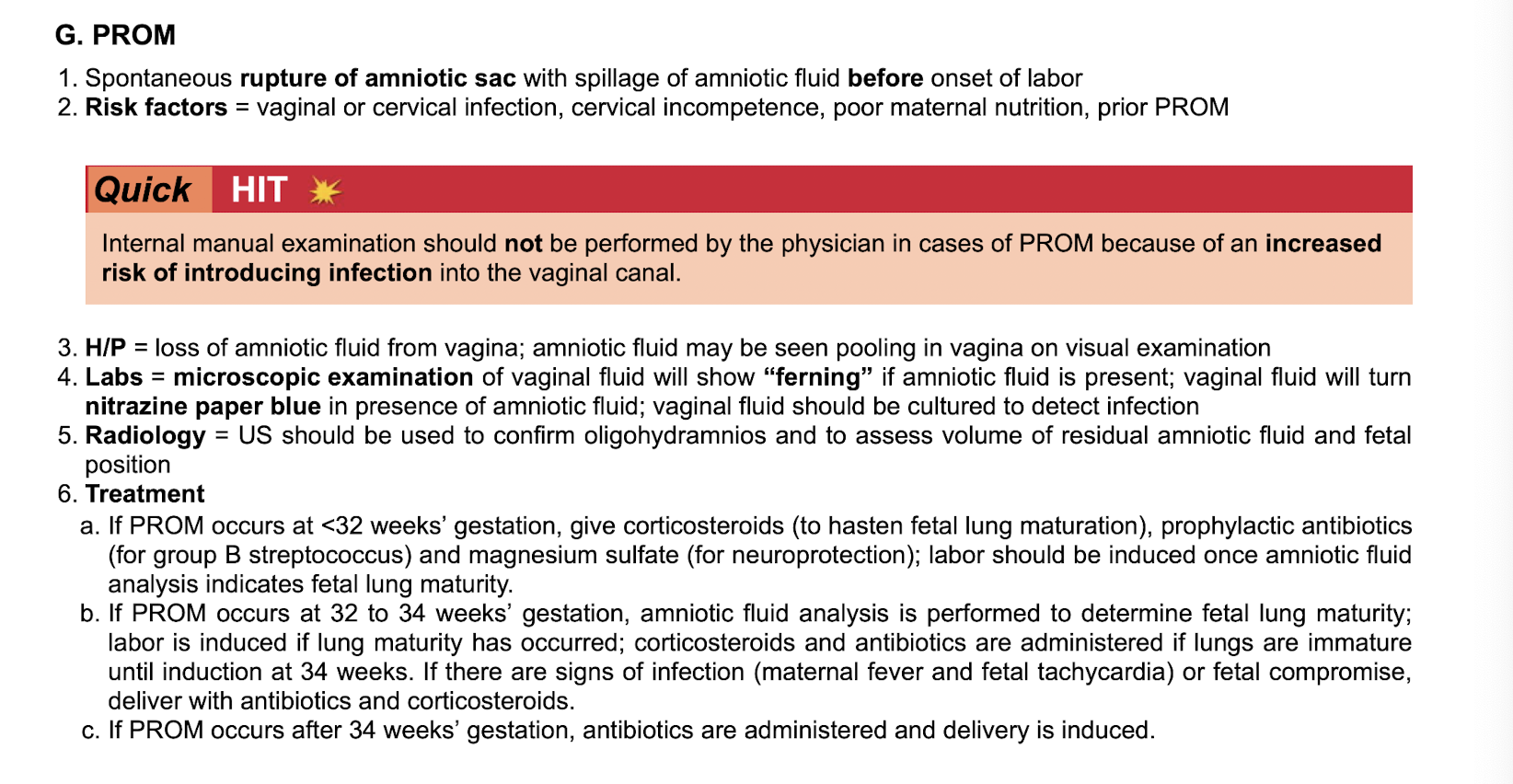
PROM

-def

-rf

-what do you not perform

-sxs

-labs

-radio

-tx based on timing
knowt flashcard image
43
New cards

Fetal lung maturity quantified by

knowt flashcard image
44
New cards

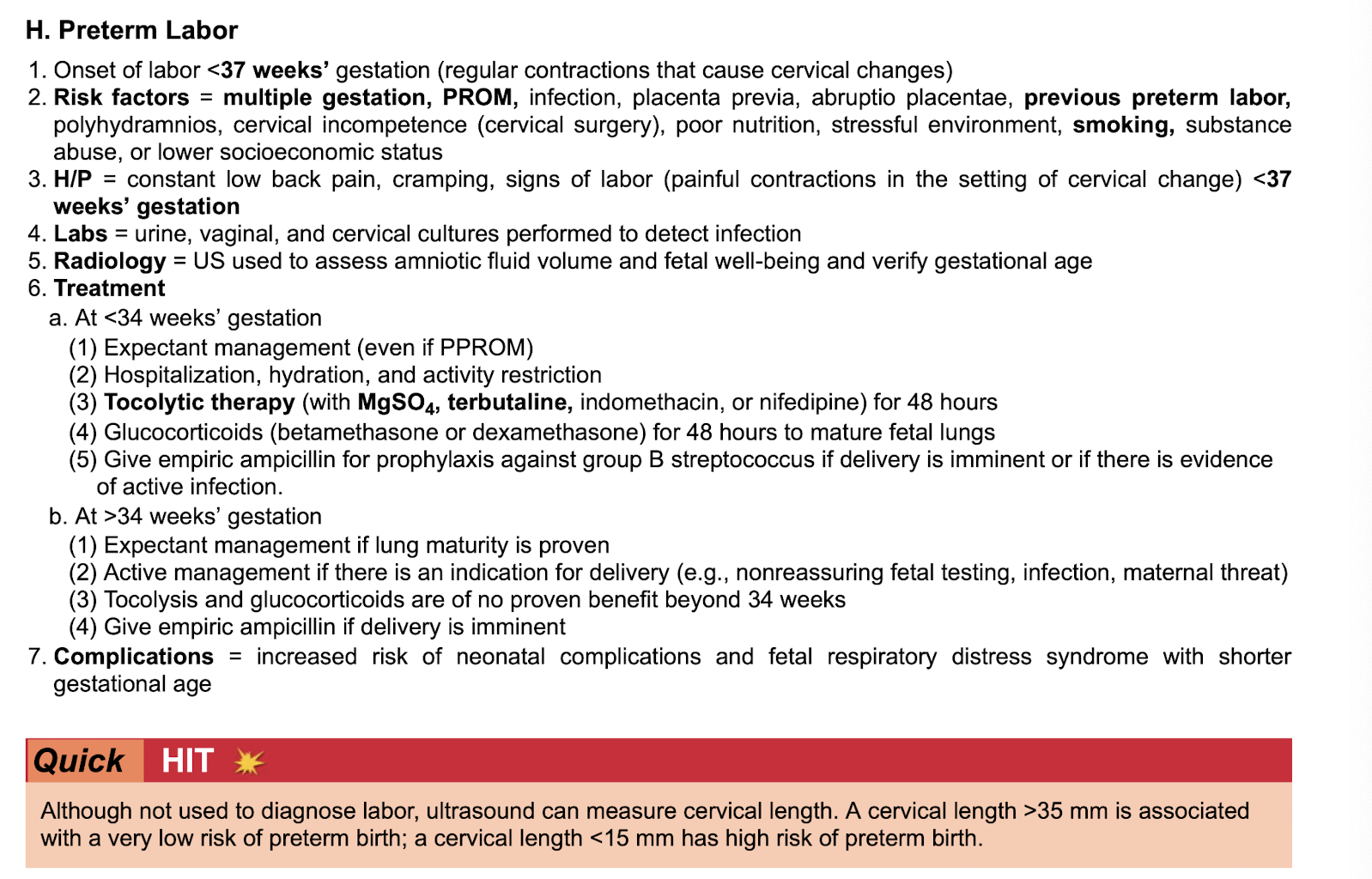
Preterm labor

-def

-rf

-sxs

-labs

-radoi

-tx based on timing

-complications

-cervical length
knowt flashcard image
45
New cards

Placenta previa

-def

-types

  • low

  • partial

  • complete

knowt flashcard image
46
New cards

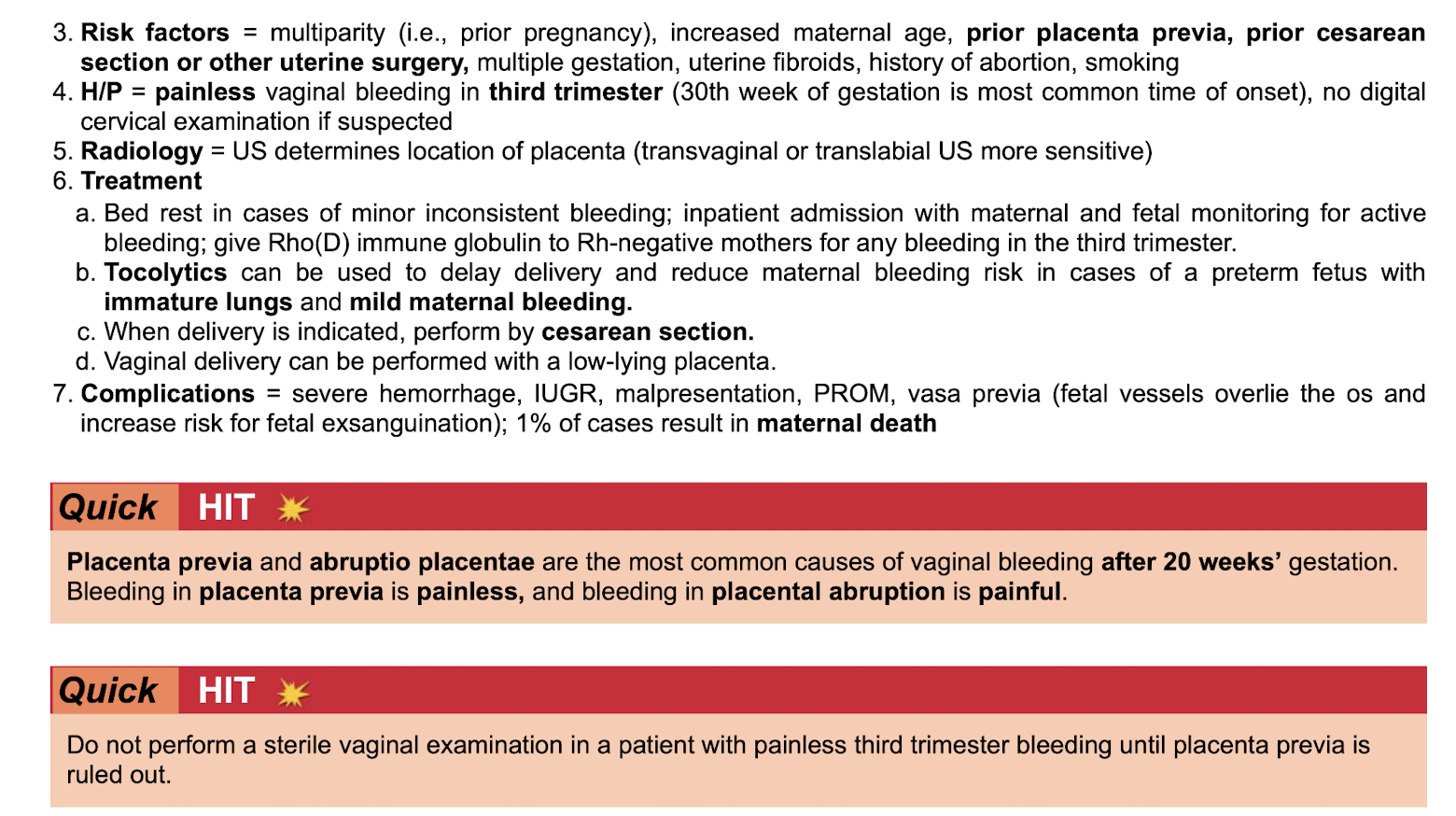
Placenta previa

-rf

-sxs

-radio

-tx

-complications

-after 20 weeks gestation

-do not perform
knowt flashcard image
47
New cards

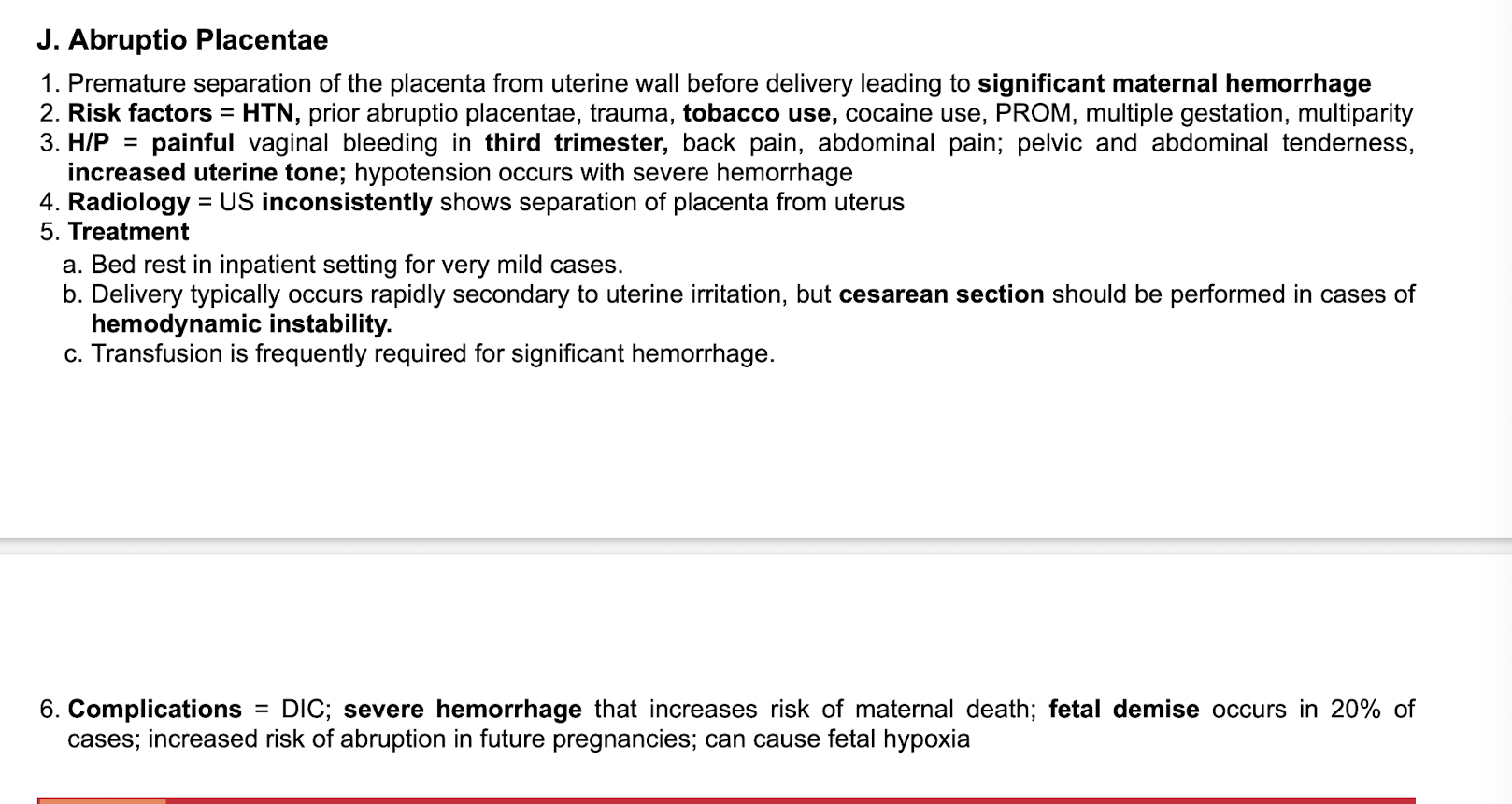
Abruptio placentae

-def

-rf

-sxs

-radio

-tx

-complications
knowt flashcard image
48
New cards

Benign low back pain in pregnancy

radiates to thighs

worsens with activity

improves with rest

49
New cards

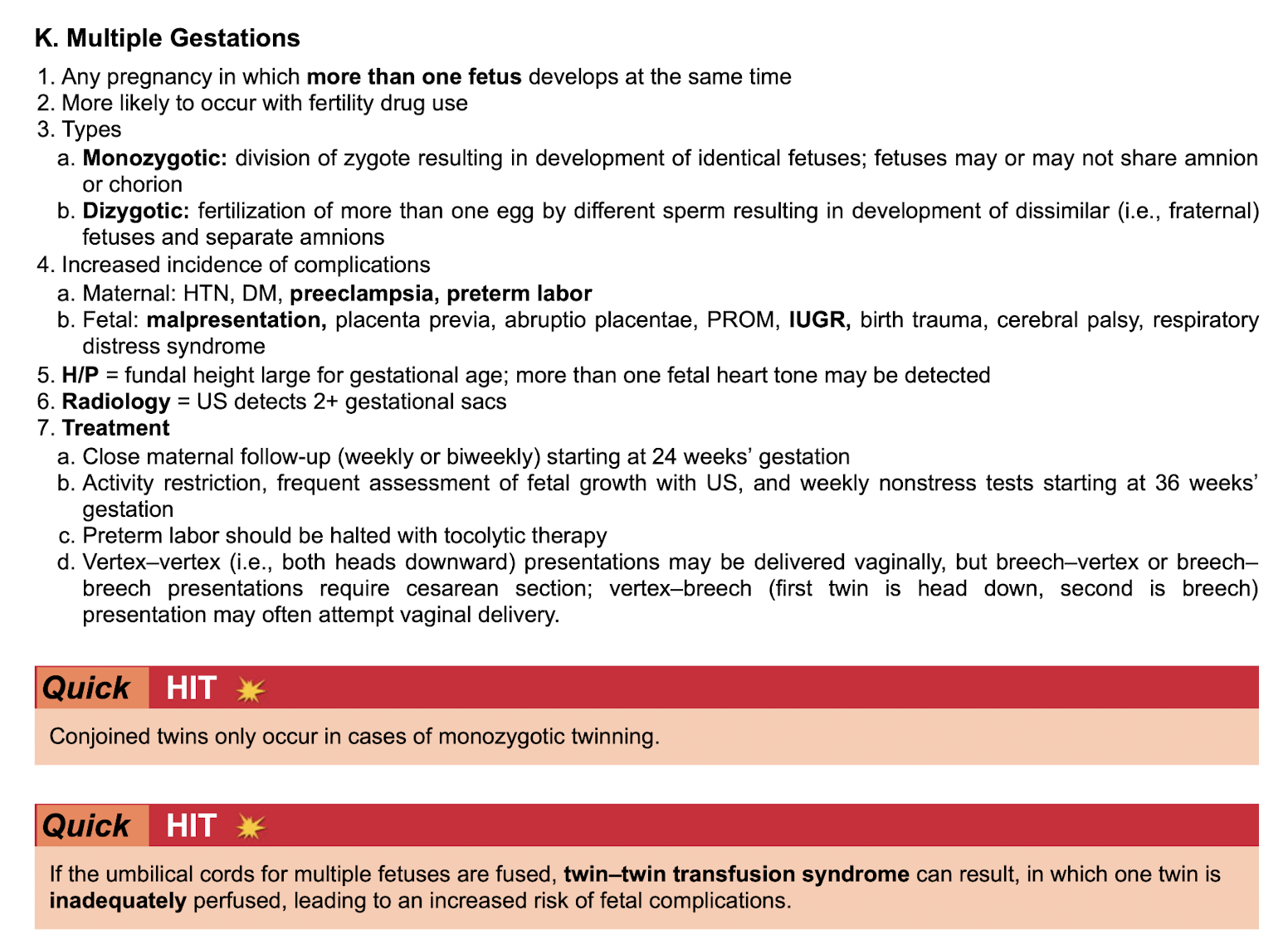
Multi gestaton

-more likely with

-types

-increased incidence of complications mom vs baby

-sxs

-radio

-tx

-conjoined twins only occur in

-twin-twin transfusion syndrome if
knowt flashcard image
50
New cards

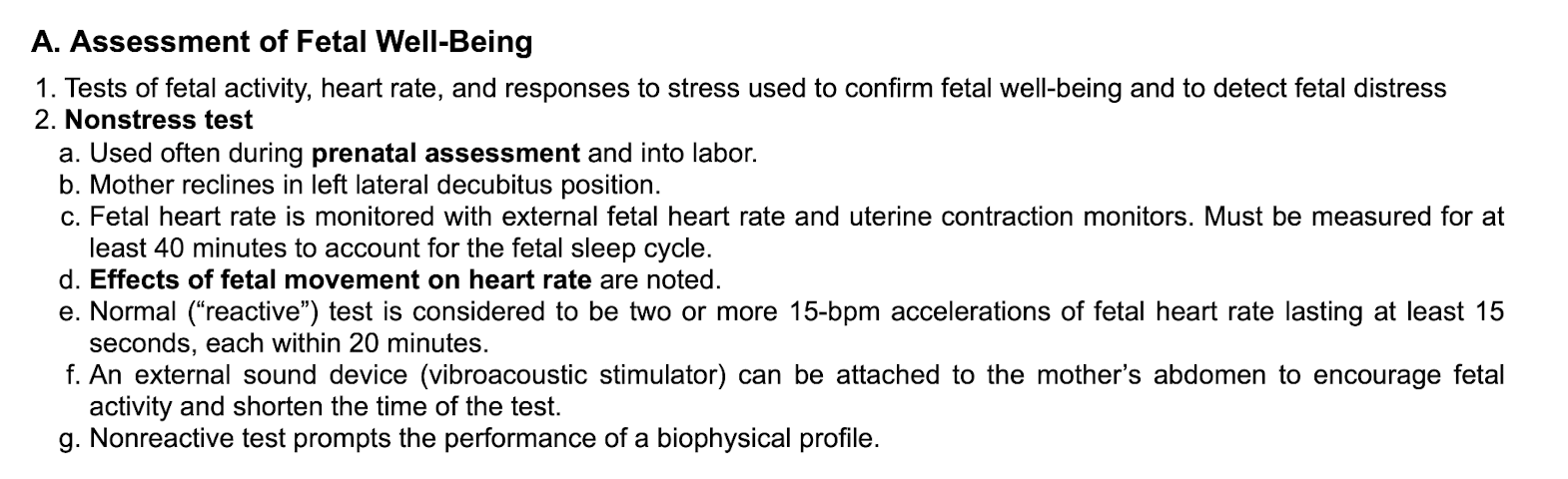
Asessment of fetal well being

-nonstress test
knowt flashcard image
51
New cards

Normal fetal HR

120-160

52
New cards

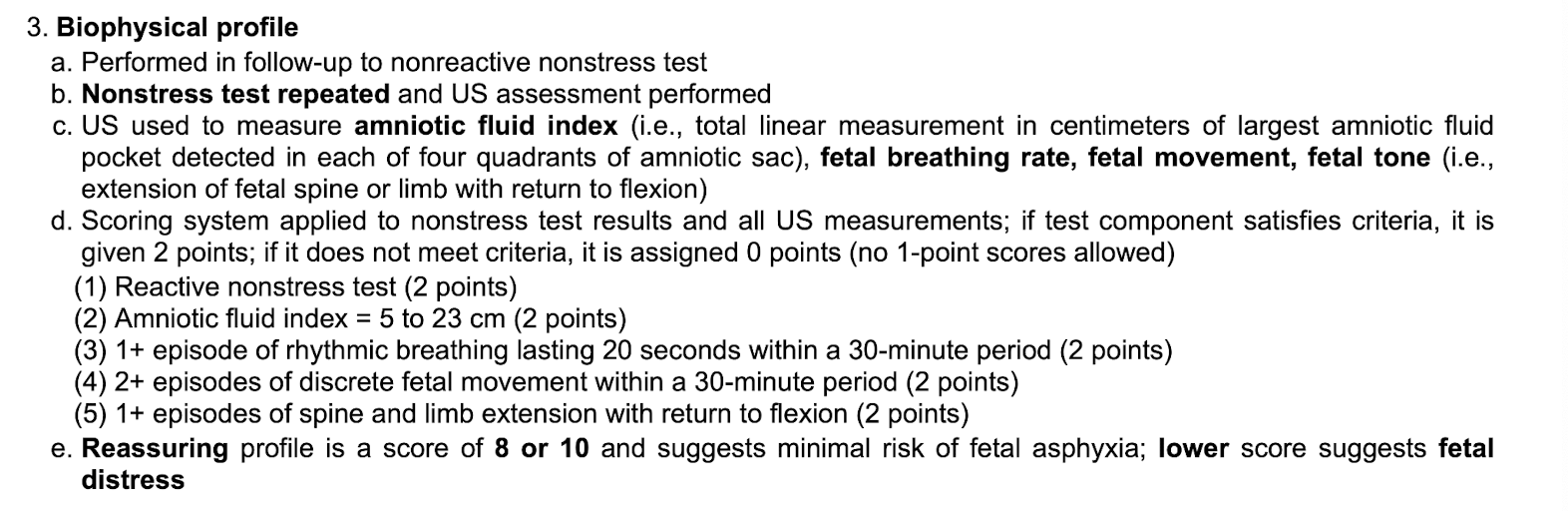
Biophysical profile

knowt flashcard image
53
New cards

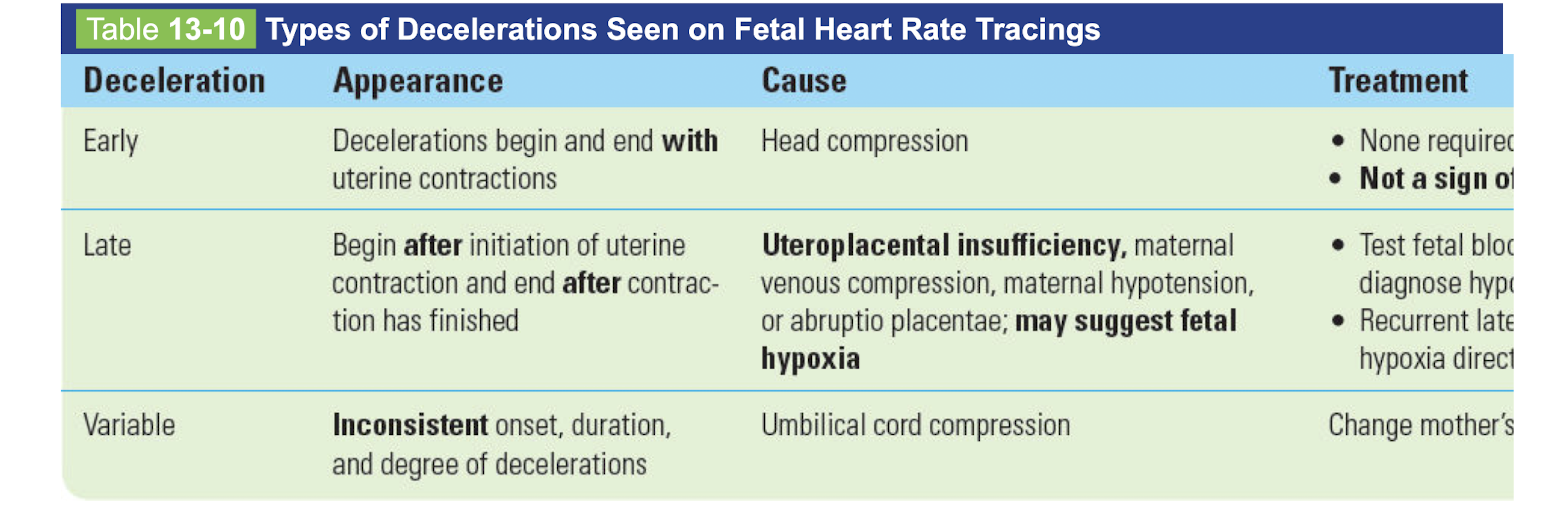
Fetal heart rate tracings

-cause and treatment

  • early

  • late

  • variable

knowt flashcard image
54
New cards

Contraction stress test

knowt flashcard image
55
New cards

Fetal scalp blood sampling

Fetal scalp monitoring

knowt flashcard image
56
New cards

During last few weeks of gestation

knowt flashcard image
57
New cards

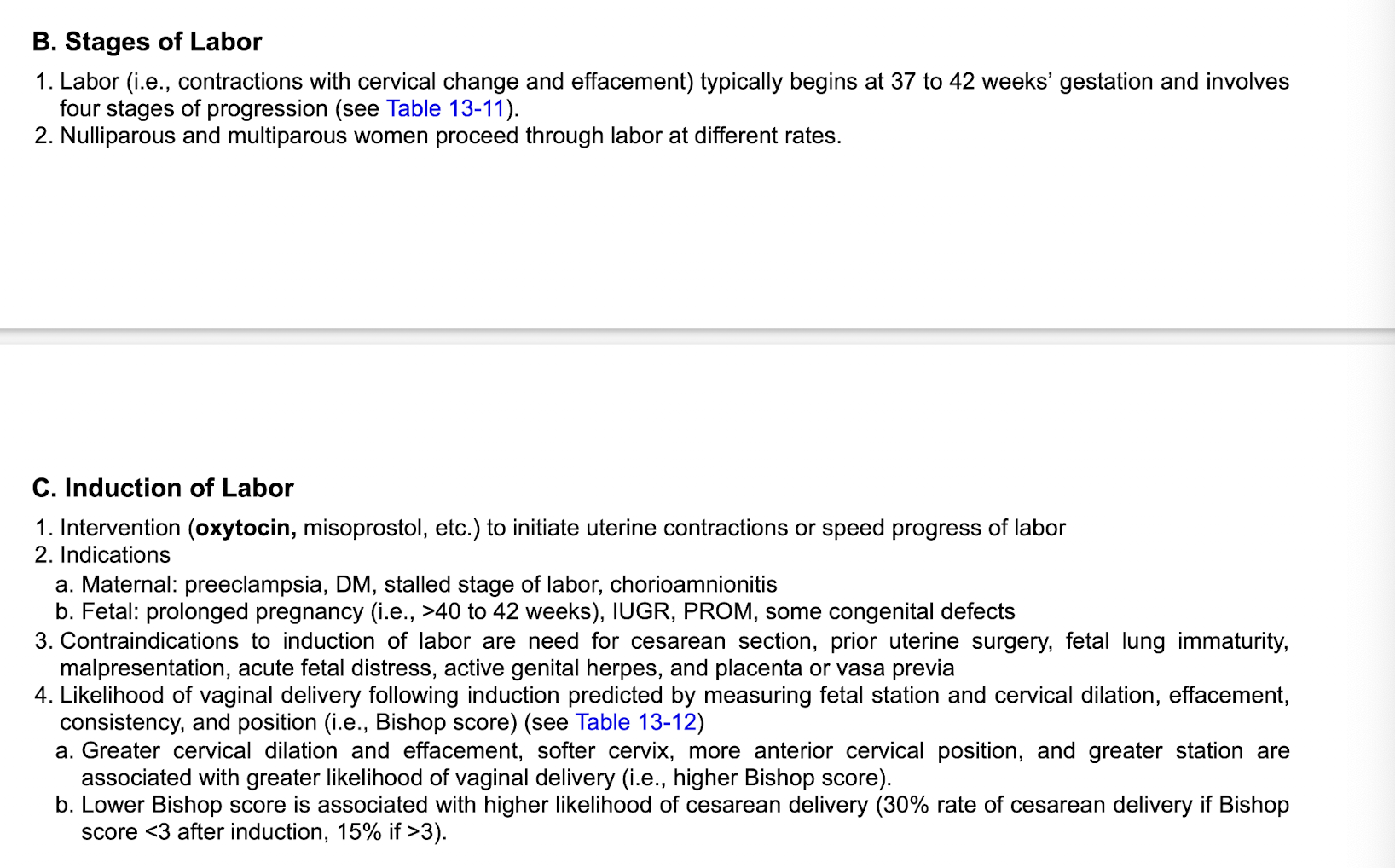
Stages of labor

Induction of labor

knowt flashcard image
58
New cards

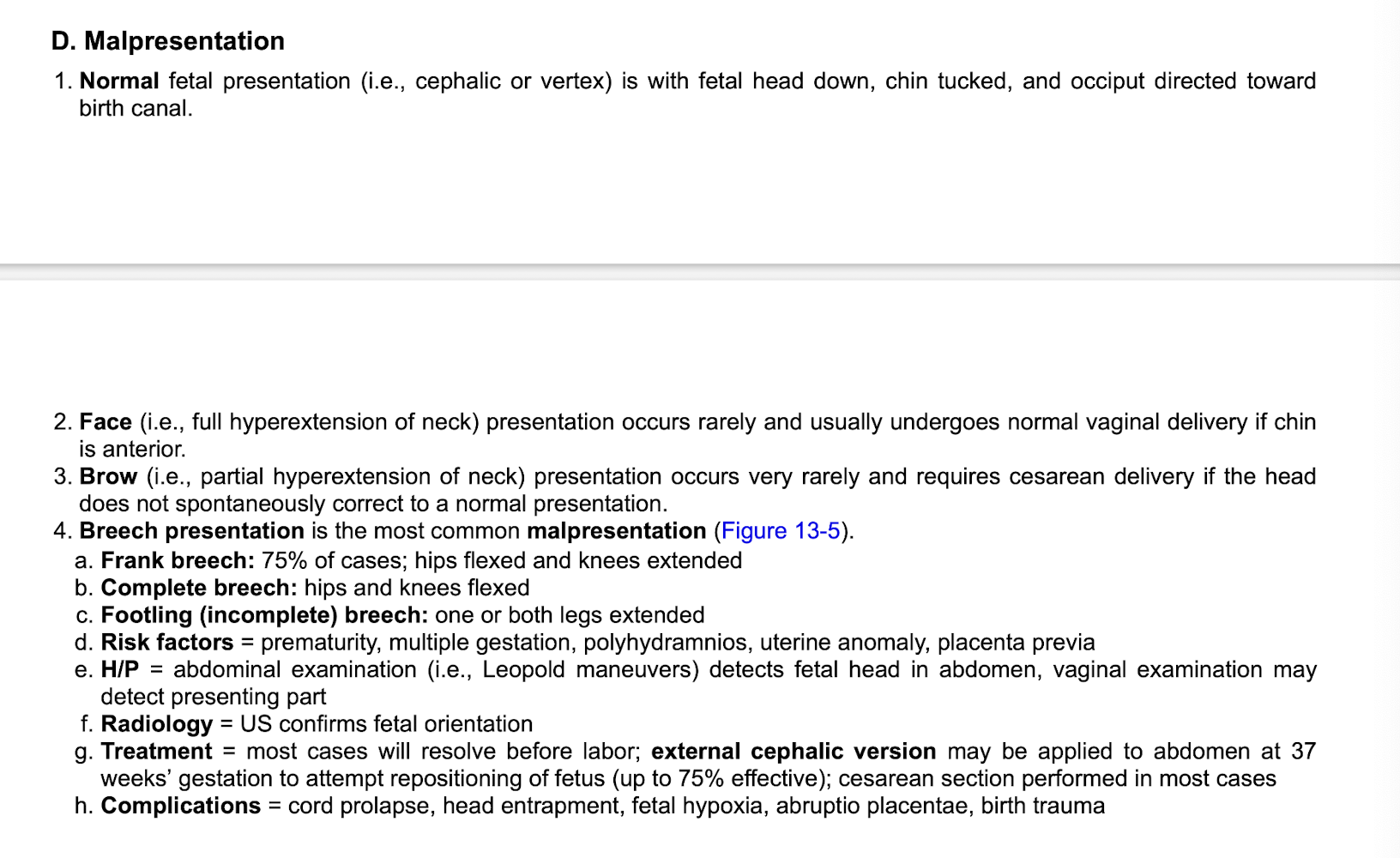
Malpresenttaion

-normal

-face

-brow

-breech: frank, complete, footling/incomplete

  • RF

  • sxs

  • radio

  • tx

  • complications

knowt flashcard image
59
New cards

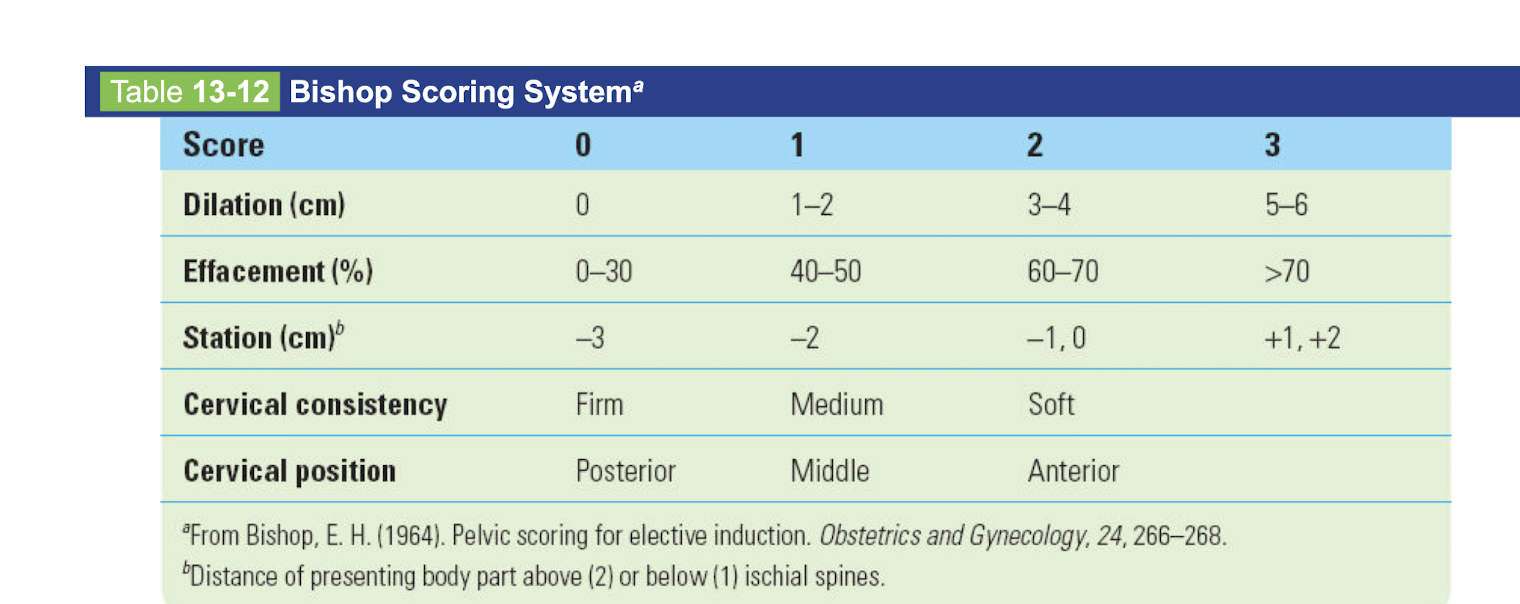
Bishop scoring system

Dilation, effacement percent, station, cervical consistency, cervical position

0-3
knowt flashcard image
60
New cards

Vertical vs low transverse C-section

knowt flashcard image
61
New cards

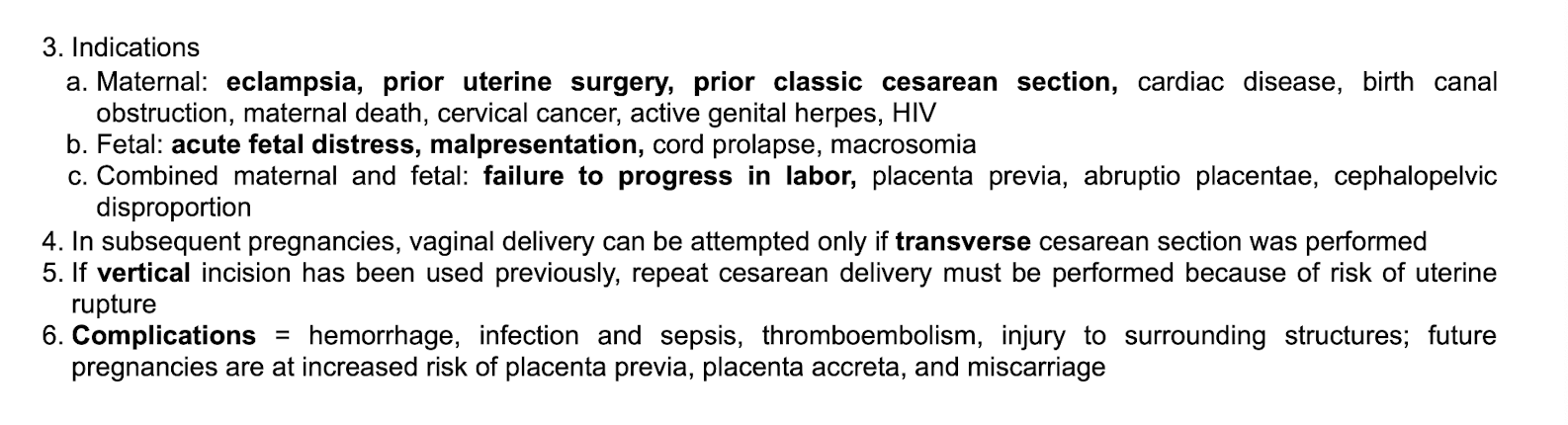
csection indications mom vs baby

subsequent pregnancies

-if vertial incision used previously

-complications
knowt flashcard image
62
New cards

breast milk ideal infant nutrient because

contains IgA Abs for newborn

sufficient supply

cost free

mother-infant bonding

63
New cards

colostrum

knowt flashcard image
64
New cards

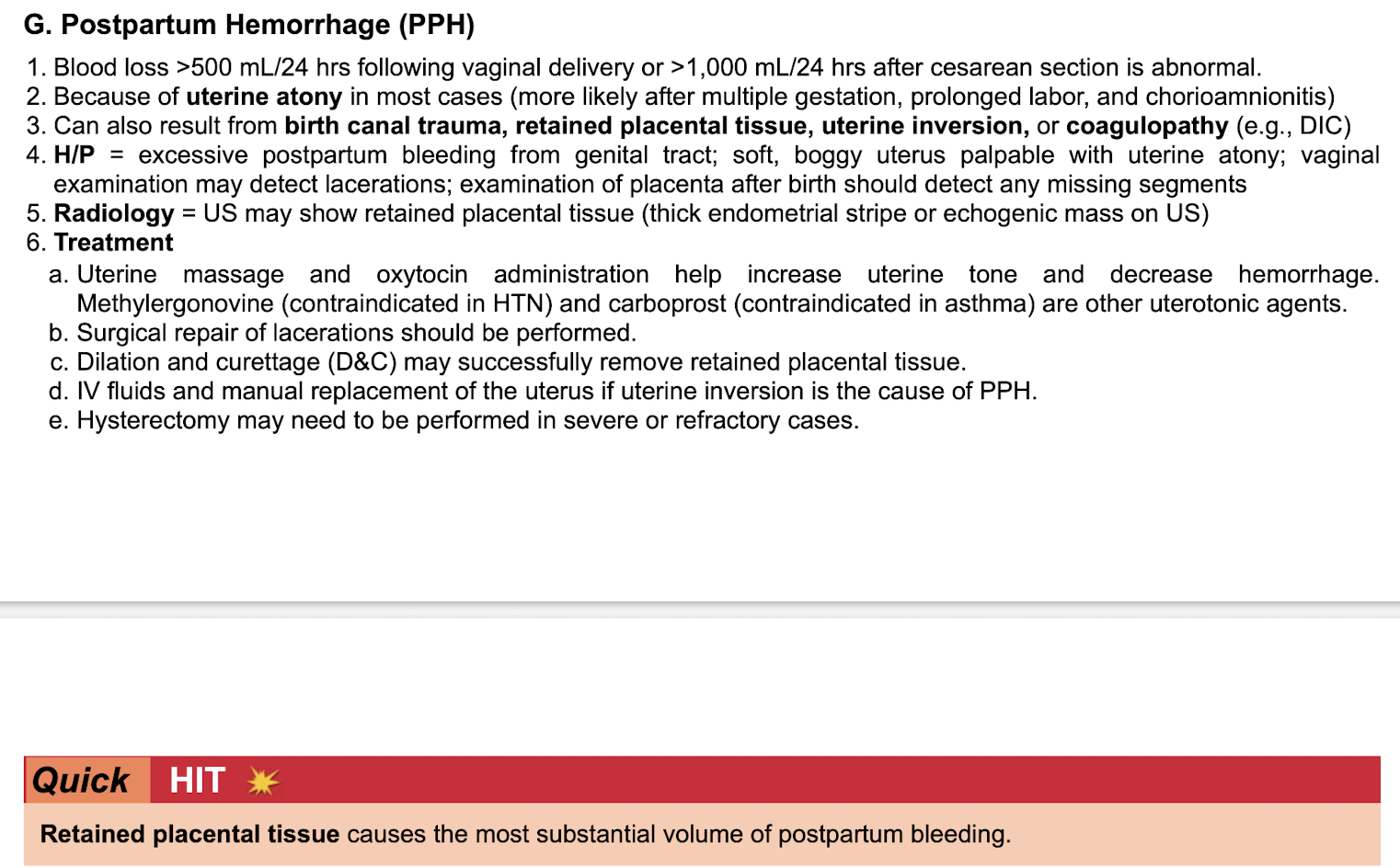
Postpartum hemorrhage

-def

-because of

-can also result from

-sxs

-radio

-tx

-retained placental tissue causes
knowt flashcard image
65
New cards

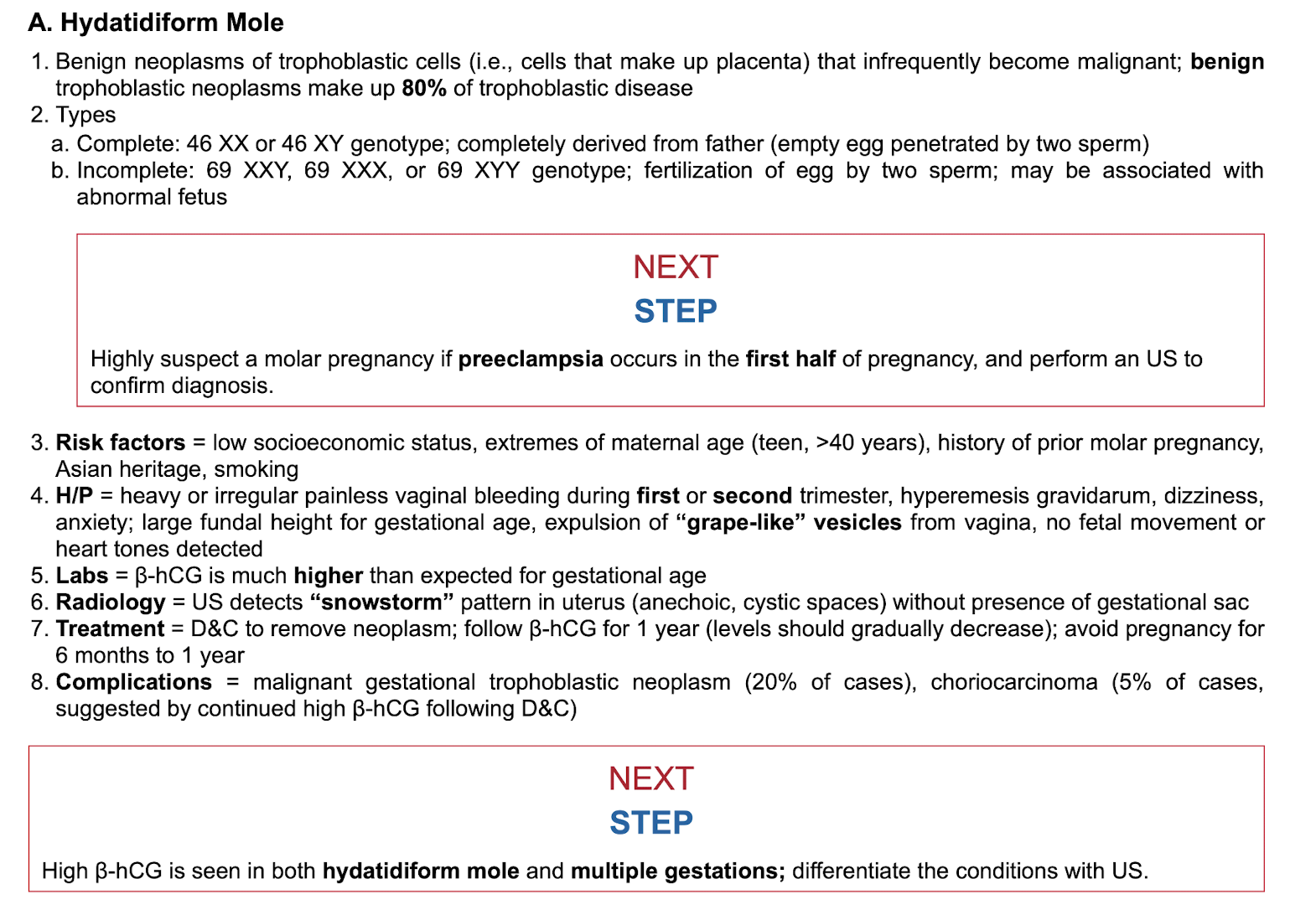
Hydatidiform mole

-def

-types complete vs incomplete

-highly suspect molar prengancy if

-rf

-sxs

-labs

-radio

-tx

-complications

-what is seen in both mole and multigestational pregnancies, differentiate how?
knowt flashcard image
66
New cards

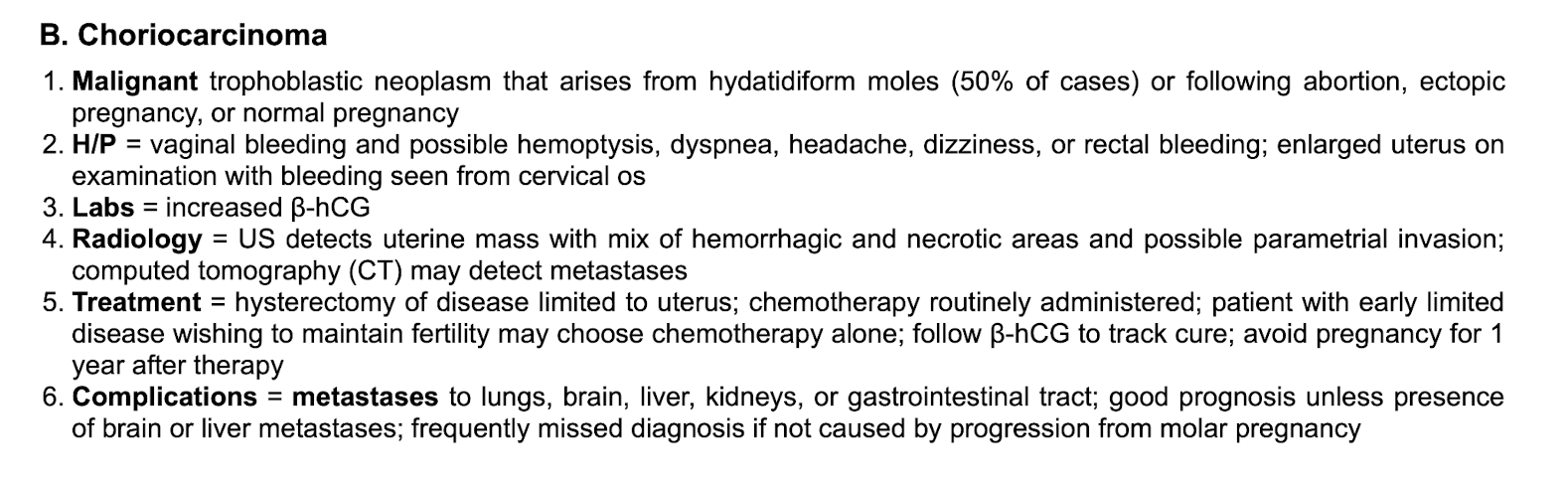
Choriocarcinoma

-def

-sxs

-labs

-radio

-tx

-complications
<p></p>