4.2 Specialisation and organisation of Animals
 Call Kai
 Learn
Learn Practice Test
 Spaced Repetition
 Match
Match Flashcards
 Knowt Play
1/12

There's no tags or description
Looks like no tags are added yet.
Name | Mastery | Learn | Test | Matching | Spaced | Call with Kai |
|---|
No analytics yet
Send a link to your students to track their progress
13 Terms
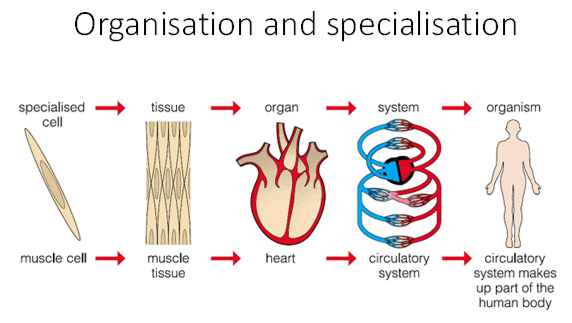
What is the order of organisation of specialisation?
Specialised cells: Cells with a specific structure for it's particular function
Tissues: A group of specialised cells functioning together for a specific purpose
Organs: A group of 2 or more tissues that work together for a specific purpose
Systems: A group of organs that work together for a specific purpose
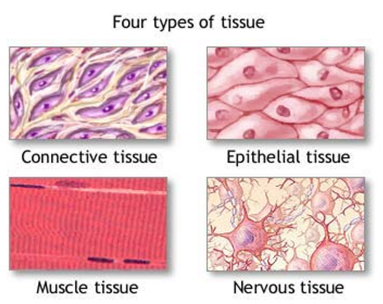
What are the 4 types of animal tissue?
4 types of animal tissue: Epithelial, Muscular, Connective and Nervous
What is epithelial tissue?
Tissue made of tightly packed cells that line surfaces
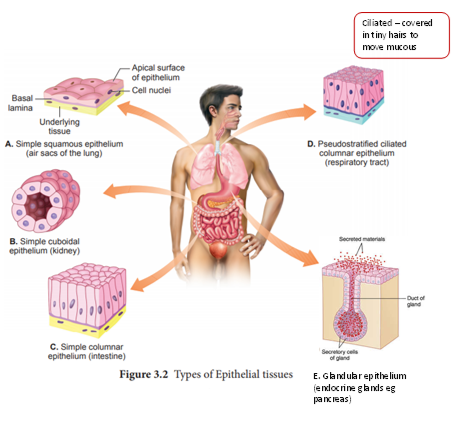
What are the 5 types of epithelial tissue?
Squamous (flattened): Alveoli and blood vessel linings
Cuboidal (cubical): Kidney and salivary gland linings
Columnar (pillar like): Small intestine, uterus, fallopian tubes
Ciliated (covered in tiny hairs to move mucous): Trachea - maybe good to remember for exam
Glandular (secretory): Endocrine glands
What is muscular tissue and what are the 3 types?
Tissue that makes up muscles and allows movement
Skeletal muscle (voluntary), smooth muscle and cardiac muscle (involuntary)
Why is skeletal muscle important?
Voluntary
Allows movement
Maintains posture
Stabilises joints
Maintains body temperature by producing heat via muscle contractions (shivering)
Why do we need smooth muscle?
Involuntary
Controls movement of substances through organs (peristalsis)
Produces the contractions during childbirth from the uterus
Regulates blood vessel diameter (vasodilation and constriction)
Regulates airway diameter
Why do we need cardiac muscle?
Involuntary
Pumps blood continuously through the heart
Produces rhythmic, coordinated contractions
What is connective tissue?
Tissue that binds and support other tissues and organs
Remember these types: Blood, bone and adipose
What are the roles of the 5 types of connective tissue?
Aerolar/loose: Found under the skin and surrounding vessels and organs, holding them in place EG Subcutaneous layer
Adipose: Fat tissue that stores energy
Fluid: Transports fluid, nutrients, wastes and hormones EG RBC, WBC, Platelets, plasma (blood) and lymph
Supporting: Provide structure and strength to body + soft tissues EG Tendon and ligaments
Skeletal: Provides structural support EG Cartilage and bone
What are the 5 types of connective tissue?
Aerolar/loose
Adipose
Fluid
Supporting
Skeletal
What is nervous tissue?
Tissue of the nervous system that transmits signals
Contains neurons and glial cells
What is the function of neurons and glial cells?
Neurons: Responsible for communication through electrical signals
Glial cells: Supporting cells that maintain the environment around the neurons