Contemporary Business Environment Y2 Revision
 Call Kai
 Learn
Learn Practice Test
 Spaced Repetition
 Match
Match Flashcards
 Knowt Play
1/70

There's no tags or description
Looks like no tags are added yet.
Name | Mastery | Learn | Test | Matching | Spaced | Call with Kai |
|---|
No analytics yet
Send a link to your students to track their progress
71 Terms
Complex Environment of Business:
Complex Environment
Organisations e.g. businesses, charities, government bodies
Stakeholders (networks)
Environment (local, national and international
Stakeholders definition:
Stakeholders: Any individual or group who can affect or is affected by actions, decisions, policies, practices and goals of the organisation. (Carroll and Buchholtz 2000)
4 types of stakeholders (DIIE):
Direct: Have a visible role within the organisation or the support and regulation of it
e.g. owners of a company such as Loughborough University Council
Indirect: those who don’t have a visible organisational role but whose interests can be enhanced or threatened by its actions
e.g. students, local community, civilians
Internal: entities who have a role within an organisation
e.g. employees, owners, managers
External: not involved in the business per se but activities are connected
e.g. customers, suppliers of the university
Stakeholders of Organisations:
community, government, financiers, owners, agents, customers, competitors, subsidiaries, associates,
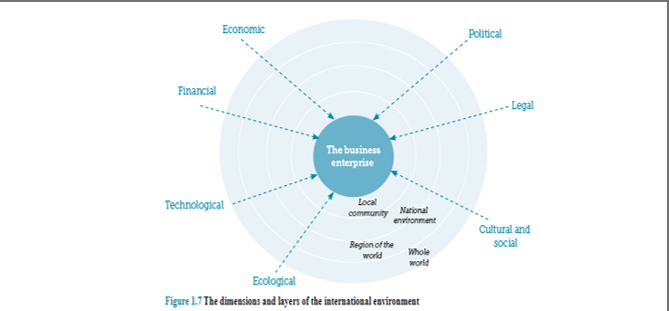
Dimensions and layers of the International Business Environment:
Economic, Financial
Political, Legal
Technological
Ecological
Cultural and social
Layers: Business enterprise —> local community —> national environment —> region —> world
They both intertwine in which layers and dimensions are interconnected
e.g. Political + National Environment: political system and the degree of civil and political freedoms
Political influences on an organisation
Regulations and technical standards
Investment incentives and currency
Ownership restrictions and laws
governments can create the rules and frameworks that affect organisations operations, which can change overtime.
External influences on an organisation:
Global influences and globalisation
PESTLE forces (Makos, 2024)
Political: Trade and tax policies, leadership changes, regulation, political trends
e.g. EU introducing General Data Protection Regulation —> impacting IT investment, customer relationships and data-handling practices
Economic: Taxation, VAT, inflation, investment, interest rates
Ireland having low corporate tax compared to EU average —> Apple and Google establishing European headquarters in Ireland
Social: Social and cultural changes, demographics, education and lifestyle
e.g. Nike’s expansion of its product line to include diverse models reflects shifting demographics and body-positivity movements, youth-appeal
Technological: digital market innovation, sustainable tech, software development
e.g. Robotics replaced human production lines, automated technology services e.g. McDonald’s self-checkout screens
Legal: Profit margins, patents, copyright, legislation
Laws have been introduced to prevent companies from Tesco from changing product prices without informing customers
Environmental: climate change, sustainability policies, regulation, renewables
IKEA has made significant strides in environmental management, emphasising on renewable energy, sustainable materials and product life extension —> become a circular business by 2030
Market forces e.g. competitors, suppliers, distributors
How does the Government support businesses
Government support e.g. subsidies and expertise
Cybersecurity training
Digital platform performance
Organisational and Individual influence on Government Politics
Organisation size
Public perception and image
Non-profit organisations can contribute e.g. Marcus Rashford
Lobbying —> changes in legislation
Corruption and crimes
Lobbying:
Lobbying: The act of individuals or groups attempting to influence government decisions such as laws and policies
Lobbyists (who may represent businesses, TU, charities etc.) try to persuade politicians or public officials through meetings, reports and campaigns.
Political stability impacting organisations:
Business success stems from informed decisions about investment / expansion
You need the economy / environment to be stable, predictable and reliable
Role of leaders such as business, public sector maintain, helps to maintain stability —> steady growth
Impacts :
political discourse, conflicts, rising prices, economic uncertainty
“Trump to impose 25% tariffs on steel and aluminium imports” (FT)
Why do organisations monitor the political environment?
Economic environment is influenced, e.g. fiscal and monetary policy impacts growth and spending power
Political stability affects market attractiveness and attracts investors
Governments pass legislation that affects the relationship between businesses, clients, suppliers and competitors
employment laws, VAT changes
Government Levels in the UK:
National (Westminster)
Devolved (Edinburgh, Cardiff, Belfast)
Regional (Country), unitary
Policy include
opportunity creation e.g. science parks
Northern Powerhouse e.g. innovation, transportation, investment
Local Enterprise Partnerships
Local / District (Borough Council, Leicester City)
“The government’s central mission is to level up every part of the UK by spreading opportunity, empowering local leaders and improving public services” (Government spokesperson)
Private vs Public sector companies:
Private Sector:
owned and managed by individuals/companies
For-profit, non-government operated
e.g. manufacturing, hospitality, financial services
2025 - 5.7M private sector businesses in the UK
Public Sector:
owned and managed by the government
e.g. fire services, health service, public schools, police
e.g. NHS, approx 1.5M employees**, £140bn** budget**, 18%** spending as proportion of Gov Exp
2021 - 5.75m; 33m UK workforce
Largest public organisations in the world: US DoD, NHS, CNPC
3 key differences between Private and Public Sector:
revenue
accountability
competition
Organisation objectives, for profit vs non-profit:
For profit:
Primary purpose of generating profits
Operate in private sector, owned by individuals or groups
Subject to legal and financial framework
e.g. manufacturing, services, technology
Not for profit:
Primary purpose is public benefit
Tax exempt + generate funding through donations, sponsorship
e.g. charities, social enterprise
Social Enterprise (non-profit):
businesses that trade to tackle social problems, improve communities, people’s life chances or the environment
Make money from selling G&S in open market —> reinvest profits back into
“SEs leverage economic activity to pursue a social objective and implement social change” (Mair et al., 2012)
National vs International Organisation differences:
National vs International:
New markets + market saturation
Efficient production
Proximity to key resources and customers
Access to technology and skills
Tax and regulation
Small vs Medium Organisations + SMEs:
Small:
Turnover < £6.5m
Balance sheet < £3.26m
Employees < 50
Medium:
Turnover < £25.9m
Balance sheet < £12.9m
Employees < 250
SME: small-medium enterprise
make up 99% of private sector organisations
Contribute employment, choice, supply and innovation to economy
Multinational Enterprise: (Peng and Meyer, 2016)
Multinational Enterprise: A firm that engages in FDI by directly investing in, controlling and managing value-added activities in other countries (Peng and Meyer, 2016)
Legal form and structure determining the type of Organisation:
Legal structure determines tax payments, grants received and business structure an organisation adopts
e.g. sole trade, partnership, Private Limited Company or Public Limited Company
Decision factors determining the type of organisation:
Internal: Size, Motivation, Ownership, Limit liability
External: Industry nature, Infrastructure, Taxation, Legislation
Globalisation definition (Buckley et al,, 2018 and House of Lords, 2002)
Globalisation: “The global movement towards cross-border integration of trade capital, communications and other factors that is creating an increasingly interdependent world” (Buckley et al., 2018)
Increasing international interactions and accelerating trade, capital and information flow (House of Lords, 2002)
Diffusion of global norms, spread of democracy and proliferation of treaties (House of Lords, 2002)
International Business (Peng and Meyer, 2024):
International business: Businesses engaging in international activities and / or the activity of doing business abroad (Peng and Meyer, 2024)
Global drivers of Globalisation and examples:
Profit and Non-Profit Organisations:
Traditional TNCs e.g. Apple, BP
Global reach for Non-profit organisations:
e.g. Oxfam, Red Cross
Supranational Organisations (for trade):
e.g. WTO, World Economic Forum, USMCA
Supranational Organisations (not specifically for trade):
e.g. United Nations, World Bank
Economic Groupings vs Trade Regions in terms of scope and politics:
Economic Groupings | Trading Regions | |
Scope | Broad economic cooperation in trade, finance and labour | Primary focus is trade agreements |
Examples | EU, G7, BRICS , Eurozone, Free Trade Areas ASEAN | USMCA, MERCOSUR, |
Political Integration? | Sometimes e.g. EU political institutions | Usually none |
Regulatory harmonisation? | Often includes economic policy beyond trade | Tariffs, quotas and trade barriers |
Examples of Economic Groupings:
European Union (EU): Political and economic union with a single market and shared policies, 27 countries
G7: Informal groping of major economies (USA, Canada, UK, France, Germany, Italy, Japan) discussing global economic policies
BRICS: A group of emerging economies (Brazil, Russia, India, China, South Africa) focused on trade cooperation, investment, development and infrastructure
OECD: The organisation for Economic Co-Operation and Development consisting of high-income economies that collaborate on policy
Wiseman et al., 2026 Trump and EU diversification:
“US trade partners are pushing to diversify their economies away from a newly protectionist United States”
“The free trade agreement between India and the EU brings much needed oxygen to a world increasingly dominated by trade conflicts,”
“The U.S., he posted, would reduce tariffs on Indian imports after India agreed to stop buying oil from Russia, which has used the sales to fund its four year war in Ukraine”
Political influence upon Economic Groupings, highlighting intersection between economics and international relations
EU Criticism:
EU Criticism:
Right-wing extremism
Economic disparity, including East vs West
Further enlargement to Slavic, Eastern nations
Fiscal differences
Free Markets vs MAGA / Protectionism
European defence NATO, issues over spending, military activity and cohesion
Examples of Trading Regions:
Trading Regions:
USMCA: United States, Mexico, Canada Agreement reducing barriers between North American Countries
ASEAN Free Trade Areas (AFTA): A trade bloc in Southeast Asia aimed at tariff reduction and catalyst for free trade and mobility of resources
MERCOSUR (Southern Common Market): South American trading bloc with economic cooperation
European Economic Area (EEA): Trading arrangement between EU and non-EU countries like Norway, Iceland and Leichtenstein
National governments impacting international business:
Attracting FDI through economic policy such as reducing national debt, improving means of resource and labour mobility and reducing corporate tax to allow for R&D
Tax incentives in which reducing corporate tax to allow for R&D
Lobbying / trade missions to encourage international business cooperation
Economic Patriotism, coupled with domestic business dealings, can result in domestic expansion of businesses
Trump placing tariffs on other countries of 15% increases domestic production and output of domestic businesses, fuelling patriotism and self-sufficiency
Disadvantages of Globalisation (EDUCBA, 2026):
Increased income Inequality:
countries excluded from trading blocs like AFTA and MERCOSUR cannot reap benefits of cheaper and freer trade, so they miss out on economic potential
OECD concentrates “wealth in the hands of a few multinational corporations, widening the gap between the rich and the poor” (EDUCBA, 2026)
This links to a loss of sovereignty and greater reliance on TNCs and foreign institutions rather than domestic patriotism and domestic decision making
Environmental Degradation:
Cross-border integration of labour and capital requires transportation, enacting negative environmental impacts
Specialisation and Competitive Advantage may lead to increased environmental degradation for countries that specialise in manufacturing or agriculture
Unstable Global Markets:
Trump’s Terrible Tariffs have caused global market volatility due to unpredictability but also rapid change in trade costs and re-shuffiling of investor portfolios
Cultural Homogenisation:
Globalisation has resulted in the spread of social elements such as Hollywood movies and fast food franchises, resulting in the erosion of tradition and values in developing countries (EDUCBA, 2026)
underlying replacement by Western Culture in terms of politics, cultural, social factors and economic activity (Neo-Colonialism)
Benefits of Localisation (Ramesh, 2026):
Global Brand Recognition:
Localisation helps companies build brand recognition and establish a strong presence by adapting norms and brands to resonate with diverse audiences
According to the 2017 Web Globalization Report Card, the world’s top twenty-five websites now support an average of 54 languages
e.g. Nivea, who customise products and promotions to suit preferences of each market, as well as language adaptability and inclusion
Market expansion:
Allows businesses to enter new markets and expand their global footprint via service and product customisation
e.g. Starbucks’ in China, modifying its store menu to Chinese culture and engaging customers with social media —> robust brand presence
Improved customer loyalty:
Demonstrating a commitment to meeting needs of exclusive needs of local consumers
Tailoring products, services and communications to enable local audience resonation, businesses can foster deeper connections, build trust and retain customers
e.g. Amazon, providing localised customer support and assistance in various languages, as well as personalising assistance and troubleshooting
cultivating meaningful customer relationships in the long-term and establishing loyalty
Risk Analysis:
Opportunity, Perception and attitude, reward, mitigation, risk averse vs taking
Ongoing activity because of global dynamism
The process of identifying and analysing potential future events that may adversely impact a company (Hayes, 2024)
Country wide: political instability, economic risk, civil unrest, economic risk etc.
Credit rating:
Credit rating: An evaluation of the credit risk of a prospective debtor such as an individual, business or company (Kronwald, 2009)
AAA = strong economic position and low default risk. UK was AA in 2022
Organisation of risk:
Financial risk, innovation, compliance, Management, HR, Reputation
UK current issues of concern:
budget, IR target, Net Zero approach, tech giants and influence of social media
Investment Framework (Laserre, 2012):
Market and Competitive Opportunities = MCO + Risk
High MCO + Low Risk = High Attractiveness e.g. scarce opportunities
High MCO + High Risk = High Risk, High Return e.g. VC investment
Low MCO + Low risk = Low risk, Low Return e.g. government bonds
Low MCO + High risk = Low attractiveness e.g. void investment
Financial Risk; Systematic vs Unsystematic Risk:
Exchange Rates: Translation, transaction and economic exposure
Systematic Risk (undiversifiable and unavoidable): impacting market wide e.g. inflation or recession
Unsystematic risk (diversifiable and avoidable): specific to certain types of investment, security e.g. industrial action
Political Risk with quotes:
Macropolitical: impacts all businesses in an economy
Micropolitical: affects some businesses e.g. SME
Examples: government change, policy change, regulation change, war, terrorism
Impact of Risk vs Likelihood of Risk occurring
“Nearly 50% of firms avoid foreign direct investment because of political risk” (Giambona, Graham & Harvey, 2017)
“54% of participants believe political risk has increased, whereas only 8.4% believe it has decreased” (Giambona et al., 2017)
Legal Risks:
Product liability, contract terms, accidents, environmental damage, IP rights
Environmental Risks:
Long-term, uncontrollable but preventable
Reputational Risk: sustainability and greenwashing
Supply chains vulnerable to natural disasters
Climate change, water scarcity and deforestation
Cultural Risks with quotes:
Differing communication styles can lead to misunderstandings and failures e.g. Walmart in Germany experiencing communication clashes
Language barriers can lead to marketing and operational mistakes e.g. HSBC global slogan “Assume Nothing” was mistranslated in several countries as “Do Nothing” —> rebranding procedure costing $10 million
Differing management styles such as hierarchy and decision making can cause organisational and structural conflict e.g. eBay in China: open online marketplaces vs relationship-based transactions
Ethical norms, unethical behaviour and ethical disagreements may occur, linking to religious and cultural beliefs
Knowledge Economy:
Knowledge Economy
“At the heart of capitalism is creative destruction.” (Schumpeter)
Economy based on creation, distribution and use of knowledge as the primary driver of economic growth
Human capital, intellectual property, innovation, tech-based services and creative industries
Goal: leverage knowledge and expertise to create economic value
Human capital + technology = knowledge economy
“All sectors are knowledge-intensive, responsive to new ideas and technological change, are innovative and employ highly skilled personnel engaged in ongoing learning” (Smith 2000, AEGIS 2003)
“Greater reliance on intellectual capabilities than on physical inputs or natural resources” (Powell and Snellman, 2004)
Knowledge Economy broad quotes:
“At the heart of capitalism is creative destruction.” (Schumpeter)
“All sectors are knowledge-intensive, responsive to new ideas and technological change, are innovative and employ highly skilled personnel engaged in ongoing learning” (Smith 2000, AEGIS 2003)
“Greater reliance on intellectual capabilities than on physical inputs or natural resources” (Powell and Snellman, 2004)
4 key reasons for innovation + innovation process:
Sustainability and business responsibility
“By 2030, the gap between global demand and supplies of fresh water is expected to reach 40%” (Guardian, 2015).
Competitive Advantage
Technological advancements
Globalisation and changing consumer behaviour
Innovation —> development —> productivity —> economic output and efficiency
Innovation definition and types:
Innovation: The introduction of new ideas, goods, services and practices which are intended to be useful
Opportunity —> Concept —> Validate —> Develop —> Deploy
Transformational: changing daily lives e.g. telephone, social media
Radical: new product or system e.g. mobile phones
Incremental: step-by-step improvements e.g. software updates
Other types: Product, Organisational, marketing, open, frugal low-cost, social, technological
Evaluation of Innovation:
Evaluation of Innovation
Entails high levels of uncertainty and complexity
Asymmetric or incomplete information
Oversimplified: building solutions is easy but finding the right problem to solve is difficult
Rocky: 70% of upstart tech companies fail, usually around 20 months
“More than 40% of new products fail” (Castellion and Markham, 2013)
Key determinants of innovation (Morrison, 2023):
Education and learning, including access and technological focus
Infrastructure: transport, communication, public utilities
Sustainability: carbon reduction, renewables, biodiversity
Regulation: rule of law, ease of start-ups, legal framework, funding schemes
Knowledge economy: networks, R&D links, local high-tech business, international transfers
Politics: stability, governance standards, democracy and accountability
Knowledge Economy + Stats:
Knowledge Economy: An economy using knowledge as a key source of competitiveness, dependent on quality, quantity and accessibility of information available.
“About 40% of GDP in the UK is generated by knowledge intensive industries such as education, health and telecommunications”
2021: Knowledge workers are 49% of UK workforce (ONS, 2021)
Knowledge definition and types:
Knowledge: the ability to understand information, and to then form judgements, opinions, predictions and decisions based on that understanding.
Explicit: Formal language knowledge, data and formulae etc.
Tacit: Personal, subjective, intuitive and instinctive
Know-What: Facts and statistics of importance
Know-Why: Scientific knowledge of principles and laws, underlying technological development
Know-How: Skills or capabilities to carry out a task e.g. businessmen judging market prospects for a new product
Know-Who: Information about relationships, social interaction and social knowledge
Knowledge Management definitions:
Knowledge Management: Identifying and gathering information from documents, reports and sources (people) and to be able to search that content for meaningful relationships (Kumar et al., 2006)
Data Mining definition:
Data Mining: A process used by companies to turn raw data into useful information by using pattern-detection software à analyse data, develop effective marketing strategies and maximise profits
Market Basket Analysis:
Market Basket Analysis: A data mining technique used to understand the purchasing behaviours of customers by explaining combinations of products purchased, as well as repeat purchases, consumer likings and enhancing product placement
Adidas Case Study: Tasked with producing the FIFA World Cup football for South Africa 2010 (open innovation):
Adidas Case Study: Tasked with producing the FIFA World Cup football for South Africa 2010
Incumbent ablities: design knowledge, manufacturing capability, sales and marketing expertise
Issue: Company lacked expertise in aerodynamic research and testing
Found experts in the Sports Technology Institute Loughborough University
Adidas entered collaborations to access highly specialised knowledge to develop the Jabulani football, based on comprehensive aerodynamic research conducted at Loughborough ***(*Adidas Annual Report, 2009)
Barriers to knowledge transfer:
Poor engagement with outside organisations
Lack of investment in R&D, employment
Lack of commercial and technical skills
Financial viability
Spread of misinformation, inaccurate information misguiding decisions
Closed Innovation Case Study (1945-Mid 1980’s):
Firms adhered to philosophy: Successful innovation requires control
Companies generated their own ideas à developed, manufactured, marketed and distributed themselves
Internalised innovation is prioritised
Erosions caused by knowledge worker mobility and a rise in private venture capital
Advantages of Closed Innovation:
Advantages of Closed Innovation
Protection of intellectual property by developing ideas internally, maintaining tight control over assets and reducing risk of IP theft
Greater control over innovation process
Optimise resource allocation, tailoring concepts to align with objectives
Internal competitiveness fostered, driving innovation, growth and breakthroughs
Apple Inc is renowned for its reliance on internal resources and expertise, helping them gain a competitive edge in the consumer electronics market.
Open Innovation definition and issues:
Definition: The use of purposive flows of knowledge to accelerate internal innovation and expand markets for the use of innovation (Chesbrough et al., 2006)
Companies cannot afford to be self-reliant on research but should instead buy or license processes of inventions (i.e. patents) from other companies
Inventions not being used in a firm should be moved externally via joint ventures or licensing
Issues: Can we ever be “fully open”, trust between internal and external organisations, poor deal agreements, logistic and geographic complications
Open Innovation vs Closed Innovation:
Open Innovation | Closed Innovation |
We need to work with intelligent people within and outside the company | Intelligent people work for us |
External R&D can create significant value; internal R&D is synecdochic to create value | We must fuel and develop our own profit sources from R&D |
Internal x External cooperation | Internal à victory |
Partner with Universities, cooperations and science parks to create knowledge | We will own all results from contracted research with universities |
We should profit from other’s use of our IP; we should buy other’s IP if it advances our business model | We should control our own IP so competition doesn’t profit from our ideas |
Business failure definition:
Definition: The discontinuance of a business due to the lack of adequate financial resources, cessation of operations with loss of creditors, operations and an exit from the business population.
The Business Environment is fluid, unpredictable and can cause problems for organisations of every size
Causes of Business Failure + quotes:
General Environment (economics, technology, society and politics)
Immediate Environment (customers, suppliers, competition, credit institutions and stockholders)
Corporate Policy (strategy, investment, commercial operations, finance and personnel)
Entrepreneur Characteristics (Inflexibility, management, technical skills, stigma of failure)
Company Characteristics (Size, maturity, industry, flexibility, culture)
“Failure experience can be beneficial in the long run, helping to equip individuals for success in subsequent ventures (at least in the identification of opportunities)”
(Mueller and Shepherd, 2016).
Google expect an 80% failure rate on New Product Development
“It’s fine to celebrate success but it is more important to heed the lessons of failure (Bill Gates)
(Scarborough, Wilson, Zimmerer 2007) definition of Entrepreneur
An entrepreneur is one who creates a new business in the face of risk and uncertainty for the purpose of achieving profit and growth by identifying opportunities and assembling the necessary resources to capitalize on those opportunities.” (Scarborough, Wilson, Zimmerer 2007)
3 reasons why entrepreneurs struggle with external environment change:
Human capital
“Represents the knowledge, information, ideas, and skills of individuals” (Becker, 1964)
Entrepreneurs need a mix of general, firm-specific and distinct human capital
Entrepreneurs must adapt to environmental change, technological development and market dynamics
Excessive environmental change and information overload
“Firm processes to generate and share market intelligence can create problems if the processing capacity of the individual is overloaded” (Ocasio, 1997; Souchon et al., 2004).
Managerial attention becomes clouded, attention cannot be directed sufficiently to tasks, and the issue of bounded rationality
Resources and capabilities
Investments can create path-dependent resource rigidities (Leonard Barton, 1992)
For youthful firms, availability of slack resources can fundamentally alter behaviour, encouraging discovery of new products but still requiring revenue streams to fund
Aspects of an Entrepreneurial country:
sufficient finance, developed infrastructure, capital and labour mobility, cultural, business and supply competition, economic stability
How to counter harmful stereotypes about Entrepreneurship:
Research to disprove data or generate new data
Sharing stories / articles via social media
Offering platforms, support and funding for less represented to share their stories and grow their business
“Minority businesses make up 1/6 of the 6 million businesses registered in the UK”
Only 1 in 3 UK entrepreneurs are female; women account for 17% of business owners (RBS Group 2013)
Elevate different types of Entrepreneurship:
Lifestyle, Social, Female, Ethnic, Born-global, Dark, Social Media
Total Entrepreneurial Activity (TEA):
A metric used to measure how active people are in starting new businesses within a region.
% of adults (usually ages 18–64) who are either:
Starting a new business, or running a business < 3.5 years old
The highest TEA rates can be found in Angola (41%), a low-income economy
Middle income levels such as Guatemala at 28% and China at 25%
3 Examples of SME’s and data:
Revolut
Market: Global digital bank (70M+ users)
Worth: $75bn
USP: All-in-one banking app
Ben & Jerry's
Market: Strong in premium ice cream
Worth: Part of Unilever (billions revenue)
USP: Ethical sourcing + unique flavours
Gymshark
Market: Fast-growing global fitness brand
Worth: £1bn+
USP: Social media & influencer marketing
What do SME’s contribute to an economy:
WTO SME’s represent over 90% of the business population, 60-70% of employment and 55% of developed GDP
SMEs held for around 20% of patents, one measure of innovation, in biotechnology-related fields in the Europe.
Employment: In the UK, SMEs account for 60% of private sector employment. EU – 66% employment.
Tax, competition, niche market, innovations, suppliers and socio-cultural benefits
International activities such as suppliers, networks, FDI, ventures and franchising
dependent on speed, market knowledge, strategy and resources
Issues for SME’s:
Issues for SME’s
Insufficient finances and market knowledge
Lack of foreign market connections, export commitment
Lack of foreign channels of distribution
Lack of productive capacity and capital to finance foreign expansion
External factors - competition, international niche markets, network partners, catalysts, global volatility, geopolitics