APWH - S2 Final
5.0(2)
Studied by 5 people Call Kai
 Learn
Learn Practice Test
 Spaced Repetition
 Match
Match Flashcards
 Knowt Play
Card Sorting
1/20

Earn XP
Description and Tags
AP/College Prep World History Final Study Guide
Last updated 1:42 AM on 6/5/23
Name | Mastery | Learn | Test | Matching | Spaced | Call with Kai | Chat |
|---|
No analytics yet
Send a link to your students to track their progress
21 Terms
1
New cards
Write a thesis statement.
create an arguable claim that includes that outlines your essay.
2
New cards
Identify an argument.
ask yourself what is the author’s message in the document
3
New cards
Provide supporting evidence for an argument.
once you identify the argument, you can think about examples that would prove that.
\
Example:
argument: Mongols improved Silk Road trade
supporting evidence: The Mongols controlling the majority of the Silk Road made trade safer, so the trade improved.
\
Example:
argument: Mongols improved Silk Road trade
supporting evidence: The Mongols controlling the majority of the Silk Road made trade safer, so the trade improved.
4
New cards
Provide a counter-argument.
once you identify the argument, you can think about examples that would DISprove that.
\
Example:
argument: The New Deal carried the American economy out of the Great Depression
supporting evidence: America lend-leased weapons to Britain and Russia, so the American economy was improved that way; therefore, the New Deal was not the sole reason why America got out of the Great Depression.
\
Example:
argument: The New Deal carried the American economy out of the Great Depression
supporting evidence: America lend-leased weapons to Britain and Russia, so the American economy was improved that way; therefore, the New Deal was not the sole reason why America got out of the Great Depression.
5
New cards
Analyze a primary source.
Look for argument, the Historical context, Audience, Purpose, Point-of-view, and Y it is written (HAPPY). Also look for how it connects to your argument.
6
New cards
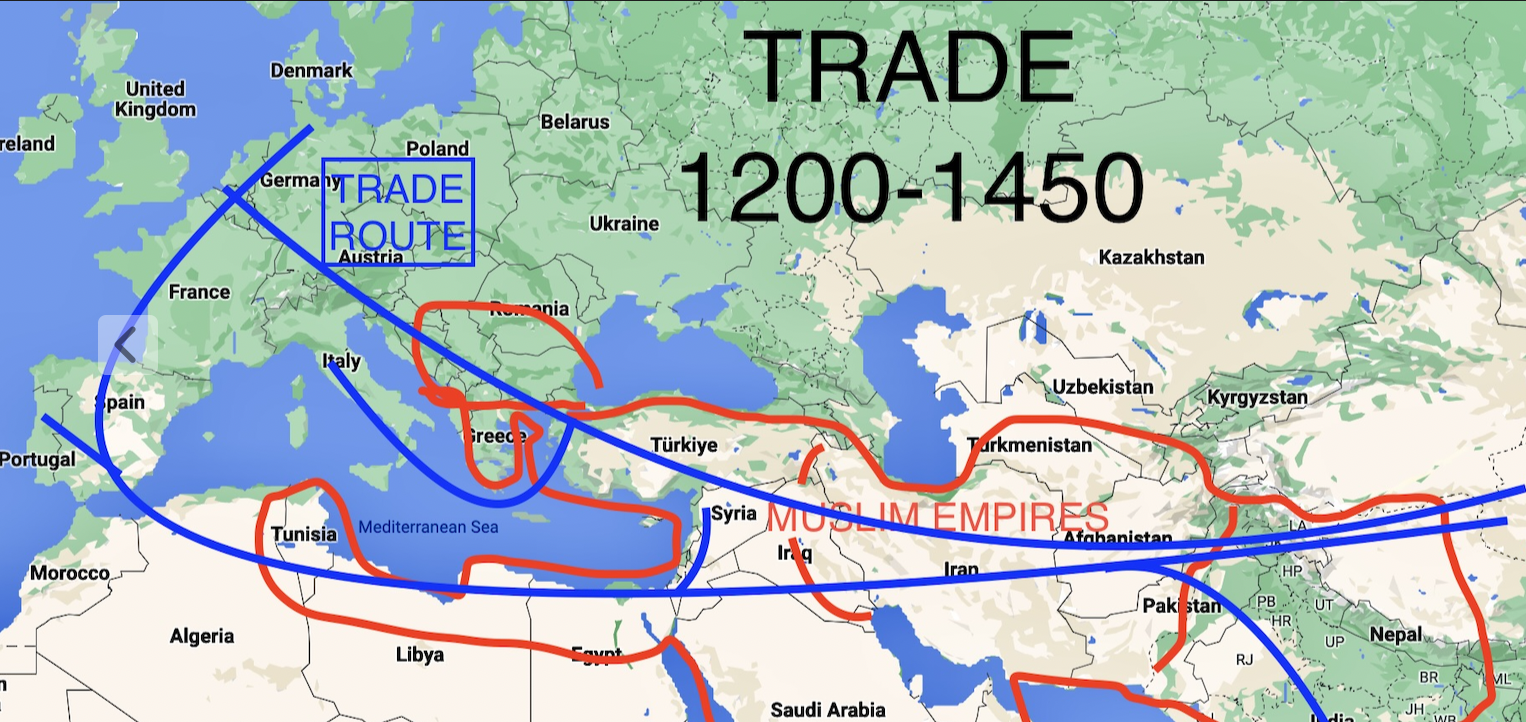
Explain the rise and decline of the Islamic Gunpowder Empires.
The Islamic Gunpowder Empires, comprising the Ottoman, Safavid, and Mughal empires. These empires experienced a period of prosperity, but eventually faced internal conflicts, external pressures, and socioeconomic challenges that led to their decline by the 18th century, resulting in the collapse of their once-powerful empires.
\
one reason was decreased money from trade. Before the age of exploration, Islamic Empires were able to get tariffs from Europeans trying to get to Asia. After Age of Exploration, Europeans went around the Islamic Empires, so they lost out on vital money from tariffs.
\
one reason was decreased money from trade. Before the age of exploration, Islamic Empires were able to get tariffs from Europeans trying to get to Asia. After Age of Exploration, Europeans went around the Islamic Empires, so they lost out on vital money from tariffs.
7
New cards
Explain the political and economic causes and effects of the Conquest of the Americas.
The political causes of the Conquest of the Americas were primarily driven by European powers seeking to expand their empires and gain control over new territories and resources. Economic motives, such as the desire for precious metals, new trade routes, and access to valuable goods, further fueled the conquest. The effects of the conquest were big, as it led to the establishment of colonial nations, the exploitation of indigenous peoples and resources, the introduction of new cultures and diseases, and the transformation of the global economy through the emergence of the Columbian Exchange.
8
New cards
Explain the process by which religion developed in the Americas after 1492.
After 1492, the arrival of European explorers and colonizers in the Americas brought about the introduction of Christianity. Indigenous peoples encountered the new faith through various means, including missionary efforts, forced conversion, and syncretism, resulting in the blending of traditional beliefs and Christian practices. Over time, religious syncretism and the resilience of indigenous spiritual traditions contributed to the development of unique religious practices, such as the emergence of folk Catholicism and syncretic religions like Vodou and Santeria.
9
New cards
Explain how people resisted the new power structures created by maritime empires.
People resisted the new power structures created by maritime empires through various means. Armed rebellions, such as the Tupac Amaru Rebellion in the Spanish Empire or the Rebellion in France, challenged colonial rule and imperial dominance. Nonviolent forms of resistance, including cultural preservation, and religious syncretism allowed communities to maintain their identities and resist assimilation. Intellectual movements and calls for political autonomy, such as the Enlightenment ideals and nationalist movements, also contributed to the resistance against maritime empires and the assertion of local power.
10
New cards
Explain how the development of maritime empires impacted social organization in the Americas.
The development of maritime empires in the Americas had a profound impact on social organization. Indigenous societies experienced significant disruptions as their traditional social structures were often dismantled or reconfigured to accommodate the imposed hierarchical systems of the colonial powers, leading to the emergence of new social classes, racial hierarchies, and systems of labor exploitation.
11
New cards
Explain the role that the Enlightenment played in the development of the Atlantic Revolutions.
Enlightenment ideas such as freedom of religion, individuality, and governance inspired nations such as France, America, and Haiti to rebel.
12
New cards
Explain how industrialization changed society.
Industrialization brought about major changes in society. It shifted economies from farming to factories, leading to the growth of cities, the rise of the working class, and the production of goods on a large scale. It also brought advancements in technology and transportation, which made work more efficient and changed the way people lived and interacted with each other.
13
New cards
Explain the rationales for neo-imperialism.
Neo-imperialism was often justified with various excuses or rationales. Some common justifications included the need to bring civilization and progress to "backward" societies, the duty to spread Christianity or other cultural values, the claim of protecting weaker nations, and the assertion of promoting stability and order in regions deemed chaotic or unstable. These justifications were often used to mask underlying economic and political motives.
14
New cards
Explain the process of imperialism in Africa and India and its effects.
Imperialism in Africa and India involved European powers establishing political and economic control over these regions. Through colonization, European countries exploited the resources, imposed their cultural norms, disrupted local societies, and facilitated the extraction of wealth, leading to long-lasting social, economic, and political consequences for both Africa and India.
BERLIN CONFERENCE FOR SPLITTING UP AFRICA
BERLIN CONFERENCE FOR SPLITTING UP AFRICA
15
New cards
Explain the causes of the Qing Dynasty’s decline.
The Qing Dynasty's decline was caused by internal factors, such as corruption and incompetence also external pressures from Western imperialism and the spread of revolutionary ideas. These factors contributed to social unrest, rebellions, and military defeats, ultimately leading to the collapse of the dynasty and the establishment of a republican government in China.
16
New cards
Explain the impact of Mao Tsedong on China.
He had a led a large revolution to put a Communist state in China. He was successful, and quickly industrialized China at the cost of millions of lives.
17
New cards
Explain the causes and effects of WWI & WWII.
WWI: MAIN- Militarism, Alliances, Imperialism, Nationalism
\
WWII: Same stuff applies, also Germany’s hyperinflation and unfair treaties causing them to want revenge in the form of war, so they elected Hitler.
\
WWII: Same stuff applies, also Germany’s hyperinflation and unfair treaties causing them to want revenge in the form of war, so they elected Hitler.
18
New cards
Explain the rivalry between the U.S. and the Soviet Union during the Cold War.
Don’t like each other. Capitalist America vs. Communist Russia. Space race and arms race. They tried to demonstrate their power through these things. It ended in the early 90s.
19
New cards
Explain the causes and outcomes of proxy wars conducted during the Cold War era.
Proxy wars during the Cold War era were caused by the ideological rivalry between the United States and the Soviet Union, as they sought to spread their influence and gain advantages without engaging in direct conflict. The outcomes of these wars varied, but they often led to significant loss of life, political instability, and economic devastation in the proxy countries involved, while serving as a means for the superpowers to exert their influence and advance their respective interests.
20
New cards
Explain what caused the decline of the Soviet Union.
1. failed invasion of Afghanistan- a lot of wasted money, lives, and civilians lost motivation to keep living in the Soviet Union.
2. Bad economy- they had closed trade and there was rampant famine. They got out money’d by Raegan’s Star Wars arms race.
3. Gorbachov- enacted policies that didn’t work, like making more stuff legal and more liberal. The people liked this, and eventually demanded their freedom.
ALL I CAN THINK OF- BUT I THINK THIS SHOULD BE ENOUGH OR THE FINAL
21
New cards
Explain the causes and effects of globalization on society.
Globalization, driven by technology and trade liberalization, has connected nations and facilitated the exchange of goods, ideas, and cultures worldwide. While it has led to economic growth and improved living standards, globalization has also raised concerns about inequality, cultural homogenization, and environmental challenges.