idiographic and nomothetic approach
 Call Kai
 Learn
Learn Practice Test
 Spaced Repetition
 Match
Match Flashcards
 Knowt Play
1/13

There's no tags or description
Looks like no tags are added yet.
Name | Mastery | Learn | Test | Matching | Spaced | Call with Kai |
|---|
No analytics yet
Send a link to your students to track their progress
14 Terms
overview of debate
The idiographic nomothetic debate is centred on 2 opposing approaches.
The idiographic approach suggests that psychology should be the study of individuals because by obtaining lots of detailed information about that individual (or group) we can understand human behaviour better.
The nomothetic approach suggests that psychology should be the study of large and varied groups to make generalisations about what is typical in different aspects of human behaviour.
Debate has implications for the types of research method psychologists use - whether we study individuals in depth or larger groups with averages
idiographic
Number of ppts typically small, often single case - some research might include information from family, friends or others but focus is on detail of the individual
This does NOT mean that generalisations are not made, just that the initial focus is on the individual
Qualitative research - uses fairly unstructured interview to get in depth view, data would be analysed and emergent themes are identified
Conclusions may help other people going through similar experiences or more widely, may help mental health professionals determine best practice
idiographic approaches
Humanistic approach - Carl Rogers developed a theory about self-development including the role of unconditional positive regard which was derived from in depth conversation with clients in therapy
Psychodynamic approach - Freud's careful observations of individuals were the basis of his explanations of human nature for example the case of Little Hans, used to explain how phobia might develop
idiographic vs nomothetic
Focus on the individual and recognition of private, subjective experiences
Investigations gain detailed information unique to individual being studied using qualitative methods
No general laws are possible because of chance, free will and the uniqueness of individuals
Emphasis on subjectivity as people's individual experience of their unique context is of utmost importance
objective vs subjective
Idea of objectivity lies in centre of nomothetic approach - laws of behaviour are only possible if methods of assessment are delivered in standardised and objective way
Ensures true replication occurs across samples of behaviour and removes contaminating influence of bias
Researchers working within idiographic approach tend not to believe that objectivity in psychological research is possible - people's individual experience of their unique context that is important rather than some underlying reality that is waiting to be discovered
nomothetic
Focus of traditional science by creating a hypothesis and testing it
Focuses on similarities between people by studying large groups
Uses mainly quantitative data
Often group averages are statistically analysed for significance to create predictions about people
Attempts to establish laws and generalisations about people
Emphasis on objectivity as laws of behaviours are only possible if methods of assessment are standardised and objective, allowing for replication
nomothetic laws
There are 3 kinds of general laws of human behaviour.
Classifying people into groups
i.e. the DSM-V having criteria for Schizophrenia or OCD.
Establishing principles of behaviour:
i.e. establishing that not only the Nazi’s were people capable of the obscene acts in world war 2 (obedience theories).
Establishing dimensions on which people can be placed and compared on.
i.e. comparing people due to IQ or Eysenck’s personality types
nomothetic approaches
The behaviourist approach - Skinner studied animals to develop general laws of learning that would apply to everyone.
The biological approach - Sperry's split brain research which involved repeated testing and was in part the basis for understanding hemispheric lateralisation and brain function.
complementarity
Idiographic and nomothetic approaches should not be seen as conflicting. It is more helpful to see them as complementary.
The insights from an idiographic approach can shed more light on the general principles developed using the nomothetic approach.
For example, Bowlby’s theory of maternal deprivation suggests that extreme maternal deprivation is irreversible. T
his theory was developed using a nomothetic approach.
However, the case of Koluchova’s Czech twins demonstrates that in this single, idiographic, case maternal deprivation was overcome.
Bowlby’s theory can therefore be challenged.
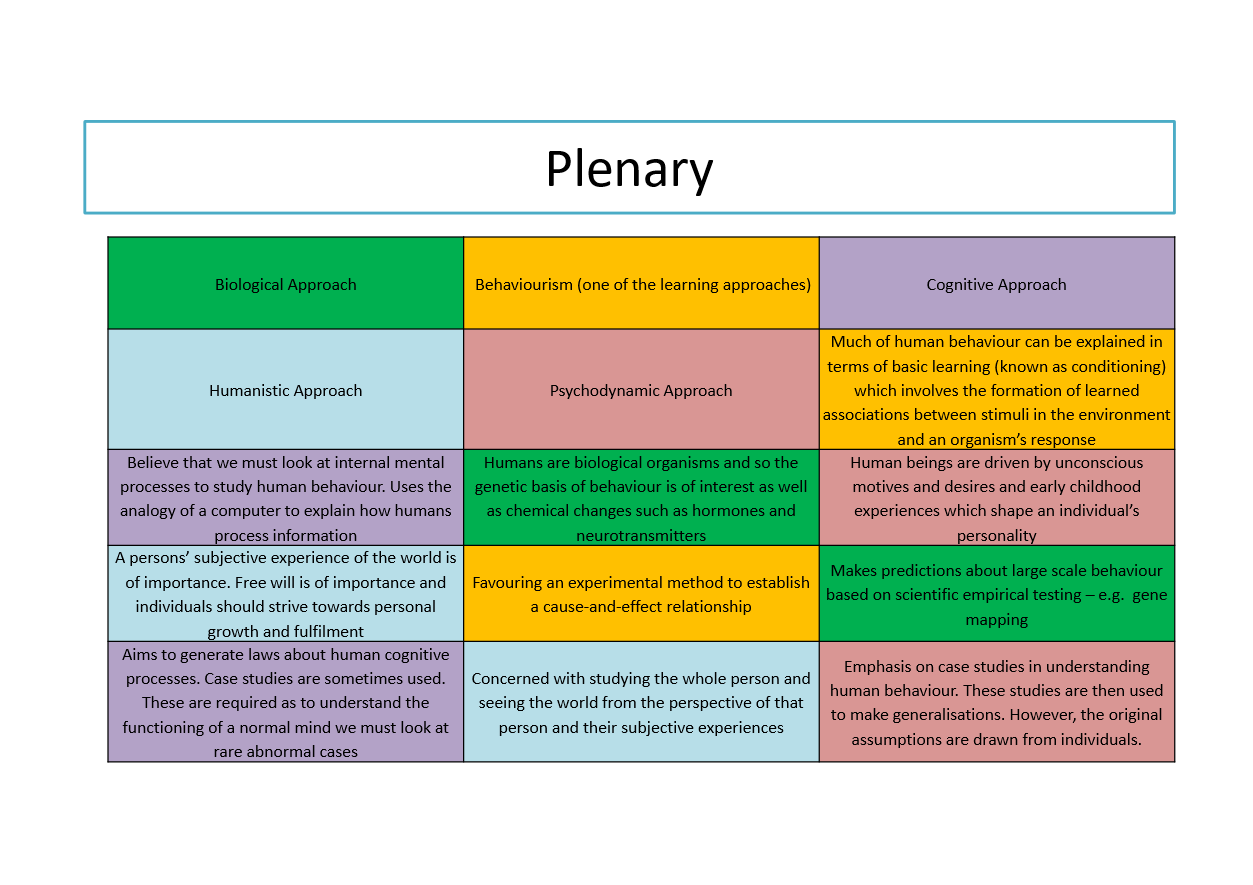
plenary
strength of idiographic approach
One strength of the idiographic approach is that it contributes to the development of the nomothetic approach.
The idiographic approach uses in-depth qualitative methods of investigation and this provides a global description of one individual.
This may complement the nomothetic approach by shedding further light on general laws or indeed by challenging such laws.
For example, a single case may generate hypotheses for further study - the pebble that starts an avalanche.
Cases like HM may reveal important insights about normal functioning which may contribute to our overall understanding.
This suggests that even though the focus is on fewer individuals, the idiographic approach may still help form 'scientific’ laws of behaviour.
However, supporters of the idiographic approach should still acknowledge the narrow and restricted nature of their work.
Meaningful generalisations cannot be made without further examples, as this means there is no adequate baseline with which to compare behaviour.
In addition, methods associated with the idiographic approach, such as case studies, tend to be the least scientific in that conclusions often rely on the subjective interpretation of the researcher and, as such, are open to bias.
This suggests that it is difficult to build effective general theories of human behaviour in the complete absence of nomothetic research.
strength of both approaches
One strength of both approaches is that they fit with the aims of science (contribute to psychology's scientific status).
The processes involved in nomothetic research are similar to those used in the natural sciences, for example establishing objectivity through standardisation, control and statistical testing.
However, researchers using the idiographic approach also seek to objectify their methods.
For example, triangulation is used whereby findings from a range of studies using different qualitative methods are compared as a way of increasing their validity.
Also, modern qualitative researchers are careful to reflect upon their own biases and preconceptions as part of the research process (this process is called reflexivity).
This suggests that both the nomothetic and idiographic approaches raise psychology's status as a science.
limitation of nomothetic approach
One limitation of the nomothetic approach is loss of understanding of the individual.
The fact that the nomothetic approach is preoccupied with general laws, averages, prediction and control means it has been accused of 'losing the whole person' within psychology.
For example, knowing that there is a 1% lifetime risk of developing schizophrenia tells us little about what life is like for someone who has been diagnosed with the disorder.
Understanding the subjective experience of schizophrenia might well prove useful when it comes to devising appropriate treatment options and gives us richer insight into their individual experience.
This means, in its search for generalities, the nomothetic approach may sometimes fail to relate to ‘experience’.
complementarity - weakness of both?
It is important to identify the two approaches because they are distinct but also they are complementary.
Each is appropriate in different situations for different research aims.
For instance in attachment research, Schaffer's stages describe general stages of development (nomothetic) whereas case studies of extreme neglect highlight the subjective experience of never having formed an attachment (idiographic).
However, there is also a sense in which the approaches are just two ends of a continuum and it is better to use them in this way.
Millon(1995) explains that when diagnosing personality disorders, for example, clinicians begin with general nomothetic diagnostic criteria, then use this to focus on the individual and their unique needs.