GPCLs for Astigmatism and Presbyopia
 Call Kai
 Learn
Learn Practice Test
 Spaced Repetition
 Match
Match Flashcards
 Knowt Play
1/35

There's no tags or description
Looks like no tags are added yet.
Name | Mastery | Learn | Test | Matching | Spaced | Call with Kai | Chat |
|---|
No analytics yet
Send a link to your students to track their progress
36 Terms
2
If the patient has corneal cylinder that is less than ___ D and it matches the refractive cylinder, the patient can be fit to a spherical GPCL as the tear lens will neutralize the astigmatism
vertical, horizontal
If a patient needing a toric GPCL is fit to a spherical lens, a patient having WTR cornea will display ____ lens decentration and a patient having ATR cornea will display ____ lens decentration. This may provide adequate vision, but it will be fluctuating and uncomfortable
Residual astigmatism
the cylindrical refractive astigmatism remaining after neutralization of the corneal cylinder by the tear lens
Front toric (F1 toric)
toric GPCL lens design that is analogous to a toric soft lens where there is a need for some form of lens stabilization in order to keep the refractive power aligned due to insufficient corneal toricity to stabilize the lens during blinking. Is indicated for corneal cylinder <1.50 with >1.50 refractive cylinder. Low corneal cylinder with >0.75 D of residual astigmatism with a spherical GPCL.
1.5, BD, inferiorly, diameter, optic zone
Stabilization of a front toric GPCL involves ____ prism diopters of ___ prism that will result in decentration of the lens slightly ____ and therefore requires a slightly larger ____ and ____
Back surface toric/spherical front
toric GPCL lens design that induces residual astigmatism that is equal to and opposite of the refractive astigmatism via difference in refractive indices between the CL material and tear film. Induced cylinder will be minus with the axis the same as the flat meridian of the cornea. Cost is slightly less than a bitoric lens.
half
The cylinder induced by a back surface toric spherical front lens will be equal to ____ the amount of toricity of the contact lens base curves
1.5
The ideal patient for a back surface toric spherical front lens is a patient whose refractive astigmatism is ___x their corneal cylinder both being at the same axis
Back surface/bitoric (F2 toric)
toric lens design where the back surface base curves approximate the corneal curvature in the principal meridians creating a near plano tear lens and refractive power ground on the front surface. Is indicated for corneal cylinder >2 D regardless of refractive cylinder.
Full alignment
bitoric lens design where the back surface base curves exactly align with the curvature of the cornea to create a plano tear lens. Lens does not have much movement, so these lenses are ideal visually but not physiologically especially as toric lenses are generally thicker as well. Ultimately, poor tear exchange!!
Low toric simulation
bitoric lens design where back surface base curve is slightly altered to allow for better lens movement when compared to full alignment. It is usually fit 0.25 D flatter than the flat K, 0.50-1.25 D flatter than the steep K. Lens is made slightly larger in diameter to compensate for increased lens movement.
Spherical power effect
bitoric lens design where the difference in base curves of the lens is equal to the difference in lens power. Occurs because refractive astigmatism is nearly all corneal. Optically performs like a spherical lens whose power is not impacted by lens rotation
Cylindrical power effect
bitoric lens design where the over-refraction using an SPE design reveals >0.75 D residual astigmatism. Occurs because refractive astigmatism is not entirely corneal. Power is impacted by lens rotation.
HVID, lid position, and mesopic pupil diameter
The lens diameter and optic zone diameter of a GPCL will depend on these three factors
spherical
If toricity of the cornea is primarily central, use ____ peripheral curves
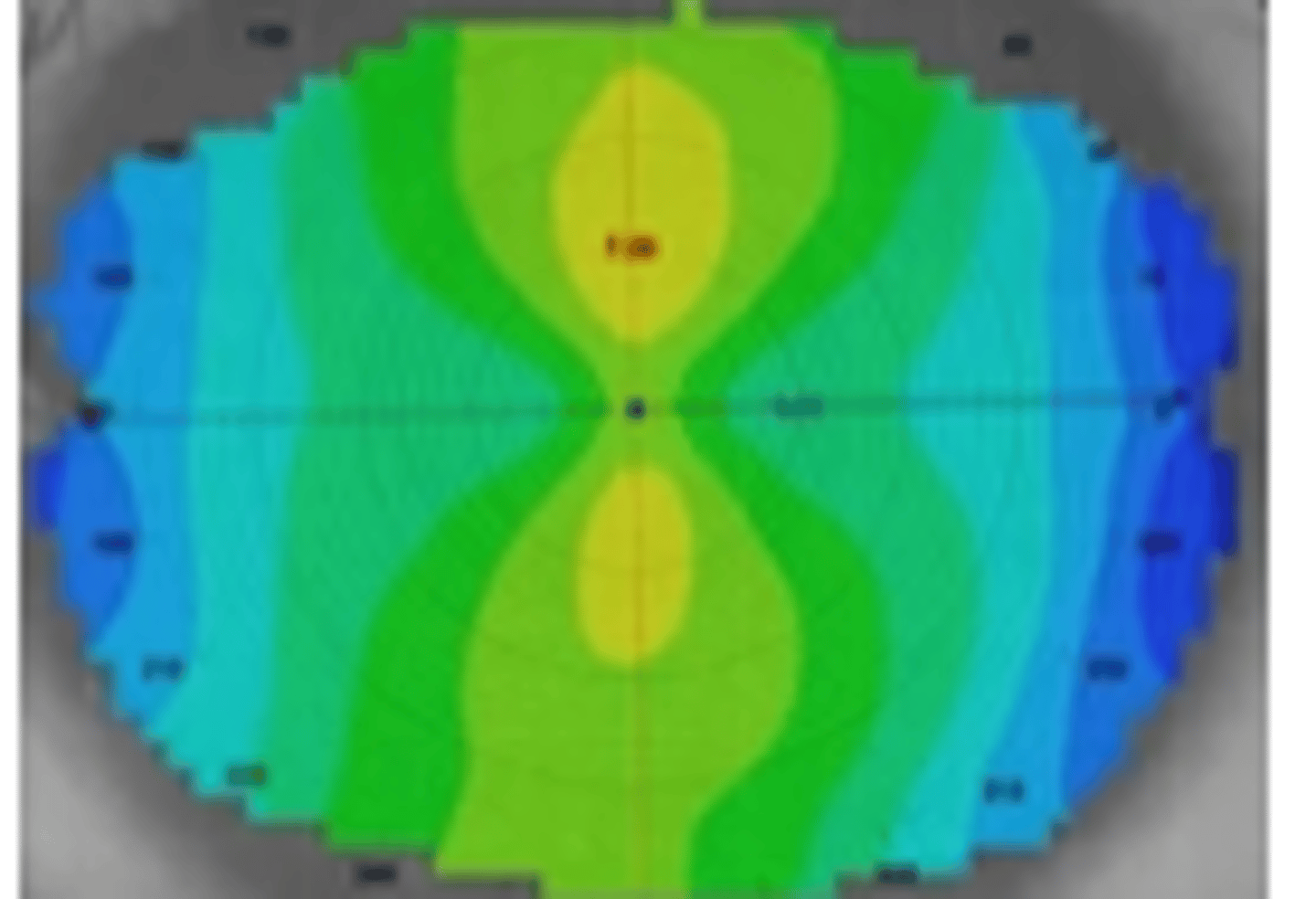
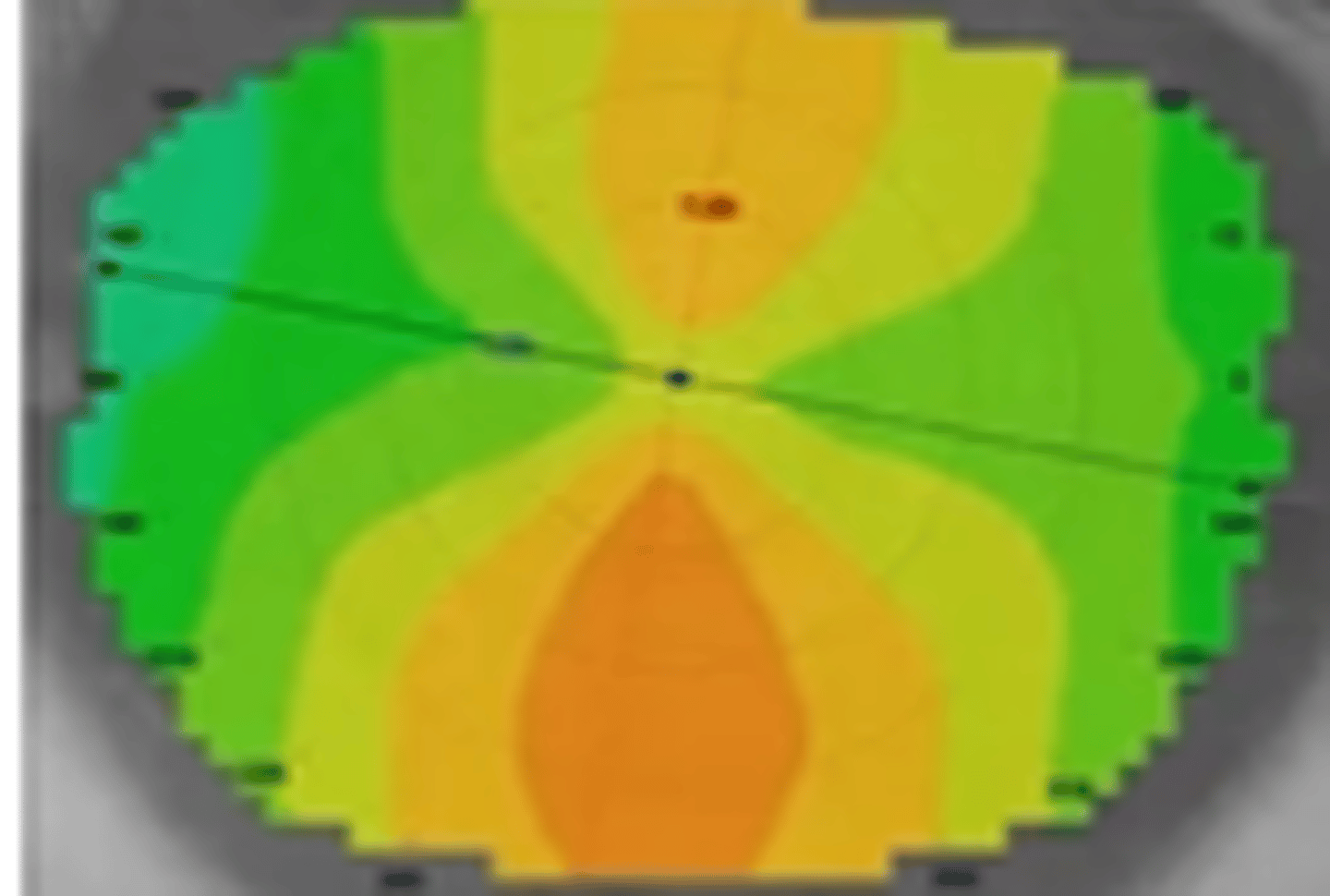
toric
If toricity of the cornea is limbus to limbus, use ____ peripheral curves to increase lens stability with blink
better
Multifocal GPCLs provide ____ vision than soft contact lenses due to the high optical quality of the lens material
Rotational
multifocal RGP design that keeps distance and near segments visually accessible even when the lens rotates under the influence of a blink. Is a distance vision center with a surrounding near vision segment.
Non-rotational
multifocal RGP design that resembles a bifocal spectacle lens with the distance vision segment on the top and the near vision segment on the bottom. The lens cannot rotate, but moves vertically to maintain vision at distance and near.
Aspheric
multifocal RGP design where the center of the lens is distance power. Lens power gradually increases in plus power from the center so that when the gaze shifts downward the patient is looking through a near add. This is achieved by a gradual change in curvature of the lens. Mimics a PAL.
simultaneous
Aspheric multifocal RGPs function optically via ____ image
early to moderate
Aspheric multifocal RGPs work best for ____ presbyopes
higher effective add power
New multifocal RGP aspheric lenses incorporate front and back curvature to allow for _____
decreases
In aspheric multifocal RGPs, as effective near power increase, the distance power zone diameter (increases or decreases)
small to medium
Aspheric multifocal RGPs require a ____ pupil size under average room illumination to minimize glare and ghosting at night induced by paracentral and midperipheral plus power
1, 3
Aspheric multifocal RGPs should have limited movement of about ____ mm. Early designs were fit as much as ___ D steep to minimize lens movement
corneal topographic changes, effective add power
A back surface designed aspheric RGP multifocal which is decentered may induce ____. Front surface designs can be used to avoid this and can also have a greater ____
Translating
multifocal RGP design which has a distance vision segment that is aligned with the visual axis in primary gaze, and a near vision segment that is aligned with the visual axis in downgaze. Requires a stabilization system to keep the lens in the optimal position (prism ballast or truncated). Mimics a bifocal or trifocal.
alternating
Translating multifocal RGPs function optically via ____ image
1.5
A translating bifocal RGP fit may be difficult if the lower lid margin is >___ mm above the lower limbus
lower pupil margin
The seg height of a translating bifocal RGP should be at the ____ in primary gaze under average room illumination
1-3 BD
____ prism is incorporated into translating bifocal RGP lenses to maintain lens orientation
50
The near segment of a translating bifocal RGP should cover at least ___% of the pupil in downgaze
0.4
A truncated translating bifocal RGP lens is ____ mm smaller vertically than it is horizontally
prism
If a translating bifocal RGP is lifting off of the eye too much with blink, increase ____ to increase the mass of the lens
edge lift, flatten
If a translating bifocal RGP is not translating adequately with downgaze, increase ____ or ____ the fit to promote more movement