ExRx Chapter 32- Children Functional Motor Skill Delays in Early Childhood with Implications for ExRx
 Call Kai
 Learn
Learn Practice Test
 Spaced Repetition
 Match
Match Flashcards
 Knowt Play
1/17

There's no tags or description
Looks like no tags are added yet.
Name | Mastery | Learn | Test | Matching | Spaced | Call with Kai |
|---|
No analytics yet
Send a link to your students to track their progress
18 Terms
A child’s actual ability to perform a movement skill
motor competence
Basic movement patterns that form the building blocks for more complex physical activity:
Locomotor (run, jump, hop)
Object control (throw, catch, kick)
Stability (balance, twisting)
fundamental movement skills
what are the fundamental movement skills?
locomotor, object control, stability
25–40% of children demonstrate below-average gross motor competence.
National survey data indicates that about 5–7% of children aged 3–7 years have diagnosed _________ ______, with higher prevalence among boys than girls.
These prevalence rates suggest that exercise professionals working with children will frequently encounter developmental variability.
developmental delays
Developmental surveillance refers to healthcare providers monitoring children’s developmental progress and parental concerns during routine visits
Rates range from 19%-61% across states
This connects to the bigger issue: Early developmental monitoring is inconsistent across the U.S.
Early identification is particularly important because developmental risk factors, including motor delays, may be associated with later _______and ________challenges.
behavioral and psychosocial
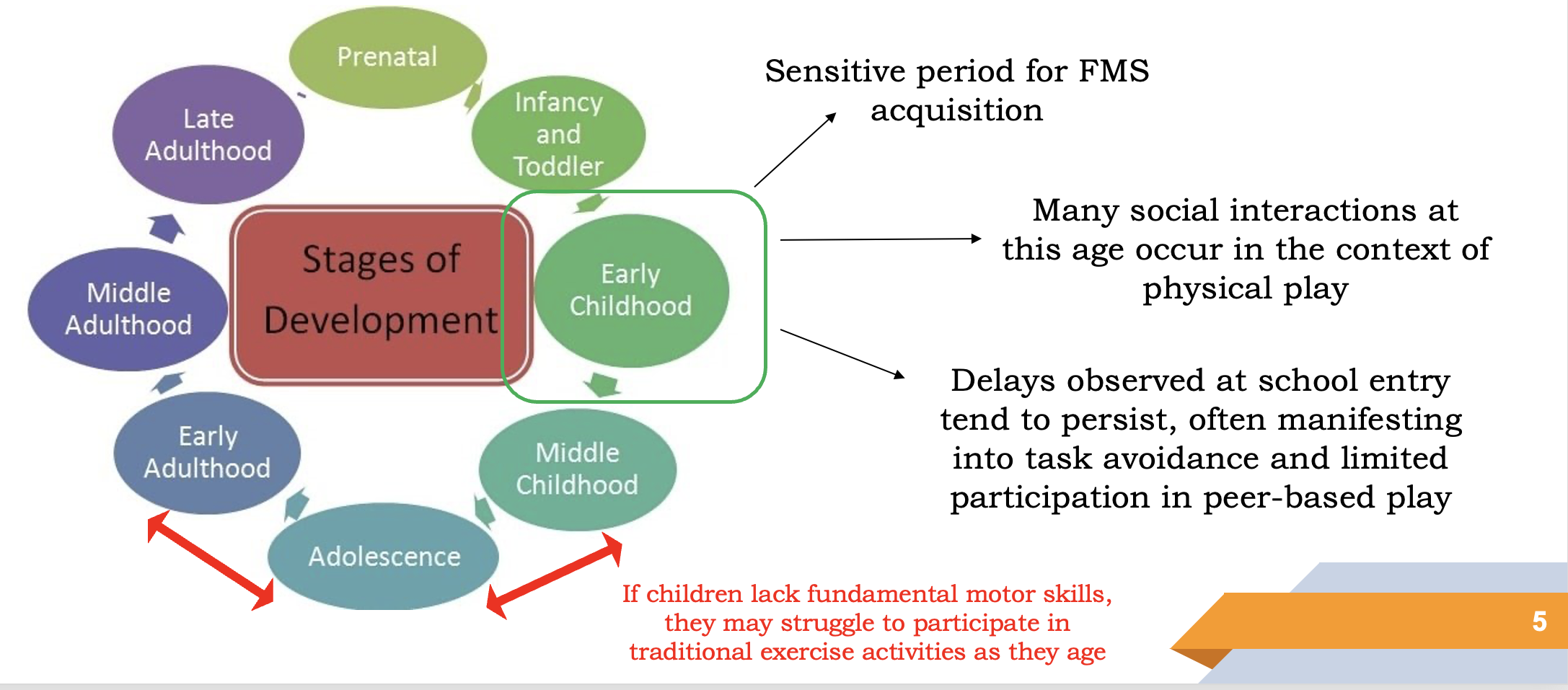
Motor skill development, stages of development
sensitive period for FMS acquisition
Many sociial interactions at this age occur in the context of physical play
Delays observed at school entry tend to persist, often manifesting into task avoidance and limited participation in peer based play
If children lack fundamental motor skills, they may struggle to participate in traditional exercise activities as they age
stages of development early childhood
When we prescribe exercise for adults, we focus on fitness, disease risk, and physical capacity…
For children, we shift towards to __________ _______
Understanding the prevalence of motor delays, with its cooccurrence in behavioral functioning, is critical for exercise prescription…
These factors directly influence children's ability to participate in and benefit from physical activity
Developmental variability!
Understanding the prevalence of motor delays, with its
developmental readiness
Developmental concerns
Behavioral challenges
Motor delays
Obesity
Chronic conditions
in clinical exercise settings professionals often work with children who have
Reflexive Movement → Birth to 1 year
Rudimentary Movement:
First 2 years
Reaching, grasping, releasing
Sitting, standing, walking
Fundamental Movement Phase→ 2-7 years old
Improved gross and fine motor skills
Running, jumping, throwing, catching
Key Functional Movements (Starting at 3 years of age)
Climbing
Running on toes
Balancing on one leg for a short time
Kicking ball from standing position
Specialized Movement Phase
7 years into adolescence
Continued refining and developing of skills
developmental progression phase
Birth to 1 year
developmental progression phase
reflexive movement
First 2 years
Reaching, grasping, releasing
Sitting, standing, walking
Developmental progression phase
rudimentary movement
2-7 years old
Improved gross and fine motor skills
Running, jumping, throwing, catching
Developmental progression phase
fundamental movement phase
(Starting at 3 years of age)
Climbing
Running on toes
Balancing on one leg for a short time
Kicking ball from standing position
key functional movements
7 years into adolescence
Continued refining and developing of skills
developmental progression phase
specialized movement phase
Children should be active at least ___ hours throughout the day
Structured, free play, and variety of opportunities
3
Should not be used just for exercise prescription
Testing is not indicated unless there is a health concern
Exercise protocol would be based on reason for the test
Always familiarize children with protocol
Treadmill and cycle ergometer should be available
Developmental variability(!)
DV: diff in development, children are psychologically and emotionally immature, require more motivation and support
recommendations for exercise training
diff in development, children are psychologically and emotionally immature, require more motivation and support
developmental variability
_______→ 76% preference by clinical centers
_______. _________
_______ ergometer population specific
treadmill, cycle and arm ergometer