CH 12 - Eukaryotic Microbes
 Call Kai
 Learn
Learn Practice Test
 Spaced Repetition
 Match
Match Flashcards
 Knowt Play
1/49

There's no tags or description
Looks like no tags are added yet.
Name | Mastery | Learn | Test | Matching | Spaced | Call with Kai |
|---|
No analytics yet
Send a link to your students to track their progress
50 Terms
Eukaryotic Microbe
How it differs from Bacteria:
has a nucleus and membrane bound organelles
cell wall (if present) DOES NOT have PEPTIDOGLYCAN
may be haploid or diploid
may have asexual or sexual reproduction
may be unicellular or multicellular
Groups of Microscopic Eukaryotes
Algae
Fungi
Protozoans
Some additional multicellular organisms that deal with transmission of human disease:
Arthropods
Worms (Helminths)
MYCOLOGY
the study of FUNGI
includes yeasts, molds, and mushrooms
Yeast
single celled fungi, reproduce by Budding (blastospores)
Mushrooms
reproductive structures of certain fungi
FUNGI
Can be represented through the following terms:
Heterotrophs
Saprotrophs
Parasites
Mycosis
Saprotrophs (saprophytes)
use nutrients from dead or decaying organic matter
major decomposers of organic material, important for nutrient cycling
Parasites
absorb nutrients from living tissues
Mycosis
disease caused by pathogenic fungi
Fungi Structure
1) Cell walls contain chitin and glucan: Glucan synthesis is a target of antifungal medications
2) Lack chloroplasts, energy storage is glycogen
3) Membranes contain ergosterol: a target of antifungal medications
Applications of Fungi
food industry
biofuel
beverage
medicine & biotechnology
agriculture
environmental management
commodities
pulp, paper, textile industry
Fungi (cont.)
most grow as molds, some grow only as yeast
fungi that transition between two morphologies are termed DIMORPHIC
Molds
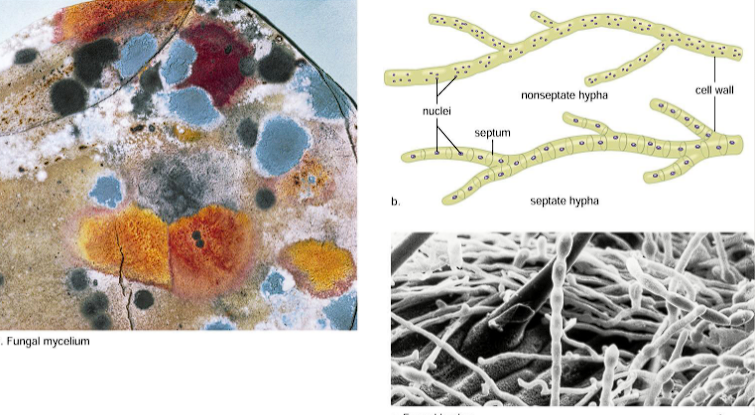
thread-like filaments called hyphae
Dimorphism
pathogenic dimorphic fungi are often SINGLE CELLED (yeast-like) at 37 C and FILAMENTOUS (mold-like) at 25 C
Mycelium Structure
Fungi (cont.)
typically non-motile, hyphae can grow toward food