W13.1 Examination of the Wrist & Hand
 Call Kai
 Learn
Learn Practice Test
 Spaced Repetition
 Match
Match Flashcards
 Knowt Play
1/157

Earn XP
Description and Tags
continue at 37
Name | Mastery | Learn | Test | Matching | Spaced | Call with Kai |
|---|
No analytics yet
Send a link to your students to track their progress
158 Terms
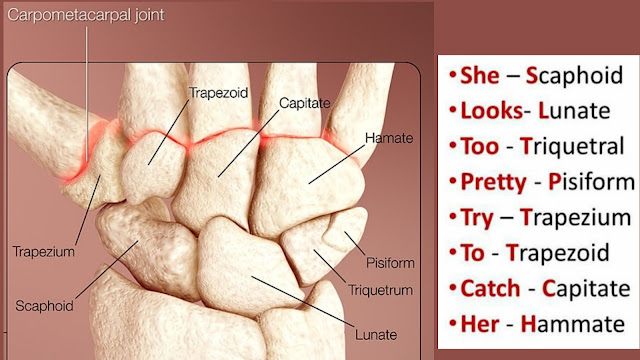
How many carpal bones are in the wrist? Name them
8
Scaphoid
Lunate
Triquetrum
Pisiform
Trapezium
Trapezoid
Capitate
Hamate
What joint is responsible for pronation and supination at the wrist/forearm region?
Distal radioulnar joint (DRUJ)
What is the wrist joint proper called?
Radiocarpal joint
What does the radiocarpal joint include?
An articular disc
What joint lies between the proximal and distal carpal rows?
Midcarpal joint
Which metacarpal is the central pillar and most stable?
3rd metacarpal
Which CMC joints are highly mobile?
1st, 4th, and 5th
What do extrinsic ligaments of the wrist connect?
Forearm to carpal bones
What do intrinsic ligaments of the wrist connect?
Carpal to carpal
What does TFCC stand for?
Triangular fibrocartilage complex
Where is the TFCC located?
In the ulnocarpal space between the distal ulna and the first carpal row
What structures are included in the TFCC?
Articular disc
Capsular ligaments of the DRUJ
Ulnar collateral ligament
What is the primary stabilizer for pronation and supination at the wrist?
TFCC
How are hand muscles classified?
Extrinsics and intrinsics
Where do extrinsic and intrinsic hand muscles originate?
Extrinsic → Forearm
Intrinsic → Hand
What is passive insufficiency?
A muscle on stretch or lengthened has a decreased ability to produce force
What is active insufficiency?
A muscle on slack or shortened has a decreased ability to produce force or torque
What muscle position is optimal for force production?
Mid-position
What three nerves supply the hand?
Median, ulnar, and radial nerves
In the hand, which nerve is sensory only?
Radial nerve
In the hand, which nerves have both motor and sensory components?
Median and ulnar nerves
What proximal regions should every hand patient be screened for?
Cervical spine
Shoulder
Elbow
Why is an upper quarter screen important in hand patients?
To rule out proximal issues manifesting distally
What are the minimum requirements of the upper quarter screen for a hand patient?
History of pain elsewhere
AROM of the upper quarter
A neuroscreen of C4-T1 dermatomes, myotomes, and reflexes
What specific history factor in wrist/hand evaluation helps point toward certain diagnoses?
Age
Why are occupation and hobbies important in wrist/hand history taking?
They help identify repetitive movements in sports or work
What onset pattern suggests trauma vs insidious wrist/hand problems?
Sudden → trauma/fall
Gradual → insidious
What symptoms in wrist/hand history may suggest nerve involvement?
Numbness, tingling, or paresthesia, especially at night
What should you ask about alleviating factors in a wrist/hand history?
Positions of the hand or upper quarter that relieve symptoms
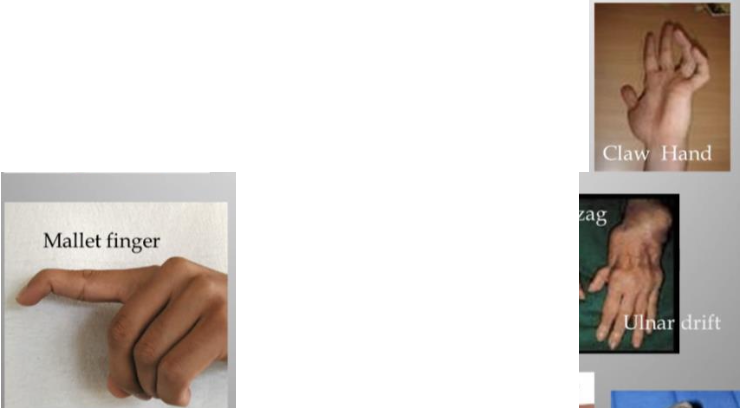
What common deformities should be observed in a hand exam?
Mallet finger
Claw hand
Ulnar drift
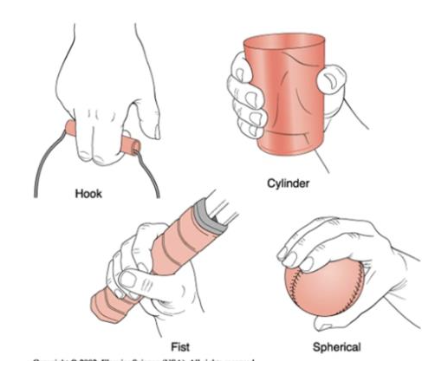
What standard grip patterns should be screened in a hand exam?
Hook
Cylinder
Fist
Spherical
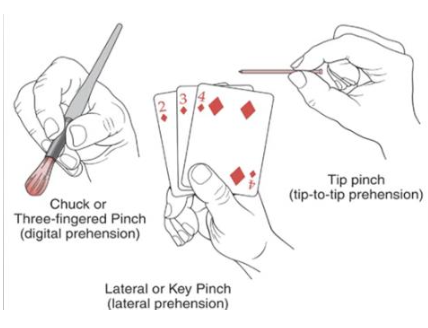
What is a three-jaw chuck pinch?
Thumb, index, and middle finger pinch
Ex: holding a pencil
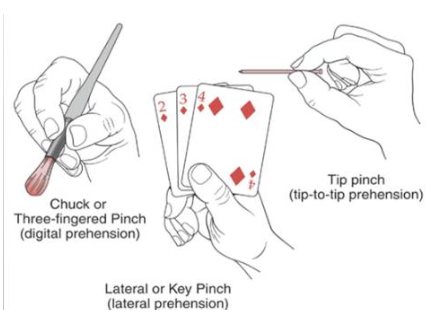
What is a lateral or key pinch?
Thumb against the side of the index finger
Ex: holding a key or cards
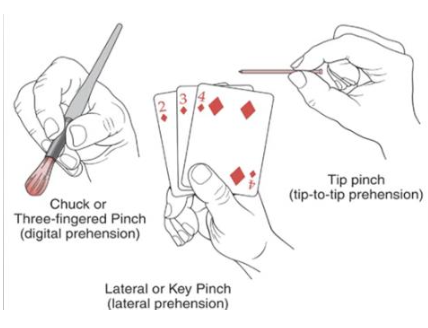
What is a tip-to-tip pinch?
Tips of fingers touching in an OK position
Ex: holding a needle
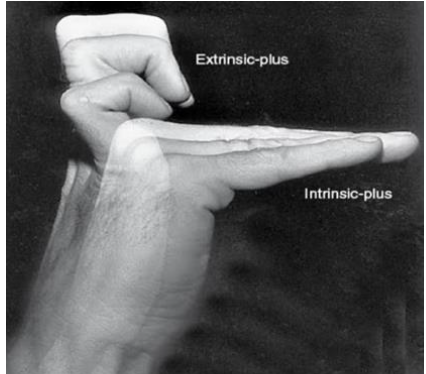
What is the intrinsic plus position?
Intrinsics firing and extrinsics silent
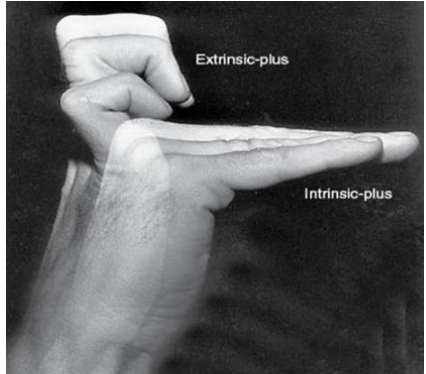
What is the extrinsic plus position?
Extrinsics firing and intrinsics silent
What hand motion screen is demonstrated with the elbow supported on the table and palm facing out?
Abduction
adduction
lumbrical
hook
straight fist
closed fist with thumb wrapped
pulp-to-pulp
tip-to-tip
closed thumb
What joint resting position is typical for the radiocarpal joint?
Neutral with slight ulnar deviation
What is the close-packed position of the radiocarpal joint?
Extension
What is the capsular pattern of the radiocarpal joint?
Flexion and extension equally limited
What is the end feel of the radiocarpal joint?
Firm/hard due to bony impact
What joint resting position is typical for the intercarpal joint?
Neutral or slight flexion
What is the close-packed position of the intercarpal joint?
Extension
Does the intercarpal joint have a capsular pattern?
No
What joint resting position is typical for the midcarpal joint?
Neutral or slight flexion with ulnar deviation
What is the close-packed position of the midcarpal joint?
Extension with ulnar deviation
What is the capsular pattern of the midcarpal joint?
Flexion and extension equally limited
What is the resting position of the thumb CMC joint?
Midway between abduction/adduction and flexion/extension
What is the close-packed position of the thumb CMC joint?
Full opposition
What is the capsular pattern of the thumb CMC joint?
Abduction and extension
What is the capsular pattern of the finger CMC joints?
Equal limitation in all directions
What is the resting position of MCP joints?
Slight flexion
What is the close-packed position of the finger MCP joints?
Flexion
What is the close-packed position of the thumb MCP joint?
Full opposition
What is the capsular pattern of the MCP joints?
Flexion more limited than extension
What is the end feel of the MCP joints?
Firm due to the volar plate
What is the resting position of IP joints?
Slight flexion
What is the close-packed position of IP joints?
Full extension
What is the capsular pattern of IP joints?
Flexion and extension
What is the end feel of IP joints?
Firm due to capsule/volar plate
What is the end feel for wrist extension and radial deviation?
Firm or hard due to bony impact of the radial styloid on carpals
What is the end feel for wrist flexion?
Tissue stretch
During wrist flexion overpressure, where should force be applied?
Through the 3rd digit
Why should pressure not be applied through the 1st or 5th digits during wrist flexion overpressure?
It causes excessive CMC rotation and does not isolate wrist motion
What is the end feel for ulnar deviation?
Firm, but without the same bony stop as radial deviation
Why does ulnar deviation lack the same bony stop as radial deviation?
The distal ulna is shorter
How can composite finger flexion be measured?
Distance from fingertip to distal palmar crease with a ruler
How can CMC opposition be measured?
Distance from thumb tip to the 5th metacarpal joint
What is the standard arm position for grip dynamometry?
Arm at side and elbow flexed to 90 degrees
What handle position is usually used for grip dynamometry?
Mid-position, usually the 3rd notch
What is the standard protocol for grip dynamometry?
Average of 3 trials alternating hands
What difference is normal between dominant and nondominant hands in grip strength?
5 to 10 percent
What test-retest grip strength discrepancy suggests inconsistent effort?
Greater than 20 percent
At what age does grip strength typically peak?
Early to middle adulthood
What reflexes are commonly included in the sensory exam for the upper quarter/hand?
Biceps, triceps, and brachioradialis
What is the starting distance for static 2-point discrimination?
15 mm
What is normal static 2-point discrimination?
Less than 6 mm
What is fair static 2-point discrimination?
7 to 10 mm
What is poor static 2-point discrimination?
11 to 15 mm
What is normal moving 2-point discrimination?
2 to 5 mm
Which type of 2-point discrimination is more functionally correlated and predicts recovery better?
Moving 2-point discrimination
What do Semmes-Weinstein monofilaments assess?
Light touch perception
What Semmes-Weinstein monofilament value indicates normal sensation?
4.08 or 1 g
What Semmes-Weinstein monofilament value indicates protective sensation?
5.07 or 10 g
What pulses should be assessed in the wrist/hand circulation exam?
Brachial, radial, and ulnar pulses
What circulation tests are commonly used in a wrist/hand exam?
Allen’s test and capillary refill
How is edema quantified with volumetrics?
Water displacement in room-temperature water
How much water displacement suggests swelling on volumetrics?
30 to 50 mL
What tape measure method is commonly used for hand edema and is less messy than volumetrics?
Figure-of-eight measurement
Describe the figure-of-eight path for hand edema measurement.
Ulnar styloid to volar wrist crease to dorsal 5th MCP to volar 2nd MCP and back dorsally to ulnar styloid
What functional tests assess timed hand manipulation?
Jebsen-Taylor, Box and Block, Moberg’s Pick-up, and 9-hole peg tests
What joint play motions are assessed at the wrist?
Distraction, dorsal glide, volar glide, lateral glide, and medial glide
Which wrist glide improves flexion?
Dorsal glide
Which wrist glide improves extension?
Volar glide
Which wrist glide improves ulnar deviation?
Lateral glide
Which wrist glide improves radial deviation?
Medial glide
What joint play motions are assessed at the finger and thumb MCP/IP joints?
Volar, dorsal, and lateral glides at the MCP
What joint play is assessed at the intermetacarpal joints?
AP rocking
What joint play motions are assessed at the thumb CMC?
Volar/dorsal, medial/lateral, internal/external, distraction/compression
Why is scar mobility assessed in a wrist/hand exam?
Scar adhesions can severely limit tendon excursion and finger movement