KIN 360 - Chapter 25 Study Guide
 Call Kai
 Learn
Learn Practice Test
 Spaced Repetition
 Match
Match Flashcards
 Knowt Play
1/28

There's no tags or description
Looks like no tags are added yet.
Name | Mastery | Learn | Test | Matching | Spaced | Call with Kai |
|---|
No analytics yet
Send a link to your students to track their progress
29 Terms
Describe the end-state molecule that is absorbed in the small intestine for carbohydrates and where digestion is initiated:
digestion intiatied in oral cavity
broken down into monosaccharides (single sugars) by digestive enzymes.
Taken up by intestinal epithelial cells by symport
Transported to the liver (hepatic portal vein), where the non- glucose sugars are converted to glucose
Glucose is transported to the cells that require energy
glucose absorbed by symport with Na+, symport driven by sodium gradient from Na+/K+ pump, glucose moves out of intestinal cells and enters capillaries of intestinal villi and is carried through hepaticp portal vein to liver
Describe the end-state molecule that is absorbed in the small intestine for lipids and where digestion is initiated:
initiated in the small intestine epithelium
Broken down into fatty acids and monoglycerides via enzymes (lipase) and emulsification (bile salts)
micelles attacth to cell membranes of intestinal cells and fatty acids and monoglycerides are taken up by intestinal epithelial cells by diffusion
Free fatty acids are combined with monoglycerides to form triglycerides within intestinal cells and are coated with proteins to form chylomicrons
Transported via lacteals within intestinal villi and carried through the lymphatic system to the bloodstream.
Stored in adipose tissue, converted into other molecules, or used as energy
Describe the end-state molecule that is absorbed in the small intestine for proteins and where digestion is initiated:
initiated in stomach
Broken down by pepsin and digestive enzymes into tripeptides, dipeptides, and amino acids.
Taken up by intestinal epithelial cells by symport, symport driven by sodium gradient from Na+/K+ pump
Broken down in intestinal cells into amino acids
Amino acids enter villi of intestinal cells and are transported to the liver (hepatic portal vein), where they can be modified or released into the bloodstream.
Actively transported into cells under the stimulation of growth hormone and insulin to be used as building blocks or for energy.
Describe locations where water enters digestive tract. Indicate where most water is absorbed
About 9 L water enters digestive tract each day via ingestion and digestive secretions
92% absorbed across wall of small intestine into bloodstream
6-7% absorbed in large intestine
Less than 1% in feces
Define nutrition, nutrients, and essential nutrients.
Nutrition
-the process by which a living organism assimilates (gather, ingest, find) food and uses it for growth and for the replacement of tissue
Nutrients
-chemicals used by the body to produce energy, provide building blocks, or function in other chemical reactions
Essential nutrients
-must be ingested because the body cannot manufacture itself or is unable to manufacture adequate amounts
-ex: most vitamins and minerals, water, certain amino acids, and fatty acids, minimum number of carbs
Define Calorie and Kilocalorie.
Calorie
-the heat (energy) necessary to raise the temperature of 1 gram of water by 1 degree C
Kilocalorie
-1 kcal or Calorie is equal to 1000 calories
-100 Calorie snack actually 100kcal or 100,000 calories
Caloric content of nutrients:
1g protein = 4kcal
1g carb = 4kcal
1g lipid = 9kcal
List the six nutrients and indicate why essential nutrients must be ingested.
-water, carbohydrates, proteins, lipids, vitamins, minerals
-must be ingested because we can't assemble ourselves, or don’t make enough and we need these nutrients for health
Define and describe carbohydrates.
-can be ingested in different forms:
1. Monosaccharides (glucose, fructose, galactose)
2. Disaccharides (sucrose, maltose, lactose)
3. Polysaccharides (starch, glycogen, cellulose)
-polysaccharides and disaccharides are converted to glucose which can be used for energy or stored as glycogen or fat
-primary role is energy source
What are the uses in the body for carbohydrates?
Digestion
-breaks polysaccharides and disaccharides into monosaccharides before absorption → must be broken down into simplest form (single sugar) before absorption
Liver
-converts monosaccharides into glucose, which is then used as an energy source to produce ATP
Excess glucose
-converted to glycogen and stored in muscles and liver cells (short-term energy source)
-excess beyond storage is converted to fat (stored in adipose tissue)
Sugars
-can also become part of DNA, RNA, and ATP, glycoproteins, glycolipids
Define and describe lipids. What are their uses in the body?
-can be ingested as Triglycerides (95%) or cholesterol, phospholipids, and linoleic acids (5%)
1. Triglycerides
-used to produce ATP or stored in adipose tissue and liver
2. Cholesterol
-forms other molecules, such as steroid hormones, can be ingested or manufactured in body
can be modified to form bile salts + steroids
-Part of the plasma membrane
3. Phospholipids
-forms part of plasma membrane
-part of bile, used to construct myelin sheath
3. Linoleic acids
-essential fatty acids
-found i seeds, nuts, legumes, grains, and green leaves
Eicosnoids derived from fatty acids: involved in inflammation, blood clotting, tissue repair, smooth muscle contraction
Define and describe proteins.
-proteins are ingested and broken down into amino acids (chains of amino acids)
-types of amino acids
1. essential: must be obtained in diet
2. nonessential: body can synthesize
-complete proteins: contain all necessary amino acids ex: meat, fish, poultry, milk, eggs, cheese
What are the uses in the body for proteins?
Protection
-antibodies
Regulation
-enzymes, hormones
Structure
-collagen
Muscle contraction
-actin and myosin
Transportation
-hemoglobin, transport proteins
Receptors
Compare lipid and water-soluble vitamins.
lipid soluble:
- A,D,E,K
- can be stored in fatty tissues until they reach point of toxicity (too much → dangerous levels cause harm)
- too much A causes bone and muscle pain; skin disorders, hair loss, increased liver size
- too much D causes deposition of Ca in kidneys, heart, blood vessels
water-soluble:
- B,C, and all others
- remain for a short time then are excreted
- too much C causes stomach inflammation; diarrhea
Indicate how many kilocalories a gram of fat, protein, and carbohydrates each yield.
Fat: ~9 kilocalories per gram (kcal/g)
Protein: ~4 kilocalories per gram
Carbohydrates: ~4 kilocalories per gram
Compare essential and non-essential amino acids.
1. essential
-must be obtained in diet
-have to maintain
2. nonessential
-body can synthesize
-body synthesized the requires amount already
Define metabolism, anabolism, and catabolism.
Metabolism
-the sum of all chemical reactions in the body
Catabolsim
-the breakdown of larger molecules into smaller molecules
-energy is released
-ab=a+b
Anabolism
-the building up of molecules, while catabolism is the breaking down of molecules
-energy is required
-a+b=ab
List the number of ATP required to initiate glycolysis.
2 ATP
Identify the molecules produced at the end of both aerobic and anaerobic glycolysis (pyruvic/lactic acid).
Aerobic glycolysis (with oxygen)
-begins with 2 ATP
-2 pyruvate (pyruvic acid) molecules
Anaerobic glycolysis (without oxygen)
-begins with 2 ATP
-2 lactate (lactic acid) molecules
So:
Aerobic → pyruvate
Anaerobic → lactate
Differentiate between the terms aerobic and anaerobic.
aerobic = with oxygen, uses oxygen to break down glucose into CO2 and water, produces 32 ATP
anaerobic - without oxygen, breakdown of glucose into CO2 a sense of oxygen into 2 lactic acid and 2 ATP
List the four steps of carbohydrate metabolism, indicate how many ATP are produced in each step (if any) and describe where the process takes place within cells.
1. Glycolysis
-location: cytosol
-ATP produced: 2
2. Conversion of acetyl-CoA
-location: mitochondrial matrix
-ATP produced: 0 ATP
3. Citric acid cycle
-location: mitochondrial matrix
-ATP produced: 2
4. Electron Transport Chain
-location: inner mitochondrial membrane
-ATP produced: 28 ATP
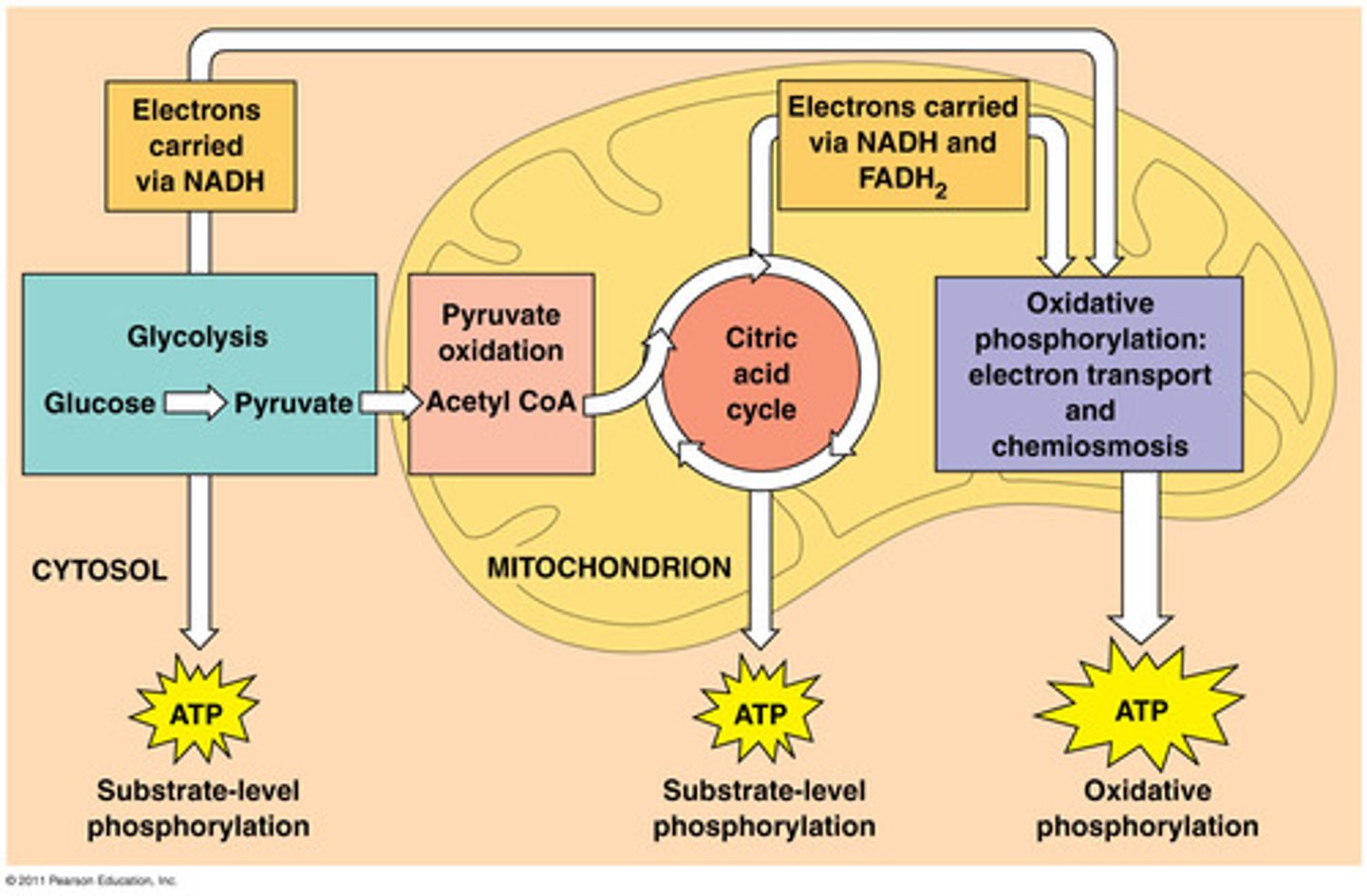
List the molecules that are transported to the electron-transport chain.
NADH and FADH2 transfers its electrons to the electron transport chain and are used to produce 28 ATP
Explain the difference in the number of ATP molecules produced by aerobic respiration and the number produced by anaerobic respiration.
Aerobic respiration
-glycolysis: 2 ATP
-conversion to acetyl-CoA: no ATP
-citric acid cycle: 2 ATP
-electron transport chain: 28 ATP
=32 ATP
Anaerobic respiration
-glycolysis: 2 ATP
-no ATP is produced in mitochondria because the ETC is inactive
Describe the role of beta-oxidation in the use of lipids as an energy source.
Triglycerides: Broken down and released as glycerol and free fatty acids
free fatty acids
-taken up by cells and broken down by beta-oxidation into acetyl-CoA
-acetyl-CoA can enter the citric acid cycle → ability to generate ATP
-acetyl-CoA can be converted into ketone bodies
Know that there are various entry points for amino acids into carbohydrate metabolism.
amino acid metabolism
-there's different entry points for different amino acids
Define glycogenesis, lipogenesis, glycogenolysis, and gluconeogenesis. Know when each would occur.
Glycogenesis
-formation of glycogen from excess glucose
-glycogen synthesis
-stored in liver and skeletal muscles
Lipogenesis
-lipid synthesis
-formation of lipids from glucose and amino acids when glycogen stores are filled
-excess glucose to lipids
Glycogenolysis
-breakdown of glycogen to glucose
-glycogen breakdown
Gluconeogenesis
-glucose synthesis
-formation of glucose from amino acids and glycerol
Indicate the two locations in which glycogen can be stored within the body.
1. Liver - used to maintain blood glucose levels.
2. Skeletal muscle - used locally by muscle cells for energy during contraction
Differentiate between the absorptive and postabsorptive metabolic states.
Absorptive state
-nutrients are used as energy or stored (absorbed, processing, and storage)
-after eating food
-period immediately after eating when nutrients are absorbed through intestinal wall into the circulatory and lymphatic systems
-about 4 hours after each meal
Postabsorptive state
-occurs late in the morning, afternoon, or night after the absorptive state has concluded
-no meal in a while
-nutrients used and processed
-blood glucose levels maintained by conversion of other molecules to glucose
Define metabolic rate and describe the three major uses of metabolic energy in the body (thermic effect of food, basal metabolic rate, physical activity).
-the total amount of energy produced and used by the body per unit of time
-estimated by amount of oxygen used per minute
1. Basal metabolic rate
-energy used at rest
-about 60%
-how much energy you ned to stay alive
2. Thermic effect of food
-energy used to digest and absorb food
-about 10%
-how much energy you need to contract and digest
3. Muscular activity
-energy used for muscle contraction
-about 30%
-can vary greatly based on lifestyle and physical activity level
-how much energy you need to move, contracting muscles
Describe body temperature regulation.
-balance between heat gain and heat lost
-heat is produced through metabolism
-heat is echanged through radiation, conduction, convection, and evaporation
-the greater the temperature difference between the body and the environment, the greater the rate of heat exchange
-body temperature is regulated by a set point in the hypothalamus (negative feedback)