Psych/Soc Discrete
 Call Kai
 Learn
Learn Practice Test
 Spaced Repetition
 Match
Match Flashcards
 Knowt Play
1/168

There's no tags or description
Looks like no tags are added yet.
Name | Mastery | Learn | Test | Matching | Spaced | Call with Kai |
|---|
No analytics yet
Send a link to your students to track their progress
169 Terms
Which statement best explains why continuous reinforcement is best for the beginning of the acquisition phase of operant conditioning?
A. The schedule unambiguously informs the subject which behavior is correct.
B. The schedule is best matched for the motivational state of the subject.
C. This leads to the greatest accumulation of reinforcements, hence the greatest pleasure.
D. It gives subjects little time for incorrect responses.
A. The schedule unambiguously informs the subject which behavior is correct.
Two male children with different biological parents are adopted in infancy and raised together. Which observation best supports the idea that heredity is an important determiner of intelligence? The two boys’ IQs:
A. are more similar to each other than to their own biological siblings.
B. are less similar to each other than to their own biological siblings.
C. are more similar to their adoptive parents than to their biological parents.
D. are less similar to each other than to their adoptive siblings.
B. are less similar to each other than to their own biological siblings.
Which phenomenon will an animal trainer most likely try to avoid when training a rabbit for a television commercial?
A. Operant extinction
B. Instinctual drift
C. Stimulus generalization
D. Partial reinforcement
B. Instinctual drift
A person has left his shopping list in the car, but decides not to go back for it because he is confident that he has the list memorized. Upon returning home, he realizes that he remembered most of the items from the beginning and end of the list, but forgot many items from the middle of the list. This outcome illustrates:
A. the serial-position effect.
B. hindsight bias.
C. chunking.
D. decay.
A. the serial-position effect.
Research on cognitive aging has demonstrated that, in general, aging does NOT diminish a person’s:
A. capacity for acquiring new declarative information.
B. capacity for controlling his or her memory processes.
C. ability to cope with Alzheimer’s Disease.
D. ability to retrieve general information.
D. ability to retrieve general information.
Under certain circumstances, such as having received news about something traumatic on a particular day, many people claim that they remember every detail of what they were doing when they received the news. Psychologists use which term to describe this unusual phenomenon?
A. Repression
B. Flashbulb memory
C. Recency effect
D. Spacing effect
B. Flashbulb memory
Which observation disconfirms the theory that the hunger drive is based on a person’s interpretation of stomach contractions, while satiety is based on stomach distension?
A. Stomach contractions do not correlate with the experience of hunger.
B. Stomach distension does not correlate with satiety.
C. Rats without stomachs cannot learn mazes when rewarded with food.
D. People whose stomachs have been removed still experience hunger.
D. People whose stomachs have been removed still experience hunger.
Which term is used to describe a memory report that is inaccurate, but expressed with extreme confidence?
A. Autobiographical memory
B. False memory
C. Amnesia
D. Recovered memory
A
According to Kohlberg’s theory of moral development, a person giving which reason for moral behavior is at the highest level?
A. To gain acceptance
B. To follow rules
C. To promote social welfare
D. To avoid disapproval
C. To promote social welfare
In operant conditioning studies, the subject’s motivational state is most typically operationally defined by:
A. observing the subject’s behavior over a long period of time.
B. using a type of reinforcement that the experimenter knows the subject usually likes.
C. depriving the subject of some desirable stimulus item for a period of time.
D. using a novel stimulus that the subject is sure to like.
C. depriving the subject of some desirable stimulus item for a period of time.
An example of intersectionality is the relationship between:
A. micro and macro levels of analysis.
B. symbolic and material culture.
C. race/ethnicity and social class.
D. cultural values and social norms.
C. race/ethnicity and social class.
Researchers design a study to explore how healthcare providers establish rapport, show empathy, and navigate disagreements with their patients. Based on this description, the researchers are most likely taking a theoretical approach that is consistent with which sociological paradigm?
A. Functionalism
B. Exchange-rational choice
C. Conflict theory
D. Symbolic interactionism
D. Symbolic interactionism
Based on the concept of the looking-glass self, which reaction is most likely for a person who acquires a stigmatized illness?
A. The person will seek out other people with the same stigmatized illness.
B. The person will internalize the perceived stigmatization against him or her.
C. The person will redirect feelings of stigmatization toward out-group members.
D . The person will become stigmatized by his or her secondary group members.
B. The person will internalize the perceived stigmatization against him or her.
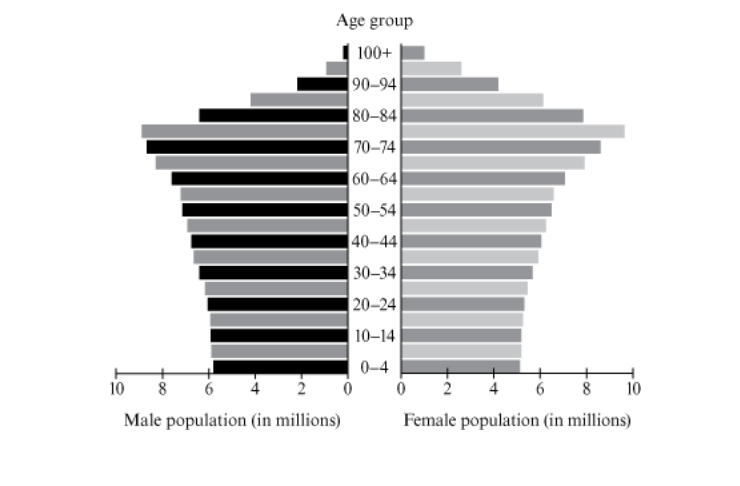
The following population pyramid best supports which projected demographic outcome?
A. The overall size of the population is likely to decrease.
B. The mortality rate of the population is unlikely to change.
C. The median age of the population is unlikely to change.
D. The birth rate of the population is likely to increase.
A. The overall size of the population is likely to decrease.
In which situation is neurotransmitter release from a presynaptic cell most likely to stimulate an action potential in a postsynaptic cell?
A. In any excitable cell, if neurotransmitter binding opens ligand-gated channels at the synapse
B. In a postsynaptic neuron where a depolarizing change in membrane potential exceeds threshold
C. In a postsynaptic neuron that expresses a high density of neurotransmitter receptors
D. In any excitable cell, if the neurotransmitter released into the synaptic cleft is acetylcholine
B. In a postsynaptic neuron where a depolarizing change in membrane potential exceeds threshold
A person looking at the night sky notices she no longer sees a dim star when her gaze remains fixated on it, but the dim star reappears when she shifts her gaze to one side of the star. What is the most likely cause of the reappearance of the dim star in her vision? Shifting her gaze moved the image of the dim star:
A. away from the blind spot where no photoreceptors are present.
B. to a region of the retina where photoreceptors have a higher threshold for light detection.
C. away from the fovea toward the periphery of the retina.
D. to a region of the eye where photoreceptors contain more than one type of retinal pigment.
C. away from the fovea toward the periphery of the retina.
A group of students takes the same test of visual perception at the same time on two consecutive days. The students’ scores are very different each time. This suggests that the test is not:
A. valid.
B. standardized.
C. reliable.
D. generalizable.
C. reliable.
A researcher finds a +0.38 correlation between a test of verbal intelligence and a test of spatial intelligence. Speculating about a common factor, “g,” the researcher concludes that:
A. performance on both tests is partly determined by “g.”
B. the two tests measure different things, which does not include a “g” component.
C. both of the tests are excellent measures of “g.”
D. that “g” is a statistical artifact with no real-world validity.
A. performance on both tests is partly determined by “g.”
Without conscious effort, people are unlikely to automatically visually process:
A. spatial information.
B. temporal information.
C. the frequency of specific events.
D. novel information.
D. novel information.
In a study of college students, a correlation was found between those reporting high rates of insomnia and reduced hit rates for detecting the sounds of birds chirping. This represents what type of correlation, and what phenomenon was described?
A. Positive, signal detection
B. Negative, signal detection
C. Positive, difference threshold
D. Negative, difference threshold
B. Negative, signal detection
A patient being treated for chronic pain receives weekly doses of morphine from the same doctor, with whom the patient enjoys conversing. On another occasion, the patient is treated at another location and finds that the same dose is ineffective. What may have caused this change in effectiveness?
A. The morphine interacted with another medicine the patient was taking.
B. The morphine was given in a new environment.
C. The doctor’s office used a different drug manufacturer.
D. The patient’s body became sensitized to the same dose of morphine.
B. The morphine was given in a new environment.
What experimental set-up is most likely to result in a person with a severed corpus callosum saying “ball” after a researcher asks, “What do you see?”
A. The letter b is projected to the left visual field, followed almost immediately by “all,” at the same location.
B. The word “ball” is projected to the right visual field, while “room” is presented to the left visual field.
C. The word “base” is projected to the right visual field, while “ball” is projected to the left visual field.
D. The word “basketball” is projected to the left visual field.
B. The word “ball” is projected to the right visual field, while “room” is presented to the left visual field.
Two friends accept internships with a city council member even though they do not agree with many of the council member’s policies. Which is most likely to happen if they are in a state of dissonance? The students will:
A. adapt their attitudes to be more in line with the council member.
B. quit the internships after a period of time.
C. continue in the internships but retain their original beliefs.
D. do as little work as possible so as not to advance the council member’s agenda.
A. adapt their attitudes to be more in line with the council member.
A constructionist understanding of gender asserts that categories of gender are:
A. biologically determined and immutable.
B. binary and the product of ingrained socialization processes.
C. fluid and subject to social processes of meaning-making.
D. binary, yet interchangeable depending on context.
C. fluid and subject to social processes of meaning-making.
According to Mead, which behavior is an expression of the Me component of the Self?
A. An individual studying for an exam instead of going to a party
B. An individual skipping work because they want to go to a concert
C. An individual ignoring the emotional needs of a significant other
D. An individual dressing inappropriately for a job interview
A. An individual studying for an exam instead of going to a party
An individual who previously worked as a salaried corporate attorney loses his or her job. Subsequently, the individual now works as an hourly wage employee at a retail store. This individual has experienced which type of social mobility?
A. No mobility
B. Intergenerational
C. Horizontal
D. Vertical
D. Vertical
Which scenario is NOT an accurate representation of the McDonaldization of society?
A. A customer cleaning their table and disposing of waste after eating at a restaurant
B. A doctor seeing a patient at his or her residence rather than at a medical facility
C. A supermarket chain using self-scan machines at check-outs, in place of employees
D. A chain of coffee shops offering the same menu and décor across the United States
B. A doctor seeing a patient at his or her residence rather than at a medical facility
Which research question would be most appropriate to evaluate using a longitudinal design?
A. The influence of an individual's attachment classification as an infant on their adult relationship style
B. The relative contribution of genetic and environmental factors in determining individual differences in intelligence
C. The relative prevalence rates of major depressive disorder among individuals from different racial/ethnic backgrounds
D. The relationship between the number of people in a crowd and the likelihood of an individual within the crowd responding during an emergency
A. The influence of an individual's attachment classification as an infant on their adult relationship style
A child is more fluent and accurate when reading aloud in front of a small group of peers than when they read aloud to themselves. Which construct best explains this outcome?
A. Deindividuation
B. Scaffolding
C. Social facilitation
D. Social support
C. Social facilitation
A researcher administers a measure of generalized intelligence to the same group of participants twice over a six-month period. Which correlation between scores at Time 1 and Time 2 would best support that the measure is reliable?
A. r = 0.11, p = 0.20
B. r = –0.11, p = 0.20
C. r = 0.84, p = 0.01
D. r = –0.84, p = 0.01
C. r = 0.84, p = 0.01
Which example best represents egocentrism according to Piaget's theory of cognitive development?
A. A child refuses to share their snack with their younger sibling.
B. A child experiences embarrassment when they trip and fall down at a crowded playground.
C. A child claims that they are the fastest student in school, even after losing a race against a classmate.
D. A child facing in the opposite direction from their parent asks, "What's that?" while pointing at an object out of the parent's view.
D. A child facing in the opposite direction from their parent asks, "What's that?" while pointing at an object out of the parent's view.
Which intervention is most likely designed to reduce the fundamental attribution error?
A. Providing individuals who report a fear of flying with statistics regarding the infrequency of airplane crashes
B. Providing therapists who are specialized in a particular treatment type with training on alternative approaches to treatment
C. Providing staff managers with training regarding how stressors in employees' personal lives can impact workplace performance
D. Providing individuals experiencing self-blame after a negative life event with strategies for reframing their explanations for why the event occurred
C. Providing staff managers with training regarding how stressors in employees' personal lives can impact workplace performance
Which scenario best represents a diathesis according to the diathesis–stress model of psychological disorders?
A. Recent job loss
B. Presence of social support
C. History of secure attachment classification
D. Presence of a gene associated with dysregulated neurotransmitter production
D. Presence of a gene associated with dysregulated neurotransmitter production
Which phenomenon is most consistent with differential association?
A. Demographic transition of generations
B. Macro level of socialization
C. Multiculturalism of social norms
D. Socialization of deviant behavior
D. Socialization of deviant behavior
Which demographic dynamics most likely lead to an aging society?
A. Increase in fertility, decrease in mortality
B. Increase in fertility, increase in mortality
C. Decrease in fertility, decrease in mortality
D. Decrease in fertility, increase in mortality
C. Decrease in fertility, decrease in mortality
Which phenomenon(phenomena) would apply to an immigrant who is leaving their home country due to lack of employment and moving to another country for employment opportunities?
A. Pull factor only
B. Demographic transition only
C. Push factor and pull factor
D. Demographic transition and social mobility
C. Push factor and pull factor
According to demographic transition theory, which phenomenon is most likely associated with an increase in women's educational attainment?
A. Decline in the number of births per woman
B. Increase in the number of births per woman
C. Increase in mortality per 100,000 women
D. No change in mortality per 100,000 women
A. Decline in the number of births per woman
Membership in political governments of feudal societies was based on which phenomenon?
A. Achieved status
B. Ascribed status
C. Ethnocentric bias
D. Social mobility
B. Ascribed status
According to strain theory, an increase in which phenomenon is most likely associated with a decrease in social deviance?
A. Socially perceived anomie
B. Social recognition of role strain
C. Social rules for cultural relativism
D. Socially accepted means for social mobility
D. Socially accepted means for social mobility
Which demographic dynamics most likely lead to a decline in the average age of a society?
A. Increase in fertility, decrease in mortality
B. Increase in fertility, increase in mortality
C. Decrease in fertility, decrease in mortality
D. Decrease in fertility, increase in mortality
B. Increase in fertility, increase in mortality
Country A only allows immigrants whose first language is the same as that spoken by the majority of citizens in Country A. Which phenomenon best reflects Country A's immigration policy?
A. Ethnocentrism
B. Globalization
C. Industrialization
D. Multiculturalism
A. Ethnocentrism
Which phenomenon has historically been one of the most likely consequences of racialization for the racialized communities?
A. Demographic transition
B. Differential association
C. Multiculturalism
D. Stigmatization
D. Stigmatization
When an individual is listening to music at a low volume, dialing the volume up a few units makes the music sound louder. However, when the individual listens to music at a high volume, dialing the volume up by the same number of units goes undetected. Which construct best explains this difference?
A. Cocktail party effect
B. Sensory adaptation
C. Law of effect
D. Weber's law
D. Weber's law
Which observation best supports the Gestalt theory of perception?
When participants are:
A. shown an image of small triangles organized to form the letter H, they perceive the figure as the letter H.
B. shown an image of small triangles organized to form the letter H, they perceive the triangles before they perceive the H.
C. asked to find a target triangle among square distractors, they respond faster if there are few distractors presented.
D. asked to find a target triangle among square distractors, they respond faster if the target and the distractors are different colors.
A. shown an image of small triangles organized to form the letter H, they perceive the figure as the letter H.
When English-speaking participants hear the word "potato," they identify the first sound as the "p" sound more quickly than when they are presented with the same "p" sound in isolation. Which type of processing best explains this finding?
A. Bottom-up
B. Top-down
C. Parallel
D. Serial
B. Top-down
A rat was trained to press a lever to obtain a food reward when a bright light was on but not when the light was off. Which procedure is best described as extinguishing the conditioned behavior?
A. Pairing the bright light with an aversive stimulus
B. Pairing the lever press with an aversive stimulus
C. Removing the availability of the food reward when the bright light is on
D. Removing the availability of the food reward when the bright light is off
C. Removing the availability of the food reward when the bright light is on
A study showed that animal subjects were more likely to associate nausea with a specific flavor than with a bright light. This finding is most relevant to the study of which phenomenon?
A. Classical conditioning
B. Operant conditioning
C. Instinctive drift
D. Habituation
A. Classical conditioning
A dog's food is kept in a drawer that makes a distinctive sound when opened. Eventually, the dog runs to its feeding bowl whenever it hears the drawer sound. Which term best describes the function of the sound in this scenario?
A. Unconditioned stimulus
B. Discriminative stimulus
C. Delayed reinforcement
D. Primary reinforcement
B. Discriminative stimulus
Which hypothetical finding is most likely predicted by optimal arousal theory?
A. Expert chess players are more likely than novice players to memorize the position of all the pieces on a chessboard.
B. Having an audience improves the performance of expert musicians but impairs the performance of novice musicians.
C. Participants who study a word list when they are excited will have better memory for the list if they are also excited during testing.
D. Participants who believed they consumed caffeine report feeling more alert than usual although they did not actually consume caffeine.
B. Having an audience improves the performance of expert musicians but impairs the performance of novice musicians.
A student who was accepted to two equally attractive colleges has difficulty deciding which one to attend. Once they decide, they feel strongly that they made the right choice, and that the college they picked offers a much better university experience than the other. Which construct best explains this attitude change?
A. Elaboration likelihood model
B. Cognitive dissonance theory
C, Self-fulfilling prophecy
D. Self-serving bias
B. Cognitive dissonance theory
A theory of emotion suggests that when individuals experience negative emotions, they act to reduce those emotions, for example by distracting themselves. According to this theory, which term best describes the function of negative emotions?
A. Drive
B. Instinct
C. Conditioned response
D. Unconditioned response
A. Drive
In studies of bystander intervention, which variable is typically found to be positively correlated with the time it takes for an individual to offer help in case of emergency?
A. The severity of the emergency
B. The number of bystanders who witness the emergency
C. The individual’s level of altruism as assessed by a standardized measure
D. The degree to which altruism is a part of the individual’s self-image
B. The number of bystanders who witness the emergency
An individual arrives late at a meeting. Which explanation for being tardy is consistent with self-serving bias? The individual will attribute being late to:
A. an uncontrollable personality trait.
B. a situational variable.
C. a controllable personality trait.
D. a stable variable
B. a situational variable.
A researcher interested in actor-observer bias asks a group of viewer participants to watch a target participant work on a series of puzzles. Which two variables is the researcher most likely to compare in this study?
A. The viewers’ memory for the puzzles and the target’s memory for the puzzles
B. The viewers’ estimate of the difficulty of the puzzles and the target’s estimate of the difficulty of the puzzles
C. The viewers’ likelihood of accurately remembering the target’s performance and the target’s likelihood of accurately remembering his or her own performance
D. The viewers’ likelihood of attributing the target’s performance to intellect and the target’s likelihood of attributing his or her own success to intellect
D. The viewers’ likelihood of attributing the target’s performance to intellect and the target’s likelihood of attributing his or her own success to intellect
A public health video designed to promote flu shots shows a physician from a prestigious institution delivering facts about how viruses spread. The video also features data on how viruses can expose the body to serious illnesses. The video uses all of the following variables to manipulate attitudes EXCEPT:
A. the peripheral route to persuasion.
B. the central route to persuasion.
C. source characteristics.
D. audience characteristics.
D. audience characteristics.
A rat receives food for pressing a lever on a variable ratio schedule. Which pattern of responding is most likely to be observed?
A. Relatively high response rate with predictable pauses after reinforcement
B. Relatively high response rate with no predictable pauses
C. Relatively low response rate with a predictable increase in responding right before reinforcement
D. Fluctuating response rate with a predictable increase in responding right after reinforcement
B. Relatively high response rate with no predictable pauses
According to the psychodynamic theory, conflict between the superego and the id leads to unconscious conflict. The ego attempts to reduce this conflict through the use of defense mechanisms. Based on this description, the unconscious conflict functions as:
A. a need.
B. negative reinforcement.
C. a drive.
D. negative punishment.
C. a drive.
A patient experiences a debilitating depressive episode after the loss of a job. A psychologist suggests that the patient had a genetic predisposition to depression and that unemployment acted as a trigger. The psychologist is using which approach to explain the patient’s depression?
A. Rogers’s humanistic theory
B. Beck’s cognitive theory
C. The opponent process model
D. The diathesis-stress model
D. The diathesis-stress model
The dependent variable in a study of polarization is most likely to be each participant’s:
A. attitude toward a topic.
B. affinity with the group.
C. performance on a complex task.
D. contribution to a group project.
A. attitude toward a topic.
Which experimental procedure is most likely to result in learned helplessness?
A. Giving a participant a very intense electric shock that the participant can escape by pressing a button
B. Placing a participant in a situation where reinforcement is delivered independently of the participant’s responses
C. Giving a participant a moderate electric shock that the participant cannot escape
D. Placing a participant in a situation where a response that previously resulted in positive reinforcement no longer does
C. Giving a participant a moderate electric shock that the participant cannot escape
Regular breathing and regular, slow brain waves are most consistent with which stage of sleep?
A. NREM1
B. NREM2
C. NREM3
D. REM
C. NREM3
A researcher compares the frequency of rats’ responses when the rats are presented with one food pellet after every 10 responses to when they are presented with one food pellet every 20 responses. The independent variable in this study is:
A. response frequency.
B. quantity of primary reinforcement.
C. different fixed ratio schedules.
D. different fixed interval schedules.
C. different fixed ratio schedules.
A rat in a shuttle box is presented with a tone followed by an electric shock. It can jump over the barrier to the other side of the shuttle box where no shock is delivered. This procedure is repeated over a number of trials. The rat will be conditioned through which type of reinforcement?
A. Positive reinforcement
B. Negative reinforcement
C. Positive punishment
D. Negative punishment
B. Negative reinforcement
A student neglects her studies and spends most of her time engaging in extracurricular activities. When her parents confront her, the student says that all her peers behave the same way. Which explanation for the student’s actions is most likely from a proponent of the humanistic perspective?
A. The student is positively reinforced for extracurricular activities and presents her behavior as average to avoid punishment from her parents.
B. The student uses projection as a defense to reduce the subconscious conflict that arises from neglecting school work.
C. The student is attempting to reduce the incongruence between the ideal self and the actual self by normalizing her behavior.
D. The student uses rationalization to reduce the cognitive dissonance that arises from the discrepancy between her behavior and her parents’ expectations.
C. The student is attempting to reduce the incongruence between the ideal self and the actual self by normalizing her behavior.
A researcher compares the brain sizes of two groups of rats. Group 1 has been raised in impoverished cages with minimal access to socialization and exercise. Group 2 has been raised in enriched cages with regular access to socialization and exercise. This is best described as a study of:
A. long-term potentiation.
B. neural plasticity.
C. hemispheric lateralization.
D. synaptic reuptake.
B. neural plasticity.
Which experimental scenario is most likely to result in social facilitation?
A. A group of participants, who initially agree on a social issue, are asked to discuss their views with each other
B. A group of participants, who initially disagree on a social issue, are asked to discuss their views with each other
C. A participant is asked to solve a complex puzzle in front of other participants
D. A participant is asked solve an easy puzzle in front of other participants
D. A participant is asked solve an easy puzzle in front of other participants
The independent variable of a memory study that tests the encoding specificity effect is most likely to be:
A. the depth of processing.
B. the amount of time allowed for encoding.
C. the location of encoding and retrieval.
D. the time interval between encoding and retrieval.
C. the location of encoding and retrieval.
Based on Piaget’s theory of cognitive development, an 8-year-old child’s cognition is likely to be characterized by all of the following EXCEPT:
A. symbolic thinking.
B. hypothetical reasoning.
C. egocentrism.
D. conservation of mass.
B. hypothetical reasoning.
An individual experiences shortness of breath and panic in confined spaces. To overcome this reaction, the individual decides to spend time in a confined space until the shortness of breath and panic response are eliminated. The patient is using which method to eliminate the symptoms?A
A. Extinction of an operantly conditioned response
B. Extinction of a classically conditioned response
C. Counter conditioning
D. Aversive conditioning
B. Extinction of a classically conditioned response
A patient diagnosed with depression blames all professional failure on personal incompetence. The therapist tries to change the patient’s thinking by suggesting that the perceived failures may be due to a lack of effort. The therapist is most likely attempting to change the patient’s:
A. self-serving bias.
B. belief perseverance.
C. hindsight bias.
D. locus of control.
D. locus of control.
A researcher is interested in assessing the size of a patient’s brain ventricles. Which method(s) is(are) appropriate for this purpose?
I. An EEG
II. A CAT scan
III. A PET scan
A. I only
B. II only
C. I and III only
D. II and III only
B. II only
A researcher presents a rat with a food pellet for looking at a lever. When the rat looks at the lever consistently, the researcher stops presenting food for the response and begins to present food if the rat approaches the lever. Eventually the rat is presented with food only after pressing the lever. This method of training exemplifies all of the following EXCEPT:
A. shaping.
B. positive reinforcement.
C. habituation.
D. operant conditioning.
C. habituation.
Which of the following is a binocular depth cue?
A. Motion parallax
B. Retinal disparity
C. Relative height
D. Relative size
B. Retinal disparity
A researcher repeatedly presents 1-month-old infants with a color patch. When an infant stops looking at the color patch, the researcher changes the hue of the color patch presented on the next trial. The researcher is using which paradigm to study color perception in infants?
A. Classical conditioning
B. Operant conditioning
C. Latent learning
D. Habituation
D. Habituation
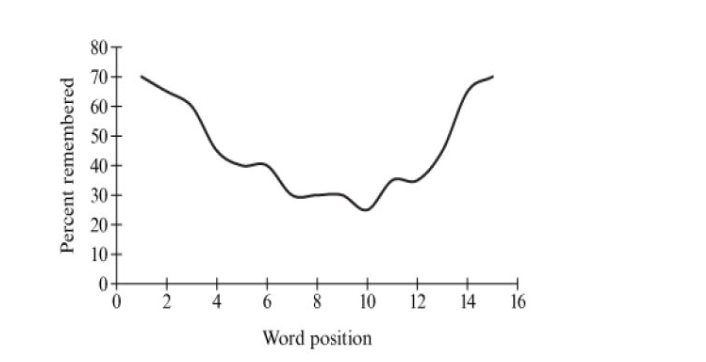
The graph shows the results of a study in which participants are asked to recall a list of fifteen words. Which statement is supported by the graph?
A. There is no primacy effect.
B. There is no recency effect.
C. Retrieval took place immediately after list presentation.
D. Retrieval took place 20 minutes after encoding.
A
A patient with Korsakoff syndrome is very guarded toward the therapist and is reluctant to answer the therapist’s questions. At subsequent appointments, the patient indicates not recognizing the therapist but is less guarded and more willing to answer questions. This suggests that the patient:
A. Has no explicit memory of meeting the therapist but does have an implicit memory of the meeting.
B. Has no episodic memory of meeting the therapist but does have a semantic memory of the meeting.
C. Has no short-term memory of meeting the therapist but does have a long-term memory of the meeting.
D. Has no sensory memory of meeting the therapist but does have a procedural memory of the meeting.
A
The sociological concept of medicalization refers to the process in which:
A. Health care costs consume a growing percentage of a nation’s overall economic output.
B. The medical profession reaches a consensus and establishes norms of professional conduct.
C. A problem becomes described in medical terminology and treated by medical professionals.
D. A society’s population increases after improved medical treatments become more common.
C
Which statement, if assumed to be true, is most likely to indicate a health disparity?
A. The risk of Type 2 diabetes is lower in younger adults than in older adults.
B. Rates of malaria infection decrease with greater distance from the equator.
C. Across the life course, men are less likely to get breast cancer than women.
D. Higher socioeconomic status is associated with a lower incidence of stroke
D
A member of a youth sports league evaluates his or her own behaviors by comparing them to those of professional athletes. For this young athlete, professional athletes represent a(n):
A. Primary group.
B. In-group.
C. Reference group.
D. Social network.
C
Role conflict is best illustrated in which of the following scenarios?
A. A child is teased by peers after playing with toys and games associated with the other gender.
B. After caring for a sick child at home, an employee falls behind with responsibilities at work.
C. Parents are unable to select a treatment for their child after doctors disagree on a diagnosis.
D. After being hospitalized with an illness, a doctor struggles to pay for all of the medical bills.
B
Which statement best reflects how sociologists differentiate the concepts of ethnicity and race?
A. Ethnicity is both dynamic and self-chosen, whereas race is immutable.
B. Ethnicity addresses shared attitudes, whereas race addresses collective norms.
C. Ethnicity is tied to a geographic region, whereas race is tied to an identity.
D. Ethnicity classifies by culture, whereas race classifies by physical characteristics.
D
A. Ethnocentrism refers to in-group favoritism, whereas cultural relativism recognizes an out-group bias.
B. Ethnocentrism assumes universal norms, whereas cultural relativism describes awareness of diversity.
C. Ethnocentrism emphasizes social interaction, whereas cultural relativism focuses on social institutions.
D. Ethnocentrism addresses discriminatory actions, whereas cultural relativism targets prejudicial beliefs.
B
Social stigma is most commonly associated with:
A. An unrecognized prejudice.
B. A failure to cope with stress.
C. An attribute that is devalued.
D. A discriminatory reaction.
C
Which concept refers to feelings of social disconnection that result from weak communal bonds and rapidly changing norms?
A. Anomie
B. Obedience
C. Out-group
D. Role exit
A
Which concept describes the self-concept as a product of social interaction, emerging out of the way an individual perceives others to view him or her?
A. The front stage self
B. The back stage self
C. The looking-glass self
D. The self-fulfilling prophecy
C
Which hypothesis is LEAST compatible with the life course approach to health?
A. Interventions that improve childhood health will have effects that last into adulthood.
B. Occupational status will be correlated with income and cultural capital in adulthood.
C. Children will imitate parents’ behavior, forming patterns that persist into adulthood.
D. Exposure to chronic stressors in adolescence will predict disease risk in adulthood
B
behaviors. If the agency followed the rational choice perspective, which strategy would they most likely use?
A. Reduce the cost of fruits and vegetables while increasing the cost of processed foods.
B. Mandate a reduction in the sugar, salt, and fat content found in public school lunches.
C. Design public spaces that encourage people to increase their level of physical activity.
D. Offer exercise ideas to parents who want to encourage physical activity in their children.
A
Which observation best demonstrates the proposition that gender is socially constructed?
A. On average, females begin pubertal development at an earlier age than males.
B. On average, adult males have higher levels of testosterone than adult females.
C. On average, females have a higher prevalence of osteoporosis than males.
D. On average, males have a higher rate of unintentional injury than females
D
Despite knowing the health risks of tobacco smoking, some long-term cigarette smokers may not attempt to quit. Which statement best explains this observation from the sociological perspective of symbolic interactionism?
A. Cigarette manufacturers have targeted certain groups, in order to exploit and profit from those who become addicted.
B. Smoking signifies membership within a group, which can maintain a social identity along with social connections.
C. Because people have choices in a democratic society, tobacco regulation only partially protects public health.
D. As the number of smokers steadily declines, smoking no longer serves the social function that it once did.
B
Which sociological theory best explains the existence of cross-cultural differences in how mental health disorders are classified?
A. Functionalism
B. Exchange theory
C. Social constructionism
D. Conflict theory
C
A theory based on which concept would best explain how economic development leads to changes in a society’s fertility and mortality rates?
A. Social reproduction
B. Demographic transition
C. Cultural diffusion
D. Social stratification
B
A researcher taking the perspective of social epidemiology is most likely to focus on:
A. Impression management during social interactions.
B. The most common pathologies of social institutions.
C. Medicalization as a feature of modern societies.
D. The social determinants of health and disease.
D
A researcher following the dramaturgical approach to social interaction is most likely to make which prediction?
A. An individual will modify his or her front stage self in response to the perceived audience.
B. The back stage self will be used in social interactions more often than the looking-glass self.
C. Impression management will occur only if individuals understand the relevant social norms.
D. Verbal communication will express more symbolic meaning than nonverbal communication.
A
A researcher designs a study that involves interviewing cancer survivors about their experiences with support groups, along with other forms of social support, during treatment. In order for the study to be considered ethical, the researcher needs to:
A. Explain the study’s research contribution to all participants.
B. Provide ample financial compensation for the participants’ time.
C. Ensure that each participant is asked the exact same questions.
D. Allow the participants to withdraw from the study at any time.
D
A study uses the receipt of government assistance to indicate socioeconomic status. Which of the following reflects the main methodological issue that is raised by using this measure?
A. Validity
B. Reliability
C. Generalizability
D. Reproducibility
A
A study is conducted in which researchers observe how physicians deal with role strain when treating patients with terminal illnesses. This study is best described as following which type of research design?
A. Ethnographic
B. Comparative
C. Experimental
D. Cross-sectional
A
A survey finds that immigrants report fewer symptoms of depression and anxiety than individuals from the same racial/ethnic group who were born in the United States. Which correlation best describes this finding?
A. A positive correlation between socioeconomic status and assimilation.
B. A negative correlation between assimilation and health status.
C. A positive correlation between culture shock and socioeconomic status.
D. A negative correlation between health status and culture shock.
B
Which statement best explains why income distributions are usually reported using the median rather than with other measures of central tendency?
A. For data on high income levels, the median is easier to calculate than the mean or the mode.
B. As a measure of income, the median is more valid and reliable than the mean or the mode.
C. Income data often includes outliers, and the median can summarize skewed distributions.
D. Income data often has missing values, and the median does not require every data point.
C
The socioeconomic gradient in health is best demonstrated by a negative correlation between which variables?
A. Age at arrival as an immigrant and exposure to chronic stressors.
B. The level of economic development and life expectancy at birth.
C. The percentage of people living in urban areas and the obesity rate.
D. Educational attainment and risk factors for cardiovascular disease.
D
Which phenomenon supports the notion that a person can process visual information without being consciously aware of doing so?
A. Age regression
B. Synesthesia
C. Blindsight
D. Agnosi
C