Learning and Memory 3
 Call Kai
 Learn
Learn Practice Test
 Spaced Repetition
 Match
Match Flashcards
 Knowt Play
1/16

There's no tags or description
Looks like no tags are added yet.
Name | Mastery | Learn | Test | Matching | Spaced | Call with Kai |
|---|
No analytics yet
Send a link to your students to track their progress
17 Terms
Engram
The neural substrate responsible for storing and recalling memories
Cells that participate are activated by a learning experience and changed physically and chemically by this experience
Activity pattern is changed in association with subsequent presentation of the stimuli associated with the learning experience – whatever triggers recall should trigger the engram pattern
Not yet a memory but provides the physical conditions for memory to emerge which will emerge when appropriate retrieval cues reactivate the engram
Identifying an engram
Optogenetics can be used to activate an ensemble of neurons that have exhibited activity during the time of learning
Genetic components of the system:
Number of transgenes
Tetracycline regulator responsive promoter that drives channel rhodopsin fused to EYFP
The channel rhodopsin generates the expression of the light induced sodium channel which will excite cells in response to blue light
EYFP allows you to visualise those cells based off fluorescence
Promoter is only active if TTA regulator is regulating it 🡪 bacterial TF not usually found in mammalian genomes so TRE promoter is usually silent but can be activated if we express TTA (tetracycline-associated activator)
tTA is under the control of the fos promoter
an early gene which is produced when cells are exposed to serum or glucocorticoids
generally associated to activity in neurons, fos specifically is associated with high calcium levels
As opposed to CREB which is associated with long term activity
By having tTA under the control of the fos promoter labels the neurons which are in the active state
tTA is also doxycycline repressible 🡪 is the animal on doxycline the system can be turned off ut withdrawal of doxycline allows for the labelling of cells
hippocampus injected with adeno-associated virus that carries the tetracycline regulator responsive channel rhodopsin-EYFP fusion
animals trained to fear conditioning in context A, but then habituated in the prescence of blue light 🡪 ensures that blue light in itself doesn’t act as the conditioned stimulus
Doxycline withheld for 3 days and on the 3rd day fear conditioning training done: foot shock in association with environment B 🡪 labelling of cells in the hippocampus which express fos
Doxycline then put back in so that no new cells labelled (express channel rhodopsin) and test the fear conditioning in context A which was previously habituated and do this in the presence of optogenetic stimulation 🡪 engrams that are formed during B are now activated in A by blue light
The memory from context B should not come back unless tested in context A
control as a construct is missing channel rhodopsin
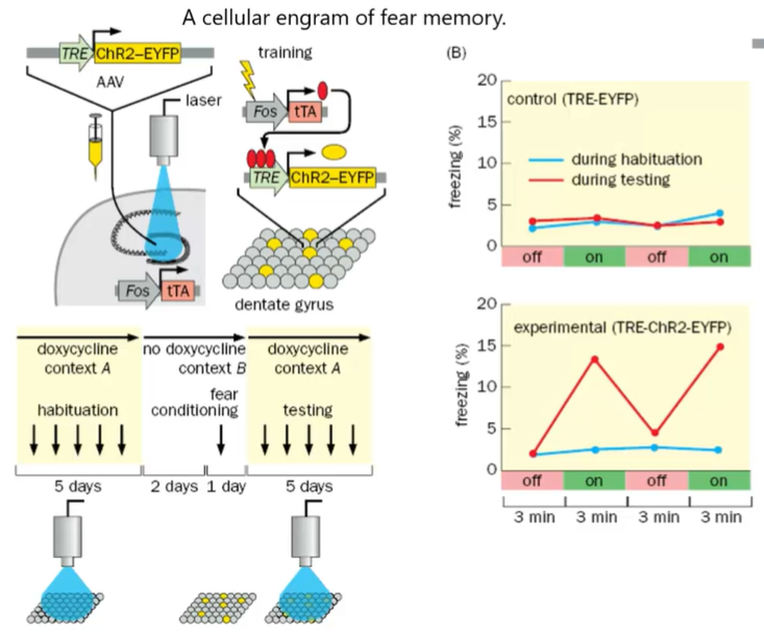
Results
During habituation and testing there’s little freezing in the control where we don’t have the channel rhodopsin
Experimental group where memory formed in context B which is retrievable by blue light exposure, we do see significant freezing but only during testing and not the previous habituation
Way of identifying where engrams are in correspondence to a set of active hippocampal neurons during training 🡪 in other words fear memory is mapped.
Engram labelling technology and memory retrieval in retrograde amnesia
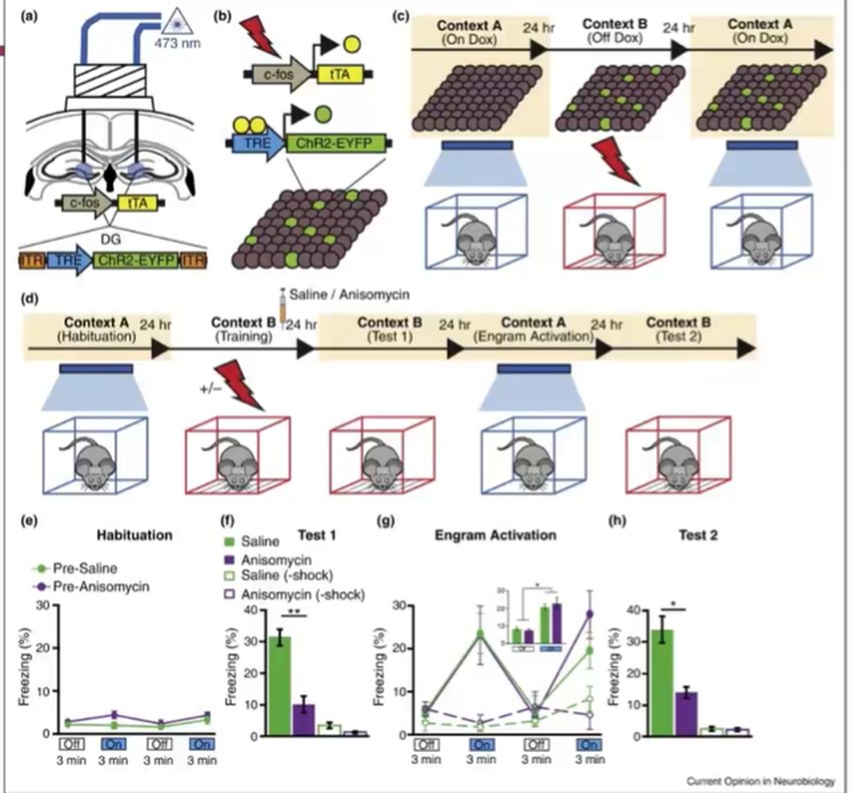
Same experiment done but now we block protein synthesis at various points
If protein synthesis blocked then we have a reduced amount of behavioural freezing, so despite the fact we have formed an engram and short term memory, this is not stable in the long run and requires a long term memory to remember the fear conditioning
If protein synthesis is blocked while forming the memory, then the memory doesn’t stay with you long enough
So protein synthesis can block the effects of training because long term memory requires protein synthesis
Instead of retrieving memory by behaviours conditioning, but instead we recall it by channel rhodopsin activation, we get good recall.
So it seems that memories that are relatively weak, due to the long term cues for changing synaptic strength and solidifying spine connections through protein synthesis being blocked, can be retrieved by the activation of corresponding cells 🡪 memory can be rescued by artificial means
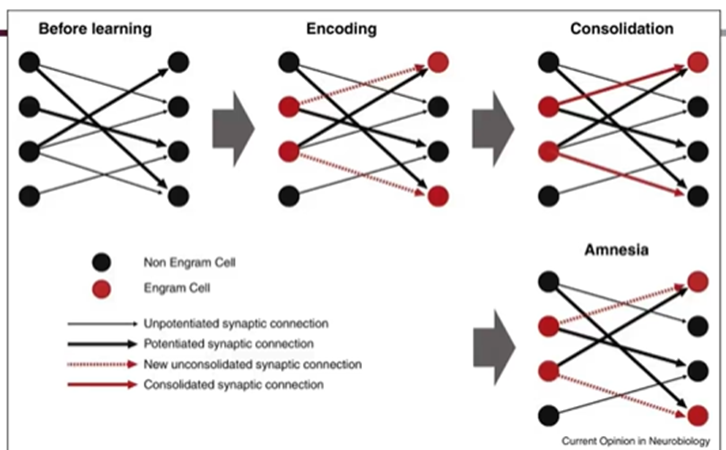
Synaptic connections fade over time if not restimulated
The engram gets formed as a connection between particular cells that encode an association 🡪 E.g: the hippocampus associated in the context with a particular fear input, so there’s new connections made to encode this but these are unconsolidated
Then when these engrams are selected for longer term, we get protein synthesis and consolidation of these connections (synaptic) as a result of protein synsthesis
When we lose these memories, its thought that these connections weaken, not because we lose these cells, but we lose that configuration as a strengthened set of synpases
In theory this could be retrieved if there was a way to seek out this pattern of neurons (trigger the right combination of neurons)
Over time, the less recall that happens for a memory, the synaptic connections hay fade and we lose these memories
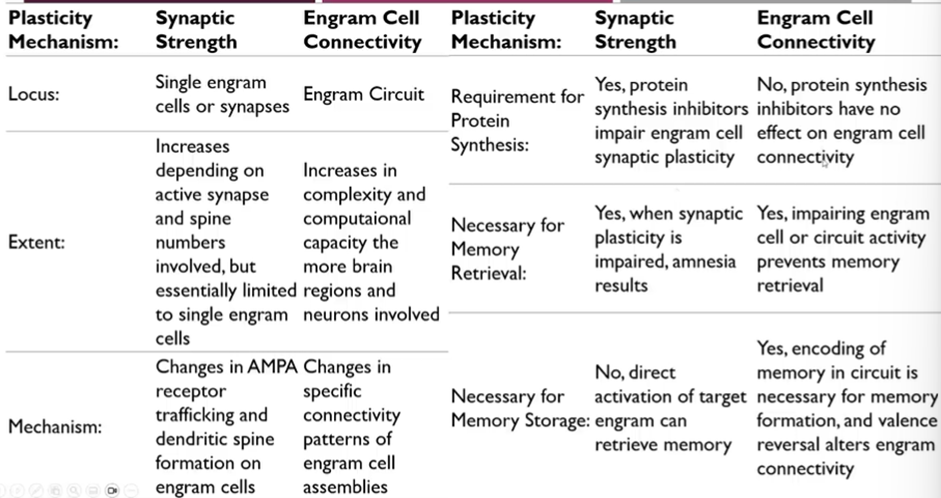
Contribution of synaptic strengthening vs the contribution of cell connectivity
The cell connectivity can overcome reduced synaptic strength if there's a way to trigger it
memory may have spatial, auditory, and visual cues all linked to it
impairing activity in an engram cell may impair retrieval, but may not be necessary for storage
Neurology memory lecture
executive function: set of higher order cognitive processes managed by the brain’s frontal lobes that enable goal-directed behaviour, planning and self regulation
Example of this is when patients asked to spell the word “world” backward 🡪 has to be pulled out of long term memory and move it into short term, change the letters around (executive function)
Even with early AD, executive function is vulnerable
“The Magic Seven”
Found that the maximum number of digits that could be memorised against the fewest number of trials was seven digits (often only 2 trials on average)
Past that, the more numbers the more attempts to get it right were necessary and often past 8 trials, more trials were no longer helpful
Found that if we group things together, known as chunking, made things easier to remember (Eg: 3840738 🡪 384-0738)
Long term memory
Classic scale for long term memory is the Wechsler memory scale
Start with orientation like what the day, month time, how did you get here etc. and are really assessing communication
Then moves onto logical memory: told 2 short stories, then after 15 mins asked to retell the stories and answer yes or no questions about the stories
Then presented 24 faces, wait 20 minutes, then present 48 faces and ask the patient whether they have seen each face before
Then can verbal paired associates with 8 word pairs and then give one word and asked what was with it 🡪 potential memory trick to visualise these two words together in an image
Family pictures – recall information
Give a list of 12 semantically unrelated words and ask how many can be repeated
Can use techniques like creating a story, or grouping words by similarities
Visual reproduction – get the patient to see a visual design and can see if they can redraw this
Test spatial span of a series of numbered blocks on a board
Then test their digit span
Stroop test
Tests executive function
Look at the colour, go down the list and say the colour aloud, then read the word 🡪 confirms that they are not colour blind and can read English well
Then shows a word with a different colour ink to what the word says 🡪 considerably more difficult because the reading part if better trained in our brain and is dominant here
Requires the executive function to reverse the automatic relationship
Loss of executive function means that people cant plan, prepare a meal, get through the day etc.
Patient H.M showing the importance of the hippocampus for storing short term memories but not long term memories
Observed by patient HM the importance of the medial temporal lobe, however, also showed that not all memory were encoded and recalled in this region due to the fact he still had his long term memories
Also lost about 3 years of retrograde memory 🡪 common for memories not just to be retrograde or anterograde but both
How we understand the fact that he hasn’t lost more memories is because the hippocampus is the site of the more recent memories
Can we have retrograde amnesia but not anterograde?
Most head injuries have more anterograde amnesia than retrograde 🡪 More difficulty laying down new memories
Rarely can have dominant retrograde amnesia: man had fell off a horse and had lost most of the episodic and autobiographical knowledge of his life and couldn’t recall much of anything before the injury but the anterograde amnesia was minimal
Injury is localised to the lateral temporal lobe, sparing the hippocampus and the critical medial part of the temporal lobe 🡪 therefore, the anterograde memory was spared
Episodic memory affected greater than semantic memory
Semantic memory is long-term explicit memory that stores general knowledge, facts etc independent of personal experience
Asked where Kilimanjaro was and knew where it was but did not recall climbing it 🡪 gave him an unconscious procedural memory
These injuries teach us that memory is broken down into different components which are distributed throughout the brain and injury may effect different parts of this
Clive Wearing
Contracted herpes encephalitis which resulted in anterograde and retrograde memory capability going back 20 years (until 1965)
Herpes virus has an affinity for the temporal lobe, but in Clive's case also effected the frontal lobe
The complete loss of hippocampal function is responsible for the memory deficits
While the damage to the frontal lobe is responsible for behaviours like repeating himself a lot and exhibiting emotional behaviour. Often manifests as frustration as he is still lucid, not demented.
Had a memory span of 7 to 30 seconds, a moment-to-moment consciousness 🡪 may be forming new memories but not able to detect them
Has to look at his watch and write things down as he thinks he’s always just woken up – though he thinks he was unconscious when he wrote these things
However, his non-declarative memory is still intact, due to the fact that he can still play piano very well, also may include his wife
Differences between the left and right hippocampal functions
Not vast differences but does depend on the region: in the parietal lobes have language on the left, spatial on the right
Fake Memory - How do we know if memory loss is real?
Anna Anderson claimed that she was Anastasia Romanov the wife of the Russian Tsar, but recalled nothing of her life
Had atypical patterns in memory testing:
Had no anterograde amnesia, usually have some kind of mild anterograde amnesia accompanying the retrograde
had a memory score poorer than chance – can fake people out to determine whether their memory is inconsistent
inconsistency between faces vs events, which is usually equally affected by retrograde amnesia
Inability to recall one’s name 🡪 can wipe out almost everything but people usually recall the ability to respond to their name
Lack of imaging evidence for brain injury 🡪 For real retrograde amnesia this is usually supported by brain imaging evidence and usually is worse up until the injury and less severe going back in time
Frequent premorbid psych history
Cases of enhanced memory
A mutant mouse line which had a better performance in memory tests than wild types as a result of NMDA receptor manipulation
Long term memory involves changing the synaptic strength of networks 🡪 get visual, auditory and tactile info from the cortex to the medial temporal cortex
Black are strong synapses, blue are weak
Introducing a new event will introduce a new pattern of synaptic connections, which is initially transient, but if rehearsed, can become stronger, resulting in the successful conversion of short to long term memory
In a mouse if we overexpress the NMDA receptor (Dougie mice) we improve learning
Since then, identified 30 proteins which over expressed improve the ability to remember information- known as hyperthymesia
First described by Luria, and describes a man who can remember amazing amounts, though was using pneumonic tricks rather than having a molecular advantage
The woman who can’t forget: able to recall everything since she was 14 and may be able to contribute to memory research. However, memory is only autobiographical, struggled with being able to recite poems etc.
May suggest that our brains are not geared to remember everything but to sort through what is useful. Our understanding that sleep helps the brain to strengthen synapses which are linked to meaningful concepts and erase impressions in the short-term memory which are isolated 🡪 This is why it’s easier to remember linked concepts or terms