PUBH 1 Actual questions and answers with 100% accuracy(VERIFIED BY PROFESSOR)
 Call Kai
 Learn
Learn Practice Test
 Spaced Repetition
 Match
Match Flashcards
1/54

There's no tags or description
Looks like no tags are added yet.
Name | Mastery | Learn | Test | Matching | Spaced | Call with Kai |
|---|
No analytics yet
Send a link to your students to track their progress
55 Terms
How is public health defined?
Efforts to keep and maintain a healthy population.
What are the seven 'Ps' of public health?
Protection, Promotion, Prevention, Prolonging, Product safety, Physical/social/economic environments, and Population.
What are 'determinants of health'?
The range of personal, social, economic, and environmental factors that influence health status and determine why a population is at risk.
How is the overall health of a population measured?
Through life expectancy from birth and infant mortality rates.
What are five public health achievements since 1900 that increased U.S. life expectancy?
Vaccinations, recognition of tobacco health risks, healthier mothers and babies, family planning, and motor vehicle safety.
What is primary prevention?
Actions taken to prevent disease before it starts, such as exercise or not smoking.
What is secondary prevention?
Actions taken to identify disease early, such as mammograms, blood tests, or colonoscopies.
What is tertiary prevention?
Interventions to assist diseased persons in limiting the effects of the disease, such as chemotherapy, surgery, or rehab.
What is the role of Federalism in public health laws?
It allows states to hold the power of decision-making for matters like quarantines and health laws.
What are the two major levels of governmental public health?
Federal and state/local.
What are the three core functions of public health?
Assessment, Policy Development, and Assurance.
What is the role of the federal government in the U.S. public health system?
To set national policy, provide funding, conduct research, and act when health threats span multiple states or exceed state resources.
What are the three approaches to organizing health responsibilities within state government?
Centralized, decentralized, and mixed (shared) systems.
What are the general responsibilities of state health departments?
Developing statewide policies, collecting health data, and providing funding for local departments.
What are the general responsibilities of local health departments?
Providing direct services like vaccinations, screenings, restaurant inspections, community health education, and outbreak response.
What is epidemiology?
The study of the spread and determinants of disease.
What does the P.E.R.I. framework stand for in epidemiology?
Problem, Etiology, Recommendations, and Implementation.
What is defined as health equity?
The principle that everyone has a fair and just opportunity to be healthy.
Give an example of the 'Protection' P in public health.
Food inspections in restaurants.
Give an example of the 'Promotion' P in public health.
Nonsmoking flyers.
Give an example of the 'Prevention' P in public health.
Vaccines and cancer screenings.
Give an example of the 'Prolonging' P in public health.
Better pre-natal care and management of chronic diseases.
Give an example of the 'Product safety' P in public health.
Recalls, testing, and regulation of consumer goods.
Give an example of the 'Population' P in public health.
Tracking obesity rates in children across neighborhoods to identify at-risk groups.
What is the 'E' in the P.E.R.I. framework?
Etiology: determining the 'why' and establishing if a cause precedes an effect.
What is incidence rate?
The number of new health-related events or cases of a disease in a population exposed to that risk in a given time period.
What is prevalence rate?
The proportion of a population that has a particular disease, injury, or condition at a specified point in time or during a specified period.
What is crude mortality rate?
The mortality rate from all causes of death for a population without adjustment.
What are macro determinants of health?
Factors that focus on larger systems and environments shaping health for entire populations, such as economic systems, public policies, and physical environments.
What are micro determinants of health?
Factors that directly affect an individual person, such as genetics, personal behaviors, income, and education.
What are the four conditions used to strengthen a contributory cause?
Strength of association, dose-response relationship, consistency, and biological plausibility.
How has the primary cause of premature death in the U.S. shifted over time?
It has shifted from smoking-dominated causes to lifestyle factors (diet/inactivity) and drug use.
What does a city tracking rising asthma rates in low-income neighborhoods represent?
Population.
What is the primary category for a law requiring calorie labels on menus?
Policy/Protection.
Which scenario best represents 'protection' in public health?
Restaurant food inspections.
What is the best example of a macro determinant?
National healthcare policy.
What is an example of a micro determinant?
Smoking behavior.
A community lacking grocery stores with healthy food is an example of which type of determinant?
Environmental determinant.
Which measure best reflects improvements in population health over time?
Life expectancy.
What does a decrease in infant mortality suggest?
Improved population health.
Which public health achievement most directly reduced infectious disease deaths?
Vaccination.
What type of prevention is a colonoscopy used to detect early cancer?
Secondary prevention.
What type of prevention is rehabilitation after a stroke?
Tertiary prevention.
Which government action reflects federal responsibility?
Coordinating response to a multi-state outbreak.
What is the primary focus of epidemiology?
Studying disease distribution and causes.
In the PERI framework, during which stage does identifying risk factors occur?
Etiology.
Which situation best represents incidence?
New flu cases this month.
What does a dose-response relationship mean?
More exposure leads to greater risk.
If multiple studies show the same result, which condition of causality is supported?
Consistency.
What does biological plausibility mean in determining causality?
There is a logical scientific explanation for the relationship.
What best demonstrates health equity?
Targeting resources to underserved communities.
Which essential public health service is used when data is collected on disease rates?
Assessment.
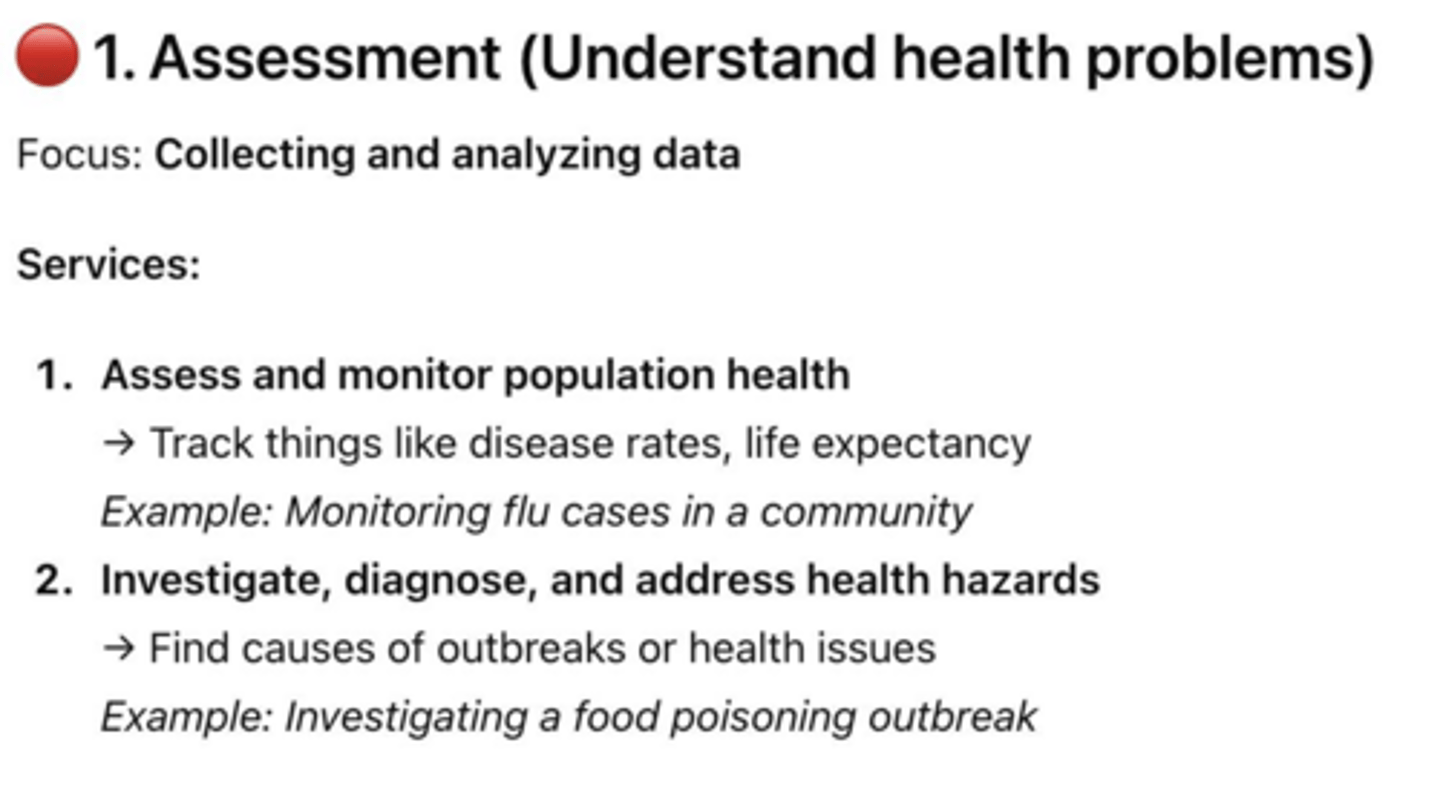
Enforcing restaurant safety codes is an example of which essential service?
Assurance.
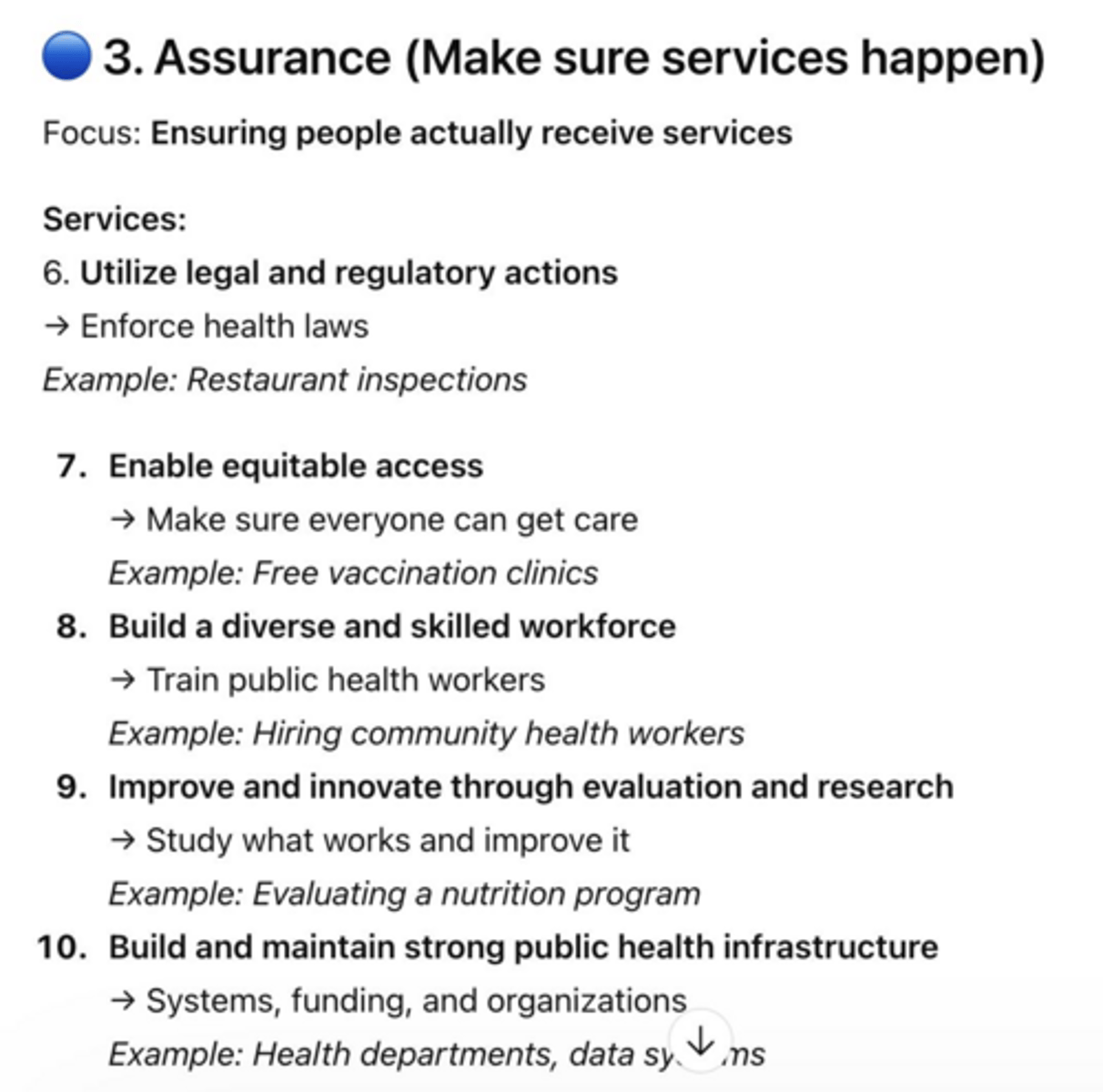
What does a national anti-smoking campaign reflect?
Promotion.
Which scenario best shows collaboration across levels of government?
CDC provides guidance, states create rules, and locals deliver services.