Respiratory responses to exercise
 Call Kai
 Learn
Learn Practice Test
 Spaced Repetition
 Match
Match Flashcards
 Knowt Play
1/14

There's no tags or description
Looks like no tags are added yet.
Name | Mastery | Learn | Test | Matching | Spaced | Call with Kai |
|---|
No analytics yet
Send a link to your students to track their progress
15 Terms
How do central chemoreceptors work?
Stimulated by increase in CO2 in the cerebrospinal fluid
This will cause an increase in depth and rate of breathing, and remove excess CO2 out of the body
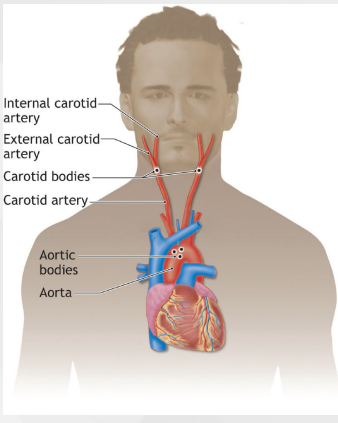
How do the 2 peripheral chemoreceptors work?
Carotid bodies = found in the neck, detecting levels of O2, CO2, H+ going to the brain
Aortic bodies = found in the heart, detecting levels of O2, CO2, H+ going to the heart
What happens to ventilation as altitude increases?
As altitude increases the partial pressure of oxygen decreases
Therefore ventilation rates increase in order to maintain homeostasis
This coordination occurs via involuntary regulation and pulmonary regulation
How does increased breathing rate remove more CO2?
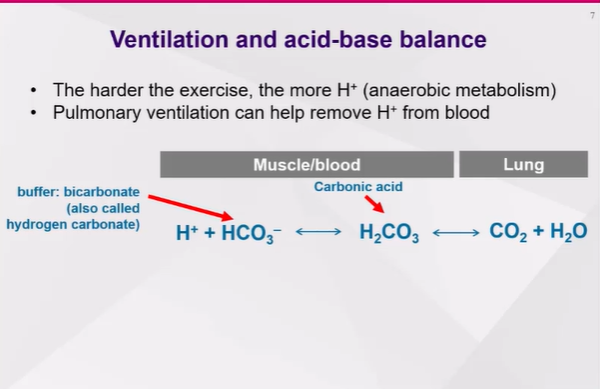
Intense exercise will produce lactate and protons due to anaerobic work
Bicarbonate buffer will combine with these protons to form carbonic acid
Carbonic acid then travels into the blood, and falls apart into CO"2 and water
CO2 will be removed as breathing occurs
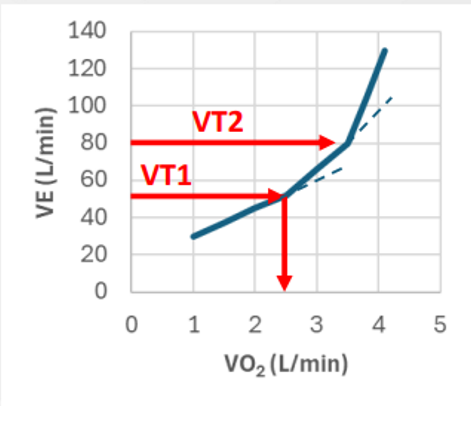
What is ventilatory threshold?
The point where minute ventilation increases disproportionately to oxygen consumption (i.e. breathings increases faster than VO2 uptake)
What is VT1?
Ventilatory threshold 1 signals the shift from fat to carb fuel usage
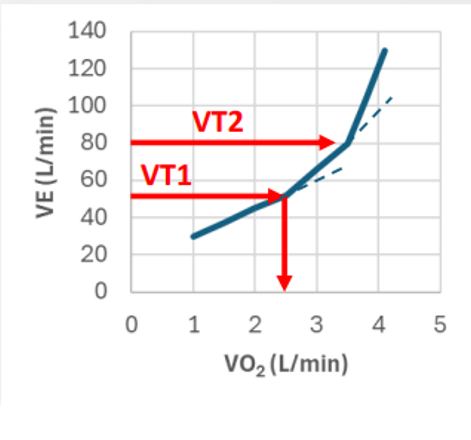
What is VT2?
Ventilatory threshold 2 signals the transition to unsustainable high intensity exercise
What is ventilatory equivalent for oxygen?
The amount of ventilation needed to take in 1 litre of oxygen
e.g. ventilation of 80L and VO2 of 2L, means ventilatory equivalent is 40L
What causes the ventilatory equivalent for oxygen to increase at VT1?
As intensity increases the blood H+ increases, producing more CO2
The increased CO2 causes ventilatory responses (e.g. increased breathing rate) to remove it
Therefore ventilation increases to reduce blood CO2 rates
What is the respiratory compensation point (RCP)?
After MLSS CO2 and lactate levels will increase, causing ventilation to further increase
This steeper rise is called the RCP, and is at the same point as VT2
What other factors cause increased ventilation?
Increased core temperature
Increased potassium levels
Mechanical receptors in muscles
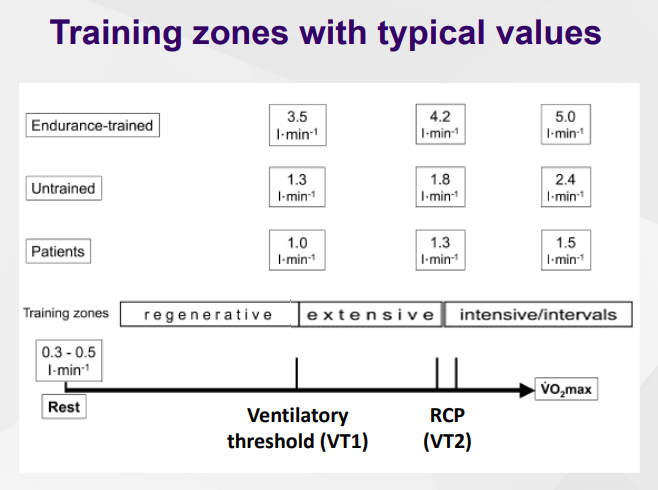
What are the typical values with different training zones?
What are the advantage for finding a persons ventilatory threshold?
Can help to prescribe training plans
Not invasive (e.g. don’t have to prick and remove blood from athlete)
What are the disadvantages for finding a persons ventilatory threshold?
Equipment is more expensive than other methods, such as blood lactate test
Face and nose mask can still be uncomfortable, and cause hyperventilation
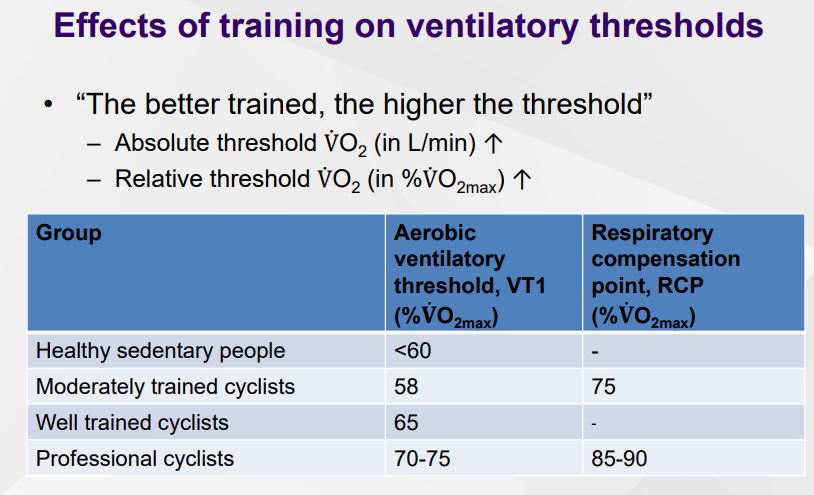
What are the effects of training on the VT1 and VT2 of an athletes VO2 Max
Endurance training increases VT1 and VT2 as a percentage of VO₂max, allowing athletes to exercise at higher intensities before lactate accumulation and respiratory compensation occur,
VO₂max remains relatively unchanged.