5.12 - Conditional cooperation and the strategy method
 Call Kai
 Learn
Learn Practice Test
 Spaced Repetition
 Match
Match Flashcards
 Knowt Play
1/17

There's no tags or description
Looks like no tags are added yet.
Name | Mastery | Learn | Test | Matching | Spaced | Call with Kai |
|---|
No analytics yet
Send a link to your students to track their progress
18 Terms
Voluntary contribution mechanisms (VCM) design
Subjects in group of size n
Money payoffs proportional to points
Each player i endowed with E token
divide between private account (each token = 1 point for i)
and public account (earns m points per token regardless of who put it in the account)
VCM strategies
If each player i wants to maximise own points:
dominant strategy for i to set contributions (ci) = 0 to public account
All players get E
Social optimum is for all players to contribute all E to public account
all receive mnE points
Typical parameter: 1 > m > 1/n
VCM typical findings
m usually set around 0.4-0.6 (and m > 1/n)
If 1-shot game:
~20% contribute 0 to public account
subjects contribute ~40-60% of endowment to public account
If repeated games (with feedback on contributions):
Contribution rates decay towards 0
Reasons / theories for contributing to VCM
Error / learning - Players may be confused in early rounds
Strategic - Players may think contributing in early rounds of repeated game will raise future contributions of others
Preference accounts - Subjects may not be motivated only by their own money payoffs
Utility doesnt just depend on own money payoff
Altruism / warm glow - Warm glow gained from ‘moral’ behaviour
BUT doesnt explain decay or why some FR in 1st round
Fischbacher et al. (2012) - OV (FGQ)
Focus on repeated game in C-experiment (10 round repeated VCM)
strangers matching protocol
Each subject’s beliefs elicited in each round about others members contributions
small reward for being right, or nearly - incentivised
P-Experiment used to classify subjects into preference types
Paper draws on:
FG(2010) - decay caused by disappointed expectations among subjects - conditional cooperators
FGF (2001) - uses same strategy method
Uses individual-level analysis that categorises each subject into a preference type from P-experiment
Strategy method
Developed by Selten in 1960s
Used in sequential games to elicit a subject’s “choice” for every point in a game tree where it would be that subject’s move
even thought not all reached in real play
FGF (2001) adapt it to symmetric, simultaneous-play games
e.g VCM games
How to detect conditional contributors
Need to know what they would want to contribute for different levels of contribution by other players.
One-shot game: Players move simultaneously, so are not responding to others.
Repeated game: Only see responses to the behaviour of others that has actually occurred
Both dont show what person would have played if known others contribution
So use contribution table to let each player announce a “strategy”, for transformed one-shot game in which they move last,
i.e. Announce a contribution level for each possible average contribution levels of other group members
Different types of strategies
Free-riders: Never contribute.
Unconditional cooperators: Maximal contribution, regardless of average contributions of others.
Conditional cooperators: Contributions vary positively and (weakly) monotonically with average contributions of others.
Perfect conditional cooperators: Contributions equal average contributions of others
Different types of strategies graphically
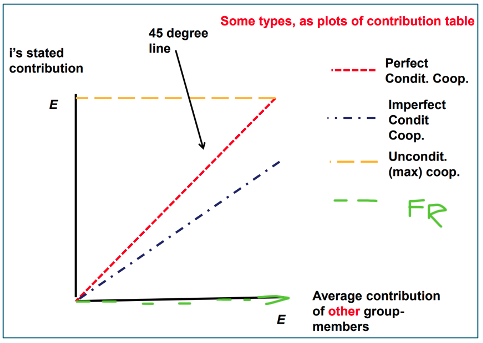
real subject might not have straight line / monotonic preferences
We assume preferences fixed BUT changes in behaviour caused by changes in beliefs
P-experiment design - FGQ (2012)
One-shot VCM game
Each subject states unconditional contribution + reveals “strategy” by contribution table.
Then 1 subject i chosen randomly from group BUT other group members play their unconditional contributions
Subject i’s choice determined by their strategy in light of the unconditional contributions of others
1 group member uses strategy whereas other 3 use unconditional contribution
Incentive to complete contribution table honestly as any part of contribution table may be used
P-experiment results - FGQ (2012)
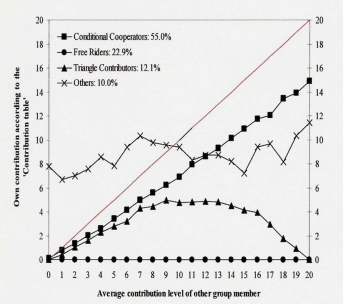
55% CC 23% FR Most people CC but not perfect CC
TC increase contributions initially and then decrease as others give higher - strategic contributions
C-experiment aggregate results - FGQ (2012)
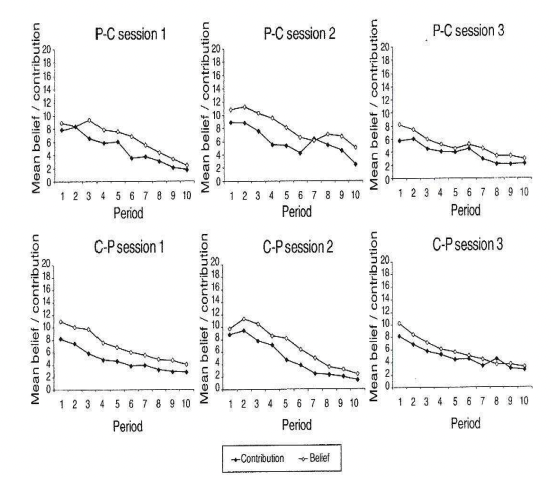
Decay in both contributions & beliefs found
contributions slightly below beliefs - causes cyclical decline
C-experiment individual prediction - FGQ (2012)
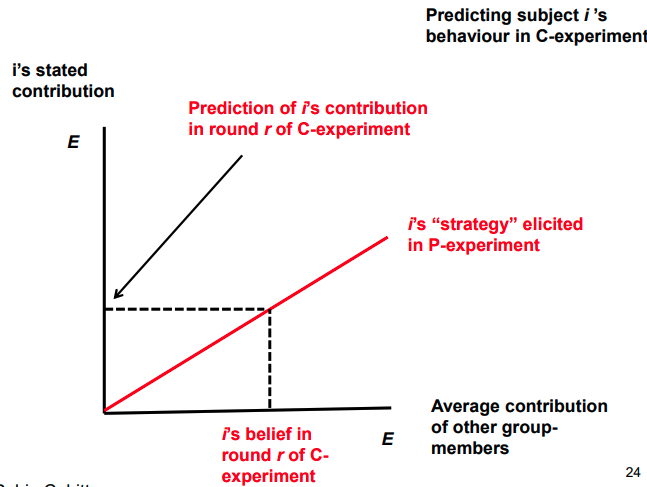
Subjects “strategy” from P-experiment + stated belief in each round of C-experiment combined to “predict” i’s behaviour in round r of C-experiment
individual level predictions
If predictions accurate then they re-assure about strategy method
+ support “stable preference + changing beliefs” account of falling contributions
Individual prediction graphically - FGQ (2012)
Individual prediction accuracy - FGQ (2012)
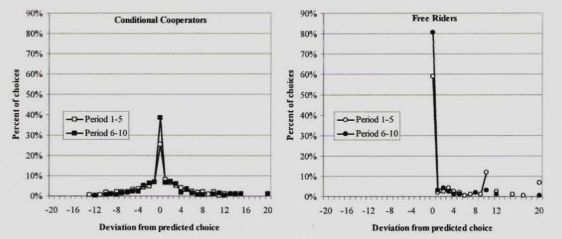
Predictions mostly accurate (for CC & FR)
especially in later rounds
Shows FR dont always FR (strategic contribution)
CC have condensed set of results (+- 4 from 0 deviation)
Contribution table telling the truth in how people would behave in real life
CC vs FR beliefs and real response - repeated game FGQ (2012)
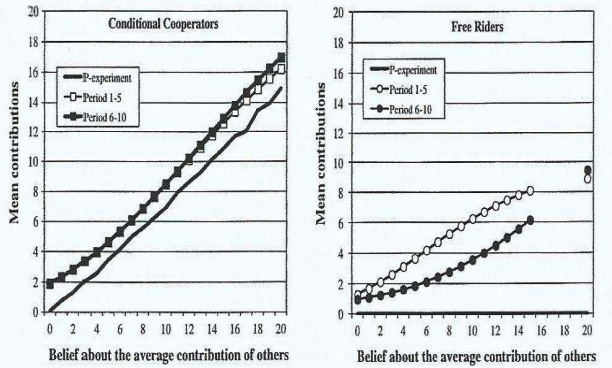
In C-experiment, CC respond like in contribution table
FR still have positive relationship between belief & action
FR behave as CC in early rounds
CC vs FR beliefs and real response - 1-shot game FGQ (2012)
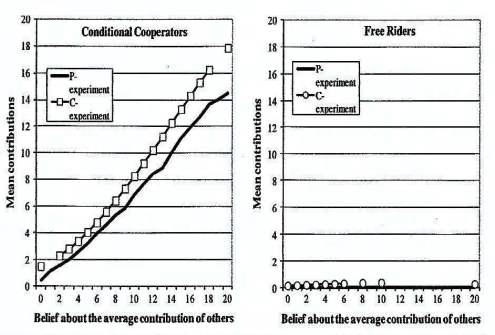
No incentive for FR to contribute at all strategically in 1-shot game
FR behave how expected (not CC at all like in repeated)
Dangerous mix and decay
Imperfect CC want to “undercut” contribution they expect from others.
Causes downward spiral of contributions subjects make expect others to make.
Presence of FR hastens this process.
Sustained high contributions to PG games very hard to see in reality
Constant undercutting from both imperfect CC + FR