Prenatal Development (not timeline)
 Call Kai
 Learn
Learn Practice Test
 Spaced Repetition
 Match
Match Flashcards
 Knowt Play
1/35

There's no tags or description
Looks like no tags are added yet.
Name | Mastery | Learn | Test | Matching | Spaced | Call with Kai |
|---|
No analytics yet
Send a link to your students to track their progress
36 Terms
fertilization
moment of conception: joining of the sperm and ovum to create a single celled zygote that develops into a baby
t/f: females are born with over 400,000 ova which mature at puberty
true
males produce sperm with much _____ (shorter, longer, or the same) lifespan as compared to ova and produce _______ sperm per day
shorter; several hundred million
3 stages of prenatal development
germinal, embryonic, fetal
germinal stage timeline
weeks 3 and 4 of pregnancy (first 2 weeks following conception)
germinal stage
first and shortest stage of prenatal development taking place during the first 2 weeks following conception
baby is called a ______ after the sperm meets the egg in the germinal stage
zygote
during the germinal stage methodical cell division leads the zygote to develop into a ___________. this is created by the cell dividing as it travels down the fallopian tube
blastocyst
blastocyst
characterized by an inner group of cells and an outer shell. the outer cells will eventually become the embryo and the outer shell will eventually become membrane that nourish and protect baby
blastocyst attaches to the uterine wall in week __
4
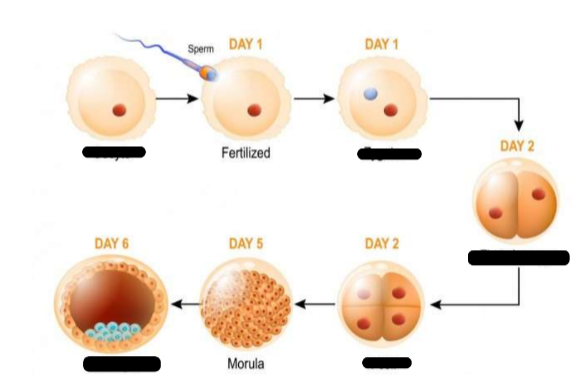
top left
oocyte
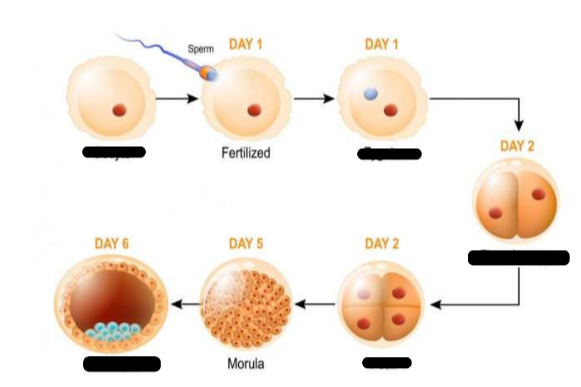
top right
zygote
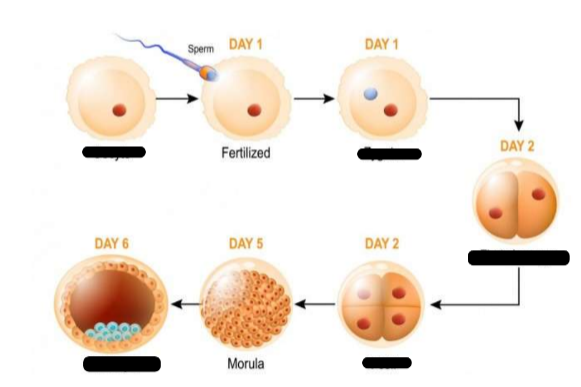
1st day 2
first clevage
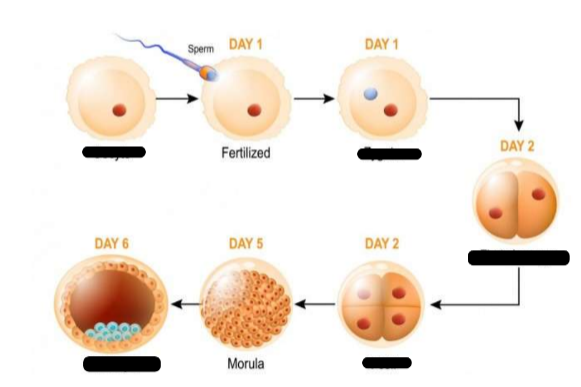
2nd day 2
4 cell
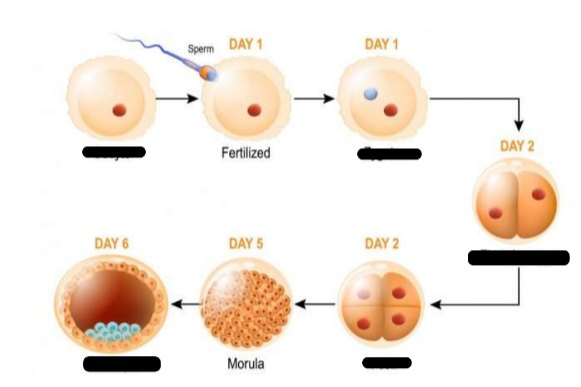
day 6
blastocyst
embryonic stage timeline
weeks 5-10 out of 40 week pregnancy (3-8 weeks following conception)
embryonic stage
middle stage of pregnancy during which significant growth occurs in the major organs and body systems. the developing child is now composed of 3 layers (ectoderm, mesoderm, endoderm)
in the 2nd stage of prenatal development, baby is called a(n) _________
embryo
fetal stage timeline
weeks 10-40 of pregnancy (begins 8 weeks after conception until birth)
baby is called a(n) _______ in the last stage of prenatal development
fetus
fetal stage
stage where baby dramatically increases in size and weight, organs become more differentiated and operational, by 3 months baby swallows and urinates, by 4 months mom can feel baby move
teratogen sensitivity
various parts of the body are more sensitive to teratogens at different stages of development
teratogens
environmental agents such as a virus, chemical, or other factor that produces a birth defect. at some stages of prenatal development this may have a minimal impact but during other periods the consequences can be severe
____ is the most vulnerable body system during prenatal development with being open to teratogen sensitivity the entire time
CNS
the heart is vulnerable to teratogens from week _-_. During the ______ stage
3-10; embryonic
mothers over 30 and adolescent mothers are at a greater risk for a variety of pregnancy and birth complications such as…
premature birth, low birth weight, down syndrome, higher infant mortality rates, illness
contracting _________ prior to the 11th week can cause blindness, deafness, heart defects, or brain damage
rubella (german measles)
_______ and _______ can cause birth defects and miscarriage
chicken pox; mumps
______ and ______ can be transmitted to the child
syphilis; gonorrhea (syphilis usually begins to cross the placental barrier at the 4th month, so if antibiotic treatment is initiated before then you can prevent complications)
______ (drug) can lead to bleeding
aspirin
______ (drug) causes missing limbs
thalidomide
_____ (drug) restricts oxygen to fetus
marijuana
_____ (drug) restricts blood flow and oxygen. also babies are born addicted and have to go through withdrawl, they’re shorter, weight less, often hvae serious respiratory probs, seizures, and it’s often impossible to soothe them
cocaine
fetal alcohol syndrome (FAS)
a disorder caused by the pregnant mother consuming substantial quantities of alcohol during pregnancy potentially resulting in cognitive delay, delayed growth, and facial deformities
alcohol-related neurodevelopmental disorder (ARND)
associated with intellectual disabilities, learning disabilities, and behavioral probs (not necessarily physical disabilities)
alcohol-related birth defects (ARBD)
birth defects related to the heart, kidneys, bones, or with hearing. these may be isolated defects or a mix of any of them (not necessarily cognitive disabilities)