Myth in Art Week 9
 Call Kai
 Learn
Learn Practice Test
 Spaced Repetition
 Match
Match Flashcards
 Knowt Play
1/85

There's no tags or description
Looks like no tags are added yet.
Name | Mastery | Learn | Test | Matching | Spaced | Call with Kai |
|---|
No analytics yet
Send a link to your students to track their progress
86 Terms
When are Roman mythological sarcophagi typically from?
Timespan: second to third centuries CE
What are key questions to consider when looking at these sarcophagi?
What myths appear and why?
Earlier precedents - are they the same myths/elements of myths used in other contexts/on other media? How are the myths different in this new context
How does the change of context affect our interpretation of the imagery?
Are there specific themes/combinations?
What are the three main types of sarcophagi?
Three main types (myth appears in all):
Garland.
Columnar.
Frieze.
What were the three major centres of production of sarcophagi?
Three major centres of production: Attica, Asia Minor and Rome
Give info on the sarcophagi that were produced in Attica:
Monumental; mythological imagery on all four sides; frieze type. Very large and almost exclusively show mythological imagery
Give info on the sarcophagi that were produced in Asia Minor:
Locally produced; columnar/garland most popular; some frieze type.
Give info on the sarcophagi that were produced in Rome:
All three types appear.- Garland, Columnar and Frieze
Around 50 different myths identified to date.
Addition of portrait heads and features.- added on to the mythological figures and start appearing from the late second century
Some non-mythological subjects (hunting/philosophy/biographical detail).
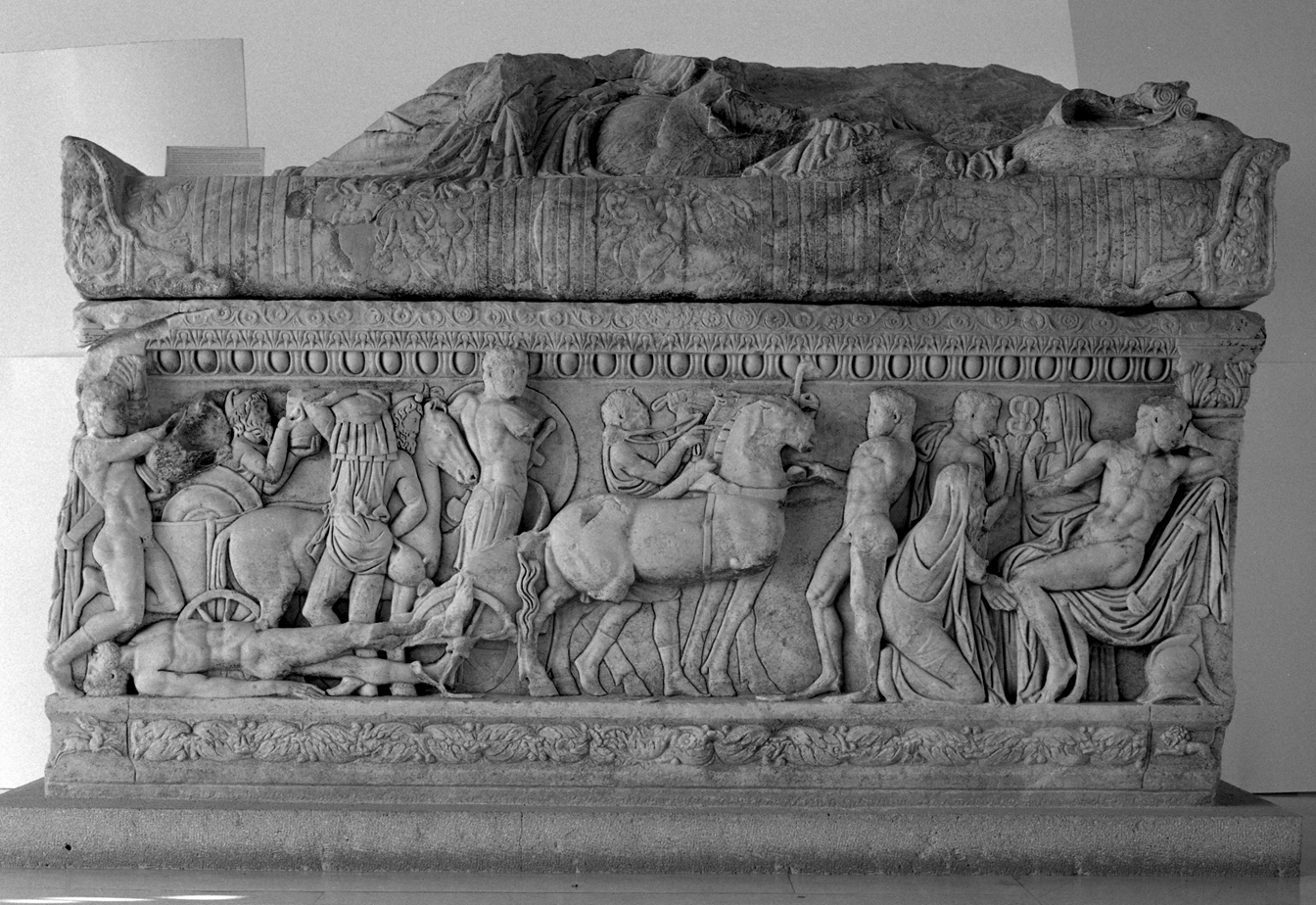
Identify where it is from, the date and the type of sarcophagi:
Attic sarcophagus:
End second century CE.
Frieze type.
Which myth does the sarcophagus portray?
Ransom of Hector.
Decoration above and below that frames the scene
On the far right we see Priam supplicating Achilles with mercury stood behind- strong Homeric theme, evokes heroism and feeds into the theme of mourning, and the need for proper burial
Identify where it is from, the date and the type of sarcophagi:
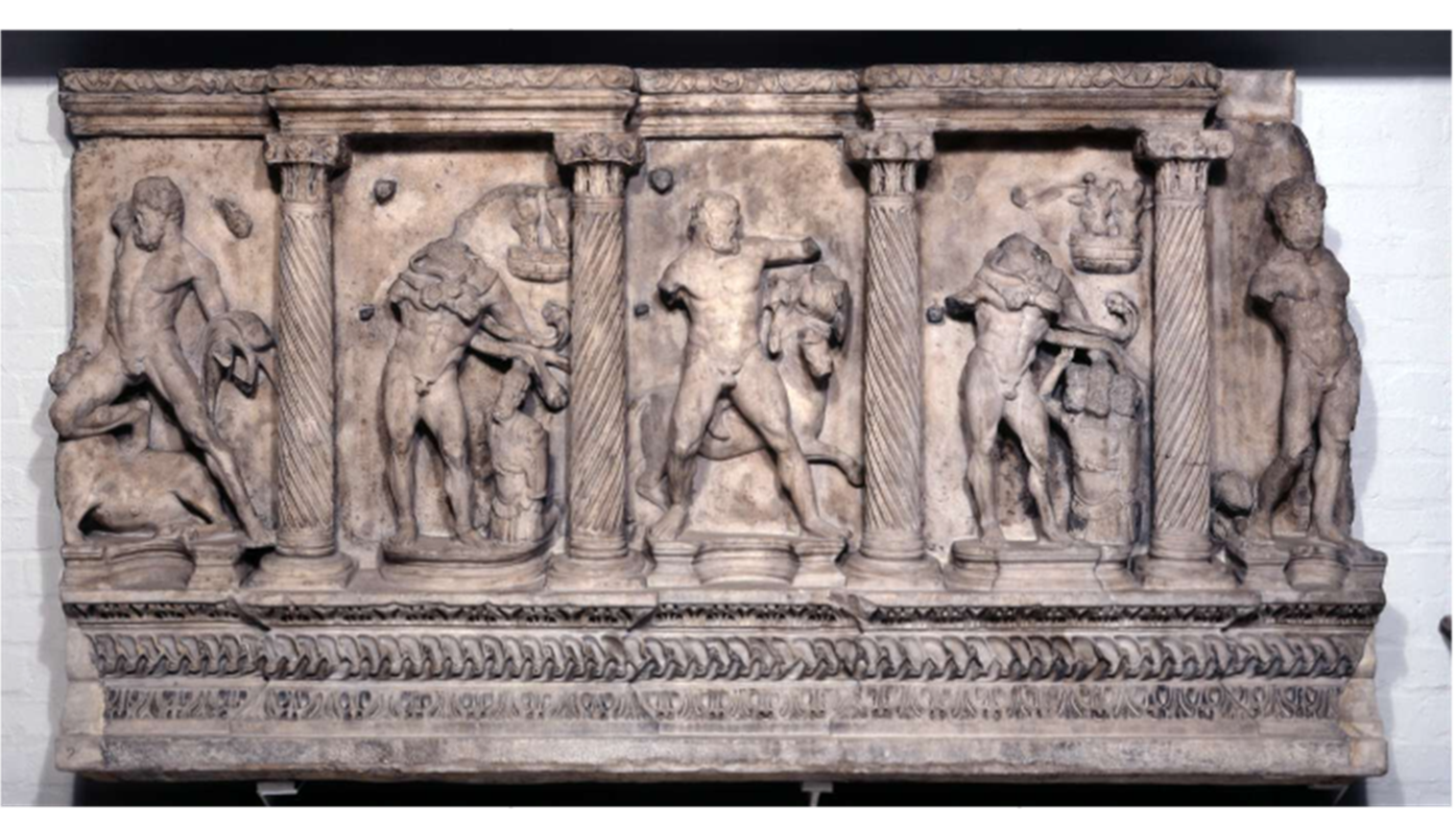
Asia Minor (Phrygia) sarcophagus:
ca. 160-190 CE.
Columnar type.
What myths does the sarcophagi portray?
Labours of Herakles (7th- 11th labours).
The imagery is very divided into separate sections, they look like free standing statuettes, theyre all standing on these plinths- main feature of columnar sarcophagi is the images being separated like this- the columns have patterning that alternates (complex decoration)
Identify where it is from, the date and the type of sarcophagi:
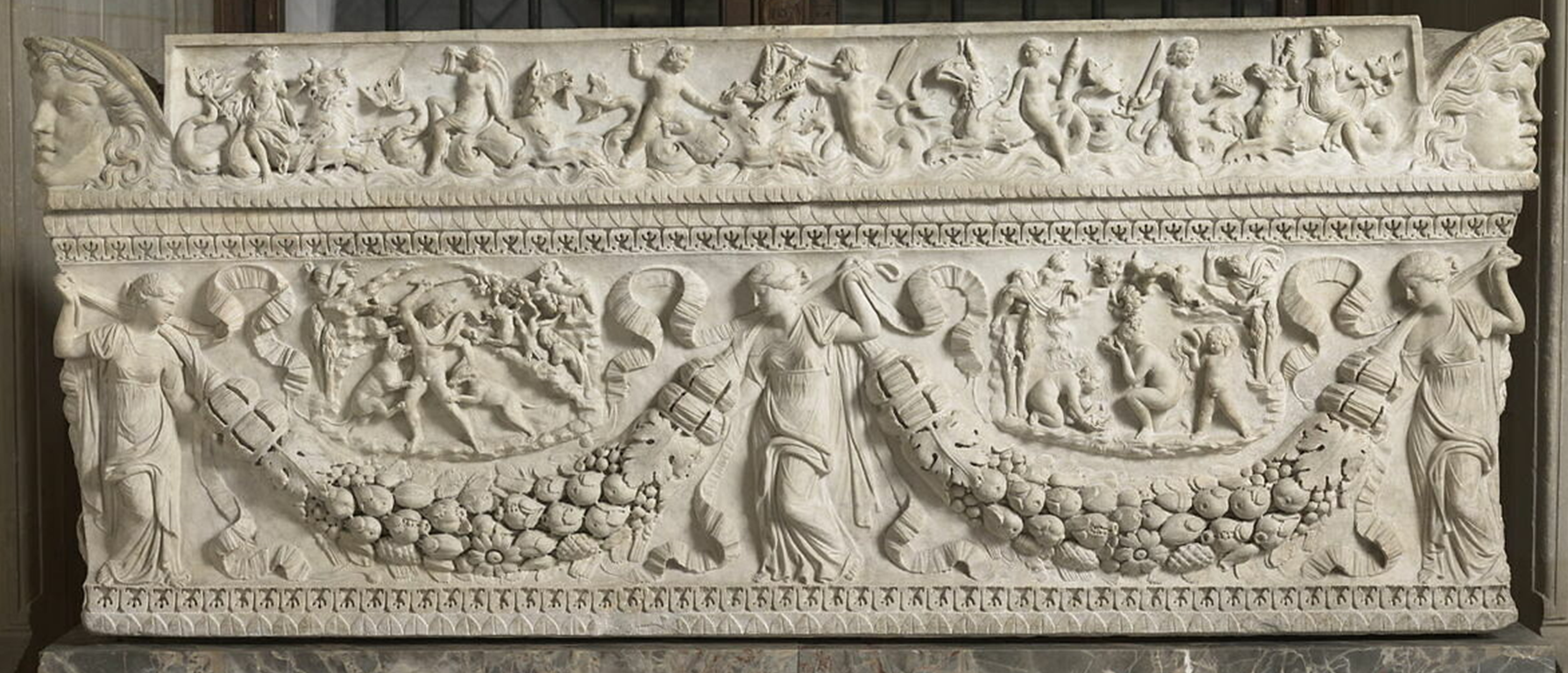
Roman sarcophagus (Via Labicana):
ca. 160-190 CE.
Garland type.
Identify the myth and characters shown on the sarcophagi:
Nereids, Artemis and Actaeon
Frieze in the upper part possibly the Nereids, below this there are three large figures of women holding up very large garlands, the garlands are made up of flowers, pinecones and leaves. Two little vignettes within the garlands- mythological imagery. Both of these refer to the myth of Actaeon, on the right we have Artemis bathing and on the left Actaeon is being attacked by the hounds. On the ends there were two further scenes relating to the myths, the prep for them going hunting and his funeral
The lid doesn’t always correlate with the main imagery
How had people typically been burried/disposed of before sarcophagi?
Change from cremation to inhumation. Cremation had been predominate before this point- there is no clear reason for why it changed
What context do we have to consider when viewing tombs?
Positioning, and the space within the he tomb. Sarcophagi were sometimes placed in niche locations meaning only paert of the tomb would have been visible- must also consider that other imagery may have been present e.g. frescos, this opens up the possibility of themes within tombs
Other imagery.
When would people have been viewing these tombs?
Funerary rites/”lying in state” type of event.
Family tombs were used over time so they would have been reopened later on- Later funerals.
Possible other cultic occasions.
What are challenges/tensions for us when looking at sarcophagi?
Lack of information about the deceased – gender/age/status. It is hard to build a picture of them, skeletons rarely survive in sarcophagi
Reuse of sarcophagi., the occupant that we might find may be of a later date than the sarcophagus
Extant human remains and imagery not correlating e.g. a sarcophagi may have imagery suggesting the occupant is female but they may turn out to be male
Different understandings of mythological narratives can complicate interpretation- the same myth can be used in different ways
Identify this sarcophagi:
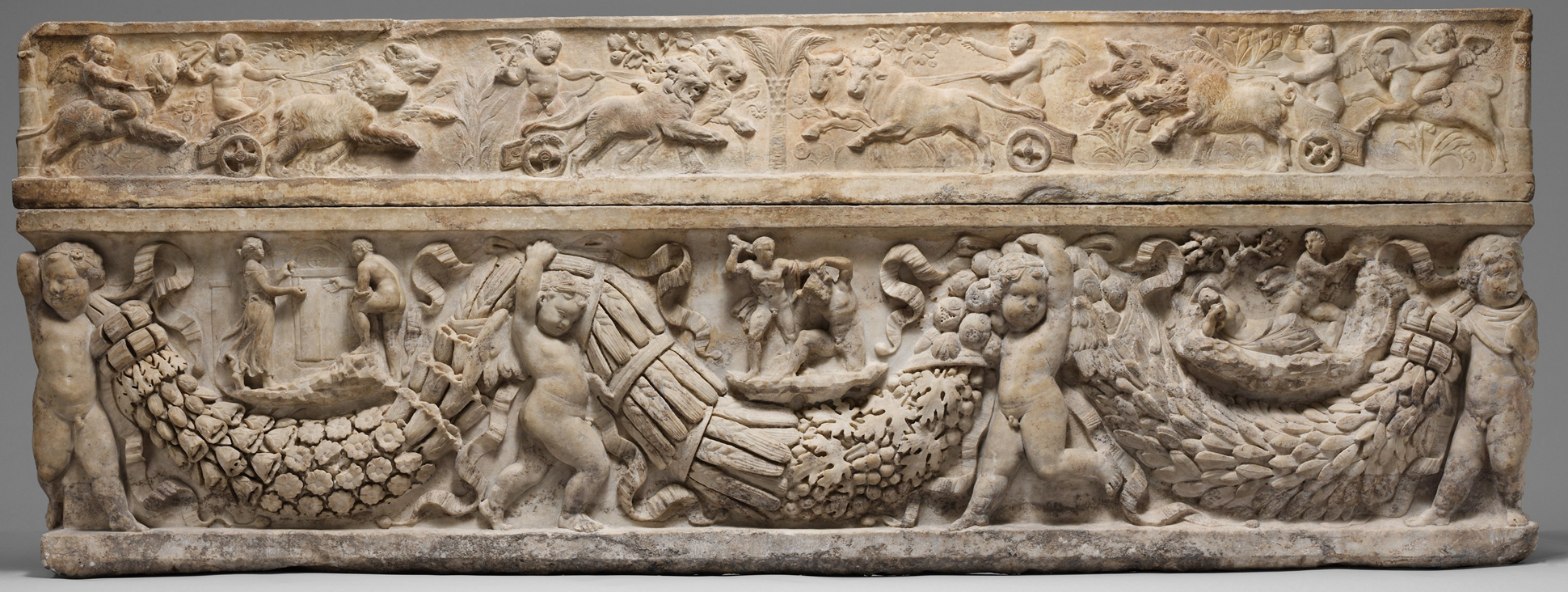
Roman Garland Sarcophagus, ca. 130-150CE. Metropolitan Museum of Art, New York 90.12
Identify the figures/scene in this part of the sarcophagi:
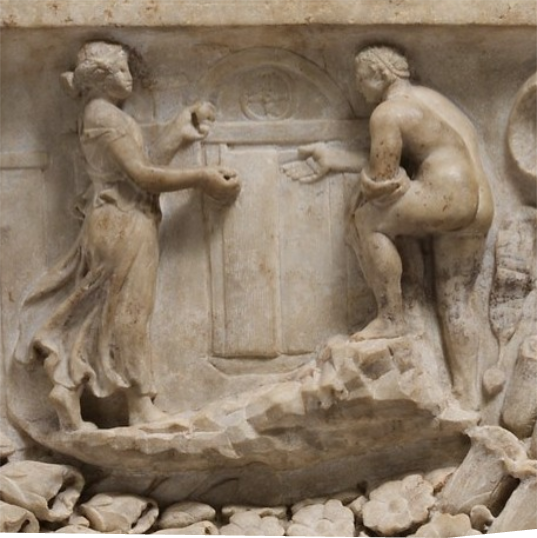
Ariadne helping Theseus
Identify the figures/scene in this part of the sarcophagi:
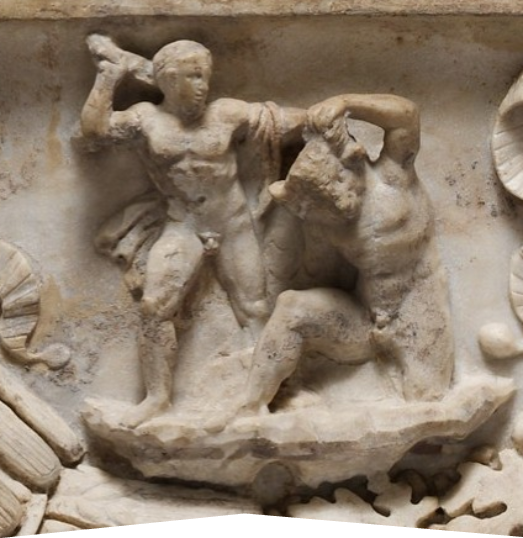
Theseus and the Minotaur
Identify the figures/scene in this part of the sarcophagi:
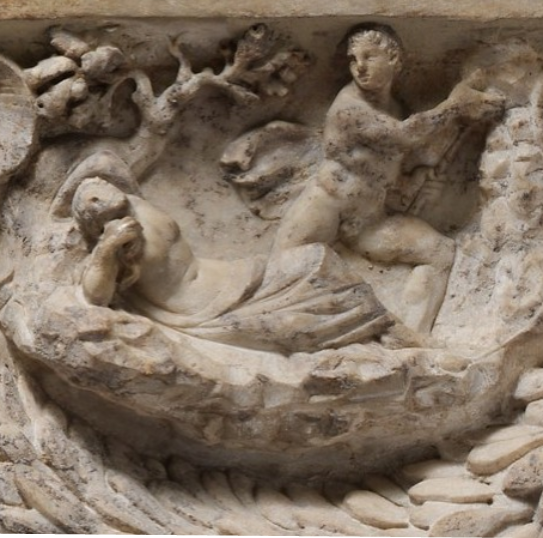
Theseus abandoning Ariadne
How do they relate to one another?
Episodes from theseus’ life
They are presented chronologically.
An example of continuous narrative, as Theseus appears repeatedly.
Could they have specific meanings in the funerary context?
To do with life and death and moving on from a lover
Death and marriage linked closely in myth
Theseus as a hero who returned from Underworld
Araidne’s journey to Dionysus/ divinity.
The doorway is allegorical for death/entrance to underworld.
Ariadne scene showing her aiding Theseus - presents her as supportive – a visual trope that appears on other sarcophagi
Central scene celebrates Theseus as a hero.
Sleeping Ariadne/Theseus departure – has resonances (also in funerary epigrams) with the bereaved imagining meeting lost relatives in their sleep.
Theseus departing, again allegorical with death.
Elevation of man who was inhumed inside (aged between 36-55) to that of a hero.
What narrative is being used on this sarcophagi?
Three episodes in the life of theseus, continuous narrative as he appears three times, it is in a chronological order.
Give a detailed description of the scenes shown on the sarcophagus:
In the image on the left ariadne is helping him by giving him the ball of wool, the doorway in the background gives the sense of a farewell scene and they also work as allegories of the underworld, ariadne is shown as supportive here- fits with he idea of female domesticity. The central scene is about celebrating Theseus as a hero and then we see him abandoning her in the final scene- resonance in the funerary context, idea of benign left behind, also theme of Theseus departing- can be allegorical with death.
There was a skeleton in this sarcophagi, idea that he was being elevated to the position of a hero.
Is this a straightforward retelling of the myth?
This is a very straightforward retelling of the myth, no change in the iconography, its just that it can take on different meaning in the funerary context
Identify and date this sarcophagus:
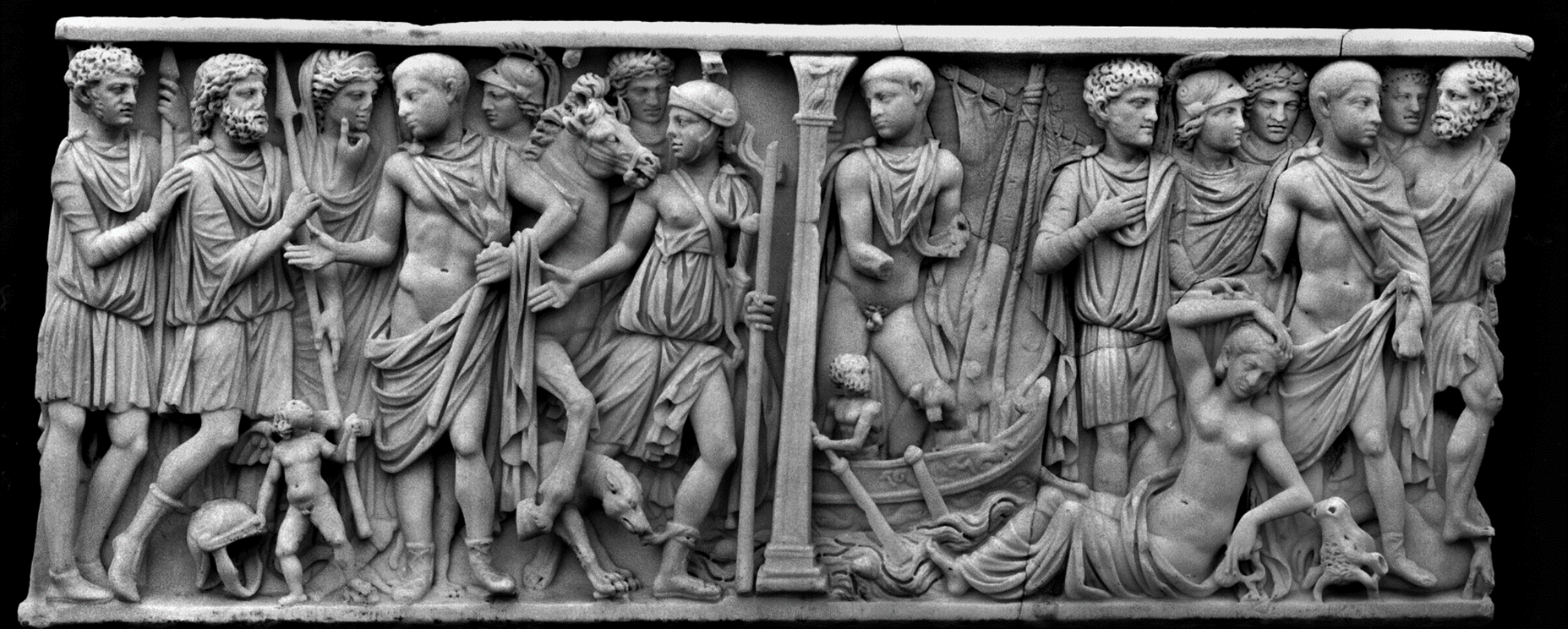
Theseus and Ariadne, Frieze Sarcophagus, late 3rd century CE. Cliveden, UK:
What does the inscription on the lid of this sarcophagi tell us?
Inscription on lid (lost): mother dedicated it to her teenage son, Artemidorus.
Is there an equation with a hero/who is depicted on the sarcophagus?
This equation with a hero is apparent on this sarcophagus as well, three scenes depicting Theseus
Describe the myths happening on the sarcophagus
The first one to the left he is surrounded by his companions, evocative of hunting- emphasis is on his physical prowess
In the centre he is on the ship and we can see ariadne being abandoned
On the right his foot is on the dead minotaur- traditional iconography, but this time there is no narrative order and it is not chronological
How is grief connected to these myths?
Both Theseus and Ariadne have portrait heads, the mothers grief is being associated with ariadnes grief over being abandoned (this myth was used to commemorate a mother and her son)
What is typically depicted on frieze sarcophagi (i think idk)
Dionysian imagery: consolation?
Specific mythological narratives:
Death and abduction: Persephone
Role models: Alcestis, Meleager, Selene and Endymion.
Problematic myths (int he way that they don’t fit into funerary context):
Medea/Creusa.
Identify and date this sarcophagus:
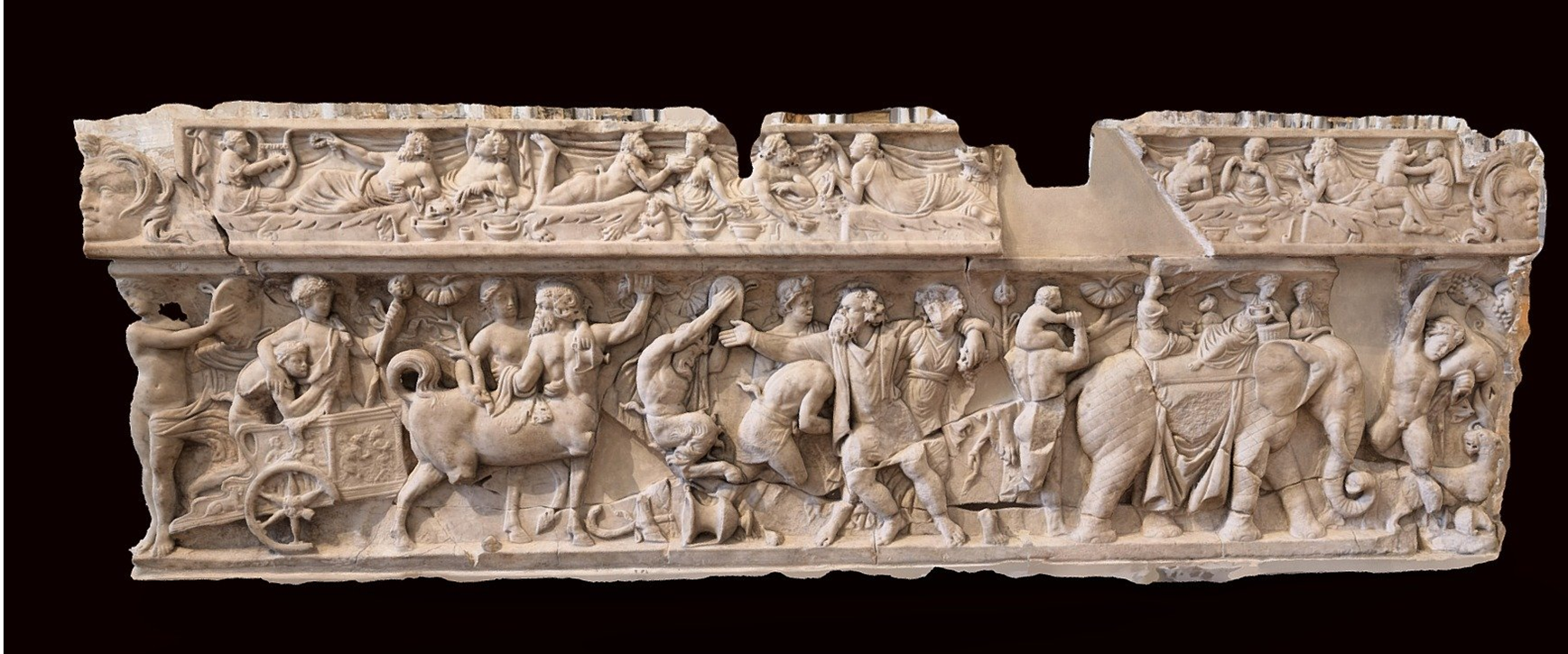
The Pashley Sarcophagus, Fitzwilliam Museum, Cambridge, GR1.1835 – ca. 101-200 CE
Identify all the characters shown on the sarcophagus sarcophagus.
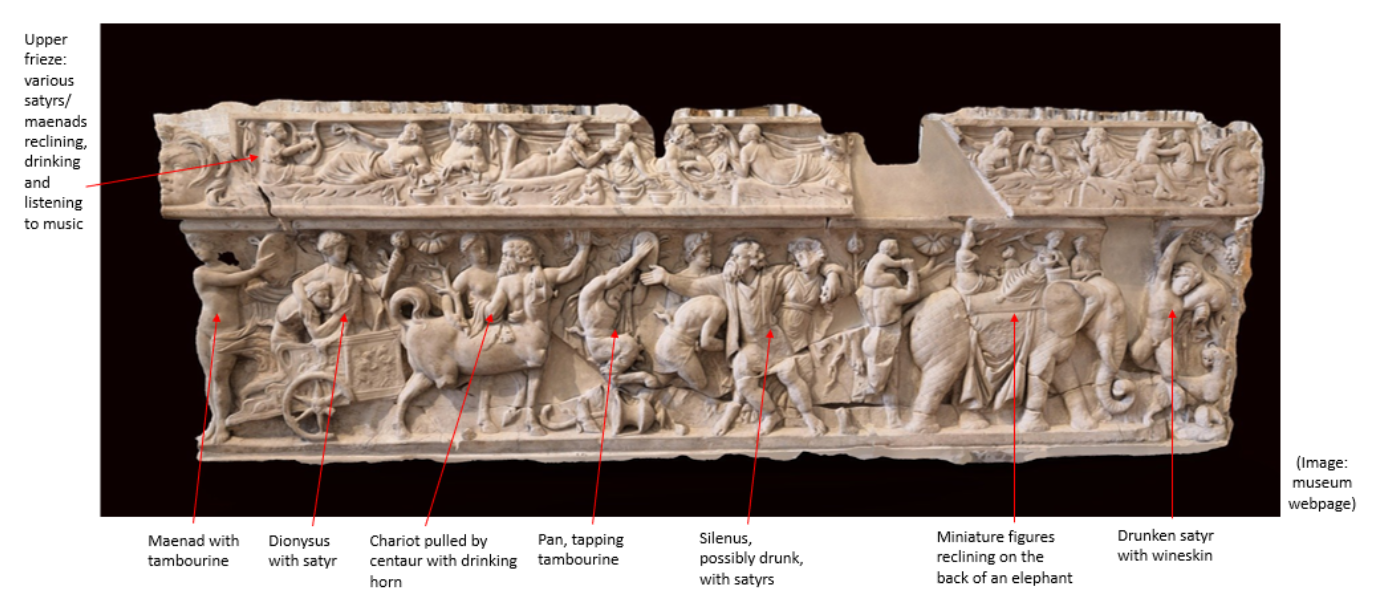
What scene/myth is this sarcophagus displaying?
This refers to the triumphant return of bacchus to the east after introducing the grape to India. Bacchus was understood to free his followers from earthly concerns so this could be read as a celebration of overcoming death through celebration of bacchus but it could also give consolation to the bereaved as it could be what they are hoping the deceased is experiencing in the afterlife.
Identify and date this sarcophagus:
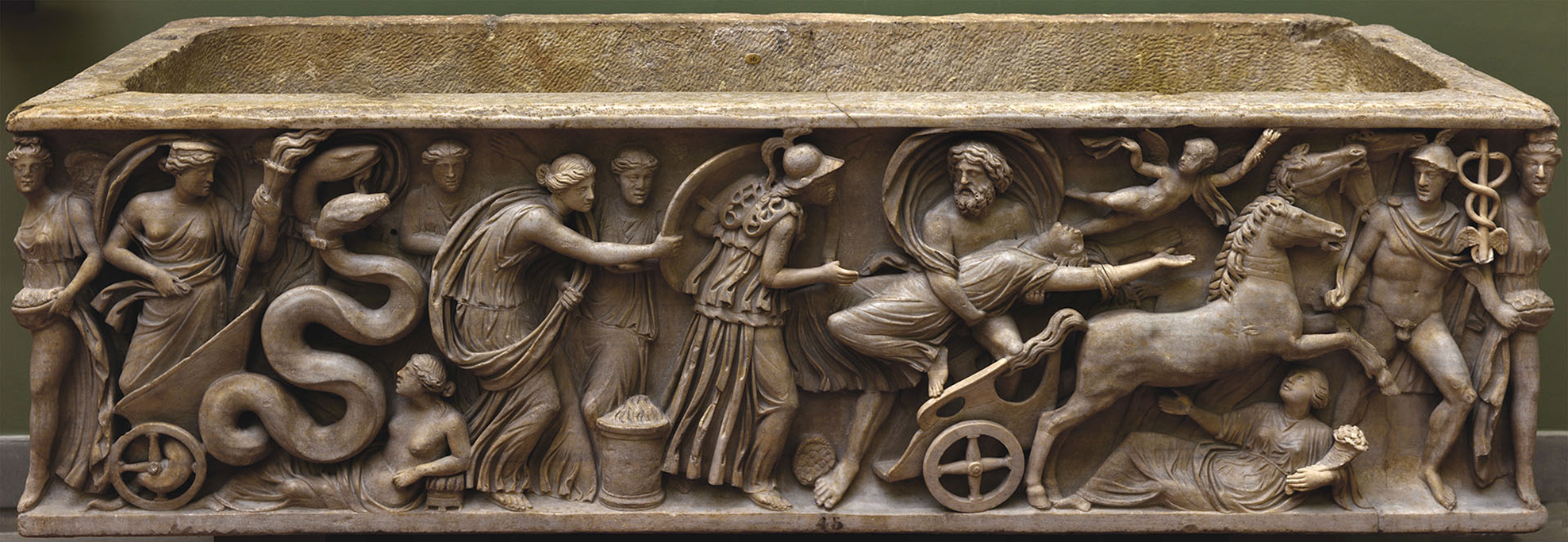
Abduction of Persephone, 160-180 CE, Galleria Degli Uffizi, Florence, Inv. 86:
Give info on this sarcophagus (themes and relations)
This one is more specific in its relation to the underworld
Abduction of persephone is quite a common theme, but this is a graphic portrayal
Framed by the seasons on either end
Identify the characters in this scene
Under her feet is thought to be a personification of the sea
Mercury is present on the far right who appears a lot on sarcophagi as he is the guide taking souls to the underworld
The two female characters in the centre are the two goddesses Athena and Aphrodite, Athena is trying to reasonw ith Hades and protect Persephone, Aphrodite appears to be holding ehr back (she represents Hades passion for Persephone).
What can we read this scene as representing?
We can read this as representing grief as the focus is on the moment of loss, the abduction of Persephone here acts as an allegory for the sudden death of a young woman, but we have to be careful as her death is often used to show the death of men and couples (her myth can just be a reference to death and the underworld as a whole)
Imagery on the two ends (shown in picture below)
Identify the myth/scene occurring in this image:
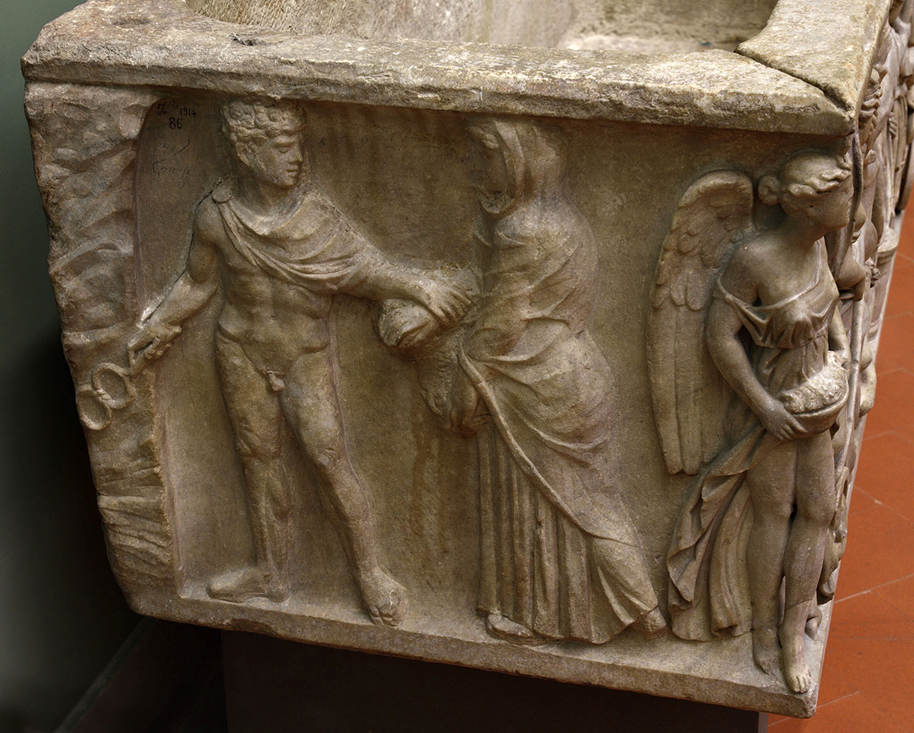
Laodamia (right) could not live without ehr husband, so she committed suicide to be with him- we see Mercury leading her to the underworld to be with him
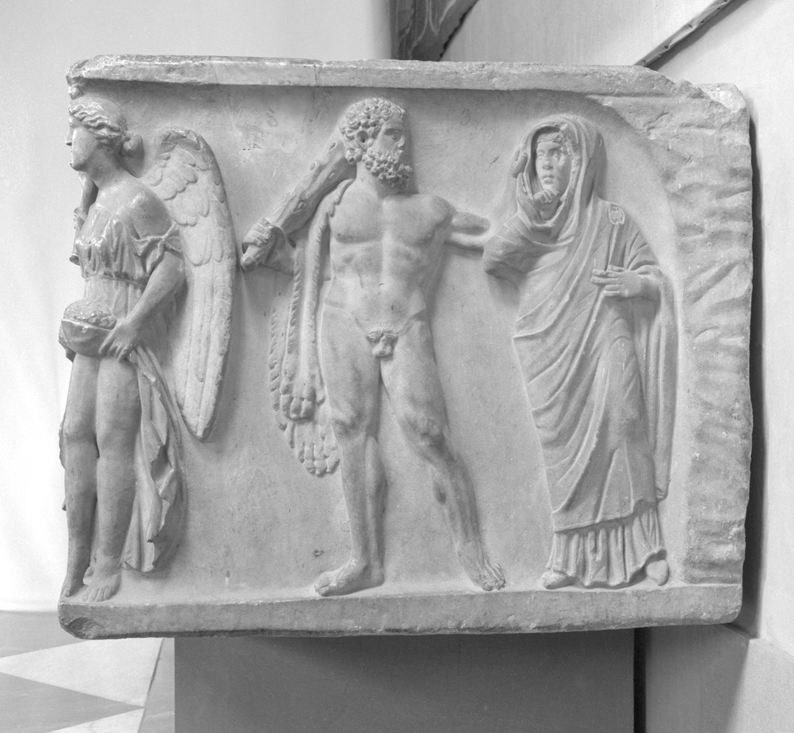
Identify the myth/scene occurring in this image:
Alcestis, Heracles leading her from the underworld
What do those two scenes leave us with an idea of?
Idea of sudden death an the entry and exit to the underworld
Identify and date this sarcophagus:
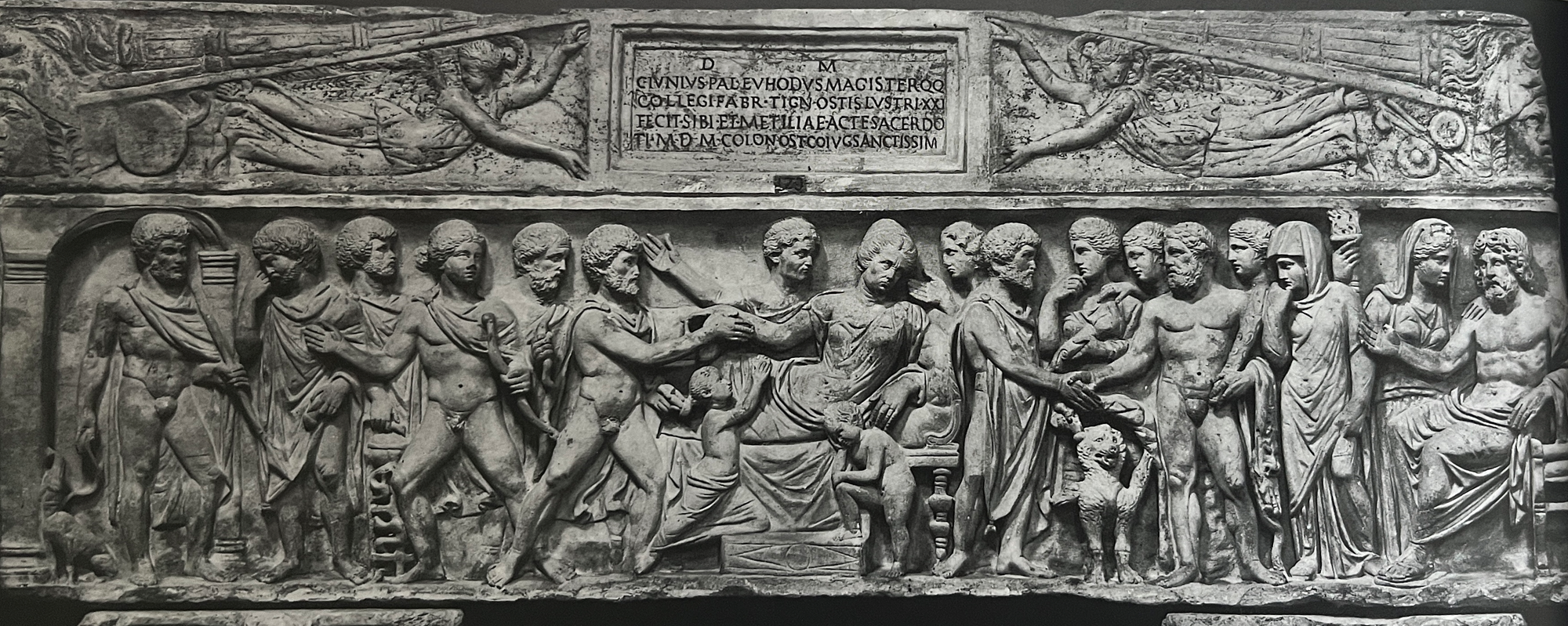
Inscription:- ‘To the spirits of the departed. Caius Junius Euhodus, of the voting tribe Palatina, chief magistrate of the Ostian association of carpenters during the twenty-first lustrum, made this for himself and for Metilia Acte, priestess (sacerdos) of the Great Mother of the Gods (Cybele) in Ostia, his most venerable (sanctissima) wife.’
Sarcophagus of C. Junius Euhodus and Metilia Acte, from Ostia, ca. 161-170 CE:
What characters/scenes can be identified on this sarcophagus?:
3 representations of Admetus, 2 of Alcestis
Far left, Admetus/Euhodus as a hunter, so an allusion to his male courage and physical strength; another 3 male figures, probably companions.
Apollo, holding his bow and his hand out towards Admetus/Euhodus, but is looking towards the centre – so this could represent him leaving ( as he does in Euripides when Alcestis is dying).
The 2nd figure of Admetus/Euhodus, strides towards/joins hands with Alcestis, who reclines on her deathbed, with their small children below; and probably 2 other female family members behind her.
To right is the 3rd representation of Admetus/Euhodus, greeting Herakles, who is leading the heavily veiled Alcestis/Metilia back from the Underworld.
Behind Herakles the 3 Fates and the dog Cereberus below.
To the far right, Hades enthroned, accompanied by Persephone holding a torch.
Is there anything about them that is particularly noticeable?
Portrait heads on Ademtus/Euhodus and on Alcestis/Metilia in centre. Her hairstyle is also contemporary with the date of the sarcophagus and reminiscent of portraits of Faustina Major.
How does the inscription characterise Metilia Acte?
Well-respected.
Pious - ‘priestess of Cybele’
‘Sanctissima’ associates her with the virtue of piety attributed to Alcestis.
How is the myth being used? Allegory for returning to a lost love?
The characters are being used to represent the virtues of the deceased.
Elements of self representation and identity projection.
Grief and loss and the bond between the couple is also highlighted.
Hope for reunion in the afterlife.
Identify and date this sarcophagus:
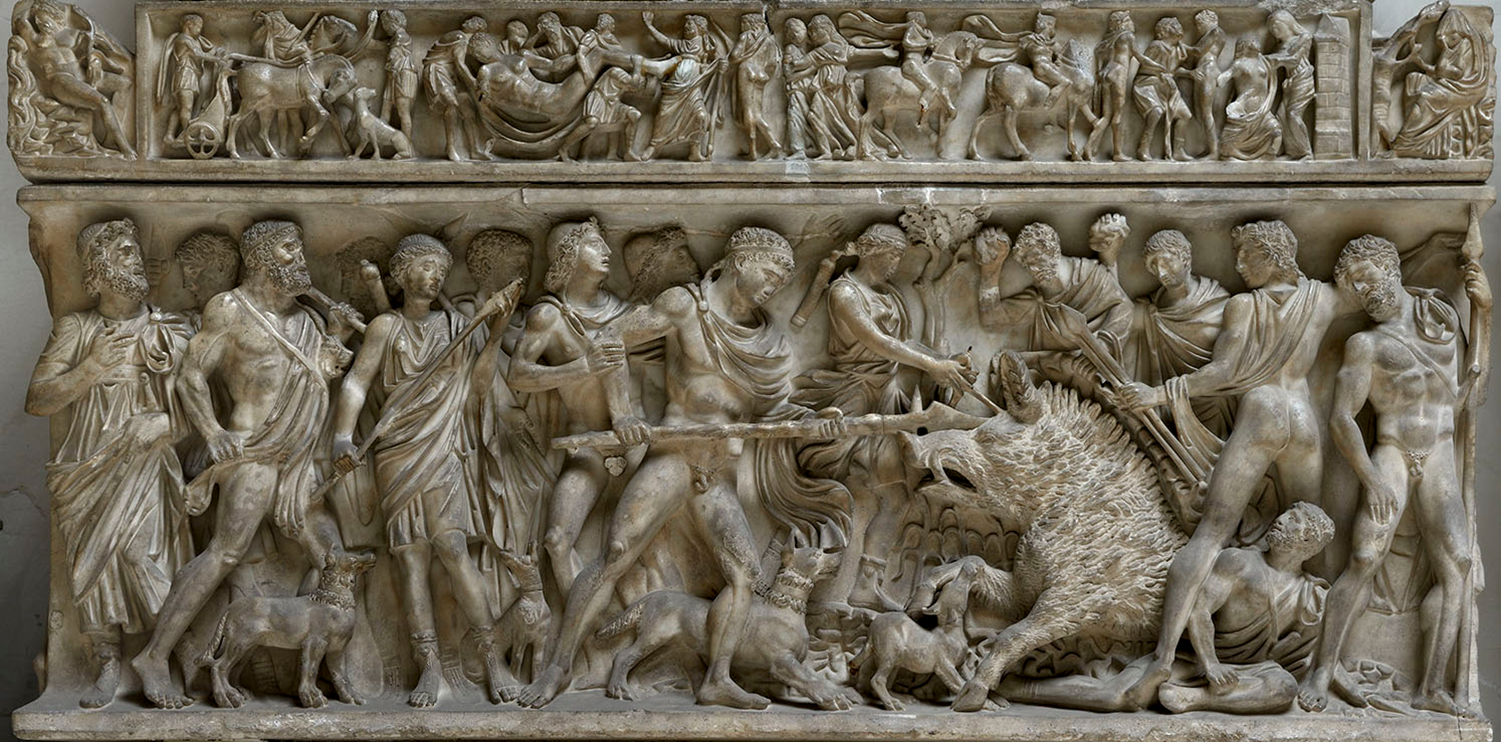
Meleager Sarcophagus, ca. 200 CE Palazzo Doria Pamphili:
Identify the characters on this sarcophagus
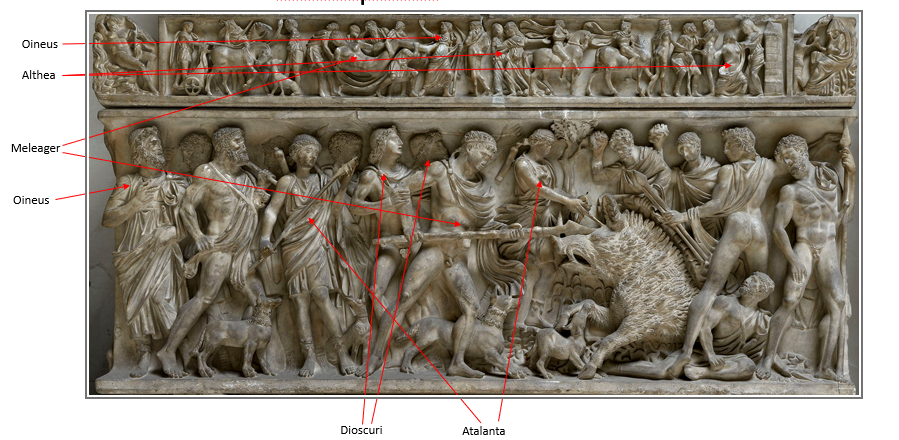
Describe what scene is playing out on the sarcophagus
Meleager ad his contest of the Caledonian boar with another frieze on top
In some versions of the myth meleager gives the dead boar as a gift to a woman he loved
Lots of sarcophagi depict Meleager, a common theme is his death
He is the central section about to slay the boar, to the far left is his father dressed in theatrical costume of kings and then various hunters and dogs, and a fellen figure to the right hand side- idea of the danger of the boar, this is highlighting male bravery and courage and physical power in killing the boar- areas of male Roman virtue, this explains the popularity of hunt and war scenes on sarcophagi
What does the upper relief of the sarcophagus show?
The upper relief is a bit of a contrast, it shows meleagres body benign brought home in a procession, his body is larger than the other figures which communicates his heroic nature, his mother is at the far right- this is supposed to be the moment she is committing suicide at his tomb, another aged figure is on the right side leaning on a stick
What sense/themes do we see from the sarcophagus?
Idea of extreme grief from the upper frieze, but in the central panel we have the deceased being linked with Meleager for his physical courage and bravery. Possible connection to early and cruel death as well
Identify and date this sarcophagus:
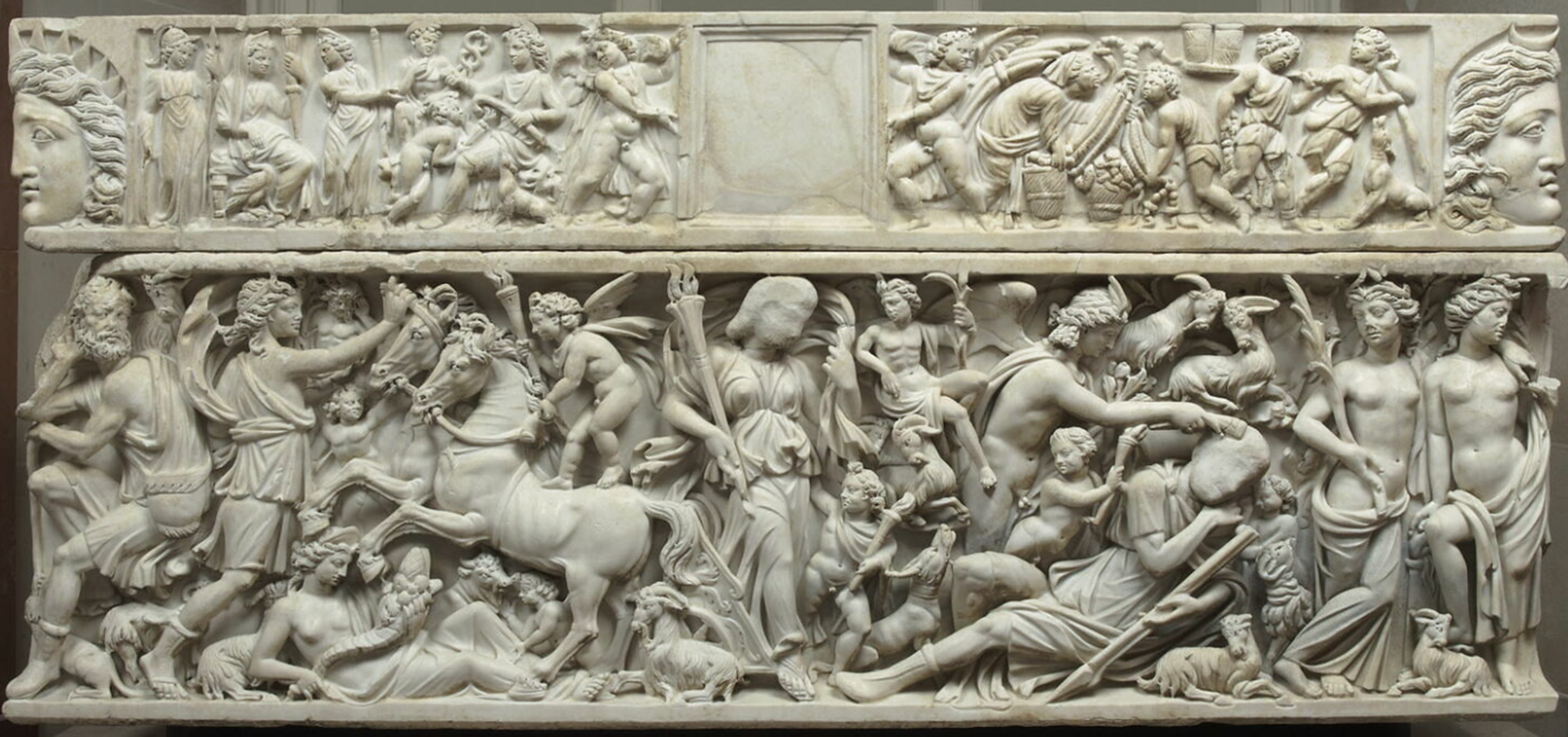
Selene and Endymion, ca. 235 CE, Louvre No. MA1335:
What myth does this sarcophagus display?
Different versions of this myth, essentially selene the moon godden fell in love with endymion (his identity varies in the versions, but he is often a shepherd), selene asks Endymion for eternal youth but he is also given eternal sleep and she returns to see him every night- never ending love/love that extends beyond death
Is this a popular myth on sarcophagi?
Quite a lot of sarcophagi show this myth
What sort of imagery does the sarcophagus have?
Quite dense imagery, a pastoral scene filled with animals and cupids and different figures
Describe Selene and Endymion on this sarcophagus
Selene is carrying a torch and steeping down from a chariot, sleeping endymion to the right, behind him is the sleeping good hypnos
Endymion is dressed like a hunter, the other noticeable thing is that the faces haven’t been carved- example of a sarcophagus that was in the process of being made as an example for other sarcohogai (inscription space left with no inscription)
Is there a reference to the funerary context on the sarcophagus?
Another pastoral scene with a reference to a fuenrary context due to the two figures weaving funerary garlands
Who was this sarcophagus likely for?
It is likely that this was a sarcophagus for a man, understand selene rushing towards him as an allegory for the deceased widow but also to idea of a happy marriage and never ending love
What do we see the idea of death being?
Idea of death as being sleep, see this with endymion and ariadne as benign particularly resonant in this regard. Idea of the dead person being asleep could be a means of consolation for the bereaved.
Identify this sarcophagus:
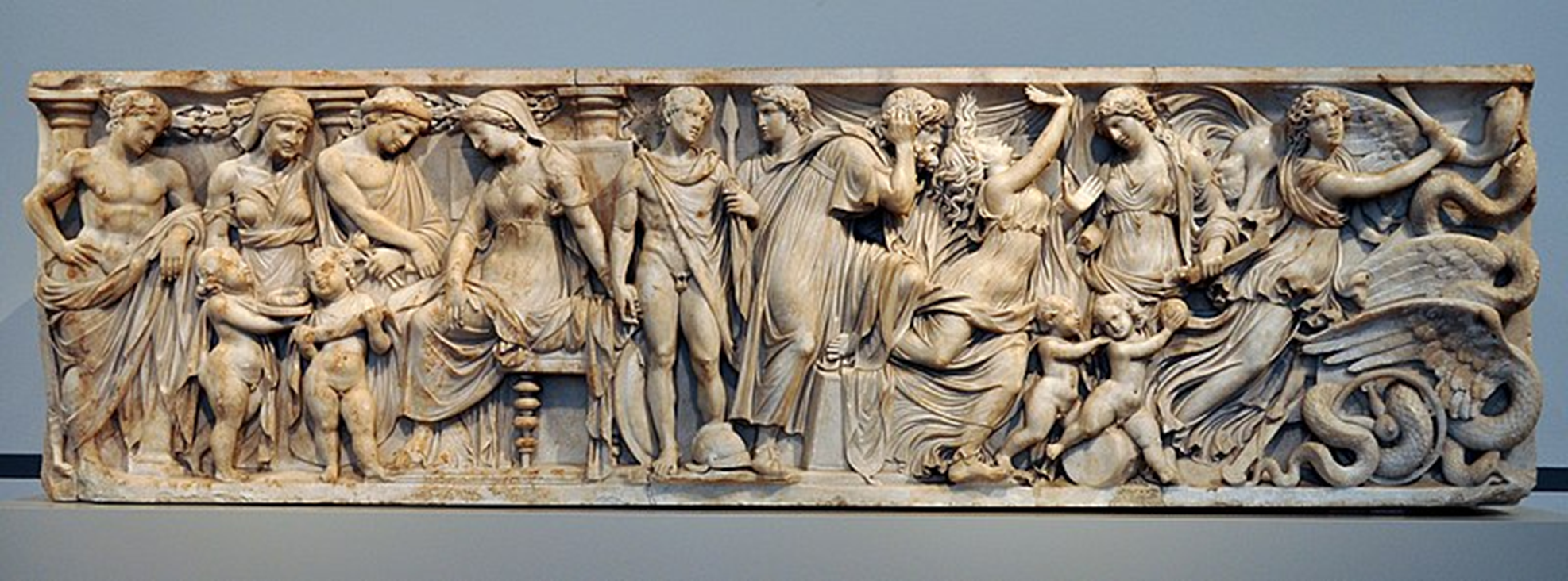
Medea/Creusa sarcophagus, mid 2nd century CE, Altes Museum, Berlin
Describe the three scenes shown on the sarcophagus:
Three scene: first scene, creusa is seated on the left (prewedding scene), Jason’s, nurse/attendant and children bring wedding stuff- this is a generic pre-marriage scene
We have Jason appearing again int he centre holding his spear below- idea of heroism (a bit problematic in how we understand Jason at this point int he storyline), another thought is that he may be about to leave on a hunt and is oblivious to what is happening besides him Here Jason is almost holding hands with the Creusa from the previous scene, sense of a bond between them. In the centre we have creon rushing forward as we see Creusa in the throws of dying- she had put on the poisoned diadem which has set fire to her head (thought that this may have been highlighted with gilding). Quite a disturbing image as she is in agony
Finals section shows two images of Medea. First shows her looking at the two playing boys, she is holding a dagger as well, the other scene shows her fleeing on a snake drawn carriage, quite graphic- one dead child over her shoulder and the leg of a dead child is hanging out of the chariot.
What are the various interpretations of this sarcophagus?
Various interpretations of this sarcophagus but the main theme it seems to be communicating is that of unfair death- Creusa is being torn from death when she should be most happy, and this is the same with the children as well.
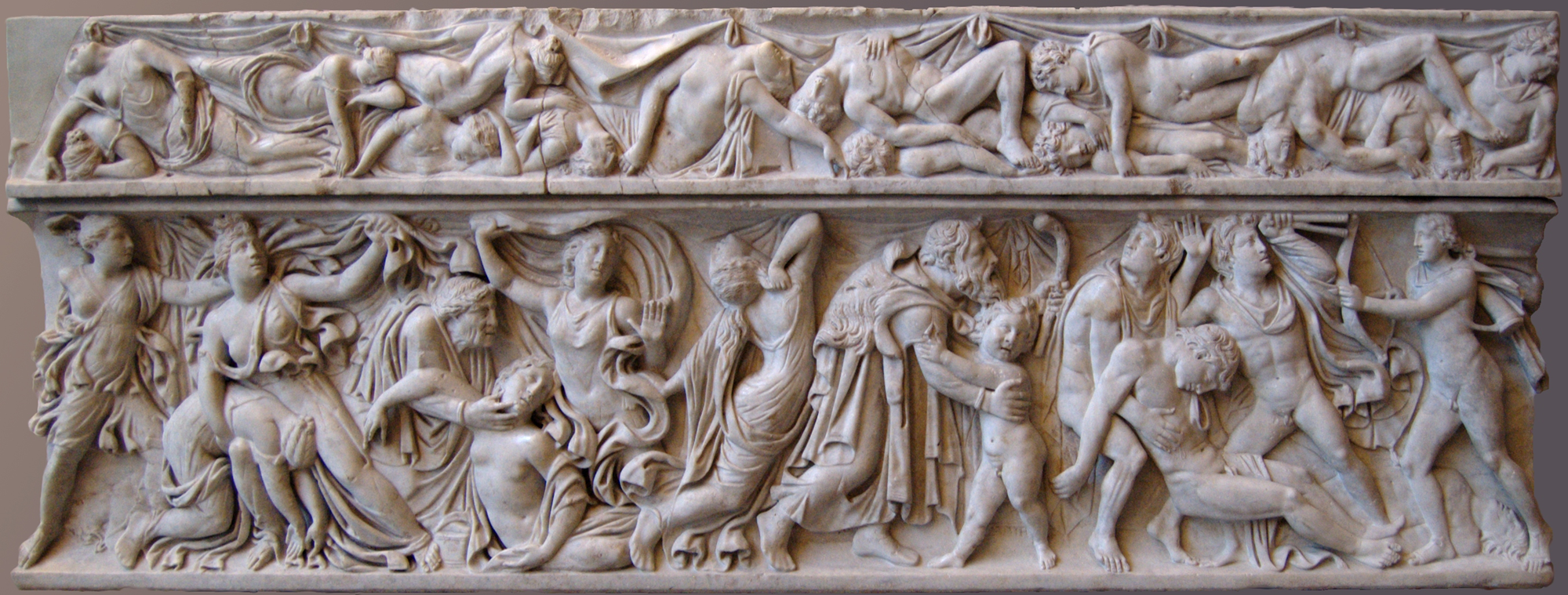
What is the myth being depicted?
Artemis and Apollo killing the 14 children of the Niobe
Two scenes:
Above - the aftermath of the killing ; on the left are Niobe’s seven daughters and on the right are her seven sons
Below - as it is happening
What is being highlighted/stressed?
Cloth depicted in the background over both scenes, possible representation of shroud, covering already-dead people (Niobids?), compared with the people who are possibly about to die.
There is an extreme dynamism in the death poses emphasising the tragedy of the scene
What message does the myth in this context convey?
Discussing the tragedy of young deaths
Pointless death/mass death, war
About untimely/tragic death.
How would the viewer have potentially interacted with it?
Would’ve prompted the viewer to reflect upon their own experiences involving premature death✔ - potentially the person buried was someone who died young?
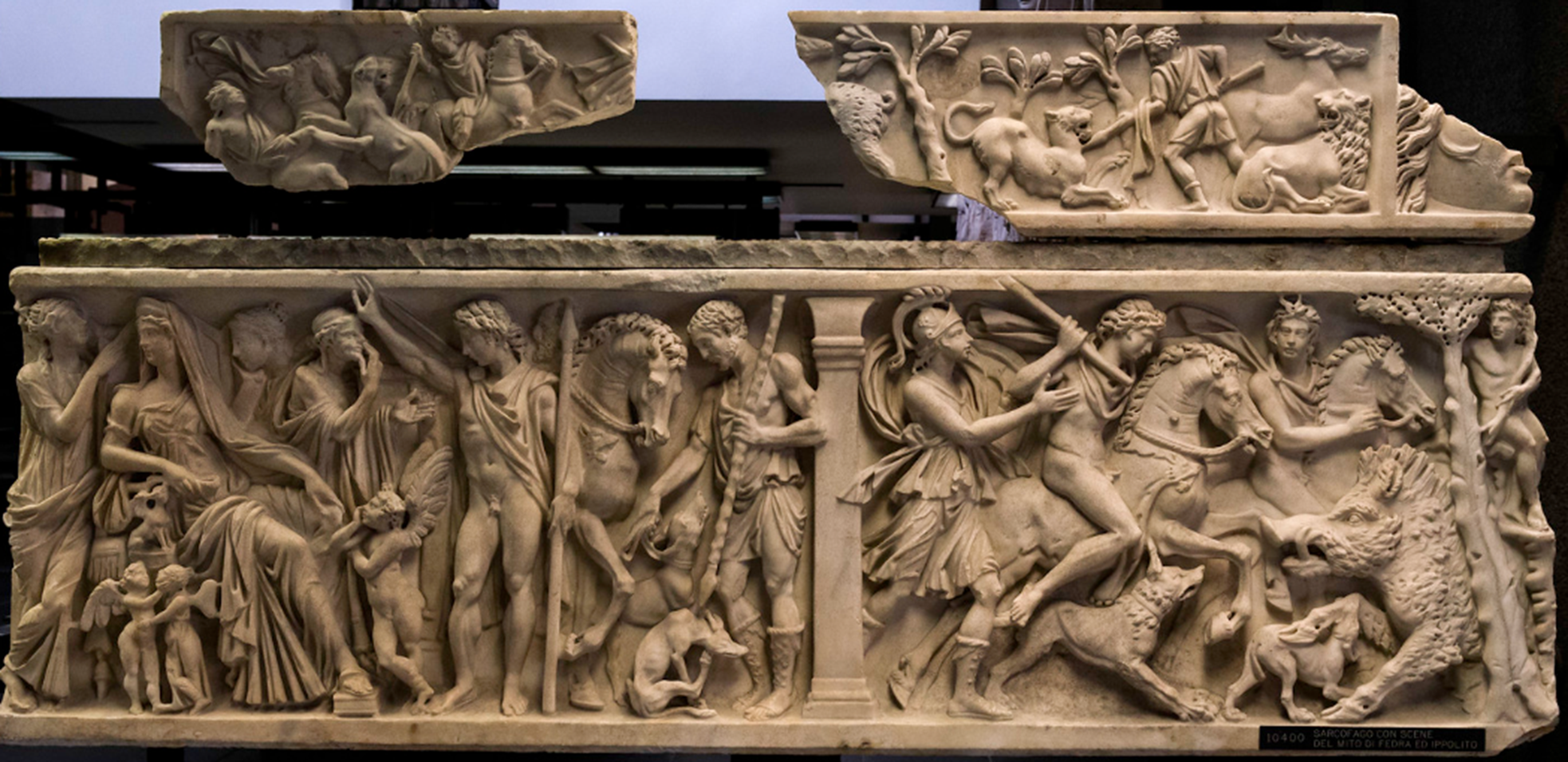
What is the myth being depicted?
Phaedra and Hippolytus, hunt represents virtus and what the deceased wished to be associated with following death
What is being highlighted/stressed?
Strength and the intervention of the gods/strength of couples love
Forbidden love
Hippolytus with arm raised may be more of a farewell scene rather than a rejection of Phaedra.
Virtus (personification of courage etc) behind him as he attacks the boar.
What message does the myth in this context convey?
Symbolises love. Not the unrequited passion of Phaedra, but more simply that she loved Hippolytus and the way she is presented here in a domestic type of scene emphasises that role and perhaps idealises her for it. Hippolytus’ departure can be a reference to his death and the hunt scene conveys his strength and perhaps youth. So, perhaps untimely death again or simply love for a lost husband/son?
How would the viewer have potentially interacted with it?
Associated the one buried with a loving marriage and being reunited in the afterlife
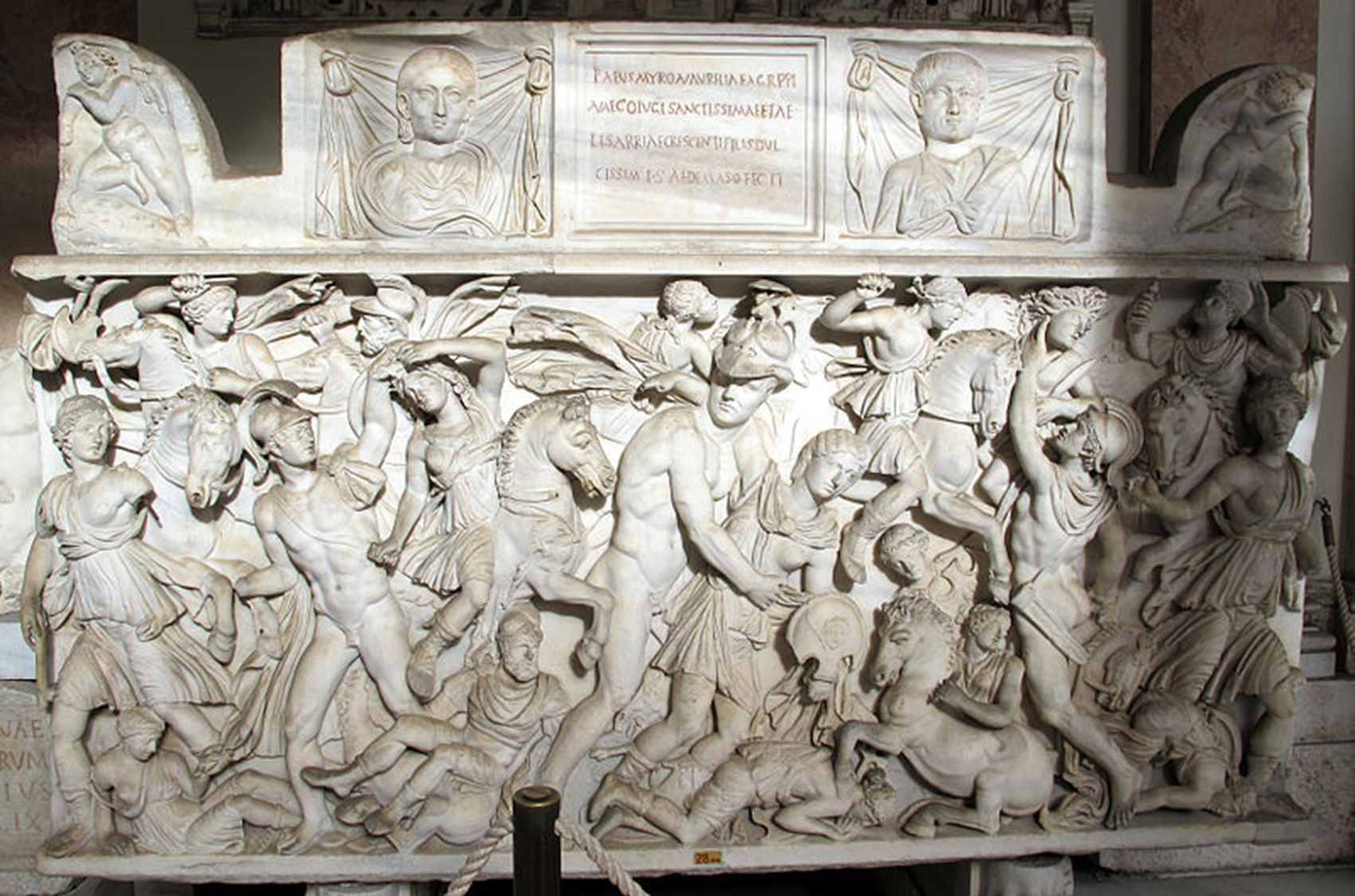
What is the myth being depicted?
Death of Penthesilea in Achilles’ arms. Amazonomachy in the background.
What is being highlighted/stressed?
The central male figure (perhaps as a hero) as he holds the dying woman
The fatal moment of her death, when he is in love with her.
The main 2 characters are larger making the focus on them.
Portrait faces - Penthesilea hairstyle is again contemporary.
What message does the myth in this context convey?
Battle imagery and the chaos of war. Silence and grief of death in amongst the surrounding ‘noise’ and pain
The loss of a wife?
Idea of a couple and their love for each other
Achilles is supporting her - not the moment of him killing her - turned away - perhaps cannot bear to see her die or is protecting her?
Victory of love over death?
How would the viewer have potentially interacted with it?
Pity? Presenting a grieving and vulnerable moment of Achilles’ life.
Inscription: tells us it was dedicated by Publius Aelius Myron for his wife Aurelia Agrippina.
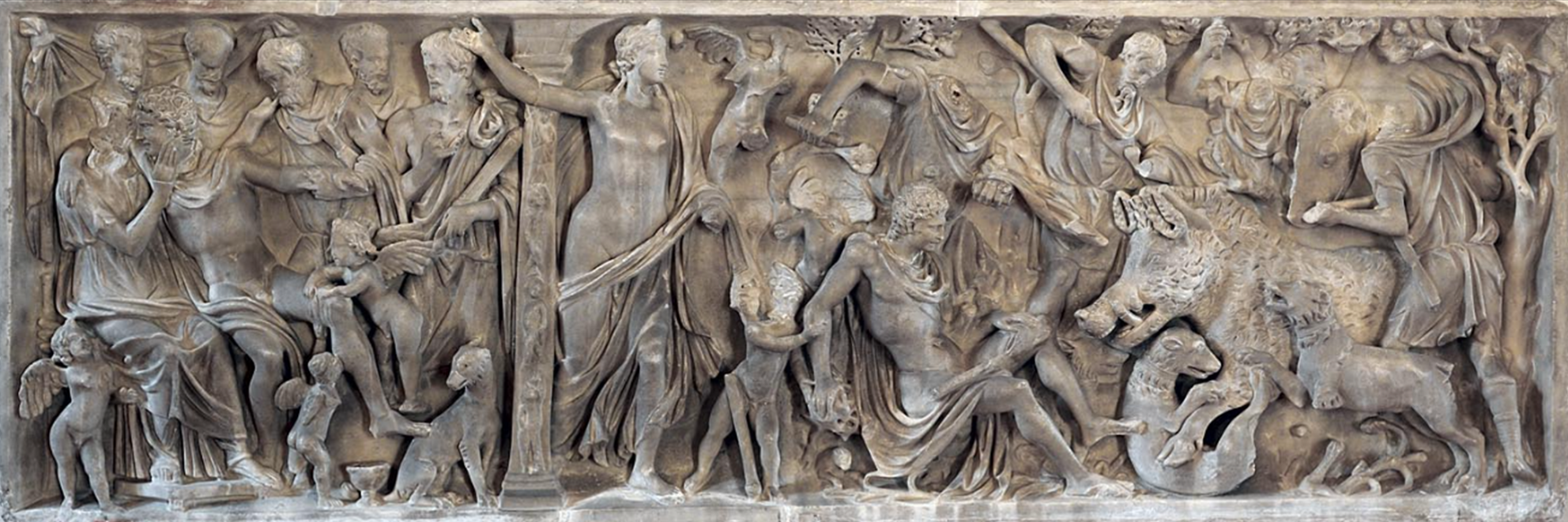
What is the myth being depicted?
Right scene shows Adonis being attacked by boar during hunt (his death scene) ✓
Left scene shows Aphrodite and Adonis seated together
What is being highlighted/stressed?
Aphrodite bridging the two scenes with her arm- she’s the unifying scene all the way through
What message does the myth in this context convey?
Inclusion of aphrodite- interesting, she’s not a death goddess. Applying loss of a romantic love to a lot of different types of loss.
Loss of husband.
Boar may have been representative of some enmity - sent by gods in the story.
Potentially commissioned by wife of deceased ✓
Adonis as hunter - courageuous etc.
Parting/death as well as love and emotion.
How would the viewer have potentially interacted with it?
Blending tragic love and violence.
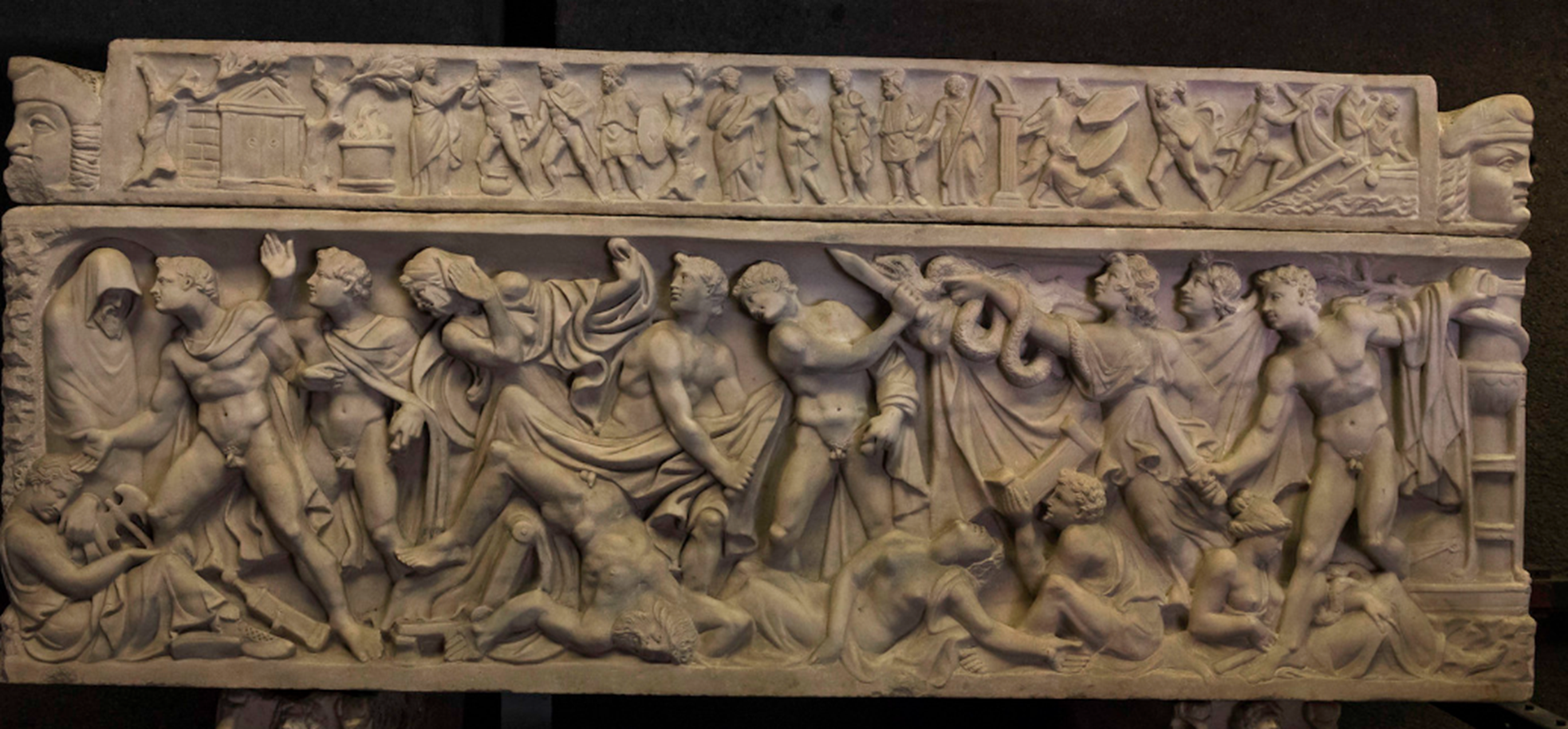
What is the myth being depicted?
Orestes killing Aegisthus and Clytemnestra. Being pursued by the Furies, and also at the tomb of Agamemnon who appears as a shade (far left).
Lid is Iphigenia in Tauris.
What is being highlighted/stressed?
The panic/death of the scene is strongly conveyed in the poses/ bodies of the sculptures
Clothes emphasise movement
What message does the myth in this context convey?
Wrongful, familial death.
Yes, cruelty of death perhaps? Was in a tomb chamber with another sarcophagus depicting the Niobids.
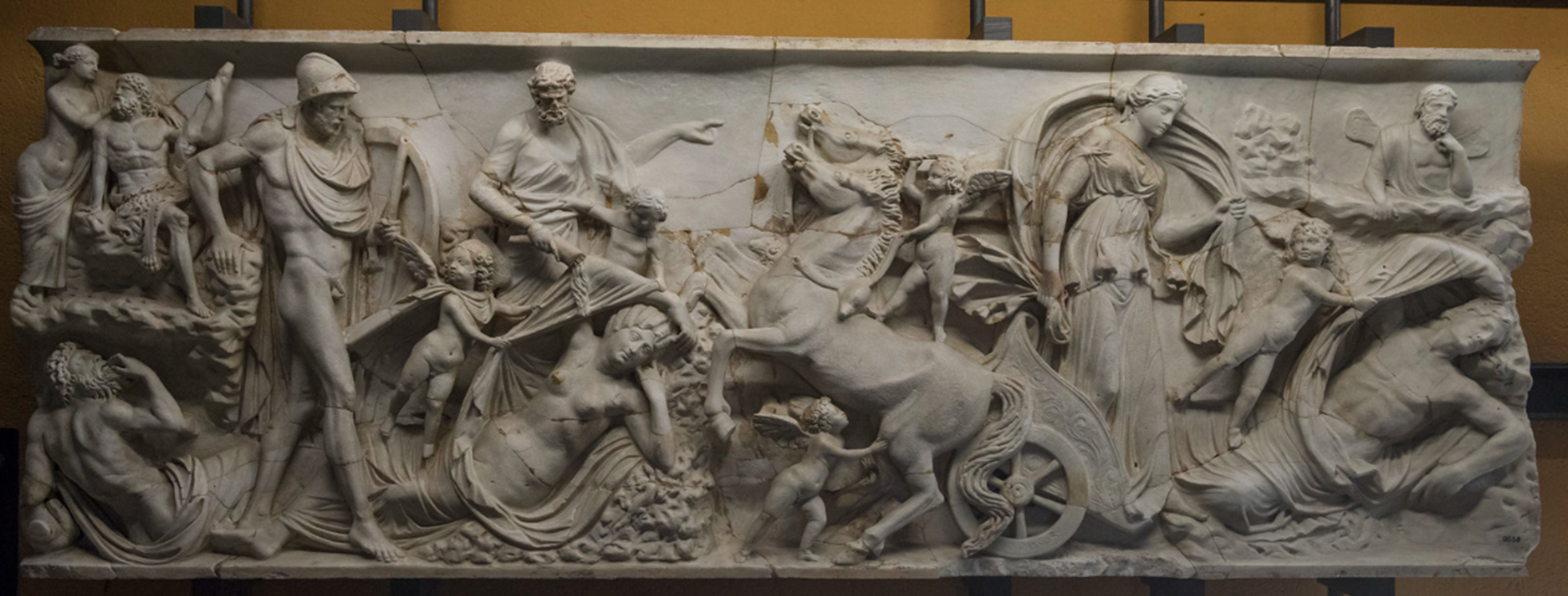
What is the myth being depicted?:
Hercules top left? He is holding a club and he has his lion skin!!
Mars discovering Rhea Silvia and Selene visiting Endymion
What is being highlighted/stressed?
Creation- foundation of Rome. Maybe this person was particularly patriotic?
Love, desire, passion. Reinforce this as being reciprocal with the role reversal.
Possibly portrait faces here too - hairstyle of Rhea Silvia is contemporary.
What message does the myth in this context convey?
Focus is on love; potentially links to the idea of death as sleep and of being reunited.
Ignores the rape narrative re Mars/Rhea Silvia and instead uses this as a metaphor for longing/love.
How would the viewer have potentially interacted with it?
Perhaps a reminder of their roots and connection to Roman pride, a sense of familiarity and comfort ??? this could be a sarcophagus belonging to someone with strong familial connections?