Anatomy Final Exam (Last two)
 Call Kai
 Learn
Learn Practice Test
 Spaced Repetition
 Match
Match Flashcards
 Knowt Play
1/38

There's no tags or description
Looks like no tags are added yet.
Name | Mastery | Learn | Test | Matching | Spaced | Call with Kai |
|---|
No analytics yet
Send a link to your students to track their progress
39 Terms
Na+, K+, and Cl- regulation is related to?
Acid-base regulation
Fluid volume maintenance
Nerve impulse transmission
Muscle contraction
Substances cross tubular epithelial cells by active or passive transport?
Both
Active transport of substances crossing tubular epithelial cells require ……… and move substances …………… or against the concentration gradient
ATP
“uphill”
The kidneys reabsorb what % of Na+ in filtrate?
99%
Primary active transport accounts for …..% of Na+ reabsorption (from filtrate back into the ………..). This occurs in all tubules except the ………………….. ………. …… …………… Carrier proteins in luminal membrane of tubule cell bind to Na+ as it diffuses across the membrane, where proteins release Na+ inside the …….. Cl- passively diffuses with …… (from the tubular lumen into the blood), which maintains ……………………………
80%
blood
descending loop of Henle
cell
Na+
electroneutrality
Na+/K+ pump actively moves …… out of cell and …… into the cell, while Cl- follows …… out.
Na+
K+
Na+
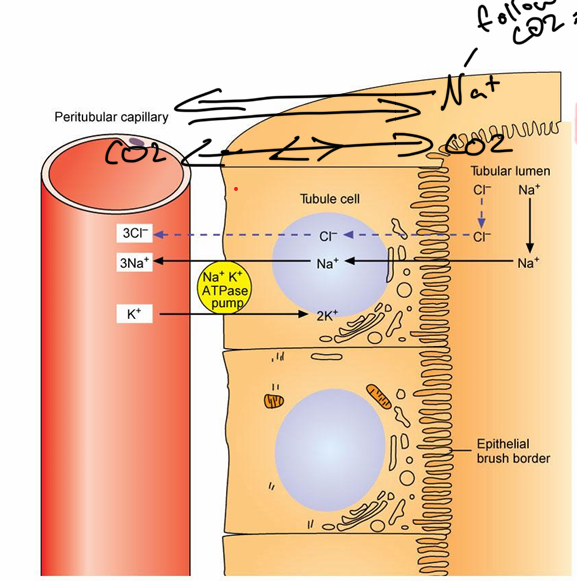
What process is this diagram showing?
Primary active transport of Na+
T or F: In Na+ primary active transport, Na+ diffuses from filtrate and into the tubule cell along its concentration gradient and because the cell interior is negatively charged.
True
T or F: In Na+ primary active transport, the Na+/K+ pump passively pumps the Na+ out of the cell which helps to create this negative interior. Cl- actively gets pumped alongside the passive transport of Na+ to maintain electroneutrality.
False
It actively pumps the Na+ out of the cell….Cl- passively accompanies Na+ for electroneutrality
What anatomical structures does the Na+ cross during active transport in order?
Moves from lumen to tubule cell to interstitial space to peritubular capillary
If 99% of Na+ is reabsorbed and primary active transport accounts for 80% of Na+ reabsorption, how is the other 19-20% of Na+ reabsorbed?
The other 20% of Na+ is reabsorbed via secondary active secretion of H+ and K+
During secondary active secretion of H+ and K+, CO2 diffuses into the ………… cell, which reacts with H2O, and forms ….. This combines with the opposite end of protein carrier for ……. Therefore, H+ is …………… into the lumen of the tubule.
tubular
H+
Na+
secreted
During secondary active secretion of H+ and K+, what is reabsorbed alongside Na+?
HCO3- instead of Cl-
T or F: Active secretion of K+ works similarly to secondary active secretion of H+ and K+ but it is more likely to occur in the presence of acidemia (When H+ is high)
False
Active secretion of K+ works similarly to secondary active secretion of H+ and K+ but it is more likely to occur in the presence of alkalemia (When H+ is low)
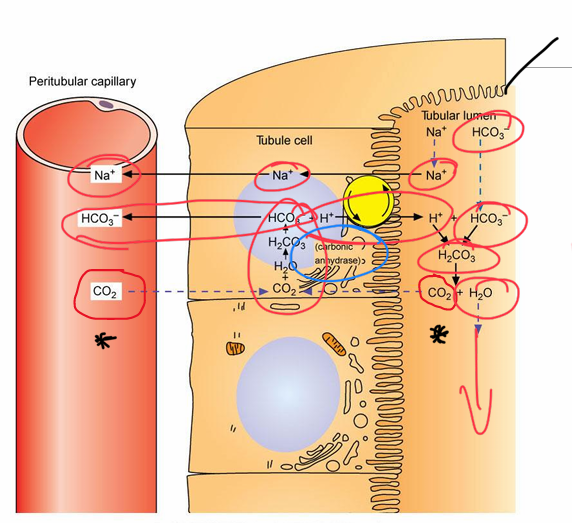
What process is this diagram showing?
Secondary active secretion of H+ and K+ to reabsorb Na+
What speeds up the reaction of CO2 and H2O in the secondary active secretion of H+ and K+ to reabsorb Na+?
carbonic anhydrase
During Secondary active secretion of H+ and K+ to reabsorb Na+, H+ and Na+ move in opposite directions which is called?
Counter-transport exchange
During Secondary active secretion of H+ and K+ to reabsorb Na+, HCO3- is reabsorbed with Na+ rather than Cl-. What does this do?
This increases blood HCO3-
T or F: Secondary active secretion of H+ and K+ to reabsorb Na+ plays a predominant role in Na+ reabsorption when Cl- is low
True
The active secretion of K+ to reabsorb Na+ is more likely to occur in the presence of what?
Alkalemia (low H+)
The active secretion of K+ to reabsorb Na+ where K+ is actively secreted in exchange for Na+, which is reabsorbed with HCO3- allows us to explain why ……………… leads to ………………………… (low K+). Since there are no H+ to secrete, it secretes ….. instead.
alkalemia
hypokalemia
K+
Why does the body allow alkalemia to lead to hypokalemia in the active secretion of K+ to reabsorb Na+?
Because the body prioritizes Na+ and therefore H2O reabsorption at all costs
T or F: most Cl- passively diffuses with Na+
True
In the secondary active transport of Cl-, Cl- is transported in the ………………… loop of Henle by a …………………
ascending loop of Henle
cotransport
How is Cl- co-transported in the secondary active transport of Cl- process?
By a protein carrier that combines with Na+ that simultaneously combines with Cl-. Therefore, as Na+ is transported, it pulls Cl- along.
T or F: the secondary active transport of Cl- requires ATP
False
Does not require ATP
T or F: K+ is reabsorbed by the same mechanism as the secondary active transport of Cl- process?
True
In the secondary active transport of Cl-, ….. sodium, ….. chloride, and ….. potassium is cotransported at once.
1 sodium
2 chloride
1 potassium
Which loop of Henle is the thick wall?
Ascending
Which loop of Henle is the thin wall?
Descending
T or F: 98% of K+ is extracellular
False
Intracellular
What could happen if there are slight changes in extracellular K+ concentrations in the body?
DEATH
With 98% of K+ being intracellular, it acts as a reservoir of K+ during …………………………, but also acts as a source of K+ during ……………………..
hyperkalemia
hypokalemia
What is K+ uptake by cells stimulated by?
Insulin
Aldosterone
B-Adrenergic stimulation
Note: Salbutamol administration lowers plasma K+
What does K+ depend largely on?
Renal excretion
K+ reabsorption is a ……………….. process and occurs in the …………………. limb of the loop of Henle. The balance that remains in the filtrate after leaving the Loop of Henle (10% roughly) is reabsorbed in …………. …………. and ………………… ………
co-transport
ascending
distal tubules
collecting ducts
Anything that impedes Na+ reabsorption will also impair?
K+ and Cl- reabsorption
What type of medication can cause both hypokalemia and hypochloremia?
Loop diuretics
Slide 13
K+ excretion