Wisconsin Foundations of Reading Test Study Guide P
 Call Kai
 Learn
Learn Practice Test
 Spaced Repetition
 Match
Match Flashcards
 Knowt Play
1/114

There's no tags or description
Looks like no tags are added yet.
Name | Mastery | Learn | Test | Matching | Spaced | Call with Kai |
|---|
No analytics yet
Send a link to your students to track their progress
115 Terms
Phoneme
The smallest part of spoken language that makes a difference of words. English has exactly 41 of them. Most words have more than one.
Grapheme
The smallest part of written language that represents a phoneme in the spelling of a word.
Phonics
The understanding that there is a predictable relationship between phonemes and graphemes.
ITS VISUAL
ALSO KNOWN AS... Alphabetic principle
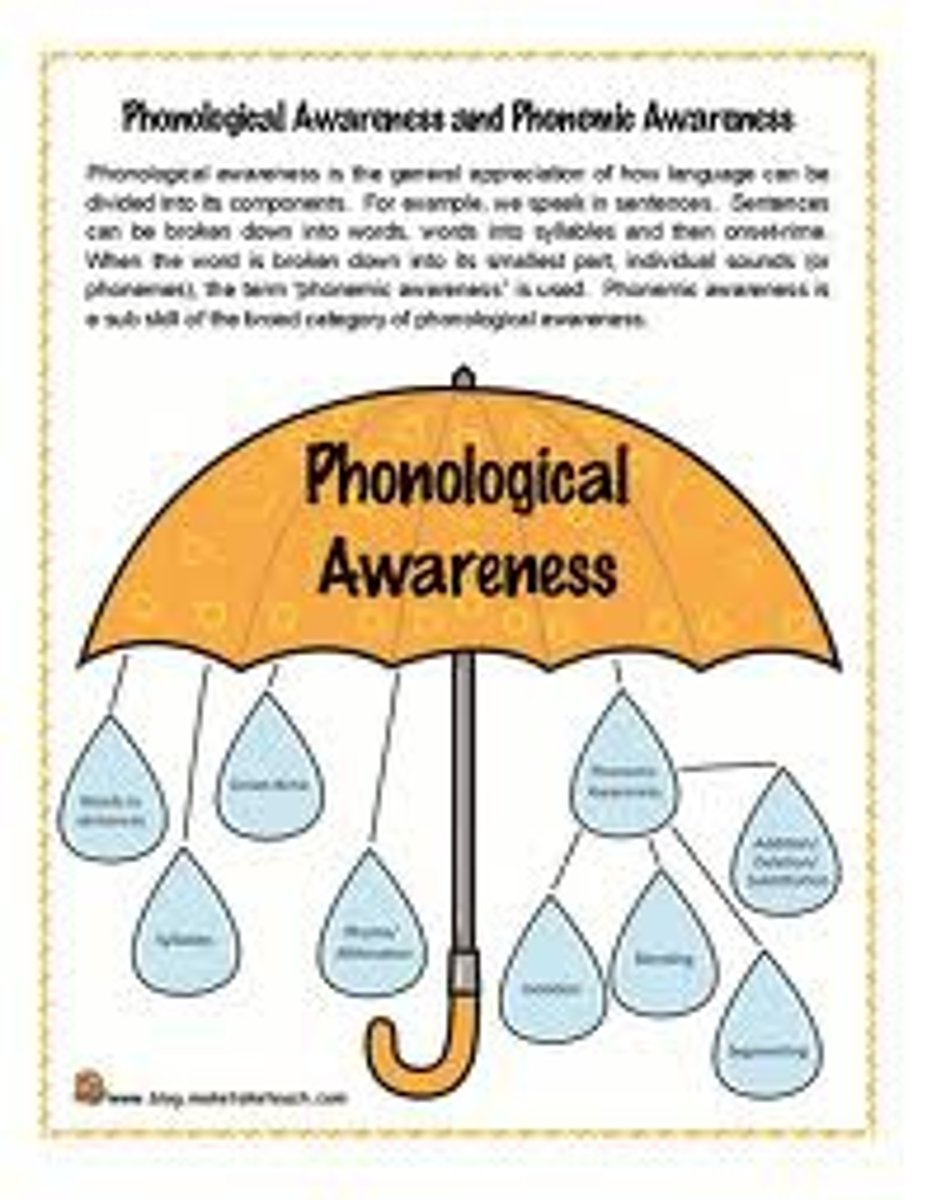
Phonemic Awareness
The ability to hear, identify, and manipulate individual sounds- phonemes- in spoken words. This is purely an auditory skill and does NOT involve a connection to the written form of language.
The MOST complex level of phonological awareness
Phonological Awareness
A broad term that includes phonemic awareness. In addition to phonemes, these activities can involve work with rhymes, words, syllables, onsets, and rimes.
ITS AUDITORY
Syllable
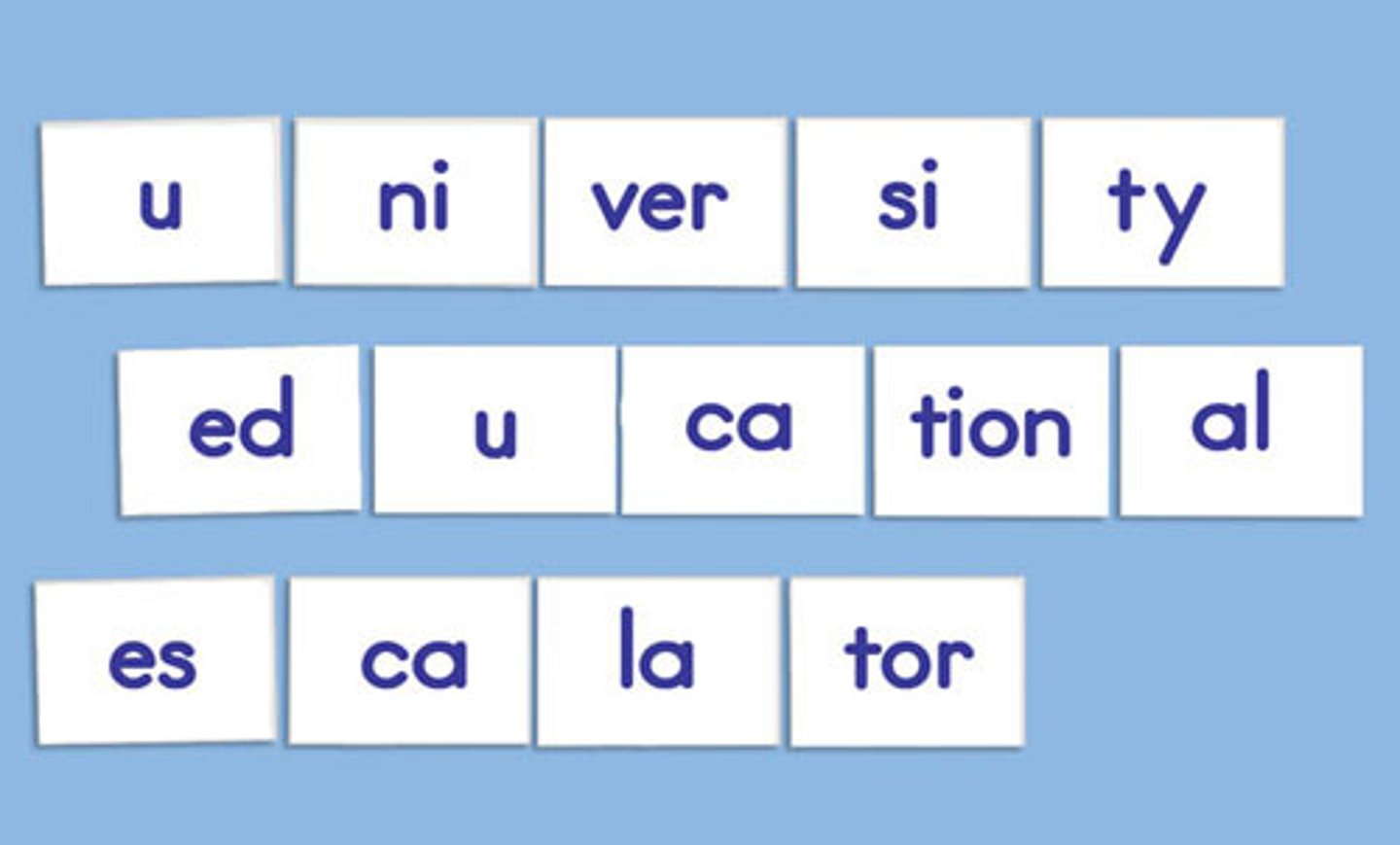
A word part that contains a vowel, or, in spoken language, a vowel sound.
Onset and Rime
Parts of spoken language that are smaller than syllables but larger than phonemes.
Onset
The initial consonant sound of a syllable
Rime
The part of a syllable that contains the vowel and all that follows it.
Phonological Awareness Skills
1. Rhyming
2. Syllables
3. Counting words in a sentence
4. Hearing/manipulating onset and rime
5. Phonemic Awareness
Phoneme Isolation
Children recognize individual sounds in a word.
Example:
Teacher- What is the first sound in van?
Student- The first sound in van is /v/.
Phoneme Identify
Children recognize the same sounds in different words.
Example:
Teacher- What sound is the same in fix, fall, and fun?
Student- The first sound, /f/, is the same
Phoneme Categorization
Children listen to a sequence of separately spoken phonemes and then combine the phonemes to form a word. Then they write and read the word.
Example:
Teacher- What word doesn't belong? Bus, Bun, Rug.
Student- Rug does not belong. It doesn't begin with /b/.
Phoneme Blending
Children listen to a sequence of separately spoken phonemes, and then combine the phonemes to form a word. Then they write and read the word.
Example:
Teacher- What word is /b/ /i/ /g/?
Student- /b/ /i/ /g/ is big.
Phoneme Segmentation
Children break a word into its separate sounds, saying each sound as they tap out or count it. Then they write and read the word.
Example:
Teacher- How many sounds are in grab?
Student- /g/ /r/ /a/ /b/. Four sounds
Phoneme deletion
Children recognize the word that remains when a phoneme is removed from another word.
Example:
Teacher- What is smile without the /s/?
Student- Smile without the /s/ is mile.
Phoneme addition
Children make new word by adding a phoneme to an existing word.
Example:
Teacher- What word do you have if yo add /s/ to the beginning of park?
Children- Spark
Phoneme Substitution
Children substitute one phoneme for another to make a new word.
Example:
Teacher- The word is bug. Change /g/ to /n/. What's the new word?
Student- bun
Phonemic Awareness Improves
Children's ability to read words
Reading Comprehension
Spelling
Phoneme Manipulation
When children work with phonemes in words, they are manipulating the phonemes.
Types: Blending, segmenting, deleting, adding, substituting.
Alphabetic Principle
Phonemes that are represented by letters and letters pairs.
Environmental Principle
Print found authentically in our environment
Emergent Literacy
Literacy development begins with one's earliest experiences of authentic literacy in home. These students are typically in early childhood setting or kindergarten.
Book Handling Skills
Illustrates a child's knowledge of how books "work" by holding a book, tracking print from left to right, front and back cover, title page.
Three Reading Cueing Systems
1. Semantics Meaning - Does it make sense?
2. Syntax Structure - Does it sound right?
3. Phonics Visual - Does it match the print?
Meaning/Semantics
The context of sentence, paragraph, passage and/or text.
Background knowledge
Illustrations where available
Structure/Syntax
Grammar
An intuitive sense of the correct order of words in a sentence, subject-verb agreement, consistent use of tense.
Visual/Phonics
Alphabetic principle
Letter-sound correspondence
Phonics generalizations
Structural Analysis Strategies
THE CUEING SYSTEM GIVEN GREATEST PRIORITY AND IMPORTANCE for INSTRUCTION
Consonant
B,C,D,F,G,H,J,K,L,M,N,P etc.
There is a strong relationship between the letter and the sound we expect it to represent.
Represent the dominant sounds in words.
Consonant irregularities
The hard c is the sound of /k/ in cat.
The soft c is the sound of /s/ in cent and city.
The hard g is the sound of /g/ in game.
The soft g is the sound of /j/ in gem and gentle
Vowels
Generally, considered short.
A: apple
E: elephant
I: igloo
O: octopus
U: umbrella
Or long such as the sounds in the words below:
A: say
E: tree
I: bike
O: boat
U: cute
Harder to discriminate then consonants.
Blends
Consonant pairs or clusters. You hear each sound through to the end. "bl" in blend till the "end"
Examples: bl, sm, scr, gr, sl,
Digraphs
Two consonant letters that together make a new sound.
A digraph makes me lau"gh".
Generalization: When two vowels go walking, the first one does the talking.
Examples: ch, ph, sh, th, wh, tch, gh, ng.
Silent E
When a short vowel ends with an "e" the first vowel usually has the long sound and the final "e" is silent.
R controlled vowels
When a vowel letter is followed by "r", the vowel sound is neither long nor short, it's different.
Example: "ir" in "bird"
Diphthongs
A blend of vowel sounds, where each sound is still heard. "oi" in boil.
Synthetic Phonics
A part-to-whole phonic approach to reading instruction in which the student learn the sounds represented by letter and letters combinations, blends these sounds to pronounce words, and finally identifies which phonics generalizations apply.
Involves the development of phonemic awareness from the outset.
BOTTOM UP
Analytic Phonics
A whole-to-part approach to word study in which the student is first taught a number of sight words and then relevant phonics generalizations, which are subsequently applied to other words; deductive phonics.
ALSO KNOWN AS... the Whole Word approach
TOP DOWN
Research-Based Instruction for Emergent Readers
Learn concepts about print
Build oral language
Build phonological awareness
Develop knowledge of letter names
May begin to develop knowledge of alphabetic principle
Research-Based Instruction for Early Readers
Instruction begins with words containing short vowels sounds. These words begin with single consonant letters and then include consonant blends and digraphs.
CVC pattern
cat
sip
bug
map
CVCC pattern
cast
tent
lift
fist
CCVC pattern
trip
twig
ship
chat
CCVCC pattern
stick
truck
twist
blend
CVCe
same
late
bike
Sight words
These appear frequently in their reading and writing and need to be memorized
Examples: because, friend, there, when
Transitional Readers
2nd grade and up
Students at this level begin to see lots of words that are not necessarily in their oral vocabulary.
Fluency
Reading smoothly, accurately, and efficiently. It includes accuracy, appropriate rate, expression, phrasing, and intonation.
How to build oral reading fluency
Lots of practice reading independent level texts.
Independent Level
95-100% accuracy
This is the level at which student should practice reading independently.
Instructional Level
90-94% accuracy
This is the student's zone of proximal development where small group instruction or individual instruction is appropriate.
Frustration Level
Below 90% accuracy
This is the level at which the student's reading development may be undermined.
Reading at frustration level should be minimum.
Strategies that support oral reading fluency
Repeated readings of familiar texts
Echo reading
Choral reading
Reader's theater
Fluency directly affects
comprehension
Morpheme
Any unit in a word is a morpheme
Base word
A simple word from which you can build a family of words around it.
Root word
The origin of a word.
Example: "locus" means place in Latin
Prefix
Morpheme added to the beginning of the word
Suffix
Morpheme added to the end of the word
Affix
Prefixes, suffixes, and inflectional ending.
Closed Syllables
When a short word with one vowel letter ends in a consonant, the vowel sound is usually short.
Examples: VC, CVC, CVCC, CCVC
Open Syllables
When a word or a syllable has only one vowel and its comes at the end of the word or syllable, it usually creates the long vowel sounds.
Example: CV, CV-CVC.
Inflectional Endings
Affixes added to the end of words to indicate number (ox/oxen, bush/bushes) or tense (playing, played, plays).
Syllabication
sum-mer
pre-vent
um-brel-la
Compound Words
hotdog
shoelace
Contractions
have not- haven't
can not - can't
Schwa
An unstressed vowel sound, such as the first sound in "around" and the last vowel sound in "custom".
Oral Vocabulary
The vocabulary one can use appropriately in speech and can understand when heard aloud
Written Vocabulary
The words one can understand when seen in written form.
Semantic Mapping
A strategy that visually displays the relationship among words and helps to categorize them.
Why is vocabulary so important to reading development?
It improves students' comprehension
Students' ability to infer meaning of text
the ability to read complex tests
Strategies for Teaching Vocabulary Effectively
Provide explicit instruction in selected words that will likely be seen in other contexts.
Provide explicit instruction in strategies to determine the meaning of unfamiliar words.
Provide explicit instruction of technical vocabulary important to understanding content in social studies and science.
Provide opportunities for children to hear books read aloud.
Provide opportunities for children to read independently.
Let children talk about what they read.
Let children make connections between oral and written vocabulary.
When answering multiple choice questions related to vocabulary, consider the purpose...
Is it to prepare students for content area (science, history) instruction? Is so, teach the concept words that are unfamiliar and necessary to understand the topic.
If the question is asking about preparing students to understand literary texts, consider the words that would be helpful to know in this test, but also in others. These are Tier 2 words.
Tier 3
Domain-specific
Science/history
Example: volcano, atmosphere
Tier 2
More sophisticated synonyms for words many children will know.
Examples: generous, bawl, whine, infant
Tier 1
Require no instruction; concepts already familiar, words familiar.
Example: Kind, cry, baby
Metacognitive Strategies
These are strategies that help the reader become more aware of their own reading process, their thoughts as they read, and help the reader to have more control over their reading.
Graphic Organizers
Visual maps or diagrams that help the reader organize the information they read. A story map is one type of graphic organizer. It allows the reader to organize the elements of a story.
Literal Comprehension
Information that is stated explicitly in the text such as who, what, when, where, and why.
Inferential Comprehension
Information that is implied within the text, but not directly or explicitly stated.
Evaluative Comprehension
The reader needs to use information from the text and their own world experiences to form a judgement.
Before Reading Activities
Activate and build upon prior knowledge
Predict what text is about based on text features, visuals, and text type.
Setting a purpose for reading.
Example: Anticipating Guide
During Reading Activities
Connect new texts with prior knowledge and experiences
Check predictions for accuracy
Form sensory image
Making inferences
Determining key vocabulary
Interpreting the traits of main characters
Self-monitoring own difficulty in decoding and comprehending texts.
Interpreting diagrams, maps, and charts.
Posing how, why, and what questions to understand.
Recognizing cause and effect relationships and drawing conclusions.
Noticing when comprehension problems arise.
After Reading Activities
Discussing accuracy of predictions
Summarizing the key ideas
Connecting and comparing information from texts to experience and knowledge
Explaining and describing new ideas and information in own words.
Retelling story in own words including setting, characters, and sequence of important events.
Discussing and comparing authors and illustrators.
Reflecting on the strategies that helped the most and lest and why.
Example: Semantic Map
Questions before reading should help the reader
Make connections
Set a purpose
Make predictions
Questions during reading should help the reader
Clarify and review
Confirm or create new predictions
Critically evaluate the story and make personal connections
Make connections with other experiences or books
Monitor the child's reading for meaning and accuracy.
Questions after reading will help
Reinforce the concept
Model ways of thinking
Encourage critical thinking
Build awareness
Informational/Expository Texts
These are factual materials for science, social studies, and other content areas, as well as "concept books" for the very young dealing with the alphabet or relationships of time, space, amount.
Cloze Procedure
A versatile, informal instrument for use in determining a student's reading level, use of context while reading, and knowledge of vocabulary. Sometimes used as an alternative to the Informal Reading Inventory for determining reading levels, students read a selection in which random words are deleted a replaced with black spaces. Students are directed to read the selection and fill in the blanks.
Ongoing Reading Assessments
Assessment made on a regular basis through a variety of means, both informal and formal. The purpose is to document progress the student makes in reading. while also identifying areas that need instruction.
Criterion-Referenced Tests
Tests based on objectives that contain specific conditions, outcomes, and criteria that are expected for satisfactory completion of the task.
Norm-referenced tests
A norm referenced test provides information on how well a student performs in comparison to an external reference group or norm group.
Miscue Analysis
Analysis of any responses made during oral reading that deviate from those anticipated.
Informal Reading Inventories
A compilation of graded reading selections with comprehension questions accompanying each selection. This inventory is individually administered to determine the students' strengths and weaknesses in word recognition and comprehension.
Running Records
Allows the teacher to determine...
text difficulty
student's placement in groups or materials
the directional movement of the child in reading connected text.
the child's ability to coordinate oral language with the visual patterns in text
the child's speed of responding
The type of cues the child uses to process
The child's self-correction behavior
Rubrics
A set of scoring guidelines for evaluating student work
Portfolio Assessment
The systematic collection of student work for use in evaluating changes in student performance in reading and language.
Omissions
High numbers show the child is not using any strategies to decode the print.
High number of initials letter attempts and substitutions
can reflect that the child has emerging decoding skills; at least the child is attempting to decode - instruction would then focus on helping child become more skilled in decoding
Errors with sight words
show that the words need to be memorized