RICARDIAN / DFS MODEL
 Call Kai
 Learn
Learn Practice Test
 Spaced Repetition
 Match
Match Flashcards
 Knowt Play
1/14

There's no tags or description
Looks like no tags are added yet.
Name | Mastery | Learn | Test | Matching | Spaced | Call with Kai |
|---|
No analytics yet
Send a link to your students to track their progress
15 Terms
Ricardian Model - Assumptions
2 countries, 2 goods
1 factor - labour
exogenous technology with constant returns to scale (CRS), presented by linear production functions
labour is perfectly mobile between industries in a given country but totally immobile across countries (no migration)
same utility function and homothetic preferences in both countries
Ricardian Model - Home & Foreign PPF
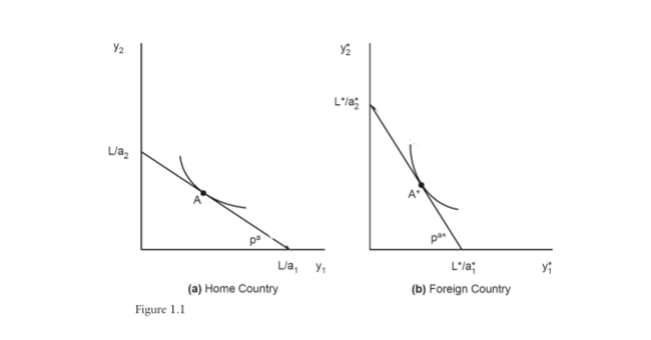
Absolute Advantage vs Comparative Advantage
Absolute Advantage - a country is more productive in producing a good
Comparative Advantage - a country is able to produce a particular good at a lower opportunity cost
z
The index of goods on the continuum [0,1], ranked by Home's comparative advantage (z=0 is Home's best good).
a(z)
Unit labor requirement in Home for good z. (The inverse of productivity: higher a(z) = lower productivity).
A(z)=a∗(z)/a(z)
Relative Technology Schedule. Downward-sloping. Represents Home's comparative advantage.
ω=w/w∗
Relative Wage. The price of Home labor relative to Foreign labor. The key adjustment variable.
θ(z)
Cumulative Expenditure Share. The fraction of world income spent on all goods in the range [0,z].
B(z)=1−θ(z)θ(z)LL∗
Relative Labor Demand Schedule (Balanced Trade). Upward-sloping. Shows the wage ω required to clear labor markets.
zˉ (Borderline Commodity)
The good where ω=A(zˉ). Home produces all z
Iceberg Trade Cost (g)
A fraction 0<g<1 of the good that arrives after shipping. 1/g is the amount that must be shipped.
Non-Traded Sector
The interval of goods (zˉ∗,zˉ) where shipping costs are too high relative to the cost advantage; produced locally in both countries.
Balanced Trade Condition
The macroeconomic requirement that the value of Home's imports equals the value of Home's exports, as there is no international borrowing.
Intensive Margin
Expansion of trade volume for goods already being traded. (Usually associated with Krugman/Melitz).
Extensive Margin
Expansion of the number of varieties or number of firms exporting. (Usually associated with Krugman/Melitz).