Bio final
 Call Kai
 Learn
Learn Practice Test
 Spaced Repetition
 Match
Match Flashcards
 Knowt Play
1/87

There's no tags or description
Looks like no tags are added yet.
Name | Mastery | Learn | Test | Matching | Spaced | Call with Kai |
|---|
No analytics yet
Send a link to your students to track their progress
88 Terms
Gregor Mendel is famous for his work with his garden pea plants. He observed several
traits and their individual patterns of inheritance. Through his F1 and F2 crosses he was able to work out two important principles, the law of ……… and the law of ……………. These principles provided us significant insight into how traits are passed from parents to offspring. He is considered the father of ………….
DOMINANCE, INDEPENDENT ASSORTMENT, GENETICS
Why do we use a punnett square? What does it specifically tell us about a cross?
To predict the phenotype and genotype potential offspring. Haploid parent cells are on the outside and diploid offspring cells are on the outside.
Dominant
Definition: Stronger trait. Example: B= brown eyes
Recessive
Definition: Weaker trait. Example: b= blue eyes
Homozygous
definition: same alleles. example: BB= shows dominant trait, bb= shows recessive trait
Heterozygous
definition: different alleles. Example: Bb= shows dominant alleles
Genotype
definition: alleles/genes. Example: BB, Bb, bb
Phenotype
definition: physical trait. Example: Blue eyes or brown eyes
Mendel concluded that certain alleles are either ………. while the others for the same gene are …….. and therefore masked phenotypically
DOMINANT, RECESSIVE
In Mendel’s F1 cross, what would you expect the potential offspring to look like(phenotypically) when a true-breeding purple flowered plant is crossed with a true-breeding white-flowered plant? (remember purple is dominant)
PP x pp = all offspring would be Pp, purple.
In Mendel’s F2 cross, based on the previous question, what was the phenotypic ratio of the offspring?
Pp x Pp = PP, Pp, pp (75% purple, 25% white)
Incomplete dominance Definition
Neither allele is dominant over the other so you see a BLEND of traits
Heterozygous is a blend
Punnett square can use the same letter or different letters depending on the problem
incomplete dominance example
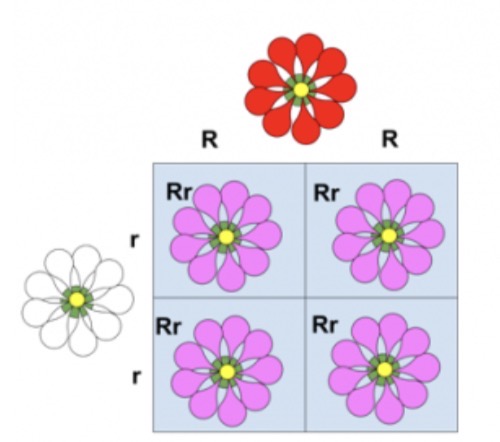
Incomplete dominance key differences from Mendelian traits
Heterozygous are BLENDED
Codominance
Both alleles are dominant so they both show in the phenotype
Use two DIFFERENT capital letters in the punnett square
Codominance example
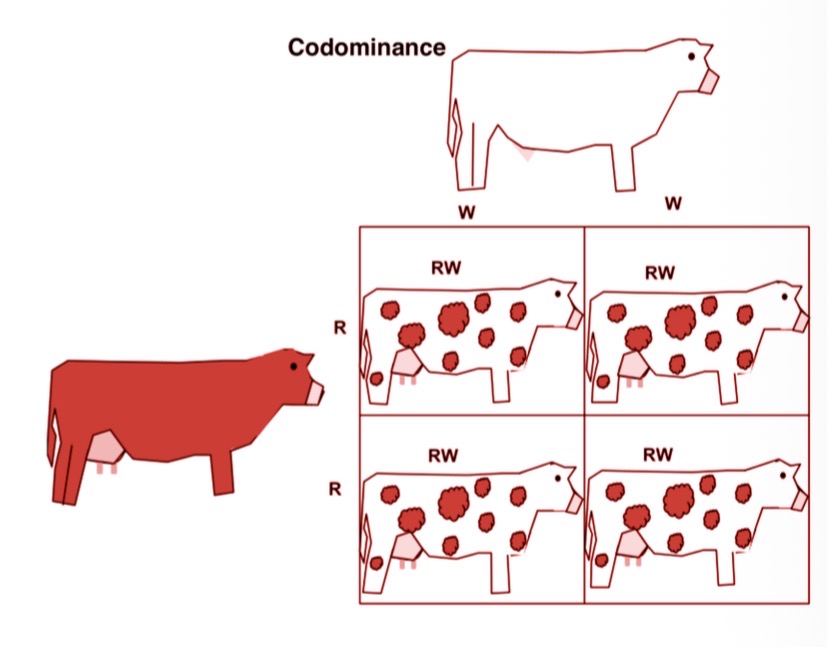
Codominance key differences from Mendelian traits
red cow crossed with white cow= spotted cow
Multiple Alleles definition
3 or more possible alleles for a trait (as a population)
Multiple alleles example
Blood type A, B, O
Multiple alleles key differences from Mendelian traits
More than two potential phenotypes
Polygenic inheritance definition
Multiple GENES contributing to one traits
Polygenic inheritance example
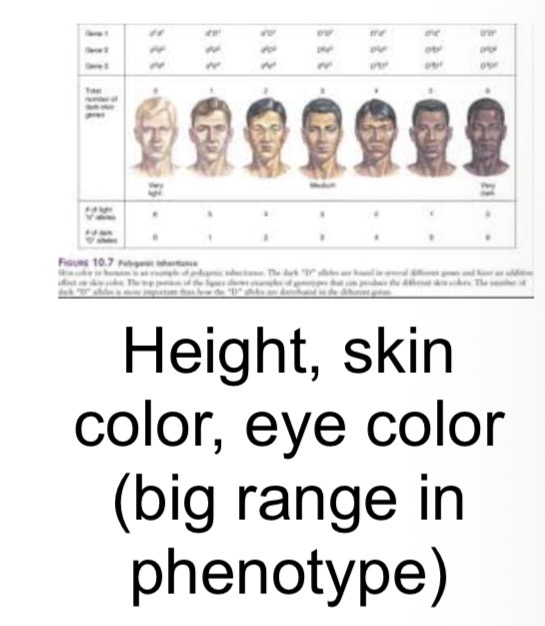
Polygenic inheritance Key differences from Mendelian traits
Larger range in phenotype
Sex-linked traits definition
Males are affected more than females because they have 1 X chromosome
Use XX for females and XY for males
Use the same letter for the trait such as:
X^A X^A
NOT: X^A X^B
Sex-linked example
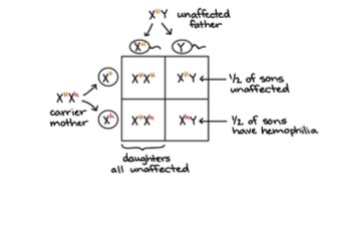
Sex-linked key differences from Mendelian traits
Color deficiency in males
Transcription- where?
Nucleus
Transcription- main purpose
DNA —> RNA
Transcription- “Language”
DNA language (ATCG) —> RNA language (AUCG)
Transcription starts and stops at…..
Promoter and terminator
Translation- where?
Ribosome
Translation- Main purpose
RNA —> protein
Translation- “Language”
nucleic acid language (AUCG) —> amino acid language (met)
Translation starts and stops at……
Start codon, Stop codon
Point mutation definition
ONE nucleotide (letter) is affected. But there is still the same number of nucleotides in the DNA sequence. (Silent, substitution, missense, nonsense)
Point mutation example
Silent Mutation
Frameshift Mutation definition
Shift the whole reading frame of DNA.
Frameshift Mutation example
Insertion and deletion
Chromosomal Mutation definition
Mutation that affects the whole chromosome (extra chromosomes, missing chromosomes, missing PART of chromosome)
Chromosomal Mutation example
Down syndrome
Overproduction
Reproduce more than can survive
Variation
Organisms within the population vary
Selection
Some organisms survive and reproduce better than others. They are more fit.
Adaptation
Genes of the more fit organisms start to increase in the population
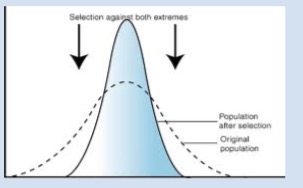
Stabilizing selection
The average phenotype is selected for
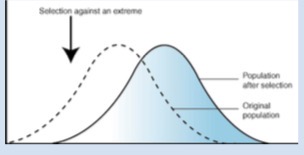
Directional Selection
One extreme phenotype is selected for
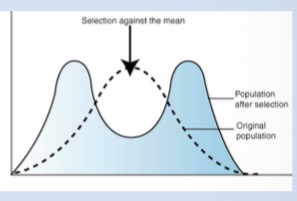
Disruptive selection
Both extremes are selected for
Biogeology
The study of where organisms live and where their ancestors lived in the past.
Selection pressures
Fossils
Embryology
Comparing the development of embryos in different organisms. Similarity in development shows common ancestor.
Ex. Chicken and Crocdile
Homologous Structures
Similar STRUCTURE -different function
***similar architecture (1 bone, 2 bone, little bones, digit)
EXAMPLE: Crocodile, whale fin
Vestigial structures
Previous function, but nothing now -left over
Appendix
Molecular Evidence
Molecular Evidence
Share similar DNA!
Morphological or Anatomical adaptations
Body structures
Camouflage
Mimicry
Defense mechanisms
Physiological adaptations
Cellular features
Internal changes
Poisons
Temp regulation
Allopatric speciation definition
Two populations of the same species become isolated from each other due to geographic changes
Allopatric speciation examples
River
Mountain
Ocean
Sympatric speciation
Two groups of the same species live in the same geographic location, but they evolved differently until they can no longer interbreed
Sympatric speciation example
Behavioral- different courtship rituals
Time of year they mate
Habitat
Different reproductive structures
Ecology is the study of interactions between different…….. and between organisms and the …….
Organisms
Environment
Abiotic factor=
NON LIVING
Biotic factor=
LIVING
The biosphere is all the places on earth where we find……
Life
Photosynthesizer: use the energy of the…….. to make food
Sun
Chemosynthesizers: use the energy of the……. To make food.
Chemical bonds
Herbivores: eat…….
Plants
Carnivores: eat…….
Meat
Omnivores: eat
Plant and meat
Scavengers: eat………
Dead carcasses
Ditritivores:
An animal that feeds on dead organic material
Decomposers:
Organisms that breakdown and obtain energy from dead organic matter
Organisms that occupy the same level of a food chain/Web are at the same…….. level
Trophic
Approximately…….. of energy is passed on from one trophic level to the next
10%
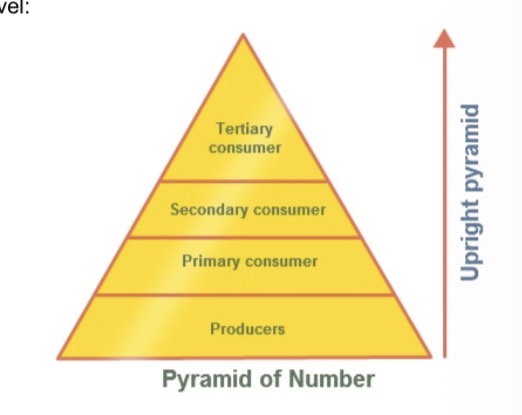
In the ecological pyramid below, please fill an organisms that occupy each level:
Communities of organisms(……. Factors) + the nonliving environment (…….. factors).
Biotic
Abiotic
Communities are different…………… living in the same area
Populations/species
Competition description
Organisms attempting to use ecological resources at the same time and place
Competition examples
Water, mates, nutrients, light food, space, shelter, etc.
Predation description
One organism hunt and eats another.
Predator: eats
Prey: eaten
Symbiosis description
Any intimate relationship between members of two or more different species
Mutualism
Both species benefit
Commensalism
One benefits and other is not affected
Parasitism
One benefits and another is harmed
One…….. living together in a defined area
Species
The number of organisms in an ecosystem can hold or sustain is referred to as…….
Carrying capacity
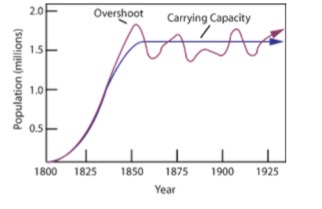
Density dependent factors
Stops a large population from getting any larger
Examples: disease, resources, predators
Density independent factors
Stop the population from growing any larger, regardless of size.
Example: humans, whether natural disaster
Positive feedback mechanism definition
Promotes the change in the system to push FURTHER away from home
Example: giving birth
Negative feedback mechanism definition
Restores the system back to homeostasis
Example: sweating