MEMORY AND LEARNING UNIT 3 - Classical Conditioning
 Call Kai
 Learn
Learn Practice Test
 Spaced Repetition
 Match
Match Flashcards
 Knowt Play
1/29

There's no tags or description
Looks like no tags are added yet.
Name | Mastery | Learn | Test | Matching | Spaced | Call with Kai |
|---|
No analytics yet
Send a link to your students to track their progress
30 Terms
Stimuli and responses functions in Classical conditioning? 4 pts
unconditioned stimulus (US) - a stimulus that elicits a respone without prior pairing with another stimulus
unconditioned response (UR) - a response elicited by an unconditioned stimulus
conditioned stimulus (CS) - a stimulus that elicits a response because of prior pairing with another stimulus
conditioned response (CR) - a response elicited by a conditioned stimulus
what is classical conditioning? 2 pts
a learning mechanism through which an initially neutral stimulus acquires the ability to elicit a reflex respone due to its repeated pairing with another stimulus that already produced it (reflex responses)
we do not learn new responses but rather learn to respond to stimuli in the presence of which we did not respond
ontogenetic behavior? 4 pts
each organism has unique onotogenetic history
classical and operant coniditoning are ontogenetic behaviors because they are learned through experience
organisms whose behavior came under the control of arbitrary environmental events gained an advantage over those whose behavior did not
thorugh darwinian evolution and selection respondent conditioning became a means of behavioral adaptation
key elements in classical/pavlovian/respondent conditioning? 5 pts
it involved the transfer of the control of behavior from one stimulus to another by S-S association (sharing a function)
the stimuli become functionally equivalent in their ability to elicit a response after S-S pairing
this kind of conditioning occurs in all species
it involves establishing conditional probability between the presence of the CS and the occurence of the US
this occurs because of the CS-US contingency not because the organism associates stimuli (association can only occur between events)
what is S-S association? 1 pt
Stimulus-Stimulus assocation that occurs when an organism learns that one stimulus predicts another contiguity
contiguity and contingency of stimuli? 3 pts
contiguity- close temporal proximity between the CS and US that is required
contingency- correlation between stimuli is the key; US should occur more frequently when the CS is present than when it is absent/CS should predict/signal the US
when stimuli or events occur near in time/are paired together they often become similar in function (equivalence relation)
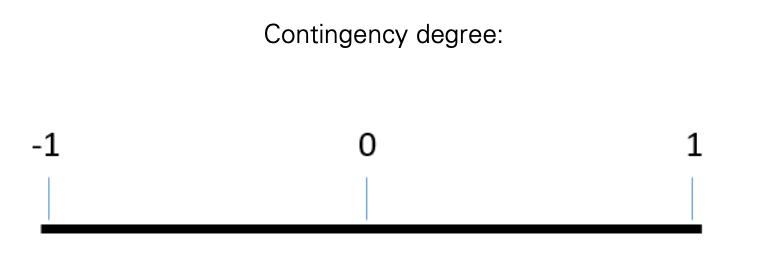
contingency degree? 3 pts
from -1 to 0 there is a negative relation
0 means there is no contingency
from 0 to 1 there is a positive relation
four types of procedures: appetitive vs aversive? 3 pts
only used to describe the valence of the US
appetitive benefits the organism while aversive harms the organism
appetitve can also be the non-appearance of an aversive stimulus that harms/does not benefit the organism
four types of procedures: excitatory vs inhibitory? 3 pts
refers to the type of contingency; relationship between the CS and US
excitatory conditioning- positive contingency that predicts the appearance of the US
inhibitory conditioning- negative contingency that predicts the non-appearance of the US and must occur in an excitatory context
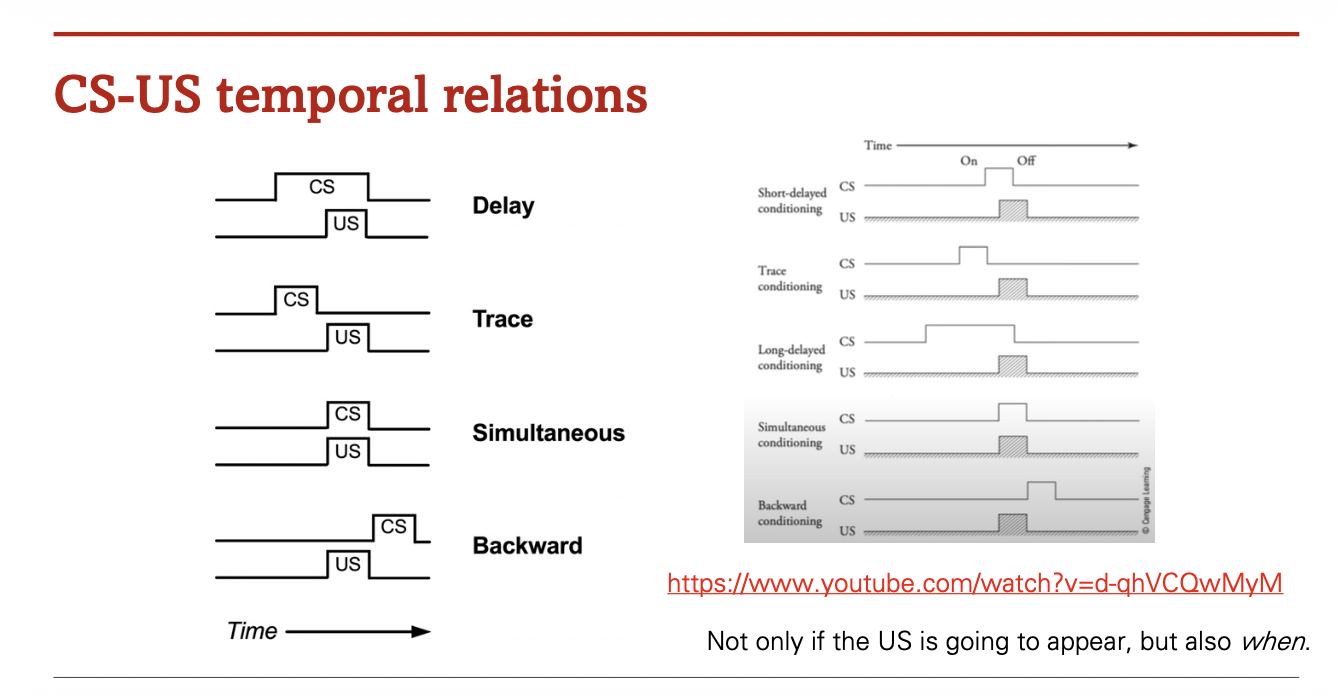
CS-US temporal relations? 4 pts
Learning depends not only on whether the US occurs, but also on when it occurs relative to the CS
delay- CS starts first and the US begins after where the CS becomes a predictor of the US and is the most effective type of conditioning
trace- there is a short delay between the end of the CS and the appearance of the US; learning still occurs but at a slower rate because the organism must remember the CS
simultaneous- the CS and US occur at the same time such that the CS does not predict the US and learning does not occur
backwards- the US happens before the CS such that the CS is not a predictor and the organism learns little to no association between the two; sometimes this causes the organism to associate the appearance of the CS as the end of the SU e.g. bell signals the end of food
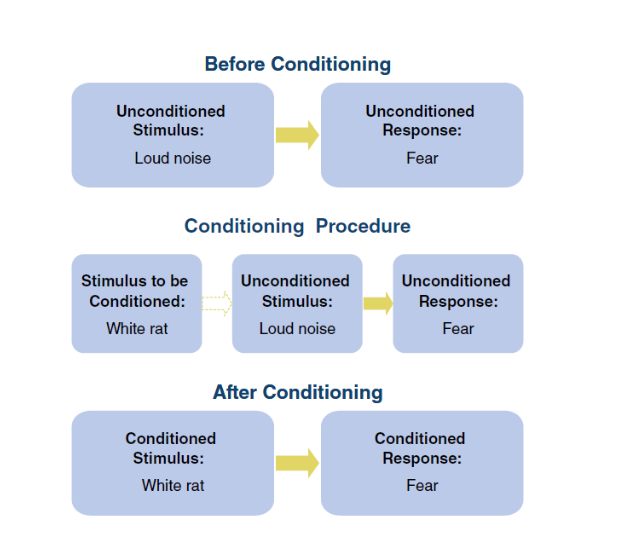
watson experiment? 1 pt
he and his assistand conditioned a phobic reaction in a 9 month ol dinfant using classical conditioning
object learning? 2pts
certain characteristics of the object are associated with the event that elicits the UR e.g, the smell of coffee signalling coffee itself
object learning constitutes the exception of the non-arbitrary relation among CS and US
arbitrary vs non-arbitrary relations among CS and US? 2 pts
arbitrary- random pairing of a CS and USthat only becomes meaningful through conditioning
non-arbitrary- naturally occurring relationship between the conditioned stimulus (CS) and unconditioned stimulus (US), making the association easier to learn
autoshaping/signal tracking? 4 pts
occurs when an animal starts approaching or interacting with the conditioned stimulus (CS) itself, even though doing so is not required to obtain the reward (US)
they behave towards the CS as it were the US; they show a high preference towards the CS
the classic example is a pigeon that receives food after a light goes on, then conditions itself to peck at the light even though the pecking is not necessary to receive the food
Signal tracking = the animal becomes attracted to the signal.
conditioned supression? 3 pts
suppression of ongoing behavior occurring when a stimulus that predicts something unpleasant (usually a shock) causes an animal to stop or reduce an ongoing behavior
the fear caused by the CS suppresses the ongoing behavior
supression is learned through classical conditioning
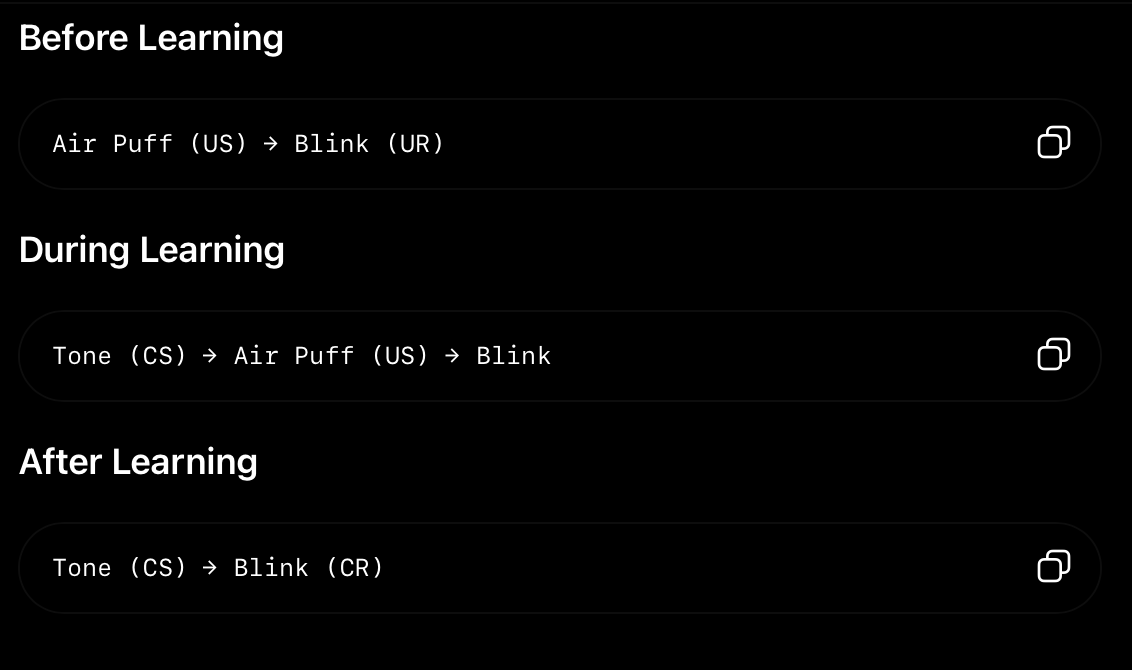
eye blink conditioning? 1 pts
a form of classical conditioning in which a neutral stimulus comes to trigger an eyeblink after being repeatedly paired with a stimulus that naturally causes blinking
food aversion (Similar to drink aversion? 4 pts
food might also function as a CS when it is followed by an aversive US like an illness
people under chemotherapy develop an aversion to what they eat before the session
this also explains food aversion in anorexia
special because only 1 trial is needed for association to occur and the US can be presented after a long delay of eating (long continguity)
luncheon technique? 1 pt
having a more favorable view of people and things when eating
latent inhibition/pre-exposure to CS? 2 pts
pre-exposure of the CS retards the acquisition/makes the CR less intense
organisms learn to respond faster and more efficiently to novel stimulus because the familiar stimulus was already learned to predict nothing
pre-exposure to US? 2 pts
makes classical conditioning slower/harder
Learning is reduced because the US is already familiar and less surprising and the organism expects the US to occur on its own
higher-order conditioning? 1 pt
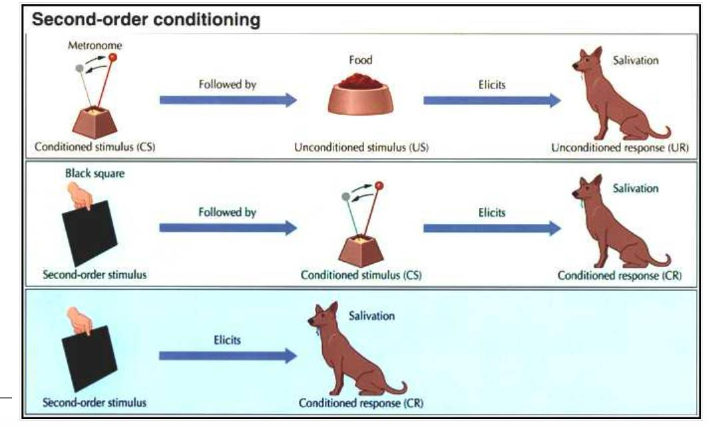
also called second order conditioning is the phenomenon by which a neutral stimulus is paired with a conditioned stimulus which already elicits a conditioned response
sensory preconditioning? 3 pts
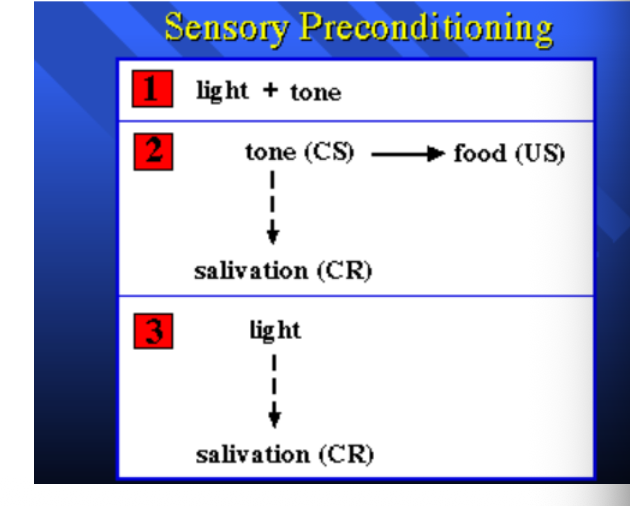
exposure to two neutral stimuli in succession leads to the association between those two stimuli
this association can occur even if neither stimulus initially elicits a response
it involved pairing of two initially unrelated stimuli in such a way that later presentation of one stimulus can evoke a response typically associated with the CR
attentional effects: blocking effect? 2 pts
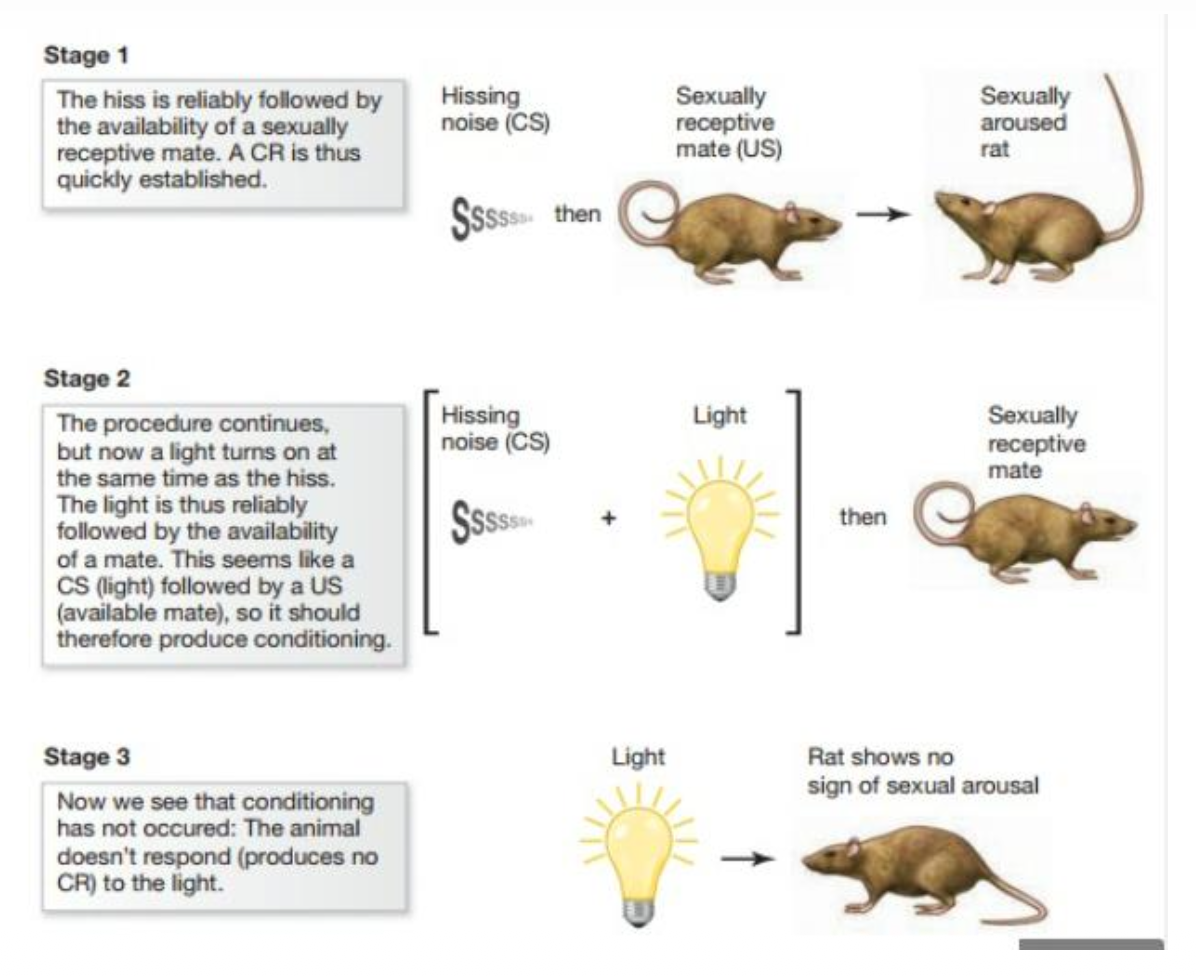
a phenomenon in classical conditioning where the presence of an established conditioned stimulus (CS1) can block the acquisition of a new conditioned response when a second conditioned stimulus (CS2) is paired with the US
if the organism has already learned to associate a particular stimulus (CS1) with an outcome it may not readily learn to associate a new stimulus with the same outcome even if the CS2 is presented alongside the CS1 during conditioning trials
salience and overshadowing? 3 pts
stimulus salience- the significance/noticeability of the stimulus; the more salient a stimuli, the faster learning occurs
a stimulus can be made more salient by increasing the intensity of the stimulus; a more intense US and CS will result in better conditioning
overshadowing- if two stimuli are presented together and followed by a US there will be better conditioning to the stronger of the two stimuli e.g a shock will overpower a sound in classical conditioning
counterconditioning and extinction? 2 pts
counterconditioning- a procedure in which an unpleasant conditioned response is changed by pairing the unpleasant conditioned stimulus (CS) with a new stimulus that produces an opposite response; you replace an old learned reaction with a new one
extinction- occurs when the conditioned stimulus (CS) is repeatedly presented without the unconditioned stimulus (US), causing the conditioned response (CR) to gradually weaken and disappear; the organism learns that the CS no longer predicts the US not because it has forgotten but because a new association has been learned instead (CS now means non appearance of US) which competes with the old learning
spontaneous recovery? 1 pt
the reappearance of a previously extinguished conditioned response after a rest period that is weaker than the original response and is more prone to extinction again if the CS does not predict the US; it is possible because extinction does not mean learned response has been forgotten
CR renewal? 1 pt
The return of an extinguished conditioned response when the conditioned stimulus is presented in a different context from the extinction context
disinhibition? 1 pt
temporary reappearance of an extinguished conditioned response following the presentation of a novel or unexpected stimulus
generalization and discrimination? 2 pts
discrimination- only responding to new stimuli that resembles the CS
generalization- experiencing the same response with stimuli with similar characteristics as the CS even though there is no prior learning