US physics II quiz 4
 Call Kai
 Learn
Learn Practice Test
 Spaced Repetition
 Match
Match Flashcards
 Knowt Play
1/53

There's no tags or description
Looks like no tags are added yet.
Name | Mastery | Learn | Test | Matching | Spaced | Call with Kai |
|---|
No analytics yet
Send a link to your students to track their progress
54 Terms
Ultrasound
bidirectional
transducer
converts one form of energy into another
transmission
Electrical → Sound
reception
Sound → Electrical
Transducer connection
Energy conversion → Sound beam → Image formation
PZT (Piezoelectric element)
performs the energy conversion that creates ultrasound imaging
PZT transmission
Voltage → Sound
pulse leaves transducer
creates ultrasound wave
PZT reception
Sound → Voltage
echo returns to transducer
creates electrical signal
↑ Damping
↓ Pulse Duration
↑ Bandwidth
↓ Q Factor
Q-Factor (Quality Factor)
Measures how efficiently a transducer produces
a narrow range of frequencies
High Q-factor
– Narrow bandwidth
– Longer pulse
– More sensitive
Low Q-factor
– Wide bandwidth
– Shorter pulse
– Better for imaging
Imaging transducers prefer
Low Q + Wide bandwidth
A transducer is modified to increase damping. Which change is MOST likely to
occur?
a) Narrower bandwidth and higher Q factor
b) Narrower bandwidth and lower Q factor
c) Wider bandwidth and lower Q factor
d) Longer pulse duration
Wider bandwidth and lower Q factor
Mechanical Transducers
■ Physical movement creates image
■ Beam direction changed mechanically
(sweep/steering)
■ Typically fixed focus
Array (Electronic) Transducers
■ Multiple active elements
■ Electronic steering & focusing
■ Most common in modern ultrasound
(provides greater beam control)
Linear
FOV: rectangular
Used for vascular, small parts
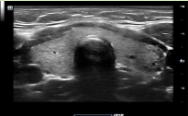
Curvilinear
FOV: curved / blunted sector
Used for abdomen, OB
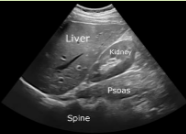
Phased Array
FOV: sector
Used for cardiac
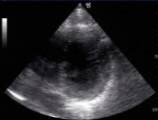
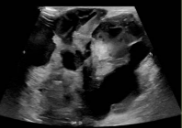
Vector
FOV: trapezoidal
Used for small acoustic windows
Higher frequency
↑ Resolution, ↓ Penetration
Lower frequency
↓ Resolution, ↑ Penetration
Thyroid →
higher frequency
Abdomen →
lower frequency
Cardiac →
lower frequency + phased array
Transducer design determines
image performance
Frequency →
Resolution & penetration
Beam shape →
Field of view
Focusing →
Lateral resolution
Array design →
Slice thickness control
Footprint →
Acoustic window access
A sonographer is scanning through a narrow acoustic window and needs the ability to electronically steer and focus the beam.
Which transducer is MOST appropriate?
a) Mechanical transducer
b) Curvilinear array
c) Phased array
d) Sequential linear array
Phased array
Beam is
narrowest at the focus
Near Zone (Near Field / Fresnel Zone)
Beam narrows with depth
Focus (Focal Point)
– Narrowest part of beam
– Best lateral resolution
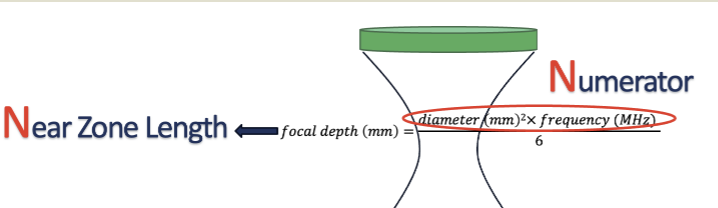
Focal Length (Near Zone Length)
Distance from transducer to focus
Far Zone (Far Field / Fraunhofer Zone)
Beam diverges with depth
Focal Zone
Region around the focus where the beam
remains narrow
Focal Depth (Near Zone Length)
■ ↑ Transducer Diameter → ↑ Focal Depth
■ ↑ Frequency → ↑ Focal Depth
Beam Divergence (Far Zone)
■ ↑ Transducer Diameter → ↓ Divergence
■ ↑ Frequency → ↓ Divergence

Which transducer would produce the least divergence?
■ 5 MHz with 5 mm diameter
or
■ 15 MHz with 20 mm diameter?
15 MHz with 20 mm diameter?
Which change would produce the deepest focus and least beam divergence?
a) ↓ Frequency + ↓ Diameter
b) ↑ Frequency + ↓ Diameter
c) ↓ Frequency + ↑ Diameter
d) ↑ Frequency + ↑ Diameter
↑ Frequency + ↑ Diameter
More rows of elements →
greater beam control
1D Array
Lateral only, Standard imaging
1.5D Array
Lateral + Elevational, Improved slice thickness control
2D Array
Multi-directional control, 3D / 4D imaging
A cyst appears partially filled with echoes that are actually coming from tissue outside the imaging plane.
Which transducer design MOST directly helps?
a) 1D array
b) 1.5D array
c) 2D array
d) Harmonic imaging
1.5D array
Which transducer array is MOST associated with 3D imaging?
a) 1D array
b) 1.5D array
c) 2D array
d) Sequential linear
2D array
A sonographer adds additional focal zones.
What is the MOST likely result?
a) Improved temporal resolution
b) Improved lateral resolution with reduced
frame rate
c) Improved axial resolution
d) Increased penetration
Improved lateral resolution with reduced
frame rate
Steering changes
beam direction, not beam width
Which problem is MOST directly improved by harmonic imaging?
a) Beam thickness
b) Contrast resolution
c) Spatial pulse length
d) Axial resolution
Contrast resolution
Harmonic imaging MOST commonly improves:
a) Temporal resolution
b) Contrast resolution
c) Penetration depth
d) Slice thickness artifact
Contrast resolution
Which concept MOST directly improves slice thickness
artifact?
a) Harmonic imaging
b) Increased dynamic range
c) Improved elevational control
d) More damping
Improved elevational control
A sonographer is imaging a small moving cardiac structure through a narrow acoustic window and wants to optimize image quality.
Which combination is MOST appropriate?
a) Linear array + multiple focal zones
b) Curvilinear array + harmonic imaging
c) Phased array + electronic focusing
d) Mechanical transducer + increased damping
Phased array + electronic focusing